Peace is upon us; there is love.

Before his crucifixion, Jesus told his disciples: “Peace I leave with you; my peace I give you. I do not give to you as the world gives. Do not let your hearts be troubled and do not be afraid.” (John 14:27.)

Today, as we celebrate Easter, remember his words and his sacrifice. For a lovely story and song in the Easter spirit, go here:

Grace is upon us
Open your heart
It is done

Grace is upon us
Open your heart
This is love,

The Lord is here
This is love

Come to the highest point of the mountain
At the earliest possible moment

With appreciation to MovedByLove.com, consider this beautiful parable of a saint:

The story of the Holy Shadow 
Osho

There once lived a saint so good that the angels came from heaven to see how a man could be so godly. This saint went about his daily life diffusing virtue as the stars diffuse light and the flowers scent, without being aware of it. His day could be summed up by two words — he gave, he forgave — yet these words never passed his lips. They were expressed in his ready smile, his kindness, forbearance, and charity.

The angels said to God, “Lord, grant him the gift of miracles.”

God replied, “Ask what it is that he wishes.”

They said to the saint, “Would you like the touch of your hands to heal the sick?”

“No,” answered the saint. “I would rather God do that.”

“Would you like to convert guilty souls and bring back wandering hearts to the right path?”

“No, that is the angels’ mission. It is not for me to convert.”

“Would you like to become a model of patience, attracting men by the luster of your virtues, and thus glorifying God?”

“No,” replied the saint. “If men should be attracted to me, they would become estranged from God.” “What is it that you desire, then?” asked the angels.

“What can I wish for?” asked the saint smiling. “That God gives me his grace; with that would I not have everything?”

The angels said, “You must ask for a miracle, or one will be forced upon you.”

“Very well,” said the saint. “That I may do a great deal of good without ever knowing it.”

The angels were perplexed. They took counsel and resolved upon the following plan: every time the saint’s shadow fell behind him or to either side, so that he could not see it, it would have the power to cure disease, soothe pain, and comfort sorrow.

When the saint walked along, his shadow, thrown on the ground on either side or behind him, made arid paths green, caused withered plants to bloom, gave clear water to dried-up brooks, fresh color to pale children, and joy to unhappy men and women.

The saint simply went about his daily life diffusing virtue as the stars diffuse light and the flowers scent, without being aware of it. The people, respecting his humility, followed him silently, never speaking to him about his miracles. Soon they even forgot his name, and called him “The Holy Shadow.”

This is the ultimate: one has to become the holy shadow, just a shadow of God. This is the greatest revolution that can happen to a human being: the transfer of the center. You are no longer your own center; God becomes your center. You live like his shadow. You are not powerful, because you don’t have any center to be powerful. You are not virtuous; you don’t have any center to be virtuous. You are not even religious; you don’t have any center to be religious. You are simply not, a tremendous emptiness, with no barriers and blocks, so the divine can flow through you unhindered, uninterpreted, untouched — so the divine can flow through you as he is, not as you would like him to be. He does not pass through your center — there is none. The center is lost.

This is the meaning of this sutra: that finally you have to sacrifice your center so you cannot think in terms of the ego again, you cannot utter “I,” to annihilate yourself utterly, to erase yourself utterly. Nothing belongs to you; on the contrary, you belong to God. You become a holy shadow. 

Happy Easter!
Lighting tomorrow.

On days that seem dark and heavy, mired with concerns about the future, it is nice to remember that babies are being born, people are proposing, family members are coming home, and we are all here today.

Today, where we still have power to work toward better tomorrows.

Keeping the hope.

There are things in this life that break us. Usually they involve some sort of loss-of health, of life, of relationship, of stuff. Despair is a crippler. You can’t breathe; you can’t think; you can’t see a way out. The world becomes very small until it feels like you are living in a tiny bubble apart from everything and everyone, floating along fragile in your pain. At times like these, you have to force yourself to hope and to push through. Start with your breath. In and out, in and out, until it is smooth and full, rather than broken with the catch in your throat from the threatening cry. Keep at that, smooth and full, smooth and full, smooth and full until you can open your eyes and start noticing beauty, maybe, at first, in the tiniest of things. A drop of dew on the grass, the feel of breeze on your skin, laughter of a child,  a bud of a flower, birds in flight. Keep at it. No one said it would be easy. Keep at it. Smooth and full, smooth and full, smooth and full.

Embracing this life.

The might have beens are a killer. We each take so many forks in the road, it’s easy to wonder how our lives might be if we had taken a different turn—gone to a different school, chosen a different career, picked a different partner. Those might have beens can keep us up late with longing and despair about the life we currently have. And, more importantly, they can strip those lives, the actual lives we are living, of joy.

Consider this poem by Carl Dennis:

The God Who Loves You

BY CARL DENNIS

It must be troubling for the god who loves you
To ponder how much happier you’d be today
Had you been able to glimpse your many futures.
It must be painful for him to watch you on Friday evenings
Driving home from the office, content with your week—
Three fine houses sold to deserving families—
Knowing as he does exactly what would have happened
Had you gone to your second choice for college,
Knowing the roommate you’d have been allotted
Whose ardent opinions on painting and music
Would have kindled in you a lifelong passion.
A life thirty points above the life you’re living
On any scale of satisfaction. And every point
A thorn in the side of the god who loves you.
You don’t want that, a large-souled man like you
Who tries to withhold from your wife the day’s disappointments
So she can save her empathy for the children.
And would you want this god to compare your wife
With the woman you were destined to meet on the other campus?
It hurts you to think of him ranking the conversation
You’d have enjoyed over there higher in insight
Than the conversation you’re used to.
And think how this loving god would feel
Knowing that the man next in line for your wife
Would have pleased her more than you ever will
Even on your best days, when you really try.
Can you sleep at night believing a god like that
Is pacing his cloudy bedroom, harassed by alternatives
You’re spared by ignorance? The difference between what is
And what could have been will remain alive for him
Even after you cease existing, after you catch a chill
Running out in the snow for the morning paper,
Losing eleven years that the god who loves you
Will feel compelled to imagine scene by scene
Unless you come to the rescue by imagining him
No wiser than you are, no god at all, only a friend
No closer than the actual friend you made at college,
The one you haven’t written in months. Sit down tonight
And write him about the life you can talk about
With a claim to authority, the life you’ve witnessed,
Which for all you know is the life you’ve chosen.

Carl Dennis, “The God Who Loves You” from Practical Gods.Copyright © 2001 by Carl Dennis. Reprinted with the permission of Viking Penguin, a division of Penguin Group (USA) Inc. For online information about other Penguin Group (USA) books and authors, see http://www.penguin.com.Source: New and Selected Poems, 1974-2004 (Penguin Books, 2004)

We have choice and agency in the life we have. It is there we find meaning and purpose. It is there, in the now, that we can find joy. Embrace that life.

Small things with great love.

We are each called to new challenges today. To make a difference, to protect the community, to keep our hope alive. Over the last few weeks, we have seen stories of both tremendous generosity and simple acts of kindness. And of compassion and resolve from leaders such as this from Queen Elizabeth.

‘We will overcome it’: Queen Elizabeth invokes WWII spirit amid coronavirus outbreak

As we move forward, Queen Elizabeth’s challenge to act in a way which will make us proud years from now rings true. How we respond to these times defines us. Consider the acts of this little boy working to secure PPE for his local hospital.

What can we do now to help?

Talk softly.

There is no one right way to get through a pandemic. Perhaps you’ve seen social posts suggesting you write a book, paint your house, or finish some other huge project. And some people do respond to stress by throwing themselves into activity. (And, apparently, love to post about it.) But others don’t. And that’s ok. We are each unique and need to listen to our own hearts and bodies to figure out what self-care looks like right now. Perhaps it’s enjoying tea, watching the sunset, reading a good book, or cleaning out a closet. Perhaps it is being still. Perhaps it is taking a break from social media to enjoy some introspective time. There are as many answers as there are people asking the question, ‘How can I best care for myself right now?’ Listen to yourself, and be gentle with yourself. This is tough.

Spring is still on.

Patience is tough. But even in the most aggravating times of waiting, nature keeps going and sends us messages of hope. Dead looking trees budding, flowers blossoming, birds singing and looking for places to build their nests. Warmth seeping back into the frigid ground.

Spring hasn’t been cancelled.

Hold on.

Reaching out

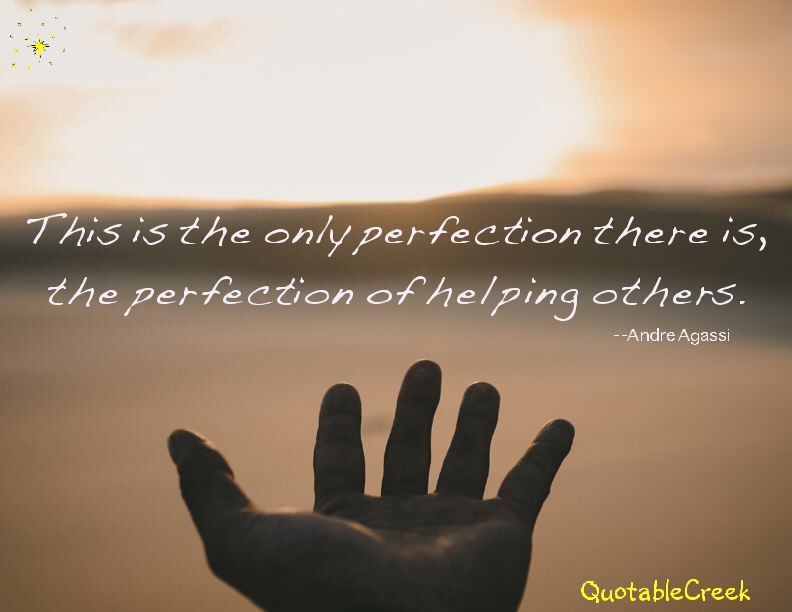
What are we here for anyway? What’s the point? Some people joke, ‘Life is hard, and then you die’, and there’s some truth to that. We are finite. We struggle. But there is purpose to life, and it lies in what we do for others. Andre Agassi says,

“Remember this. Hold on to this. This is the only perfection there is, the perfection of helping others. This is the only thing we can do that has any lasting value or meaning. This is why we’re here.”

Others joke ‘The one who dies with the most toys wins,’ but those things we do purely for ourselves are vanity. Instead, when we use our gifs and talents to reach out and help others, we’ve upped the good in the world. We’ve made a difference.

Though isolated, each of us has the ability to reach out. Phone calls, cards, texts, care packages. Others need to hear from you. They need to know someone cares. And you need to know you care about others. If you have extra, you can share. If you are going to the store, you can pick up something for someone who can’t go out. So many ways to help. And in the helping, we help ourselves as well.