The days before Christmas can be frantic. We sometimes find our tempers short, our tongues loose, and our wits frayed. We think of Christmas as something in the future, speeding toward us, that we need to hurry around and prepare for so that we can enjoy His coming. But a birthday, like Christmas, is a celebration of something that has already happened. And, in the case of Christmas, it is a celebration of a whole new world order that is here. We are His now, not just at Christmas. We need to shine with His love now and everyday. Particularly when the world is harried. We need to reflect the joy and peace that comes with knowing that love conquers all.
One of the most joyful things about teaching is finding the method that leads to a particular child learning where perhaps they struggled before. Finding the right key for the lock. Teaching, in this way, is one of the most creative and challenging jobs because each child is unique. Not every child can simply sit at a desk and listen to their teacher drone on and somehow absorb and master the material. In fact, a student who would prefer this lecture method is rare.
A vibrant classroom is filled with hands-on, group work, mentoring, art, music, activities, and so on. There are so many ways to teach and pair the right method with the right child. This is why a good teacher will always feel they learn as much as they teach. Of course, implicit in this challenge is having as the goal, helping the child learn. When obedience and regiment replaces learning as the goal, and the teaching method is rigid and unyielding, often students will struggle and fall through the gaps.
Teachers need to always keep their eye on the ball. The bottom line, the mission, is helping children learn.
There are so many areas where the same analysis applies. Where perhaps we fail to keep our eye on the right ball.
My pastor posted the following:
The method v. The mission. There are many ‘This is the way we’ve always done it’ or ‘Technology isn’t our thing’ or ‘Let’s just keep to ourselves’ sentiments behind each failing church. And misplaced beliefs that perhaps there’s just no space for church anymore in today’s world.
And yet.
In both teaching and ministry, there remains the mission. To help children learn. To help God’s people. And these needs in the world are growing, not shrinking.
So then the question becomes, and really always has been, how can we adapt our methods to fulfill our mission?
It’s okay to be heartbroken for more than one group of people at the same time. When it comes to showing compassion, we don’t have to pick sides. Sometimes, often really, maybe even always, there is hurt and anguish everywhere, and we can mourn the lot of it.
Beware people who tell you not to be concerned for this group or that group and the hurt they feel.
Beware those who try to dehumanize others.
Beware those who lump you in as the ‘enemy’ for working to assure people are treated humanely.
Beware people who draw lines between us and them.
Beware those who try to limit you to a label or single identity.
Our hearts are big enough to embrace it all. What we must save is love.
When we find ourselves in challenging times and are unsure which way to turn, let these words help guide you.
Do justice. Peace, justice, love are things we do and bring about, not things we wait for. With our best discernment, we offer ourselves to the world, hoping to make a difference. Kind words, loving hearts, calm demeanors, patience, forbearance, and forgiveness. The way of the One we follow. A servant’s heart but a leader’s strength.
Love mercy. Oh, how the world loves vengeance, cancelling, grudges, getting even, punishment. To love mercy is a kinder, gentler path, one that believes in the redeem-ability of every last one of us. One that doesn’t insist on being avenged or having the last word. One that delights in forgiveness and healing.
Walk humbly. No matter how hard we try to do or be right, we may be wrong. The other guy might be right. And, get this, God loves the other guy as much as God love you.
There is a certain tipping point where life becomes weighted with loss. Things shift from everything out ahead to having a full past. In many ways, it is challenging, sad, and frustrating. But in some, it can be liberating.
Consider these words from Anne Lamott:
“So many indignities are involved in aging, and yet so many graces, too. The perfectionism that had run me ragged and has kept me scared and wired my whole life has abated. The idea of perfectionism at 60 is comical when, like me, you’ve worn non-matching black flats out on stage. In my experience, most of us age away from brain and ambition toward heart and soul, and we bathe in relief that things are not worse. When I was younger, I was fixated on looking good and impressing people and being so big in the world. By 60, I didn’t care nearly as much what people thought of me, mostly.”
“I do live in my heart more, which is hard in its own ways, but the blessing is that the yammer in my head is quieter, the endless questioning: What am I supposed to be doing? Is this the right thing? What do you think of that? What does he think of that?”
“A lot of us thought when we were younger that we might want to stretch ourselves into other areas, master new realms. Now, I know better. I’m happy with the little nesty areas that are mine. For some reason, I love my softer, welcoming tummy. I laugh gently more often at darling confused me’s spaced-outed ness, although I’m often glad no one was around to witness my lapses.”
I do ‘feel I live in my heart more’ as she notes. And that grief is keen and biting. Almost as if my mind is at war with itself, one half realizing that death is a natural part of life, inevitable. While the other half refuses to accept the new reality. And yet, ultimately, it is our impermanence that gives our lives luster and meaning. And acceptance, if it should come, may not bring comfort, but peace.
“In one of John Muir Laws’s books, I read something profound that changed the way my brain thinks. “As you draw the bird,” he writes, “try to feel the life within it.” So now I look at the bird before me and imagine how it senses the world, how it feels breathing cold air, how it feels to have its feathers ruffling in the wind, how it feels to always have an eye out for possible food and possible predators. The bird sees me and is a nanosecond from flying off, but it stays. Why? By imagining the life within, the bird I am drawing is alive, no longer a shape and its parts, but a thinking, sentient being, always on the brink of doing something. By feeling the life within, I am always conscious that all creatures have personalities, and so do trees and clouds and streams. To feel the life within, I now imagine myself as the bird that is looking at me. I imagine its wariness, the many ways it has almost died in its short life. I worry over its comfort and safety, and whether I will see my little companion the next day, the next year. To feel the life within is to also feel grief in the goneness of a single creature or an entire species. Imagination is where compassion grows. Let us join with children to imagine and wonder, to use curiosity as the guide to miracles in plain sight. Let us enter with them into wild wonder so that we become guardians together of all that is living and all that must be saved.”
From Orion Magazine, “The Life Within”.
I wonder if we can look at each other that way, as something vaster, as thinking sentient beings with worlds of experience, some harsh. Would that help us to treat each other better? In her book, Dead Man Walking, Sister Helen Prejean describes just this sort of thing as she works with a death row inmate, a man who admittedly committed a heinous act, seeing not just the man but also, though covered with tattoos and bathed in bravado, the little wounded child within. That empathy allowed her to see past the crimes to the human and to feel compassion for him.
Perhaps today we can look with new eyes to see each other as a composite of good and bad, but each fully human and fully deserving of respect and compassion. To paraphrase Amy Tan above, when we consider the person, can we try to picture the life within, the challenges and struggles, hopes and triumphs? Can we become, together, ‘guardians of all that is living and must be saved’ in a place where ‘compassion grows’?
How do we read the news and not get overwhelmed or angry, disconnected or depressed? How do we keep showing up with compassion and grace in a world where there is so much hate? How do we keep ourselves on the right path through the midst of it all? How do we continue to show up from a place of compassion, forgiveness, and grace? how do we keep our hearts from growing hard?
In this thoughtful letter, Rabbi Yael Levy shares his insights on how to pray with the news:
The 17th of the Hebrew month Tammuz initiates a three-week period of mourning that leads to Tisha b’Av, which is the day that marks the destruction of the Temples in Jerusalem in 586 BCE and 70 CE.
Tradition teaches that the Temple was destroyed because hatred became the operating principle in the community. The scorn, contempt and disdain that characterized daily interactions caused the Divine Presence to flee and leave the Temple vulnerable to attack.
These next three weeks ask us to reflect on the hatred that we allow to take root in our hearts. The wisdom of the tradition acknowledges that hatred can sometimes feel energizing and “so right,” but allowing it to fill our bodies and guide our actions leads to destruction.
Many years ago I was taught the practice of praying with the news. I have shared it over the years and always find myself returning to it during this season.
In this practice, each time we read or listen to a news report that enrages us, we turn our attention to those harmed by what is happening and pray for their healing and well-being. Doing so encourages us to acknowledge feelings of anger, grief and despair, and at the same time it turns our attention toward connection and compassion. Praying with the news can help us learn to bear witness to devastation and mayhem, while keeping our hearts soft, our minds calm, and our actions clear.
I am struggling mightily with this practice these days in the wake of continued violence and oppression in this country and throughout the world. Hatred can sometimes feel like such a welcome harbor. Not only does it feel so right, it can also act as a shield, creating the illusion that I don’t have to acknowledge the grief and heartbreak I am experiencing.
I need practices to help quiet the rage and fear, to loosen the constriction of hatred and to help me be with overwhelming grief. I need practices to help me return to compassion, love, joy and possibility. I find praying with the news both painful and helpful. It keeps me connected, allows sorrow, and grounds me in care and love.
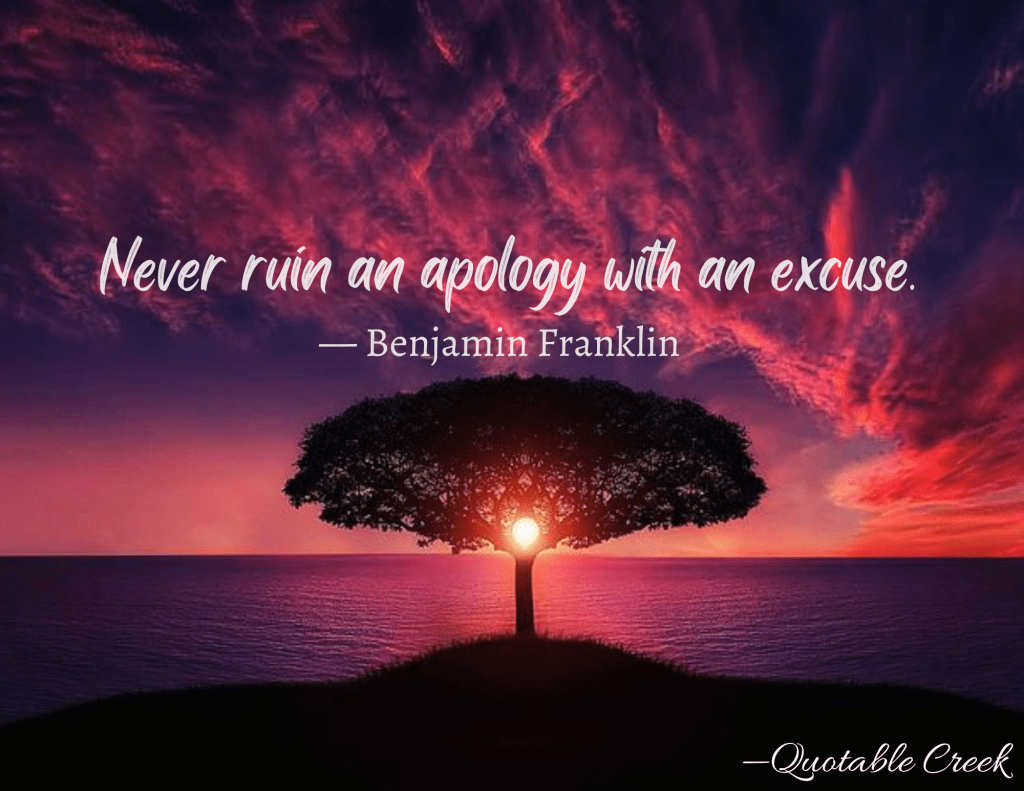
“I’m sorry, but…” Some apologies make things better, and some just don’t. In fact, they might make things worse by blaming the person you hurt or showing that there is just no true awareness of what went wrong.
Generally, the apologies that have an excuse fall in the latter category. A good apology makes you feel seen and heard, that someone has looked at things from your point of view and understood the negative impact they have made. A good apology requires us to stand in the shoes of the person we’ve wronged and feel what they are feeling. Not what we would feel if we were in their shoes, but what they’re feeling.
Then, when we feel the harm we’ve caused, it should change us, make us not want to cause that harm again to that person or others, and make us want to make amends. It shouldn’t leave us where we were. If it does, if we repeat the same hurtful words or behavior, perhaps we haven’t yet done the work that goes into reconciliation.
Back into the other person’s shoes we go until we understand and grow. This is how progress is made, how relationships heal and grow stronger, how trust is restored. And, because we humans are very fallible creatures, it’s not a one and done thing, but a continuing process. Evaluating the effect we are having on people, making sure we are treading softly, taking responsibility and making amends when we don’t. Perhaps two steps forward, one step back, but staying in relationship, rebuilding trust, and moving forward together.
When we are being welcoming, the focus is outward not inward. We look to what would make the other person comfortable, not what would make us comfortable. We don’t invite vegetarians, and then serve meat. Or teetotalers and serve alcohol. We get out of our own perspective and walk in the guest’s shoes to consider what would make them comfortable.
Aesop illustrated this premise with the Tale of the Fox and the Stork:
A fox invites a stork to eat with him and provides soup in a bowl, which the fox can lap up easily; however, the stork cannot drink it with its beak. The stork then invites the fox to a meal, which is served in a narrow-necked vessel. It is easy for the stork to access but impossible for the fox. The moral drawn is that the trickster must expect trickery in return and that the golden rule of conduct is for one to do to others what one would wish for oneself.
The same is true, presumably, when welcoming people to the Lord’s table. What would make others comfortable? How can you reach more people? What about the way you do things might be off putting? How can you step out of your own perspective to consider what would make others in the community feel welcomed and comfortable? Our job isn’t to be a bar to spreading the word but a conduit.
Desmond Tutu talks about the importance of a broad welcome:
We are made for goodness. We are made for love. We are made for friendliness. We are made for togetherness. We are made for all of the beautiful things that you and I know. We are made to tell the world that there are no outsiders. All are welcome: black, white, red, yellow, rich, poor, educated, not educated, male, female, gay, straight, all, all, all. We all belong to this family, this human family, God’s family.
Life can be tough. Even the most charmed of lives has loss and heartbreak, disillusionment and despair. Everyone hurts. But buried deep under the hurt and pain is the little waif you used to be, full of hope and promise, enthusiasm and excitement.
Your identity is not equivalent to your biography. There is a place in you where you have never been wounded, where there is still a sureness in you, where there’s a seamlessness in you, and where there is confidence and tranquility in you.
The intention of prayer and spirituality and love is now again to visit that inner kind of sanctuary.
Deep in there, behind the daily worries, aches and pains, hurts and disgruntlements, is your soul. Prayer, staying still and letting your mind clear in meditation, will take you there, again and again, a way to connect with both your own individuality and your place in the awesome collective of it all.





 QuotableCreek.com