There are things in this life that break us. Usually they involve some sort of loss—of health, of life, of relationship, of stuff. Despair is a crippler. You can’t breathe; you can’t think; you can’t see a way out. The world becomes very small until it feels like you are living in a tiny bubble apart from everything and everyone, floating along fragile in your pain. At times like these, you have to force yourself to hope and to push through. Start with your breath. In and out, in and out, until it is smooth and full, rather than broken with the catch in your throat from the threatening cry. Keep at that, smooth and full, smooth and full, smooth and full until you can open your eyes and start noticing beauty, maybe, at first, in the tiniest of things. A drop of dew on the grass, the feel of breeze on your skin, laughter of a child, the bud of a flower, birds in flight. Keep at it. No one said it would be easy. Keep at it. Smooth and full, smooth and full, smooth and full.
In 2016, Pope Francis sainted Mother Teresa. She was a beloved paragon of a selfless life, ministering to the poor and dying, shining a light on the importance of the little things and the love of family. After her death, her diaries showed her struggles with doubt. Once feeling clearly called to her mission, in the last several decades of her life she felt God’s absence. She said,
Lord, my God, who am I that You should forsake me? The Child of your Love–and now become as the most hated one–the one–You have thrown away as unwanted–unloved. I call, I cling, I want–and there is no One to answer–no One on Whom I can cling–no, No One.–Alone … Where is my Faith–even deep down right in there is nothing, but emptiness & darkness–My God–how painful is this unknown pain–I have no Faith–I dare not utter the words & thoughts that crowd in my heart–& make me suffer untold agony.
So many unanswered questions live within me afraid to uncover them–because of the blasphemy–If there be God –please forgive me–When I try to raise my thoughts to Heaven–there is such convicting emptiness that those very thoughts return like sharp knives & hurt my very soul.–I am told God loves me–and yet the reality of darkness & coldness & emptiness is so great that nothing touches my soul. Did I make a mistake in surrendering blindly to the Call of the Sacred Heart?
And on until her death, she felt God’s absence, rather than his presence. And yet she persisted doing the work to which she had been called, living a life of faith.
Some may call her a hypocrite to have an outward smile of peace and an inner crisis of faith, but isn’t her struggle every one’s struggle? Who among us doesn’t struggle with doubt? Don’t we all rely on faith when our paths grow dark and twisting?
St. Teresa of Calcutta inspires us to hang on during the dark nights of the soul, to continue to walk the walk, to be faithful and steadfast, and to shine light in the dark places. She can aptly be considered the Patron Saint of Doubters.
Bless the comforters, those who reach out and see others hurting and grief stricken, and offer them solace. Who sit with those going through difficult times, and give of their presence. Who offer kind, comforting words.
We sometimes think those who are good at comforting don’t know loss of their own, but the opposite is probably true.
As said by Rainer Maria Rilke:
Do not assume that he who seeks to comfort you now lives untroubled among the simple and quiet words that sometimes do you good. His life may also have much sadness and difficulty, that remains far beyond yours. Were it otherwise, he would never have been able to find such words.
Perhaps the only good to come of great loss is the ability to recognize it in others and offer them comfort and companionship.
Sometimes things hum along nicely, and you can feel a deep sense of progress in yourself, your relationships, and the world.
Sometimes the opposite is true.
You feel yourself retreating and losing hope. Your relationships fray. Progress in the world is wiped away.
At times like these, we need to hunker down and draw on a well of hope inside in each of us that springs up with the knowledge that we can do better, we deserve better, and we will fight for ourselves and each other to make the world better.
We may not know yet the battleground we will be called to or the terms of engagement.
We do, though, know the weaponry we will fight with.
Love, honesty, integrity, justice, compassion. These tools of the light will vanquish darkness. We can’t forget what is good and right.
Finally, brethren, whatsoever things are true, whatsoever things are honest, whatsoever things are just, whatsoever things are pure, whatsoever things are lovely, whatsoever things are of good report; if there be any virtue, and if there be any praise, think on these things. Philippians 4:8
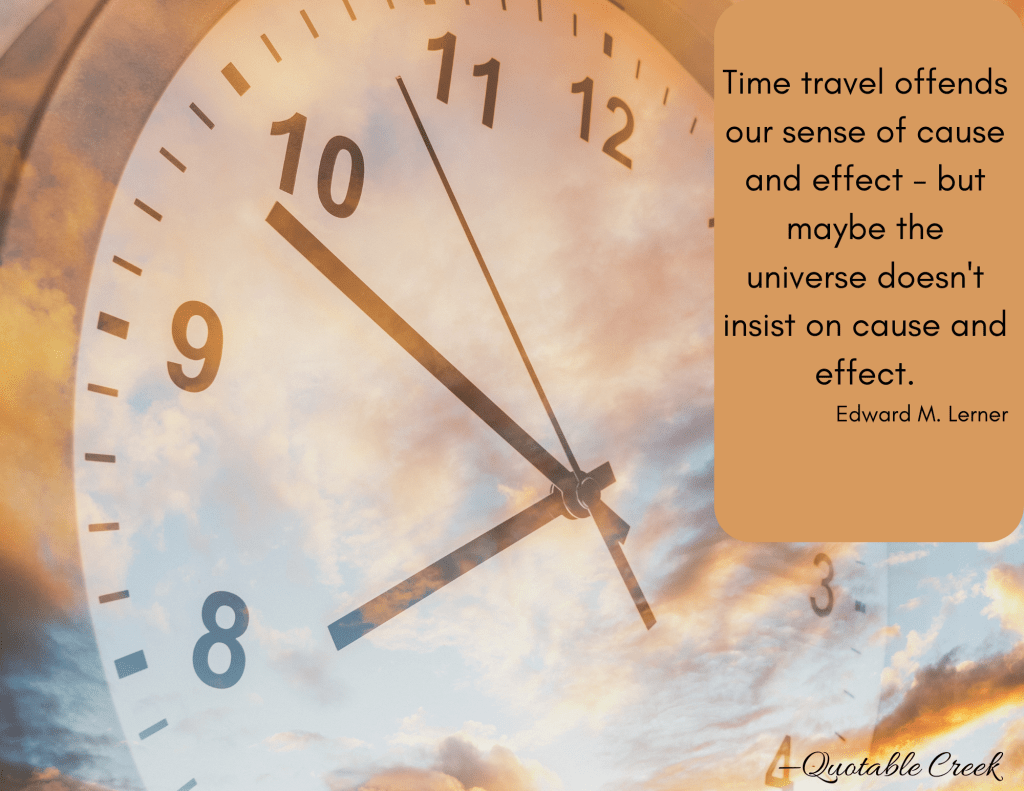
I’m always a bit confounded by stories of time travel, easily lost in the logical fallacies and conundrums. But when you strip the mechanics away and just enter into a state of suspended disbelief that it might be possible, time travel stories are remarkably profound. To have a character with full knowledge of the present time be able to walk around and marvel at a prior time uncovers interesting juxtapositions, exposes similarities and differences, and allows you to evaluate your own time period afresh.
I just finished Time and Again by Jack Finney, which offers a time travel vehicle that allows his character to step back into a time before many of our modern problems—world wars, pollution, climate change—and enjoy a less jaundiced perspective. More important, though, the time travel opens his eyes to the humanity and complexity of the people, long dead now, walking around living and breathing in that present:
“In some ways, the sight of that ordinary man whom I never saw again is the most intensely felt experience of my life. There he sat, staring absently out the window, in an odd high-crowned black derby hat, a worn black short-length overcoat, his green-and-white striped shirt collarless and fastened at the neck with a brass stud; a man of about sixty, clean-shaven.
I know it sounds absurd, but the color of the man’s face, just across the tiny aisle, was fascinating: this was no motionless brown-and-white face in an ancient photograph. As I watched, the pink tongue touched the chapped lips, the eyes blinked, and just beyond him the background of brick and stone house slid past. I can see it yet, the face against the slow-moving background, and hear the unending hard rattle of the iron-tires wheels on packed snow and bare cobbles. It was the kind of face I’d studied in the old sepia photographs, but his hair, under the curling hat brim, was black streaked with gray; his eyes were sharp blue; his ears, nose, and freshly shaved chin were red from the winter chill; his lined forehead pale white. There was nothing remarkable about him; he looked tired, looked sad, looked bored. But he was alive and seemed healthy enough, still full-strength and vigorous, perhaps with years yet to live-and I turned to Kate, my mouth nearly touching her ear, to murmur, ‘When he was a boy, Andrew Jackson was president. He can remember a United States that was -Jesus- still mostly unexplored wilderness.’ There he sat, a living breathing man with those memories in his head, and I sat staring at the slight rising and falling of his chest in wonder.”
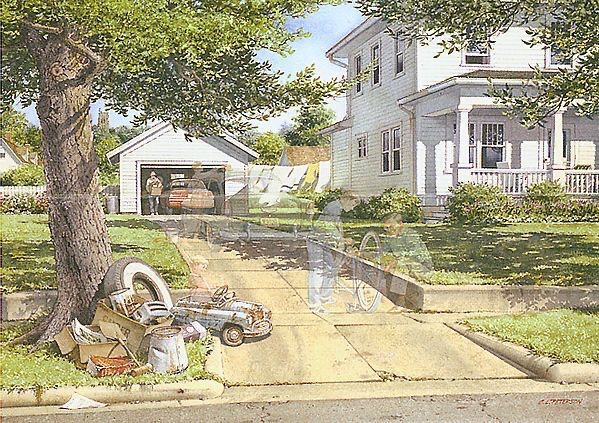
The premise for time travel in this book, for what it’s worth, is that the times are all existing at once, in the way a river exists even though, when you’re in it, you can’t see up past the bends ahead, or back to the parts you’ve already traveled. You merely step into a prior time period once you strip from your mind all the things tethering you to the present. Or, using a different metaphor, time is like transparencies in a book, each laid over the same foundational picture, but each distinct as well. You simply turn to the right page and step in.
The transparency metaphor reminds me of the art of Charles Peterson, the opaque areas reflect action of the present, but the wisps reflect prior generation that lived their lives fully in that spot in the past.
In many ways, we are time travel machines in our own right. We can look at history and reflect how we might have behaved in the same time and place had we those choices and circumstance. We can step out of our own present day group think now and consider how things may hold up with a longer view from the future looking back.
What is happening right now in front of us, that future generations might look back on fondly, or with horror? How can we bring those insights to bear to inform how we act right now?
Is your life all ups, no downs? Do you ever feel a need to make it look like it is? Maybe to pretend the rough stuff doesn’t exist or put on a big smile to cover a broken heart? Do you ever feel like there must be something wrong with your faith if your life is going badly?
Truth is, bad things happen. To the best, most faithful of people. Life’s struggles can feel overwhelming. You can get to the point where you simply cannot see how someone could think and feel the way they do. You can lose hope.
At times like these you need to breathe deep and get yourself to a quiet place. And it sure would do no harm, and maybe a whole lot of good, to read a poem like this:
The Peace of Wild Things
by Wendell Barry
When despair for the world grows in me
and I wake in the night at the least sound
in fear of what my life and my children’s lives may be,
I go and lie down where the wood drake
rests in his beauty on the water, and the great heron feeds.
I come into the peace of wild things who do not tax their lives with forethought of grief.
I come into the presence of still water.
And I feel above me the day-blind stars waiting with their light.
For a time I rest in the grace of the world, and am free.
And the good news is, you can read this poem, and your soul will calm without even being in that place where the wood drake rests in his beauty on the water. The words of a good poem are like magic. They can heal you and still the churning waters of your soul. And they can help you remember the ‘day-blind stars waiting with their light’, because, yes, we cannot see the stars in the daytime, but they are there. Shining.
May you rest in the grace of the world and find peace.
Fear keeps us from trying, from stepping out, from baring our hearts. It makes us smaller than we are. When we fear heartbreak, we flee from love or offer only a superficial version of ourselves, practically guaranteeing the relationship will lack depth. When we fear failure, we don’t try, or try only halfheartedly, practically assuring a lack of success. When we fear others, we keep to those we perceive to be like ourselves, thereby ensuring that we will not enrich our relationships with diversity.
Fear tells us to cower, to not show up, to be less than we know we are.
We build our fears and then act in ways that reinforce them until they become self-fulfilling prophecies. Our fears become so much a part of our reality that we begin to accept them as ‘truth’. But when we analyze our fears critically, we can harness our inner strength and step through our limitations. So the antidote to fear may well be truth, cultivating it relentlessly, forcing ourselves to examine our fear with a microscope, and dissect it into harmless pieces.
In this powerful TED talk, Issac Lidsky explores how his fears that blindness would rob him of joy and meaning in his life fell aside when he critically examined them and chose to push through those fears to a full and rich life– lacking in sight, but abundant in vision. He urges us to push through our own fears, challenge our assumptions, and correct our misconceptions:
Hold yourself accountable for every moment, every thought, every detail. See beyond your fears.Recognize your assumptions. Harness your internal strength. Silence your internal critic. Correct your misconceptions about luck and about success. Accept your strengths and your weaknesses, and understand the difference. Open your hearts to your bountiful blessings.
Your fears, your critics, your heroes, your villains — they are your excuses, rationalizations, shortcuts,justifications, your surrender. They are fictions you perceive as reality. Choose to see through them.Choose to let them go. You are the creator of your reality. With that empowerment comes complete responsibility.
Today, consider what’s holding you back and challenge your assumptions.
Sometimes a good walk can change your perspective. Consider these words from Anne Lamott:
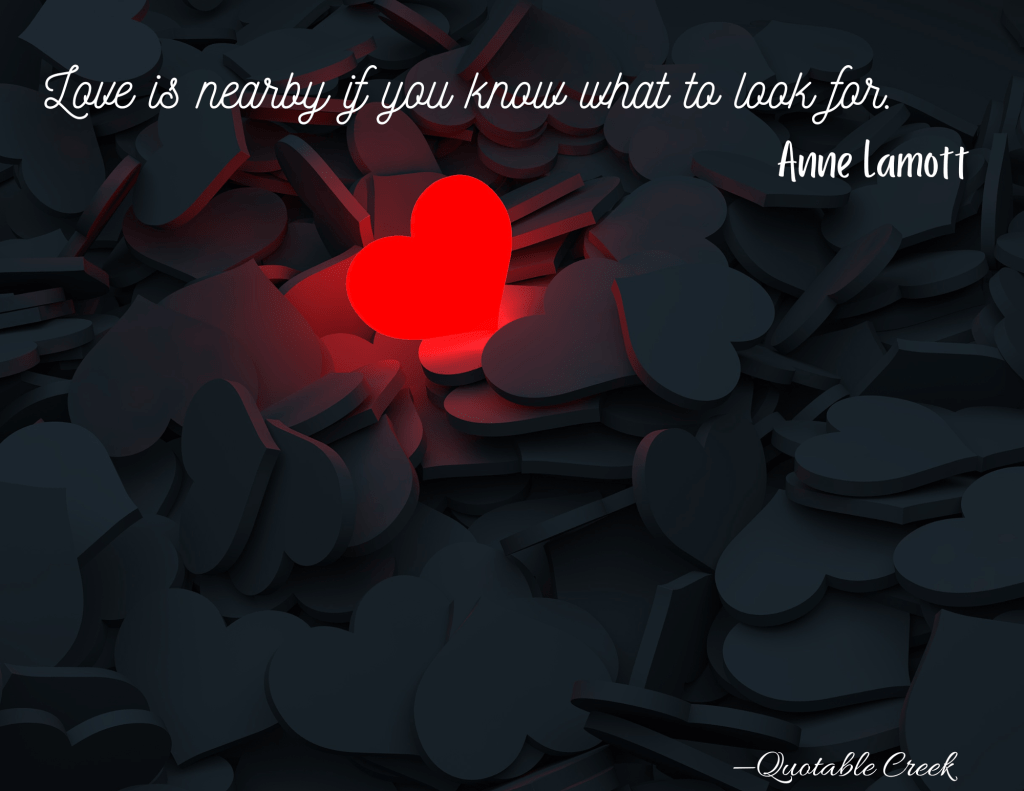
My husband said something a few years ago that I often quote: 80% of everything that is true and beautiful can be experienced in any ten minute walk. Even in the darkest and most devastating times, love is nearby if you know what to look for. It does not always appear at first to be lovely, but instead may take the form of a hot mess or a snoring old dog. Or someone you have sworn to never, ever forgive (for a possibly very good reason, if you ask me). But mixed in will also be familiar signs of love: wings, good-hearted people, cats (when they are in the right mood), a spray of wild flowers, a cup of tea. What are we even talking about when we talk of love? What is it?
On a ten minute walk anywhere…, love abounds and abides, flirts and weeps with us. It is there for the asking, which is the easy part. Our lives’ toughest work is in the receiving. Love presents most obviously in babies and kids being cuddled, yet also as patience with annoying humans we live or work with or are. We feel love upon seeing our favorite neighbors and first responders, we see it in fund-raising efforts, peace marches, kindergarten classrooms, gardens. When flowers don’t stir feeling of love in me, something is gumming up the works.
What at first unlovely things do you see around you that are really love? What evidence of love do you see on your walk? In your day? In your home?
Love is everywhere. We just sometimes need to make sure to notice.
Apparently, chaos is on the agenda. With breakneck speed, legal norms are being tossed aside, and guardrails appear missing. It’s hard not to be overwhelmed with concerns about our future.
What to do?
When we lose our way or feel overwhelmed, we can return to nature and be renewed. Hear the birds singing. Feel the cool breeze. See the long grass ripple in a gentle wind like ocean waves. Breathe in the sweet earthy fragrance of the morning. Feel small and surrounded by an amazing, complicated system that has been pulsating with life for millions of years. That awe is good for us:
It has long been established that a healthy diet and lots of sleep and exercise bolster the body’s defenses against physical and mental illnesses. But the new study, whose findings were recently published in the journal Emotion, is one of the first to look at the role of positive emotions in that arsenal.
That awe, wonder, and beauty promote healthier levels of cytokines suggests that the things we do to experience these emotions—a walk in nature, losing oneself in music, beholding art—has a direct influence upon health and life expectancy,” says UC Berkeley psychologist Dacher Keltner, a coauthor of the study.
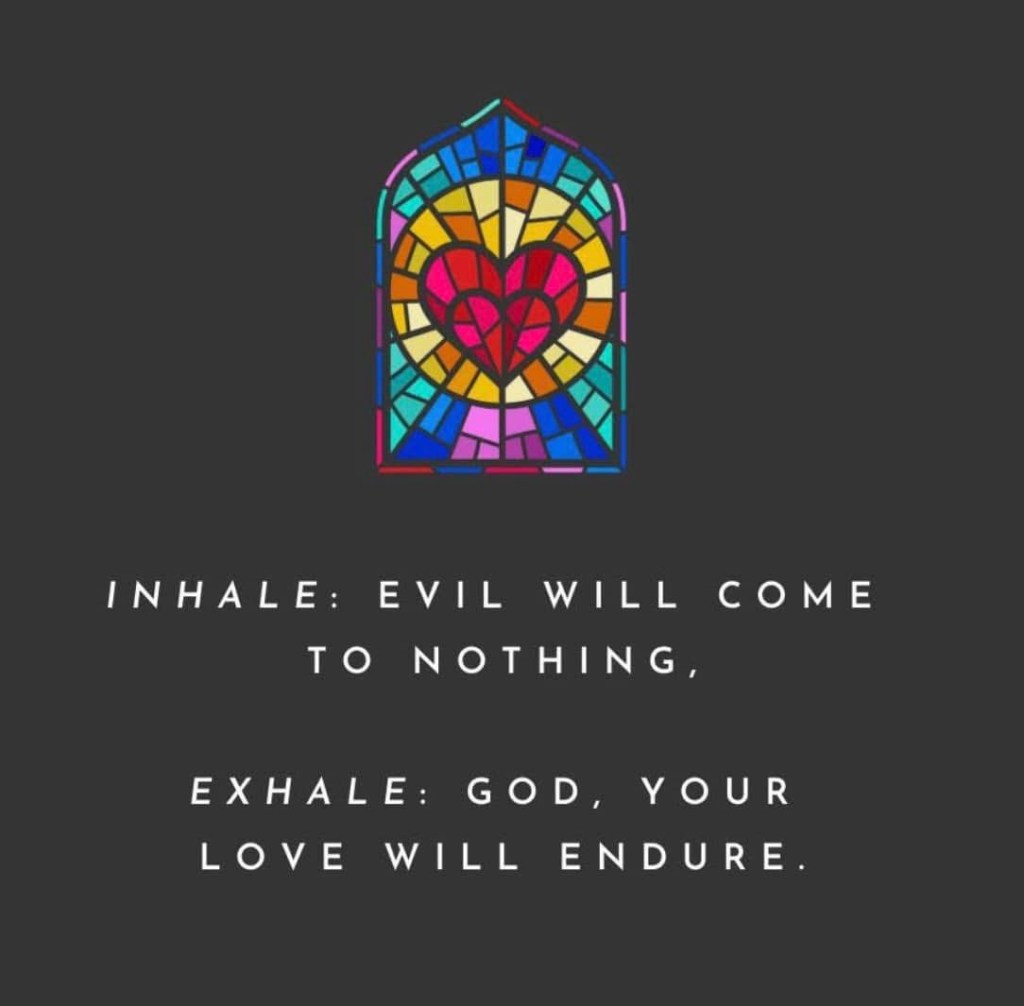
Breathe in the day, full of life and possibility. Breathe out the stress, the worry, the defeat.
In.
Out.
In.
Out.
In.
And for a more guided practice consider adding these words to your breath, suggested by my former pastor John Foster:
We hear we should fight fire with fire or get down in the gutter and fight dirty with the rest of them, but is this the best way? Won’t everyone just be hurt? Won’t our young lose role models for the importance of virtue?
What of other, softer, ways to resist?
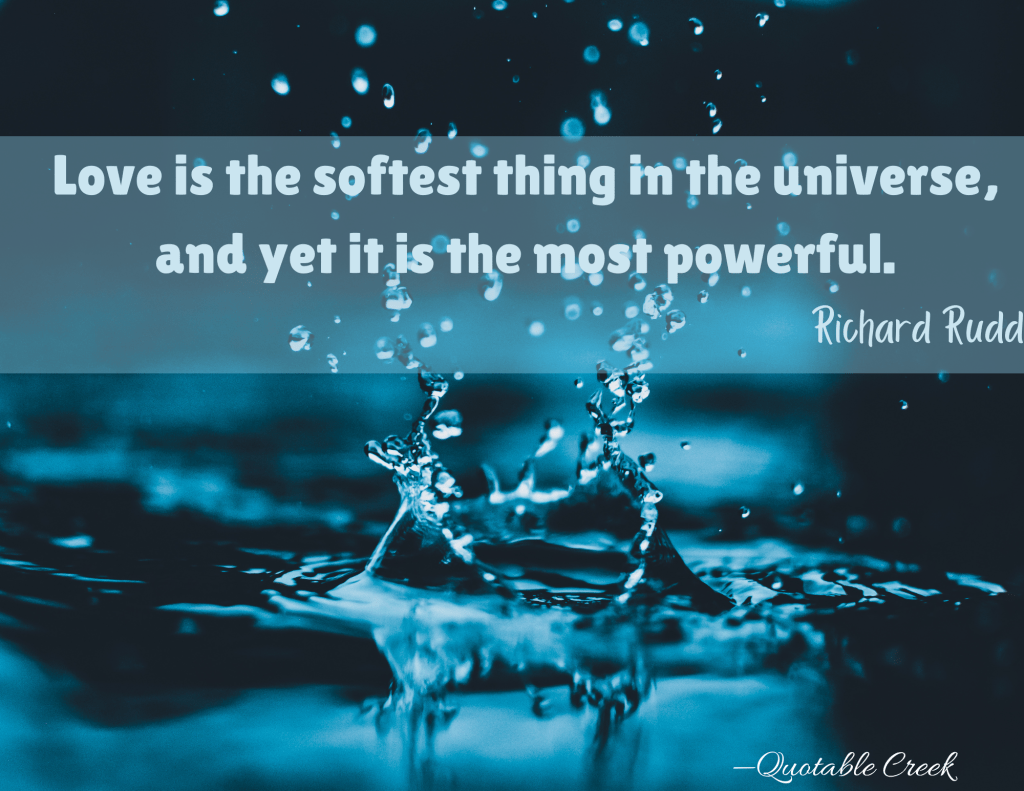
Consider these words from Richard Rudd:
The Softening
Softness is one of the great secrets of all spiritual practice.
When we become soft, we become like water.
We let life come to us.
We trust in its flow, and we allow ourselves to be taken in whichever direction it chooses.
This is true power because it comes from love, and love is the softest thing in the universe, and yet it is the most powerful.
When you soften your attitude to yourself, to others, and to life, you release the natural wisdom that lies within you.
Your body softens, your thoughts soften, and your heart softens.
Through softness, you find clarity and purpose without needing to force anything.
Your life becomes a gentle unfolding rather than a constant battle.


 QuotableCreek.com