There are so many ways to find solace in troubling times. Lately, I’ve been paying attention to delight. What a lovely emotion is delight, and instances can be found everywhere.
For me, just this past few days, I’ve found delight in a friend’s video of their new grandson laughing, the unabashed belly laugh of the new to this world that can’t help but make me smile. In a friend’s periwinkle sweater, my favorite color, a favorite shared with my late grandmother who I adored and the color of jacaranda blossoms that takes me back to days sitting on the lawn of my children’s elementary school under the falling blooms as a best friend and I waited, chatting, for our kids to come running out at the end of their school day. In the fragrance of a new foaming bath soap, this one Winter Citrus Wreath, selected by my husband, who picks a half dozen or so out to surprise me, knowing how much I love scents. And so on.
Delight is everywhere when we look for it, and lingering for a moment in that feeling lifts us up and gives us hope.
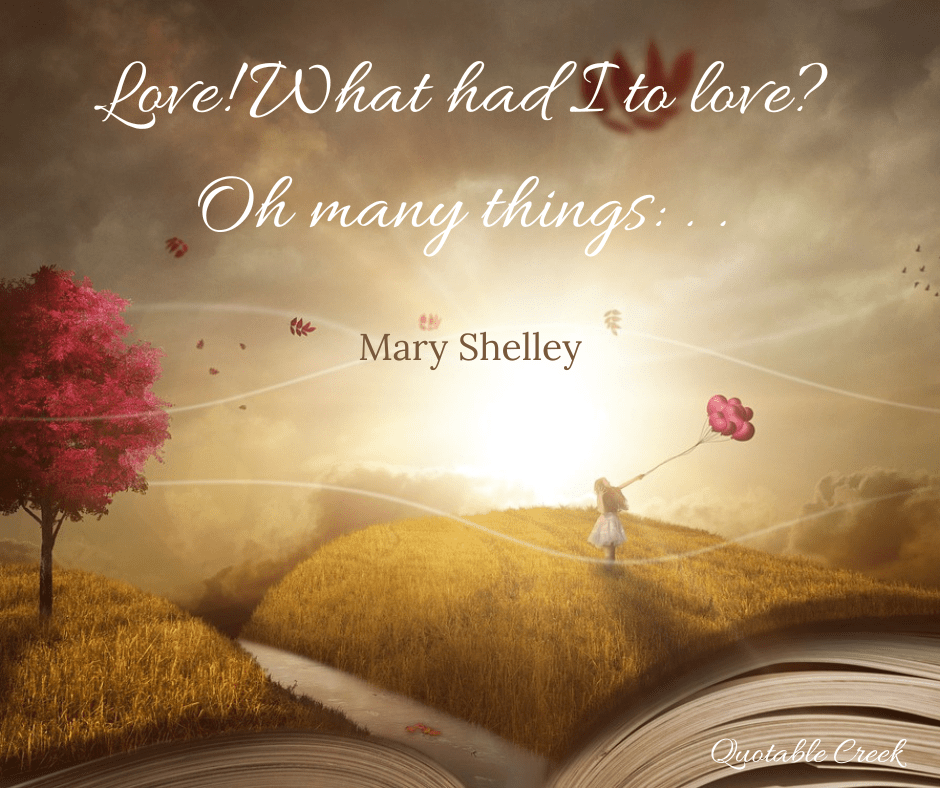
Consider Mary Shelley’s complete list of the simple things she found to love:
Love! What had I to love? Oh many things: there was the moonshine, and the bright stars; the breezes and the refreshing rains; there was the whole earth and the sky that covers it: all lovely forms that visited my imagination, all memories of heroism and virtue. Yet this was very unlike my early life although as then I was confined to Nature and books. Then I bounded across the fields; my spirit often seemed to ride upon the winds, and to mingle in joyful sympathy with the ambient air. Then if I wandered slowly I cheered myself with a sweet song or sweeter day dreams. I felt a holy rapture spring from all I saw. I drank in joy with life; my steps were light; my eyes clear from the love that animated them, sought the heavens, and with my long hair loosened to the winds I gave my body and my mind to sympathy and delight.”
Oh, to give our body and mind to sympathy and delight. Definitely good for whatever might ail you.
In times of great change, it is challenging to predict the future. So much is in flux. And yet, forward we must go.
In harrowing times, focus on each day, each moment, each breath. And breathe deeply. Rely on the things you know to be true and unchanging. Make the best decisions you can with what you have to work with.
Sean Penn had an interesting way to describe navigating these times, paying attention to the difficulties around you and how you can help, while also making sure to savor and appreciate the beauty of life so you don’t become lost in the morass:
[Penn points to one eye] I wake up every day with this eye clear about the threat to the environment, the anguish people are going through, attempts to figure out how I can be of any value-added. [Penn points to his other eye] And this one is driving me from the time I wake up, and all I see is that this is still a magic trick of a beautiful cosmos and I am gonna [expletive] enjoy it every day – and I do.
Remember you have made it through everything that has come your way so far.
In a captivating interview, Jane Goodall offers some final thoughts, filmed to be aired only after her death, with the last bit spoken directly to the camera with no one overhearing. Apparently, this is part of a series on Netflix called Famous Last Words.
It’s a sobering thought, thinking about what is the final thing you want to say to the world, to loved ones, to friends. Because they’re your last chance, these types of words hold special import.
As is unsurprising, Goodall’s final words focused, not on herself, but on others, inspiring everyone to make a difference and not give up in what she called these ‘dark’ times’.
Here are Jane’s final words:
In the place where I am now, I look back over my life. I look back at the world I’ve left behind. What message do I want to leave? I want to make sure that you all understand that each and every one of you has a role to play. You may not know it, you may not find it, but your life matters, and you are here for a reason.
And I just hope that reason will become apparent as you live through your life. I want you to know that, whether or not you find that role that you’re supposed to play, your life does matter, and that every single day you live, you make a difference in the world. And you get to choose the difference that you make.
I want you to understand that we are part of the natural world. And even today, when the planet is dark, there still is hope. Don’t lose hope. If you lose hope, you become apathetic and do nothing. And if you want to save what is still beautiful in this world – if you want to save the planet for the future generations, your grandchildren, their grandchildren – then think about the actions you take each day.
Because, multiplied a million, a billion times, even small actions will make for great change. I want to – I just hope that you understand that this life on Planet Earth isn’t the end. I believe, and now I know, that there is life beyond death. That consciousness survives.
I can’t tell you, from where I am, secrets that are not mine to share. I can’t tell you what you will find when you leave Planet Earth. But I want you to know that your life on Planet Earth will make some difference in the kind of life you find after you die.
Above all, I want you to think about the fact that we are part – when we’re on Planet Earth – we are part of Mother Nature. We depend on Mother Nature for clean air, for water, for food, for clothing, for everything. And as we destroy one ecosystem after another, as we create worse climate change, worse loss of diversity, we have to do everything in our power to make the world a better place for the children alive today, and for those that will follow.
You have it in your power to make a difference. Don’t give up. There is a future for you. Do your best while you’re still on this beautiful Planet Earth that I look down upon from where I am now.
God bless you all.
As they did while she was alive, her words inspire us to do as much as we can with what we have, to look out for others, and to cherish and care for creation. let her words be a blessing and beacon to all of us now.
Jane Goodall was an inspiration. She will be missed. Consider her words above today.
Think of all the people you’ve brushed up against as you went about your day today. Were their lives made better by the encounter? Even something as simple as a greeting or smile can brighten someone else’s day, and they in turn will be more encouraged to brighten someone else’s day and so on and so on and so on. Good cheer ripples out into the world endlessly. So, of course, does a dour grumpy mood. But who needs more of that?
Consider your actions today. You’re making ripples of one kind or another.
Do you find yourself comparing your life with that of your friends or co-workers? Science says that Facebook and other social media can actually make people feel sad rather than connected because it seems like your friends are having a better time than you are. Often that comparison is misleading.
But always that comparison is beside the point. There will always be someone smarter, richer, more accomplished, happier, etc. than you; just like you will be all those things for someone else.
The challenge is to be happy with what you are and have. At times like these, it is comforting to read Saint Teresa of Calcutta’s words:
People are often unreasonable, irrational, and self-centered. Forgive them anyway.
If you are kind, people may accuse you of selfish, ulterior motives. Be kind anyway.
If you are successful, you will win some unfaithful friends and some genuine enemies. Succeed anyway.
If you are honest and sincere people may deceive you. Be honest and sincere anyway.
What you spend years creating, others could destroy overnight. Create anyway.
If you find serenity and happiness, some may be jealous. Be happy anyway.
The good you do today, will often be forgotten. Do good anyway.
Give the best you have, and it will never be enough. Give your best anyway.
In the final analysis, it is between you and God. It was never between you and them anyway.
Don’t worry about the Joneses. Instead, keep your heart grateful and your actions focussed on making a positive difference in this world.
I discovered a new word the other day that has me soul-searching. Gramnesia, a portmanteau combining ‘grandparent’ and ‘amnesia’. A grandparent experiencing gramnesia trots out recollections of the good, easy times they had raising their children, and brings those up in a way which can be a tacit criticism of the way those children are now raising their grandkids. In other words, someone experiencing gramnesia has forgotten the complete picture of parenthood.
While it’s natural to look fondly back on the years when your children were little, it may be problematic if you make those now grown children feel it is unnatural to struggle.
As Allie McQuaid says:
In a follow-up Instagram Reel, McQuaid explained that the main reason these comments are unhelpful is that they don’t change the things parents of young kids are struggling with and they minimize the very real stress they’re facing.
“Our boomer parents telling us that we didn’t cry ever (whether that’s true or not is up for debate apparently..) doesn’t change the fact that OUR baby now is crying and needs our care,” McQuaid wrote.
Instead of judging or comparing, perhaps it would be more helpful for grandparents to be curious. What might they learn and discover from how their children are showing up now as parents?
Parenting techniques change. Smacking someone with a paddle may have been acceptable once, but now it’s illegal, for instance. Priorities change. Keeping up with the Joneses or maintaining appearances may not be as important to your kids as quality time with their kids. Perhaps the gramnesiac will have something to learn. and perhaps, too, they’ll discover a way to help, something they may have greatly appreciated when they were going through the challenges of raising children.
And also, as hard as it is to be vulnerable and discuss the hard times, those stories, call them ‘momeries’, (portmanteau of mom and memories) may make your child feel hopeful and encouraged as they shoulder parenting duties, that times will be both tough and rewarding beyond their wildest expectation.
We don’t let just anyone see us vulnerable, hear our secret stories, watch us struggle. To most of the world, we carry a bit of a shield between them and our tender parts. But there are some few we trust to see the real person behind the mask. We must love those people very much to be so naked and exposed.
Because we need to lay those masks down sometimes, don’t we? We can’t live a life of posture. And so we seek out places where and people with whom we can relax and let down our hair, unafraid of judgment, unconcerned with being deemed eccentric. Perhaps to be part of nature, to rest among creation until we lose sight of where we stop and others begin.
In this poem, Mary Oliver takes us into her sacred space–the woods.
She must love us very much.
How I Go To the Woods
by Mary Oliver
Ordinarily, I go to the woods alone, with not a single friend, for they are all smilers and talkers and therefore unsuitable.
I don’t really want to be witnessed talking to the catbirds or hugging the old black oak tree. I have my way or praying, as you no doubt have yours.
Besides, when I am alone I can become invisible. I can sit on the top of a dune as motionless as an uprise of weeds, until the foxes run by unconcerned. I can hear the almost unhearable sound of the roses singing.
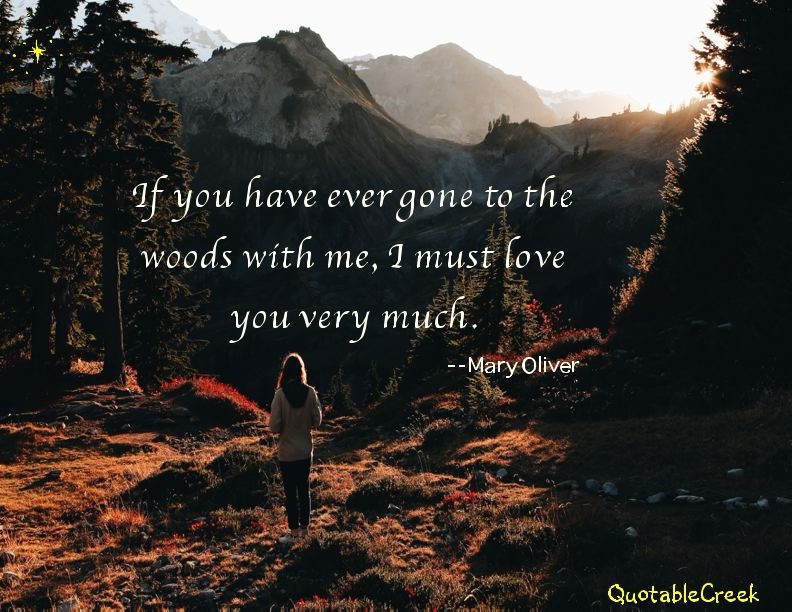
If you have ever gone to the woods with me, I must love you very much.
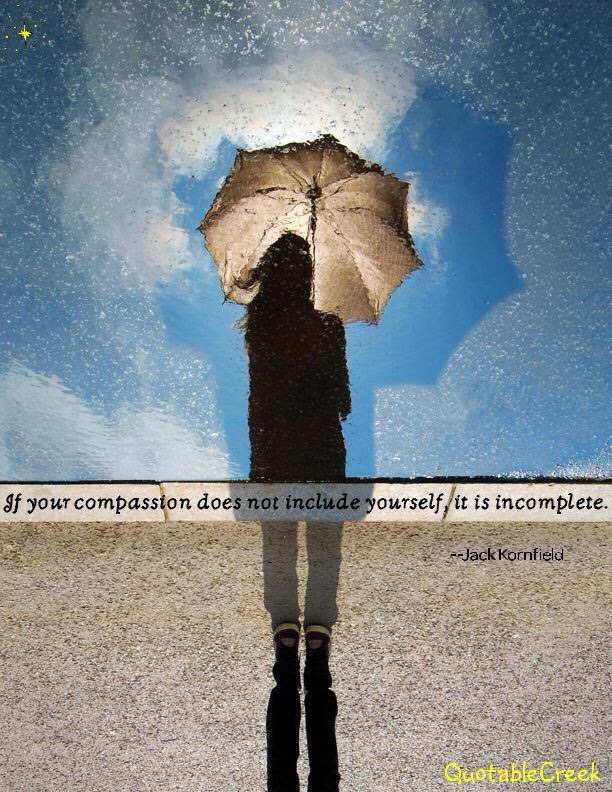
If one of your friends were struggling with the problems you are facing right now, what words would you offer in support? Would you call them names, berate them, remind them of all the other times they messed up just like this and how, honestly, can they ever expect to get anything right, ever?
Probably not. Right? But often this is the way we talk to ourselves. We replay all our other mistakes in our minds, call ourselves stupid, sink into our shells scared to face the world.
But why do we do this? If the words we would offer our friend are what we think would help, why are we so reticent to speak kind encouraging words to ourselves? Maybe today is a good day to try a different approach.
Be a kind friend to yourself. Offer yourself words of support and encouragement. Focus on all the many times you got things right. Tell yourself the truth: you are precious and beloved.
In a difficult and challenging place and time, we are called to continue the fight for what is right and good, true and just, honorable and compassionate. We push forward– listening more, caring more, giving more. We can drown out the din and listen to our hearts which strive for peace and harmony, communion, reconciliation. We must hold fast to our principles and to hope as our anchor, especially now.

 QuotableCreek.com