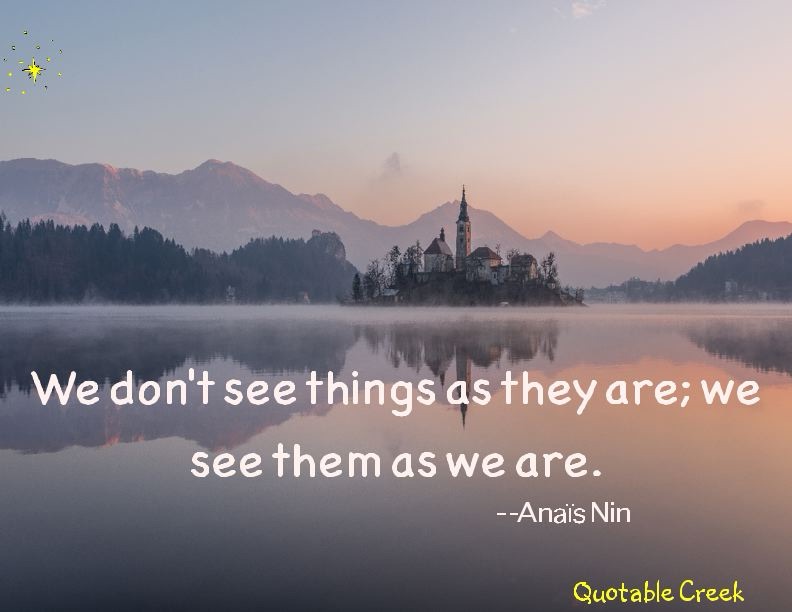
A guy cuts you off in traffic. How do you see him? Is he an inconsiderate lout caring little for the aggravation he causes you or a distracted hapless soul, perhaps late for an emergency? How we see this situation, or any situation, can have a profound effect on our lives.
In this thoughtful essay, Elizabeth Gilbert considers the power of perception. She recounts a time when her father and his siblings were reminiscing about their late mother and how she used to take a sip from any glass of milk she poured for them. They agreed on the fact, that she took a sip, but wildly disagreed on their perception of that fact:
At one point, they found themselves sitting around the old kitchen table, eating sandwiches and talking about the past. My uncle, the baby of the family, looked at the refrigerator and said, “I can still see Mom standing there, pouring me a glass of milk. Do you remember that sweet thing she always used to do whenever she got us a glass of milk? Remember how she’d take a tiny sip first, to make sure it wasn’t spoiled? Always looking out for us.”
My father, the analytical engineer of the family, raised his eyebrows. “No,” he said. “You are so wrong. Mom wasn’t sipping our milk to test it for freshness. She was sipping our milk because she always overfilled the glass. She had no sense of spatial relations. It used to drive me crazy.”
My brilliantly sardonic aunt looked at her two brothers like they were the biggest idiots she’d ever seen.
“You’re both wrong,” she said. “Mom was stealing our damn milk.”
So, what have we learned about my grandmother from this story? Was she a devoted caregiver, an incompetent dunderhead or someone who would steal the milk out of the mouths of her children? (Or maybe just an exceptionally thirsty woman.) The world will never know the truth.
But does the truth really matter?
I don’t think so.
Wow! What a remarkable difference in what each brings to the encounter. Now imagine yourself in each of those mindsets: hostile, critical, or grateful. Which would lead to the happier life?
We don’t have control over facts, but we sure have a tremendous amount of control over how we perceive those facts. We owe it to ourselves to try to see the facts in the most favorable light even if that means consciously going over all the possible interpretations of something and actively selecting the best one to pick.
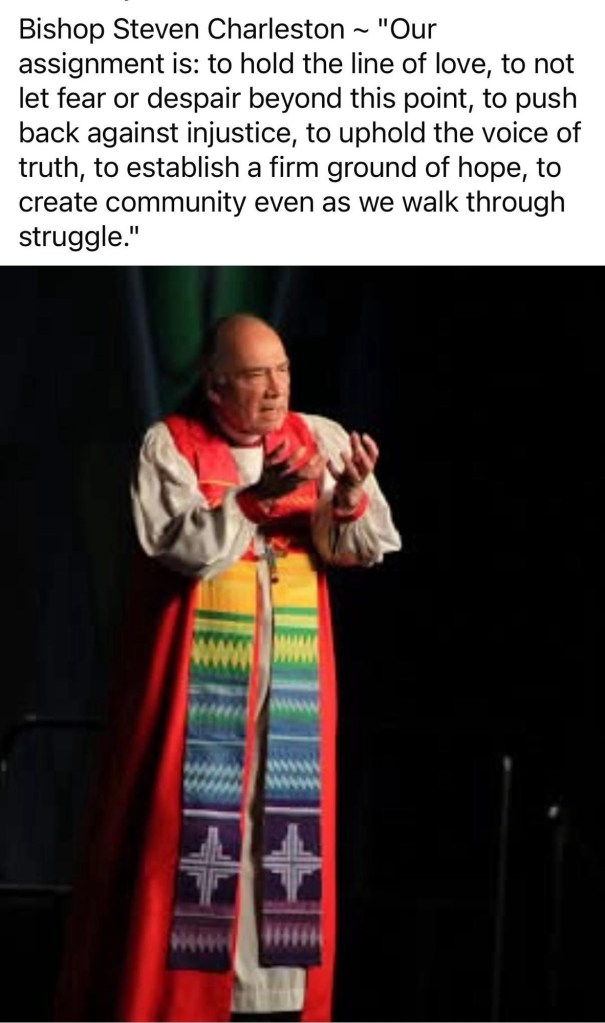
What is our job in these troubled times? During any times, but particularly during times where we are seeing peoples’ rights eroded and trampled, when legal safeguards are flouted, and when authoritarianism is on the rise, our job is to hold the line. Continue to be a place of comfort and succor to the hurting, feed the hungry, grieve with the mourning.
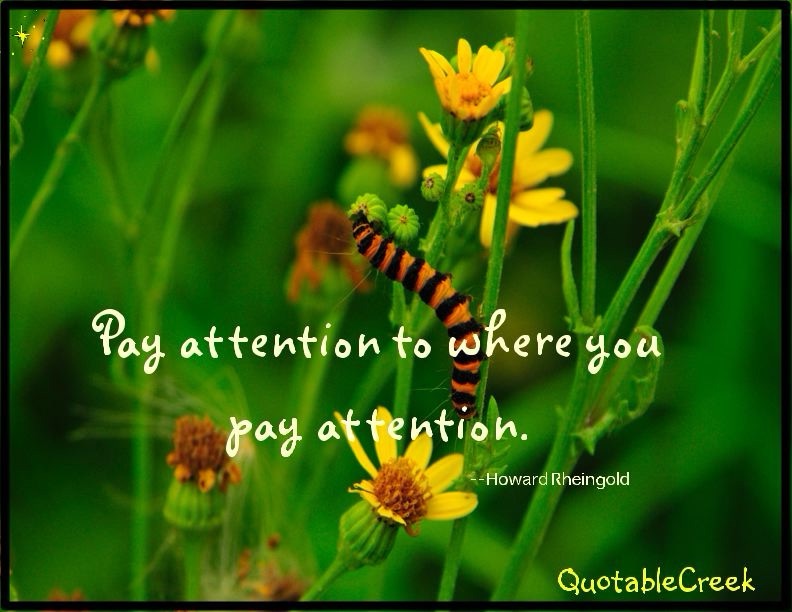
Have you ever wondered why everything is so beautiful? Have you stood rapt in the brilliant colors of a sunset, or listening to birdsong in the morning, or watching the way a caterpillar humps along with all its little feet working together? Perhaps there are logical, book smart reasons, like flowers are beautiful to attract bees, or animals are beautiful to attract mates or to warn predators they’re toxic, or some such thing, but don’t those answers beg the question really? Why is beauty? Could the answer be that it is to inspire awe in us? And our job is to notice.
A master violinist can play Bach on a precious instrument, and most people will just walk by:
We are living in a place filled with beauty if we only stop to notice. For inspiration, consider Mary Oliver’s poem, The Summer Day:
The Summer Day
Who made the world?
Who made the swan, and the black bear?
Who made the grasshopper?
This grasshopper, I mean-
the one who has flung herself out of the grass,
the one who is eating sugar out of my hand,
who is moving her jaws back and forth instead of up and down-
who is gazing around with her enormous and complicated eyes.
Now she lifts her pale forearms and thoroughly washes her face.
Now she snaps her wings open, and floats away.
I don't know exactly what a prayer is.
I do know how to pay attention, how to fall down
into the grass, how to kneel down in the grass,
how to be idle and blessed, how to stroll through the fields,
which is what I have been doing all day.
Tell me, what else should I have done?
Doesn't everything die at last, and too soon?
Tell me, what is it you plan to do
with your one wild and precious life?
What a gift we have been given to have the chance to notice the beauty all around us today!
I was recently reminded about a story from 2017 where two little boys were caught in a rip tide and swept out to sea. Their entire family and four woud-be rescuers tried to swim out to save them but ended up similarly stranded. Officials on shore stood, helpless, waiting for a rescue boat while the family and would-be rescuers floundered.
But then the people on the beach did a remarkable thing. People from all walks of life, across every possible difference or division, linked arms together and formed a human chain stretching out into the ocean until they reached those stuck and and then passed them person to person, beginning with the little boys, Noah (11) and Stephen (8), and ending with their grandmother who had tried to save them, back to safety.
Stories like this don’t get a lot of press. But it’s why we’re here.
What do you feel entitled to? Your life, job, spouse, happiness, health, good weather? It’s remarkable how we can feel that we have earned our stations in life and are entitled to all the good things.
Until something happens to take it away.
A diagnosis, job loss, natural disaster, and then we realize we weren’t entitled to any of it after all. It was a gift, and we hadn’t been grateful.
Right now, I’m experiencing a bit of a health crisis that has me worried about my eyes and thinking about all the millions of things I love to see. My family, my garden, my cats, my friends, everything, really. What a miracle it is to see.
Maybe today is a good day to pause and think of all the things you love to see. Or hear. Or experience.
Think of all you have been blessed with and be grateful.
Most of us will not be inventing a vaccine to end a pandemic or donating millions to the research. Most of us will not be heroes in the saving the day sense.
And yet each of us has incredible power to choose how we want to meet each day when life is so stressful. Whether we want to retreat into a cocoon focused only on our own wants and needs or use this as an opportunity to reach out to others. Whether we want to add to someone’s anxiety or be their shelter in the storm. Whether we want to be comforted or to comfort.
And the impetus for any acts of kindness comes from the deep recognition of how important those acts of kindness have been to you when you have despaired. The kind gesture, the comfort of a friend simply abiding with you as you travel a dark path, the reminder that you are precious when you’ve forgotten and can see only your mistakes. These have been your lifeblood. And you can offer that gift to others, particularly now.
Take a moment to enjoy this profound poem by Naomi Shihab Nye.
Before you know what kindness really is you must lose things, feel the future dissolve in a moment like salt in a weakened broth. What you held in your hand, what you counted and carefully saved, all this must go so you know how desolate the landscape can be between the regions of kindness. How you ride and ride thinking the bus will never stop, the passengers eating maize and chicken will stare out the window forever.
Before you learn the tender gravity of kindness you must travel where the Indian in a white poncho lies dead by the side of the road. You must see how this could be you, how he too was someone who journeyed through the night with plans and the simple breath that kept him alive.
Before you know kindness as the deepest thing inside, you must know sorrow as the other deepest thing. You must wake up with sorrow. You must speak to it till your voice catches the thread of all sorrows and you see the size of the cloth. Then it is only kindness that makes sense anymore, only kindness that ties your shoes and sends you out into the day to gaze at bread, only kindness that raises its head from the crowd of the world to say It is I you have been looking for, and then goes with you everywhere like a shadow or a friend.
Children have a way of shaking things up. Don’t they? They see things we’ve stopped noticing. They question things we’ve started to take for granted. They cause us to stop and notice. They hold up a giant mirror to us and cause us to do some soul-searching.
That is, if we take the time to listen.
Why is that person asking for money? Why are people starving? Why do some people get treated better? Why do you say one thing in public but do another in private? Is this fair? Does everyone cheat? Does everyone lie? Is there a better way?
They force us to confront the gap between what we say they should do and what we do, or what society does, or what their friends do. Most adults suffer from some degree of cognitive dissonance: the mental discomfort from holding two or more differing beliefs, ideas or values at the same time. We value honesty but cheat on our taxes. We tell them not to bully others but then bully them or laugh as others are bullied. We tell them never to hit someone else while spanking them. We tell them all children are precious but then harbor racial or gender biases.
They notice.
And they point it out.
For those of us listening, this is a time to ask ourselves what we do, in fact, stand for and then work to align our lives with those values, to be internally and externally consistent.
For an unbelievably uplifting video of a diverse group of kids singing their hearts out, please watch this video. It will start your day off with hope and promise and excitement for the future of our nation and world.
What makes some people able to empathize more than others, able to help in dire circumstances, able to put the greater good above the personal good? Bryan Stephenson, founder of the Equal Justice Institute, fierce advocate against systemic racism, and criminal defense attorney for those on death row explains: “I do it because I’m broken, too.” That recognition of a common humanity and brokenness by a system that needs changing propels him to fight.
Who among us isn’t broken? Because we all are bound together, we all suffer in an unjust world. Because we all have known pain, we all have the capacity to put ourselves into the shoes of those hurting.
In his book, Just Mercy, Stephenson explains:
My years of struggling against inequality, abusive power, poverty, oppression, and injustice had finally revealed something to me about myself. Being close to suffering, death, executions and cruel punishments didn’t just illuminate the brokenness of others; in a moment of anguish and heartbreak, it also exposed my own brokenness. You can’t effectively fight abusive power, poverty, inequality, illness, oppression, or injustice and not be broken by it.
We are all broken by something. We have all hurt someone and have been hurt. We all share the condition of brokenness even if our brokenness is not equivalent. I desperately wanted mercy for Jimmy Dill and would have done anything to create justice for him, but I couldn’t pretend that his struggle was disconnected from my own. The ways in which I have been hurt–and have hurt others–are different from the ways Jimmy Dill suffered and caused suffering. But our shared brokenness connected us.
Paul Farmer, the renowned physician who has spent his life trying to cure the world’s sickest and poorest people, once quoted me something that the writer Thomas Merton said: ‘We are bodies of broken bones.’ I guess I’d always known but never fully considered that being broken is what makes us human. We all have our reasons. Sometimes we’re fractured by the choices we make; sometimes we’re shattered by things we would never have chosen. But our brokenness is also the source of our common humanity, the basis for our shared search for comfort, meaning, and healing. Our shared vulnerability and imperfection nurtures and sustains our capacity for compassion.
We all have a choice. We can embrace our humanness, which means embracing our broken natures and the compassion that remains our best hope for healing. Or we can deny our brokenness, forswear compassion, and, as a result, deny our humanity
…So many of us have become afraid and angry. We’ve become so fearful and vengeful that we’ve thrown away children, discarded the disabled, and sanctioned the imprisonment of the sick and the weak–not because they are a threat to public safety or beyond rehabilitation but because we think it makes us seem tough, less broken. …We’ve submitted to the harsh instinct to crush those among us whose brokenness is most visible. But simply punishing the broken–walking away from them or hiding them from sight–only ensures that they remain broken and we do, too. There is no wholeness outside of our reciprocal humanity.Just Mercy, by Bryan Stephenson
How many of the problems we face today can be mitigated by recognizing our common humanity, by following the Golden Rule of treating others how we would have them treat us, a tenet found in many of the world’s religions? How would we have others treat us if we were the elderly, the sick, the refugee, the hurt, the accused, the other? Each of us would benefit from considering things from this perspective. Bryan Stephenson continues:
Whenever things got really bad, and they were questioning the value of their lives, I would remind them that each of us is more than the worst thing we’ve ever done. I told them that if someone tells a lie, that person is not just a liar. If you take something that doesn’t belong to you, you are not just a thief. Even if you kill someone, you’re not just a killer. I told myself that evening what I had been telling my clients for years. I am more than broken. In fact, there is a strength, a power even, in understanding brokenness, because embracing our brokenness creates a need and desire for mercy, and perhaps a corresponding need to show mercy. When you experience mercy, you learn things that are hard to learn otherwise. You see things you can’t otherwise see; you hear things you can’t otherwise hear. You begin to recognize the humanity that resides in each of us.
…I began thinking about what would happen if we all just acknowledged our brokenness, If we owned up to our weaknesses, our deficits, our biases, our fears. Maybe if we did, we wouldn’t want to kill the broken among us who have killed others. Maybe we would look harder for solutions to caring for the disabled, the abused, the neglected, and the traumatized.Just Mercy, by Bryan Stephenson
We are all broken. Some of us don’t acknowledge that. We have all hurt and been hurt. It is that humbling insight that can help us recognize our common humanity across all divides. If we just have the eyes to see and the ears to hear. Stephenson refers to an unnamed pastor who would preface singing: “The minister would stand, spread his arms wide, and say, “Make me to hear joy and gladness, that the bones which thou hast broken may rejoice.”
In a recent Oprah magazine, Elizabeth Gilbert talks about her Inner Crone — a version of herself old, happy, and well past the point of fear — that she pictures when she needs a shot of courage. She considers her Inner Crone to be “a badass old lady who already dwells somewhere deep within [her] and whom [she] hope[s] to fully become someday.” Picturing her Inner Crone gives Gilbert gumption.
But she also remembers her Inner Child, and pictures that child particularly when she is feeling depressed or hard on herself:
Many years ago when I was going through a dark season of depression and self-loathing, I taped a sweet photograph of myself at the tender age of 2 on my bathroom mirror. Looking at that photo every day reminded me that I once was this blameless little person, deserving of all tenderness–and that part of me would always be this blameless little person deserving of all tenderness. Meditating upon a smaller and more innocent version of my face helped me to learn to be more compassionate to myself. I was finally able to recognize that any harm I inflicted on me, I was also inflicting on her. And that little kid clearly didn’t deserve to be harmed.
We could all benefit from picturing our Inner Child when we are being hard on ourselves. Would you criticize that little child the way you are criticizing yourself now, or would you be more patient and encouraging? Would you demand perfection from that child, or would you celebrate progress? If you were wounded by adults when you were a child, you now are an adult who can support that little child in a healing way.
Think back. Can you remember that Inner Child who is still a part of you? The joy and exuberance, enthusiasm and trust, innocence and promise? No matter how far you’ve come from that start, treat yourself with kindness, patience, and compassion. That Inner Child is alive and well…and trusts you.
Picture a fussy baby, afraid to fall asleep, but then comforted in his mother’s arms by her lilting lullaby, her breath soft against his face, her song sweet to his ears.
Who among us can’t, at times, relate to that child? The future seems particularly uncertain. Worry disrupts sleep. Anxiety weakens our resolve.
There is something about a lullaby, though, the soft tones, the repetitive melody, the gentleness of the presentation, that can help soothe and relax, comfort and reassure us. The sweet song can reach into our long past baby consciousness and help us rest.
Take a minute to enjoy this beautiful rendition of Billy Joel’s Goodnight, My Angel, by Social Dissonance with soloist Ryan Nagelmann. May it help you find peace.
 QuotableCreek.com