Today, in the United States, we vote. We celebrate a country that allows its citizens input into this remarkable experiment of a government of the people, by the people, and for the people.
We honor this country and its principles of equality, freedom, and justice for all. Our understanding of those concepts has evolved over time, and taken some steps back, but today let us be grateful for how far we’ve come and consider the steps that we each might take today and every day to make this country move closer to the ideals for which it stands. It is both a privilege and a responsibility to vote.
Oh, child. How I wish for you to have a life without misery and heartache, a world without disillusionment and betrayal, a childhood unmarred by neglect or abuse, a journey without conflict. But, alas, that will not be. We do not live in a utopian world, but here in this world, and you will know sorrow and pain and, as much as I would love to shield and protect you from it, I cannot. There will be dark days, my love.
But you are brighter than the darkness, and, even in your misery, you will find a way to shine. And when you are at your lowest point, I will be there beside you knowing that you will rise again and that this pain will make you more compassionate and humble, more honest and fierce, more determined to make this world a more perfect place, because you, my beautiful child, are not meant to be kept down in the darkness, but to shine.
What questions do we frame for ourselves at the end of the day? What are the questions that have caused us to soul-search and perhaps take a new path? What questions have forced you to look at something a different way?
Sometimes the questions are more important than the answers. There are some that resonate so deeply with us, we may spend a lifetime trying to answer them. In her piece about the beauty of these profound questions, Karen Horneffer-Ginter identifies some that have been meaningful to her:
When used properly, questions have the potential to connect us to the world of another. A heartfelt “How are you?” or “How was your day?” can become the bridge that keeps us in relationship to the lives of those we love. Sometimes, too, questions create a bridge within ourselves, allowing us to hear what’s going on at a deeper level. We know when we’ve encountered a question that has this potential because it stays with us — maybe for the day, maybe for our whole lives. It taps us on the shoulder to wake us up, or it wiggles its way in more deeply, opening us up to seeing things in a new way.
I still recall first encountering Judith Duerk’s chorus of questions about how my life might have been different if there had been a sacred circle to step into. Mary Oliver asking me about my plans for this one wild and precious life, Oriah Mountain Dreamer wanting to know what I ache for and if I dare to dream of meeting my heart’s longing, and Angeles Arrien reminding me of the questions asked in some indigenous cultures: When did you stop singing? When did you stop dancing? I think of my friend Ming, asking me at lunch one day if I thought writing was my fullest and truest expression. All these questions have remained close companions across the years.
The questions that have been consuming my thoughts and are my close companions these days are What does it mean to be welcoming? How does welcome look? How does it change the mix if it is accepted? What are the stumbling blocks to be truly welcoming? Where does fear creep in to inhibit welcome? How will my life be different because I have welcomed another into it? How will it disrupt my comfort zone, and how will I get my ego out of the way to be more accepting?
What are the questions in your heart, questions that are your close companions? And just the framing of those questions can be significant, as she suggests above. Consider the difference between ‘What do I have to do today?’ and ‘What do I get to do today?’ That simple shift helps us move from feeling burdened to being grateful for all the opportunities presented by the day.
What are the questions that have been your close companions? What do you get to do today to help answer them?
Sometimes, when we feel down, we need to evaluate the input coming into our lives. Are we steeped in negativity? Maybe not just news, but the vitriol that follows it in the comments? The political back and forth can get ugly and pull us down. And then we can think about the friends we surround ourselves with. Are they upbeat, trying to make things better, or always complaining?
And, while we don’t want to retreat from fighting the good fight or the friends who are going through a rough patch, it’s so easy for people to tear things down, to find the flaws, to make a conflict, and, when we are around that kind of energy constantly, we can feel beaten down.
But, there is good news to be had, and there are positive people and opportunities to be found. Sometimes we need to focus our attention there, if only for a break from the storm.
We start so little and helpless, not knowing much of anything, but responding to love, comfort, care, concern. As we grow, there have been people who have brought joy to our lives, people who have helped us step out and grow.
For these people, we offer thanks.
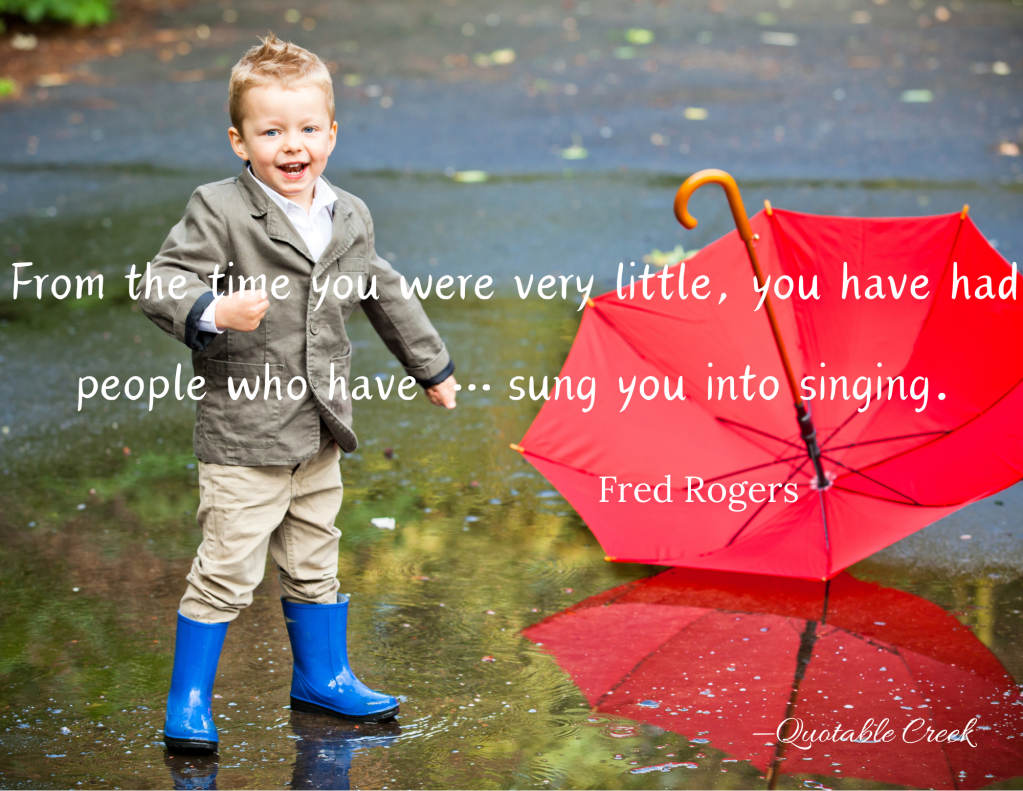
As Mr. Rogers explained:
From the time you were very little, you’ve had people who have smiled you into smiling, people who have talked you into talking, sung you into singing, loved you into loving. So, on this extra special day, let’s take some time to think of those extra special people.
And we have them now, don’t we? Those people who smile us into smiling and love us into loving?
I am a huge fan of birdsong. It is so joyful. Listening to a little bird, so unassuming, singing with all it has to welcome the day reminds us of what it is like to be alive—vibrant and grateful, blessed with a day ahead to sing our song however that might manifest itself in each individual life. Open. Ready. Eager even.
And yet life can bring us low. Consider Shakespeare’s 29th Sonnet below. He certainly gets what it is like to feel outcast and alone, bemoaning our fate, jealous of others’ future and friends, their talents and possibilities, when we feel we have none.
And yet,
There is, or maybe was, someone who brightened our spirits. Someone who loved us and, like the simple lark singing its joyful song, that love can change an outlook in a blink. And next to that love, all the treasure of kings is paltry.
For a perfect, tear-jerking read of this Sonnet, take a listen to Judi Dench in the clip below. and take a minute, sometime today, to listen to a bird singing its heart out and remember those you love and those who love you.
When, in disgrace with fortune and men’s eyes,
I all alone beweep my outcast state,
And trouble deaf heaven with my bootless cries,
And look upon myself and curse my fate,
Wishing me like to one more rich in hope,
Featured like him, like him with friends possessed,
Adulting isn’t for the faint of heart. Responsibilities, worries, concerns for the future can weigh us down and make us nostalgic for the carefree days of youth. But, perhaps, there’s a remedy.
When was the last time you started something new? An art, language, trip, habit? Maybe followed a lifelong dream. Perhaps it is scary to become a ballerina at 60+ years old, but doesn’t it sound delightful? Or perhaps learn how to refinish cast-off furniture. Or speak a different language.
These are the ones I’m thinking of, what would you try? As we age, being a beginner is harder. We worry about embarrassment, or struggle with not knowing everything already. Or perhaps we think if we try something like this, we have to be a professional and don’t give ourselves permission to be bad at it. We’ve forgotten the joy in just immersing ourselves in something new.
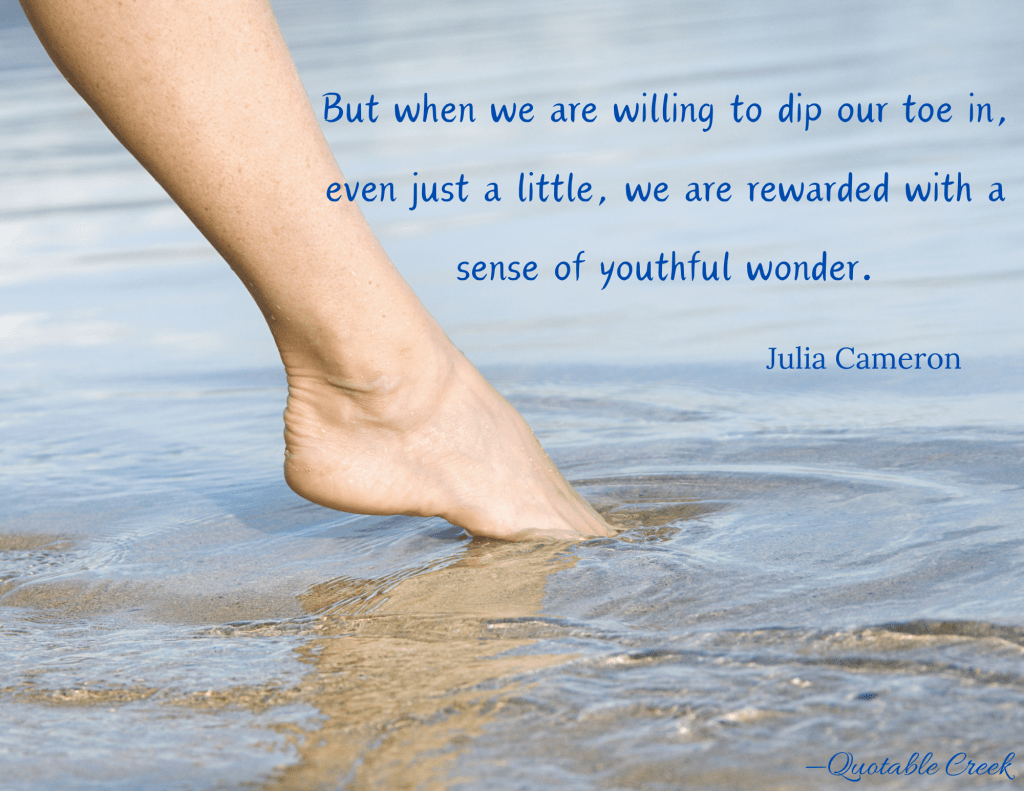
Julia Cameron says:
Often, when we say it is ‘too late’ for us to begin something, what we are really saying is that we aren’t willing to be a beginner. But when we are willing to dip our toe in, even just a little. We are rewarded with a sense of youthful wonder. Never give in, never give in, never, never, never, never.
There is always something new and exciting around the corner just waiting to experience.
When I was a girl, text books used the term ‘melting pot’ to describe America as if everyone were thrown into one big pot and all the differences were boiled out, with America becoming just one big homogenous pot of glop. But better metaphors have popped up in the years since. Such as a salad bowl:
We don’t need a melting pot in this country, folks. We need a salad bowl. In a salad bowl, you put in the different things. You want the vegetables – the lettuce, the cucumbers, the onions, the green peppers – to maintain their identity. You appreciate differences.Jane Elliot
But perhaps my favorite is Jimmy Carter’s:
We become not a melting pot but a beautiful mosaic. Different people, different beliefs, different yearnings, different hopes, different dreams.Jimmy Carter
I love the idea of a mosaic to define America—beauty in all the bits and pieces, each a small distinct individual unit but also a necessary part of a larger picture.
No matter how you describe it, America at its best, living up to its ideals, is stronger because of its diversity, the unique perspectives, the mix of voices, backgrounds, cultures, and traditions.
Are there any more beautiful words in English literature than these: “But soft! What light through yonder window breaks?”
These are Romeo’s words when he gazes at Juliet above on the balcony, but what if we were to bring these words into our everyday encounters?
But soft! Listen to the hush here, the rapt attention, all of his focus on her, just her. What if we were to whisper these words to ourselves before we talk with someone? But soft! The world fades, the focus sharpens, all of our attention is on that person. But soft! reminds us not just to be calm and attentive, but also to be gentle and reverent. Wouldn’t any conversation shift if it were preceded by such a lovely call to silence? Wouldn’t But soft! be a perfect pairing of words to bring back into common usage?
“What light through yonder window breaks?” Again, what if we were to look at each other this way? As light, as beings capable of making the world a brighter place. Even those with much of darkness about them have an inner light, a spark of good. What if we were to ignore the dark and focus on the light in each other? What a compliment it is to be called a light! Wouldn’t someone noticing our light make each of us want to shine ever more brightly? And wouldn’t that, accordingly, make the world an ever brighter place?