We are each born helpless. How we got from there to where we are now depended on the generosity of many people. Among those are our teachers, those people who devoted their time to making sure we understood the world around us and how to negotiate the ups and downs of the road ahead. Those teachers who went beyond the lesson plan to help us learn not just facts, but how to think and analyze, how to care and feel, and how to reach out to others deserve our unending gratitude.
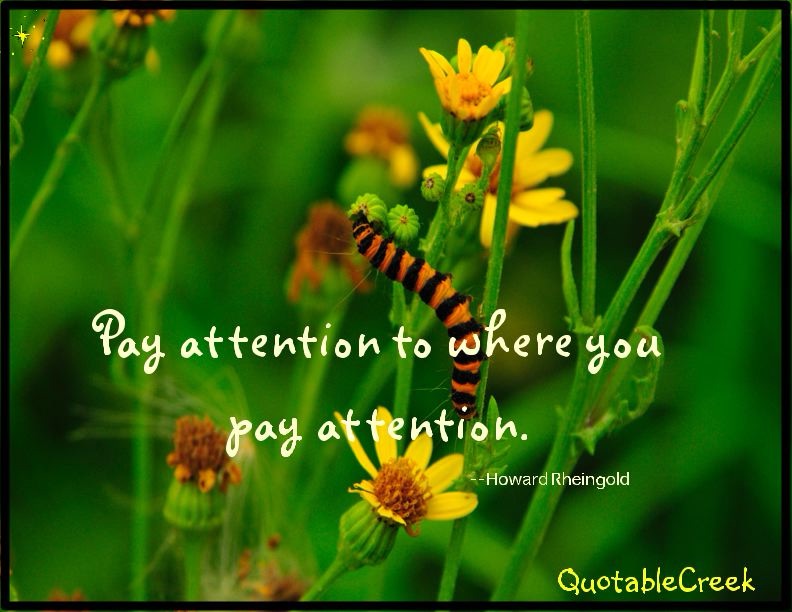
Have you ever wondered why everything is so beautiful? Have you stood rapt in the brilliant colors of a sunset, or listening to birdsong in the morning, or watching the way a caterpillar humps along with all its little feet working together? Perhaps there are logical, book smart reasons, like flowers are beautiful to attract bees, or animals are beautiful to attract mates or to warn predators they’re toxic, or some such thing, but don’t those answers beg the question really? Why is beauty? Could the answer be that it is to inspire awe in us? And our job is to notice.
A master violinist can play Bach on a precious instrument, and most people will just walk by:
We are living in a place filled with beauty if we only stop to notice. For inspiration, consider Mary Oliver’s poem, The Summer Day:
The Summer Day
Who made the world?
Who made the swan, and the black bear?
Who made the grasshopper?
This grasshopper, I mean-
the one who has flung herself out of the grass,
the one who is eating sugar out of my hand,
who is moving her jaws back and forth instead of up and down-
who is gazing around with her enormous and complicated eyes.
Now she lifts her pale forearms and thoroughly washes her face.
Now she snaps her wings open, and floats away.
I don't know exactly what a prayer is.
I do know how to pay attention, how to fall down
into the grass, how to kneel down in the grass,
how to be idle and blessed, how to stroll through the fields,
which is what I have been doing all day.
Tell me, what else should I have done?
Doesn't everything die at last, and too soon?
Tell me, what is it you plan to do
with your one wild and precious life?
What a gift we have been given to have the chance to notice the beauty all around us today!
Sometimes you can lift out of a moment and say to yourself, ‘This is a wonderful moment. I am so content.’ Everything has a new luster. And sometimes a song might come to mind.
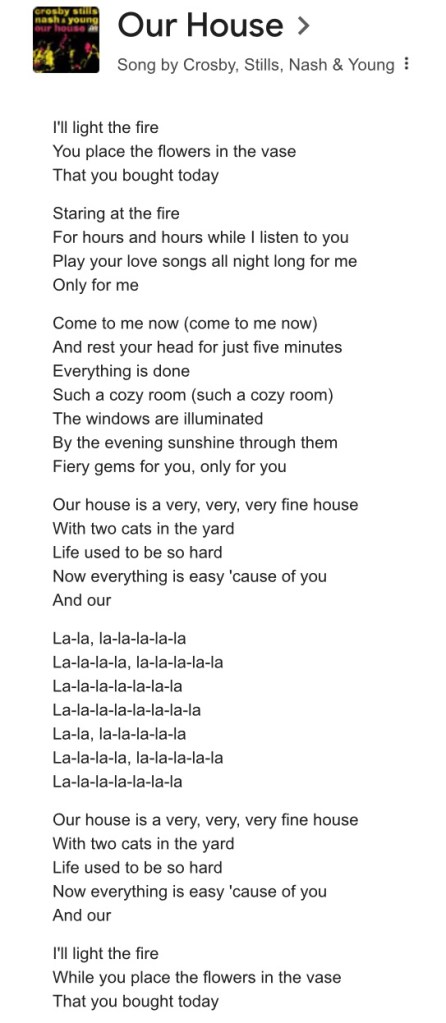
In my case, I was sitting with my husband, watching our two cats (pictured) and thinking about how homey everything felt. It brought to mind the CSNY song, ‘Our House’.
Here are the lyrics:
And, while we were sitting so inclined, my husband did a Google search about the song and learned that Graham Nash and Joni Mitchell had been shopping after dining at Art’s Deli, bought a vase, came back to her two cats, and lit the fire on a drizzly day. Nash sat at her piano and wrote this song in an hour. He must have been feeling what we felt. Content. Full.
How lovely he memorialized it for all of us to share.
Joy is a fascinating emotion. It often springs up in us at surprising times. There is something of a wellspring vibe to it, as if it bubbles up in us with little bearing to our circumstance in life or particular experience. As C. S. Lewis notes,
“I call it Joy. ‘Animal-Land’ was not imaginative. But certain other experiences were… The first is itself the memory of a memory. As I stood beside a flowering currant bush on a summer day there suddenly arose in me without warning, and as if from a depth not of years but of centuries, the memory of that earlier morning at the Old House when my brother had brought his toy garden into the nursery. It is difficult to find words strong enough for the sensation which came over me; Milton’s ‘enormous bliss’ of Eden (giving the full, ancient meaning to ‘enormous’) comes somewhere near it. It was a sensation, of course, of desire; but desire for what?…Before I knew what I desired, the desire itself was gone, the whole glimpse… withdrawn, the world turned commonplace again, or only stirred by a longing for the longing that had just ceased… In a sense the central story of my life is about nothing else… The quality common to the three experiences… is that of an unsatisfied desire which is itself more desirable than any other satisfaction. I call it Joy, which is here a technical term and must be sharply distinguished both from Happiness and Pleasure. Joy (in my sense) has indeed one characteristic, and one only, in common with them; the fact that anyone who has experienced it will want it again… I doubt whether anyone who has tasted it would ever, if both were in his power, exchange it for all the pleasures in the world. But then Joy is never in our power and Pleasure often is.” The Shape of My Early Life
Joy is distinct from pleasure and happiness. It is an abundance, a bliss, an immeasurable gratitude for the privilege of being. It isn’t meant to be ignored, but embraced, relished, cherished. Not as a byproduct of some other experience, but in itself.
As Mary Oliver says,
“If you suddenly and unexpectedly feel joy,
don’t hesitate.
Give in to it.
There are plenty of lives and whole towns destroyed or about to be.
We are not wise, and not very often kind.
And much can never be redeemed.
Still life has some possibility left.
Perhaps this is its way of fighting back,
that sometimes something happened better than all the riches or power in the world.
It could be anything, but very likely you notice it in the instant when love begins.
Anyway, that’s often the case.
Anyway, whatever it is,
don’t be afraid of its plenty. Joy is not made to be a crumb.
Swan, Poems and Prose Poems
If you should be lucky enough to feel joy bubbling up, savor it. Don’t hesitate.
There is a sort of magic in reading a book. Someone, maybe long dead, has perhaps expressed deep feelings or new thoughts or complex theories, writing out of their aloneness, and connecting with someone they have never met and may never meet.
And yet the impact of that shared space over a book can be life-changing. It can help you feel less alone in this big world. It can help you feel empathy for others in a way you may never have experienced without the book. It can open your heart and mind in new and wonderful ways.
How much do our expectations get in the way of our gratefulness? If we were expecting nothing, would our eyes open more to all the gifts we receive each day. Brother David Steindhal-Rast explores just this link between surprise and gratitude:
Have you ever noticed how your eyes open a bit wider when you are surprised? It is as if you had been asleep, merely day-dreaming or sleepwalking through some routine activity, and you hear your favorite tune on the radio, or look up from the puddles on the parking lot and see a rainbow, or the telephone rings and it’s the voice of an old friend, and all of a sudden you’re awake. Even an unwelcome surprise shakes us out of complacency and makes us come alive. We may not like it at first, but looking back, we can always recognize it as a gift. Humdrum equals deadness; surprise equals life. In fact, my favorite name for the One I worship in wonder – the only name that does not limit God – is Surprise.
Right this moment, as I remember spiritual giants I have been privileged to meet – Mother Teresa, Thomas Merton, Dorothy Day, His Holiness the Dalai Lama – I can still feel the life energy they radiated. But how did they come by this vitality? There is no lack of surprises in this world, but such radiant aliveness is rare. What I observed was that these people were all profoundly grateful, and then I understood the secret.
Surprise is a seed. Gratefulness sprouts when we rise to the challenge of surprise
A surprise does not make us automatically alive. Aliveness is a matter of give-and-take, of response. If we allow surprise to merely baffle us, it will stun us and stunt our growth. Instead, every surprise is a challenge to trust in life and so to grow. Surprise is a seed. Gratefulness sprouts when we rise to the challenge of surprise. The great ones in the realm of Spirit are so intensely alive because they are so deeply grateful.
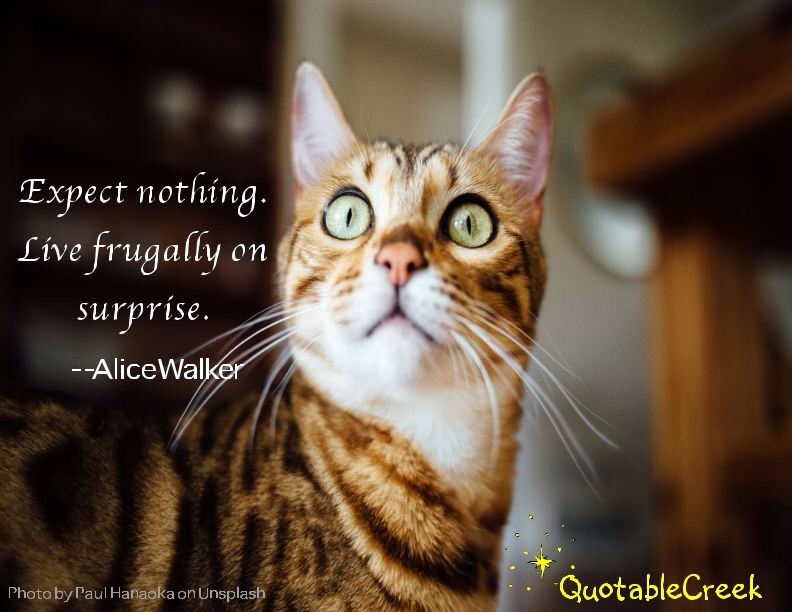
Gratefulness can be improved by practice. But where shall beginners begin? The obvious starting point is surprise. You will find that you can grow the seeds of gratefulness just by making room. If surprise happens when something unexpected shows up, let’s not expect anything at all. Let’s follow Alice Walker’s advice. “Expect nothing. Live frugally on surprise.”
To expect nothing may mean not taking for granted that your car will start when you turn the key. Try this and you will be surprised by a marvel of technology worthy of sincere gratitude. Or you may not be thrilled by your job, but if for a moment you can stop taking it for granted, you will taste the surprise of having a job at all, while millions are unemployed. If this makes you feel a flicker of gratefulness, you’ll be a little more joyful all day, a little more alive.
Once we stop taking things for granted our own bodies become some of the most surprising things of all.
Once we stop taking things for granted our own bodies become some of the most surprising things of all. It never ceases to amaze me that my body both produces and destroys 15 million red blood cells every second. Fifteen million! That’s nearly twice the census figure for New York City. I am told that the blood vessels in my body, if lined up end to end, would reach around the world. Yet my heart needs only one minute to pump my blood through this filigree network and back again. It has been doing so minute by minute, day by day, for the past 75 years and still keeps pumping away at 100,000 heartbeats every 24 hours. Obviously this is a matter of life and death for me, yet I have no idea how it works and it seems to work amazingly well in spite of my ignorance.
I do not know how my eyes adapt, yet when I chant by candlelight they are 100,000 times more sensitive to light than when I read outdoors on the porch at noon. I wouldn’t know how to give instructions to the 35 million digestive glands in my stomach for digesting one single strawberry; fortunately, they know how to do their job without my advice. When I think of this as I sit down to eat, my heart brims with gratefulness.
From the humble starting point of daily surprises, the practice of gratefulness leads to these transcendent heights.
In those moments, I can identify with the Psalmist who cried out in amazement, “I am fearfully and wonderfully made.” (Ps.139:14) From there it is only a small step to seeing the whole universe and every smallest part of it as surprising. From the humble starting point of daily surprises, the practice of gratefulness leads to these transcendent heights. Thomas Carlyle pointed to these peaks of spiritual awareness when he wrote, “Worship is transcendent wonder” – transcendent surprise.
Surprise is a seed; let it sprout and blossom today to color your life with gratitude.
I confess there are times I leave the conversation. Not bodily, but heart, mind, and soul. I drift. Such a time happened the other night. I was having dinner with a group of long-time friends. We were outside in one’s lovely yard which overlooks a golf course and the hills beyond. My wandering off, metaphorically speaking, began with a flock of ducks flying overhead across the darkening sky. And then birds broke into song all about us, flitting from bush to bush. It was such a joyful moment. And although I tried to call my friends’ attention to the ducks and birds, it maybe was just a singular moment for me, astonished by the joy in it all. A moment to savor.
Mary Oliver often captures such moments.
Consider her poem, What Gorgeous Thing about the ineffable joy in bird song:
I do not know what gorgeous thing the bluebird keeps saying, his voice easing out of his throat, beak, body into the pink air of the early morning. I like it whatever it is. Sometimes it seems the only thing in the world that is without dark thoughts. Sometimes it seems the only thing in the world that is without questions that can’t and probably never will be answered, the only thing that is entirely content with the pink, then clear white morning and, gratefully, says so.
There is a wordless something in nature that communicates both nothing and everything, and sometimes we just need to drink it all in. (And then get back to the conversation before you’re missed.)
It certainly changes things depending on your perspective. Someone who thinks of life as a contest is always striving, comparing what he has to others. The one who views life as a burden might sigh a lot. And so on.
But what if we thought of life as a gift? Unearned, given out of love, no strings attached. Something to be grateful for. Something to savor and enjoy but also something to treasure. Would that affect what we see when we open our eyes in the morning? Face challenges? Greet people? Pick a career?
Brian Zhand says:
Most of us are scripted to think that life is a game and the purpose of life is to win. But the divine truth is that life is a gift and the purpose of life is to learn to love well.
The truth is being here is a gift, an opportunity, a chance to do some good. Open your gift.
Are there people in your life who encourage you and make you feel stronger and lifted up? Are there some who drag you down or take the wind out of your sails? In her book, Balcony People, Joyce Landor Heatherley argues there are two types of people: the evaluators and the affirmers. She suggests:
I am sure, if there were a way to view a movie and see instant replays of all the strategic change points in our lives, that we’d instantly spot the people who either broke our spirits by their critical or judgmental evaluations, or who healed us by their loving, perceptive affirmations.
To be honest, I seem to be able to remember the negative comments of evaluators faster and more clearly than the positive remarks of the affirmers. I’m not alone in this ability to recall the negative….I suspect that not far from anyone’s conscious level of thinking lies the memory of an evaluator who pulled on his or her spiked boots and stomped deliberately over our bare soul and personhood.
Do you have any of these evaluators in your life? Maybe you can recognize the voice in your head that tells you that you can’t do something. In her book The Artist’s Way: A Spiritual Path to Higher Creativity, Julia Cameron calls these the censors. Maybe you have many censors, a rogue’s gallery of them.
So what do we do with these evaluators and censors to keep them from stifling our blossoming with their negative talk or opinions? Heatherley suggests leaving them in the past, even if that past was five minutes ago:
We all have the choice to replay the harmful remarks from evaluators, or we can choose to let them pass on. We can even choose to make allowances for their discouraging, destructive words. But best of all is the choice to willingly focus our minds and hearts on today’s person who is affirming us.
So who are these affirmers in our lives? Think back…
Who by one small sentence or more, has changed and lifted your opinion of yourself? Who was the person early in your life who recognized the first sparks of originality in the labyrinths of your mind and soul and saw what no one else saw? And who is the special affirmer who catches quick glimpses of the flames from the fires of your potential and tells you so? Who, by his or her words, helps you to respect and believe in your own value as a person? And who is the affirmer who encourages you to stretch and dream beyond your self-imposed limits and capabilities?
These affirmers are your Balcony People, cheering you on to blossom and stretch. These are the people whose words you must cling to when working toward your goal. These affirmers see you “by a clearer, truer light. They [are] able to peel back the layers of pretense [you] wear like like costumes for a bad play. Most of the time they [see] through and past the masks [you] hide behind. Then, once having broken through to [you] they’d get on with the business of motivating [you] to be all [you] can be.”
Affirmation is vital to our health and progress:
When others discern the good, the noble, the honorable, and the just tenets of our character (no matter how minuscule they may be) and proceed to tell us how they admire those traits, we feel visible. We begin to ‘see’ ourselves and our worth. We feel nurtured and nourished, but mostly we feel loved.
The Basement People do just the opposite. With their words they cause you to doubt and shrink. They focus on your flaws or failings. They encourage you to not try, to stay where you are, to wallow in the “murky waters of failure and discouragement.” We don’t need to linger on their words.
Who is in your Balcony? Who cheers you on and sees your unique worth? Who do you admire in history for their accomplishments or moral victories?
When you struggle, picture these people, your Balcony People. Remember their words. Let their affirmations encourage and comfort you in defeat and to keep pressing onward in your goals.
You are meant to blossom not wither. You are meant to shine not lurk in the shadows.