Everything is easy ‘cause of you.

Sometimes you can lift out of a moment and say to yourself, ‘This is a wonderful moment. I am so content.’ Everything has a new luster. And sometimes a song might come to mind.

In my case, I was sitting with my husband, watching our two cats (pictured) and thinking about how homey everything felt. It brought to mind the CSNY song, ‘Our House’.

Here are the lyrics:
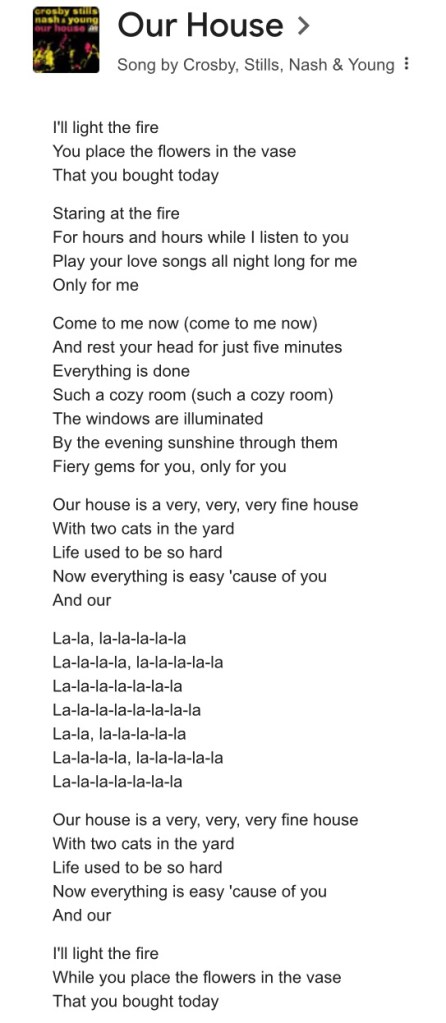
And, while we were sitting so inclined, my husband did a Google search about the song and learned that Graham Nash and Joni Mitchell had been shopping after dining at Art’s Deli, bought a vase, came back to her two cats, and lit the fire on a drizzly day. Nash sat at her piano and wrote this song in an hour. He must have been feeling what we felt. Content. Full.

How lovely he memorialized it for all of us to share.
The singing leaf and your busy heart.

Let heaven and nature sing.

There is a thrum, a life force, a joy at the core of it all, and sometimes we need to tune in to it and listen.

As Mary Oliver wrote:

What can I say that I have not said before?

So I’ll say it again.

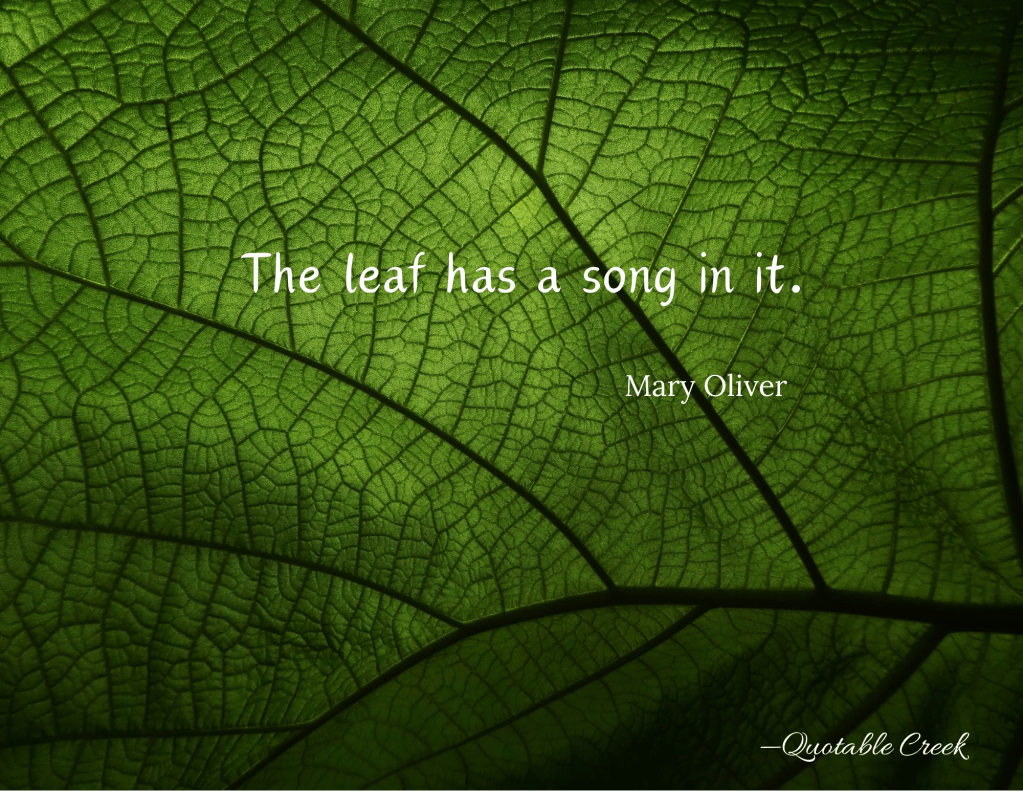
The leaf has a song in it.

Stone is the face of patience.

Inside the river there is an unfinishable story and you are somewhere in it

And it will never end until all ends.

Take your busy heart to the art museum and the chamber of commerce

But take it also to the forest.

The song you heard singing in the leaf when you were a child

Is singing still.

I am of years lived, so far, seventy-four,

And the leaf is singing still.

Where will you take your busy heart today? Can you hear the leaf singing?

How to be a good creature.

Sy Montgomery’s delightful book, How To Be a Good Creature, is a ‘Memoir in Thirteen Animals‘. What an interesting way to organize a memoir, focusing on the impact various animals have made on her life and what they have taught her about co-existing as fellow creatures on this planet! It is a profound, yet simple, book.

If you were to write a memoir of your life through that lens, who would the animals be that impacted your life in meaningful and enriching ways? What life lessons did you learn? How were your limits expanded from sharing space with that fellow creature?

For inspiration, consider Montgomery’s words:

All the animals I’ve known–from the first bug I must have spied as an infant, to the moon bears I met in Southeast Asia, to the spotted hens I got to know in Kenya–have been good creatures. Each individual is a marvel and perfect in his or her own way. Just being with any animal is edifying, for each has a knowing that surpasses human understanding. A spider can taste the world with her feet. Birds can see colors we can’t begin to describe. A cricket can sing with his legs and listen with his knees. A dog can hear sounds above the level of human hearing, and can tell if you’re upset even before you’re aware of it yourself. Knowing someone who belongs to another species can enlarge your soul in surprising ways.

I often wish I could go back in time and tell my young, anxious self that my dreams weren’t in vain and my sorrows weren’t permanent. I can’t do that, but I can do something better. I can tell you that teachers are all around to help you: with four legs or two or eight or even none, some with internal skeletons, some without. All you have to do is recognize them as teachers and be ready to hear their truths.

Today, consider the wonder of creation around you and thank your teachers of the non-human persuasion.

Your imperfect offering.

Perfection can be the enemy of progress. When we need to move forward, we often wait until we come up with a perfect solution, sometimes so long that the opportunity to make our contribution passes. It is not only ok to be fallible, it is all we’ve got to work with: Our imperfect, fallible, often short-sighted selves doing our best to make the world a better place right here, right now, with what is right in front of us.

Take a minute to watch this lovely video of Leonard Cohen singing a reminder that perfection isn’t an option; we must do our best now.

I shall not pass this way again.

There is an elephant in the room. We don’t talk about it, we try not to think about it, we pretend it doesn’t exist. That elephant is the fact that we are all on a one way journey through this life. Our time is limited. None of us knows in advance when our end of the journey will come, but that end will come.

When we pull ourselves out of denial and gaze directly at this elephant, we can realize something important: our opportunities should be seized now. That good we can do? Don’t put it off. That kind word? Say it. That gift or remembrance? Give it now.

We will not have this place and time and opportunity to make a difference again.

Let it begin with me.

We wish for peace but quarrel with our neighbor. We tremble from talk of war but allow ourselves to respond to others with hate, sarcasm, anger, and animosity. We expect leaders to be the adults in the room, but mock and deride them mercilessly. Peace, it seems, is something for other people out there to do and strive for because we are angry and fed up and impatient, and peace isn’t in our everyday lexicon at the moment.

But we can fight for peace, by controlling ourselves, treating each other respectfully, and speaking out against injustice. Take a minute to watch this beautiful video.

Let there be peace on earth
And let it begin with me
Let there be peace on earth
The peace that was meant to be
With God as our father
Brothers all are we
Let me walk with my brother
In perfect harmony

Let peace begin with me
Let this be the moment now
With every step I take
Let this be my solemn vow
To take each moment
And live each moment
To take each moment
And live each moment
To take each moment
And live each moment
In peace eternally
Let there be peace on earth
And let it begin
With me (me)
With me

Songwriters: Jill Jackson / Sy Miller

Hit pause.

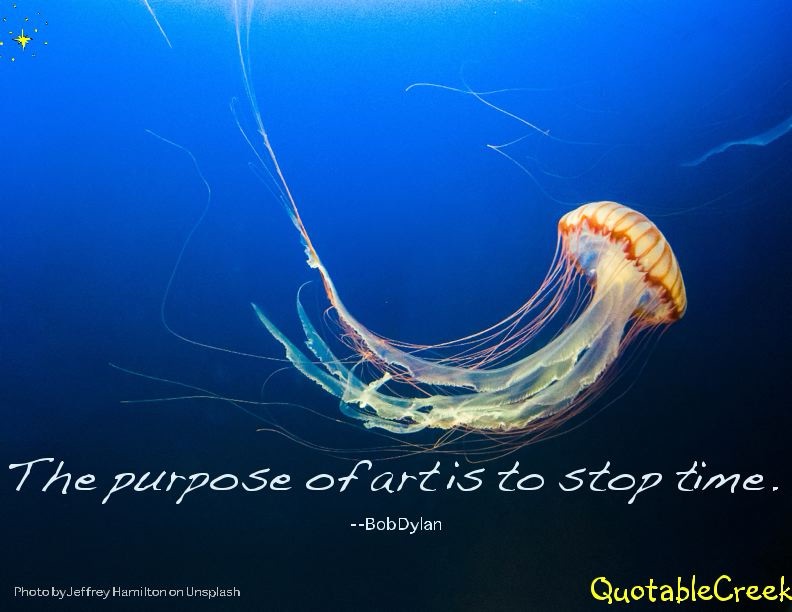
We are caught in the steady, persistent, ruthless flow of time. And yet there are moments when we can step out of time to pause, focus, and gain perspective. The arts do that. As you admire a piece of art, whether photograph, painting, novel, poem, film, dance and so on, we are grounded in detail. We can observe intricacy. We pause in the captured emotion and can rest there awhile. We are transported.

When the cares of the world become too great, we can pause and admire the detail in a jelly fish, the sweetness in bird song, or read soothing words such as these by Wendell Barry:

The Peace of Wild Things

When despair for the world grows in me

and I wake in the night at the least sound

in fear of what my life and my children’s lives may be,

I go and lie down where the wood drake

rests in his beauty on the water, and the great heron feeds.

I come into the peace of wild things

who do not tax their lives with forethought

of grief. I come into the presence of still water.

And I feel above me the day-blind stars

waiting with their light. For a time

I rest in the grace of the world, and am free.

Take a moment to pause on something beautiful.

Compassion as strength.

Last week at the DNC, we glimpsed Gus, the son of vice-presidential candidate Tim Walz, in an unguarded, moment, filled with pride and love, crying, and saying, ‘That’s my dad!’ For me and millions of others, that raw, unfiltered emotion choked us up. It was a beautiful moment, such a clear window into a pure love.

But for many others, trained perhaps to hide their own emotions and toughen up as they age, that moment led to mockery and cruel responses.

What accounts for such wildly different responses?

Perhaps the difference lies in how we view vulnerability, which in turn, colors how we trust others. Do we feel like we must mask our emotions and vulnerabilities? Do we feel like we must project only a polished and tough persona?

Brené Brown says,

Vulnerability is not winning or losing; it’s having the courage to show up and be seen when we have no control over the outcome. Vulnerability is not weakness; it’s our greatest measure of courage.

Do we really believe the bully is the strong one? Perhaps the strong one is the one brave enough to be honest and true.

Joy shadow.

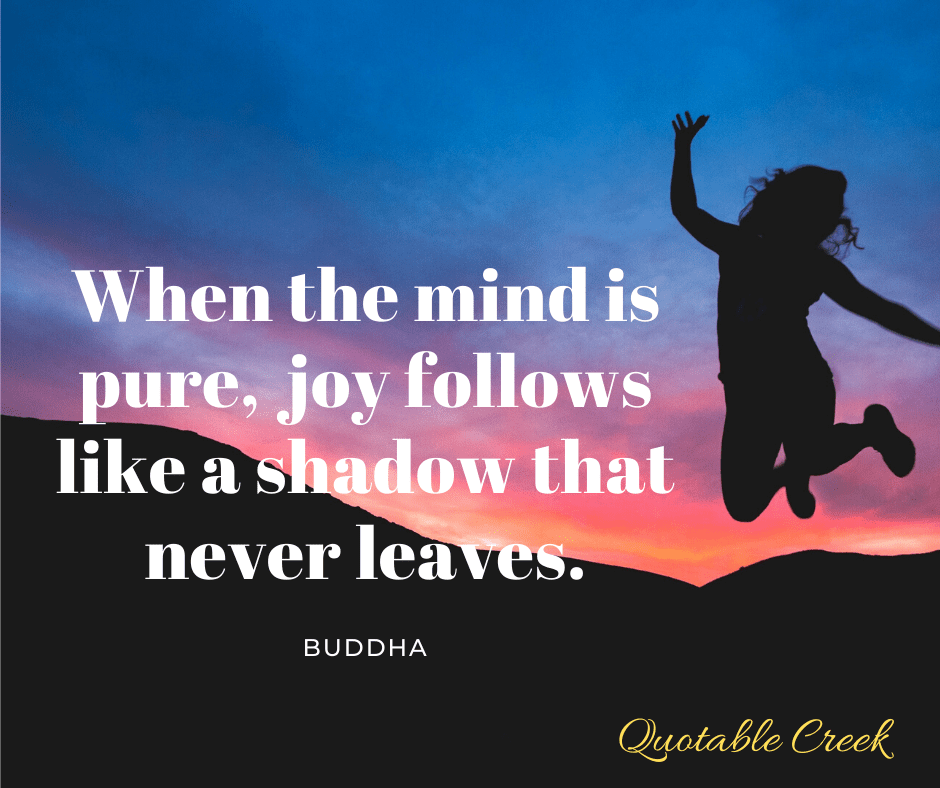
How wonderful it would be to count all joy– to recognize the gift in the difficulty, to see the growth in the hardship, to see joy as a reflection of sorrow. Grief, despair, hopelessness, loss can hit so hard, it may feel like we will never feel joy again. And yet joy follows us like a shadow if we can pause to be grateful.

Then a woman said, “Speak to us of Joy and Sorrow.” 

And he answered: 

Your joy is your sorrow unmasked. 

And the selfsame well from which your laughter rises was oftentimes filled with your tears. 

And how else can it be? 

The deeper that sorrow carves into your being, the more joy you can contain. 

Is not the cup that hold your wine the very cup that was burned in the potter’s oven? 

And is not the lute that soothes your spirit, the very wood that was hollowed with knives? 

When you are joyous, look deep into your heart and you shall find it is only that which has given you sorrow that is giving you joy. 

When you are sorrowful look again in your heart, and you shall see that in truth you are weeping for that which has been your delight. 

Some of you say, “Joy is greater than sorrow,” and others say, “Nay, sorrow is the greater.” 

But I say unto you, they are inseparable. 

Together they come, and when one sits alone with you at your board, remember that the other is asleep upon your bed. 

Verily you are suspended like scales between your sorrow and your joy. 

Only when you are empty are you at standstill and balanced. 

When the treasure-keeper lifts you to weigh his gold and his silver, needs must your joy or your sorrow rise or fall. Khalil Gibran, Joy and Sorrow, Chapter Viii

Adulting.

Toni Morrison had a gift for complexity and nuance in her writing. Multi-dimensional characters and lots of gray area rule the day in her work.

I found it interesting to hear this perspective from her:

I just think goodness is more interesting. Evil is constant. You can think of different ways to murder people, but you can do that at age five. But you have to be an adult to consciously, deliberately be good — and that’s complicated.

It’s an age-old question whether people are inherently good, whether altruism is learned or instinctive, whether selflessness develops naturally.

But there definitely is an intentionality to doing good, choosing kindness, forgiving, welcoming, holding your tongue. And as we grow older and cast off our childish ways, we learn the wisdom of restraint and forbearance.

And we learn the power of good because often we are on the receiving end of it and know how much it matters.

And then when it’s our turn, we want to pass it on.