Finding your spirit

There are many seasons in life. Fall, winter, spring, summer. Childhood, middle age, old age. Caterpillar, pupa, butterfly. And so on. One of my favorite ‘seasons’ is graduation season. I love liminal, threshold spaces, moving from one stage to another. But most of all, I love graduation speeches. What do you say to this group of young adults ready to embark on that magical mystery tour of life? What will resonate as both inspiring and yet true? What will help them in the time travel way an older version of ourselves might come back with a warning or suggestion?

One of my favorites this graduation season is from Anne Lamott to the 2023 graduation class of U.C. Berkeley. In her characteristic way of blending depth, humor, and warmth, she begins:

So I thought it might help if I just went ahead and told you what I think is the truth of your spiritual identity …

Actually, I don’t have a clue.

I do know you are not what you look like, or how much you weigh, or how you did in school, and whether you get to start a job next Monday or not. Spirit isn’t what you do, it’s … well, again, I don’t actually know. 

And thus she begins from this deep place of not knowing and urges the graduates to not confuse their spiritual lives with their lived lives, to find a way to plug into that which awakens them, and to keep the faith:

It’s magic to see spirit largely because it’s so rare. Mostly you see the masks and the holograms that the culture presents as real. You see how you’re doing in the world’s eyes, or your family’s, or — worst of all — yours, or in the eyes of people who are doing better than you — much better than you — or worse. But you are not your bank account, or your ambitiousness. You’re not the cold clay lump with a big belly you leave behind when you die. You’re not your collection of walking personality disorders. You are spirit, you are love, and you are free. You’re here to love, and be loved, freely. If you find out next week that you are terminally ill — and we’re all terminally ill on this bus — all that will matter is memories of beauty, that people loved you, and you loved them, and that you tried to help the poor and innocent.

So how do we feed and nourish our spirit, and the spirit of others?

First, find a path, and a little light to see by. Every single spiritual tradition says the same three things: 1) Live in the now, as often as you can, a breath here, a moment there. 2) You reap exactly what you sow. 3) You must take care of the poor, or you are so doomed that we can’t help you.

Her whole speech is well-worth a read, but if you want one thing to hold onto right now, remember this: “You are spirit, you are love, and you are free.”
The hidden details

Humans are complicated creatures. Sometimes we feel emotions and have no idea why. And perhaps that is for good reason because much of what affects us is hidden. Consider, for example, subliminal advertising. People would go to the movies and watch reels that had ‘Buy Popcorn’ hidden in a few frames, not enough to consciously notice, but enough so that people watching got the sudden urge for popcorn. Or perhaps you’ve been watching a show where the characters are sharing a cup of coffee and, suddenly, felt an urge for a cup of Joe. Model homes are designed and staged in such a way that you can easily imagine yourself living there and stepping into the life reflected in the art and photographs of that fictional happy family, if only you buy the house.

Or consider the influence of color. Pink has been associated with a calming effect and has been used in drunk tanks and visiting team locker rooms in an effort to sway human behavior. And it works so well that now the Western Athletic Conference has a rule that the lockers rooms can be painted any color, including pink, but both teams must have the same color.

It behooves us to pay attention to what we are paying attention to. Are our emotions being stirred up? Take a minute and consider why. Is someone trying to manipulate us in some way? It happens often in advertising and politics. Being aware of the ways we can be influenced, and opening our eyes to those manipulations, helps keep us in the driver’s seats of our own lives.

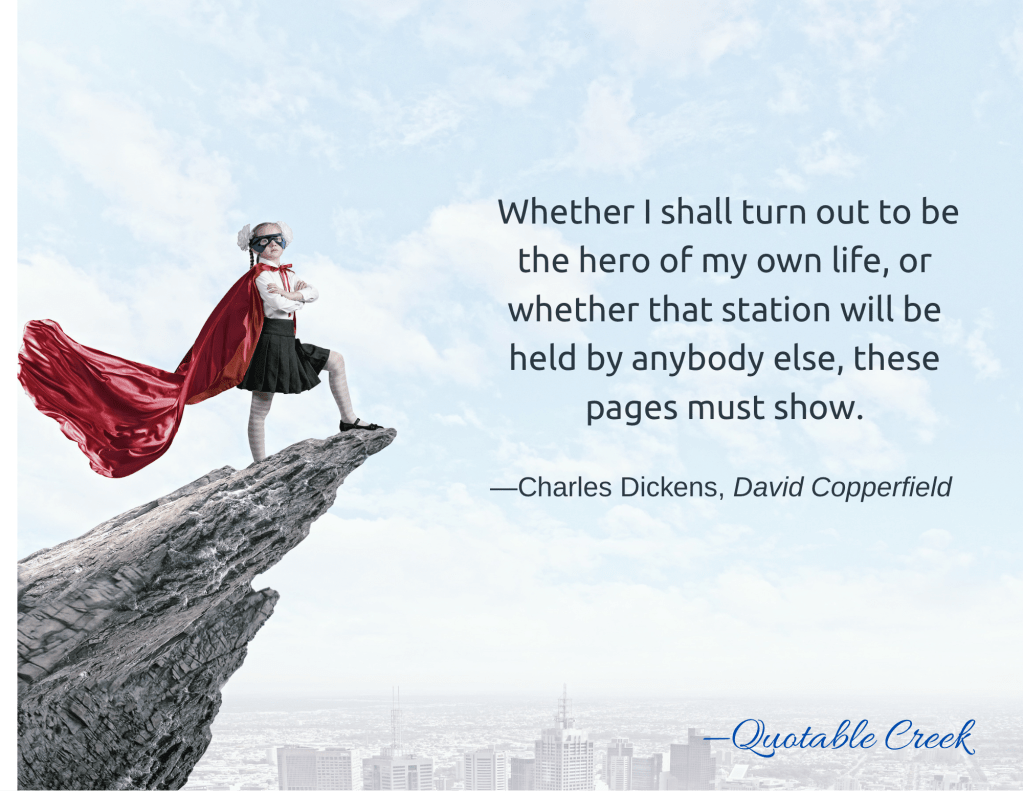
Being the Hero of Your Own Life

When we think about our own personal heroes, can we see a pattern? How did they rise to the challenges presented in their day?

How are we rising to the occasions and the challenges presented in our time? Right now. Are there injustices we can speak up against? Are there places where our voices will make a difference? What are the rights and wrongs happening right now today?

I am about one-fourth of the way through Charles Dickens’s, David Copperfield. It’s astonishingly good, as are most of his books. And, like others, it calls out some of the injustices of his day—child labor, poorhouses, domestic violence, emotional cruelty, sexism, bullying and so on. With his wide audience and engaging stories, he had tremendous power and is credited for being the impetus for many social justice reforms.

However, he had his own blind spots.

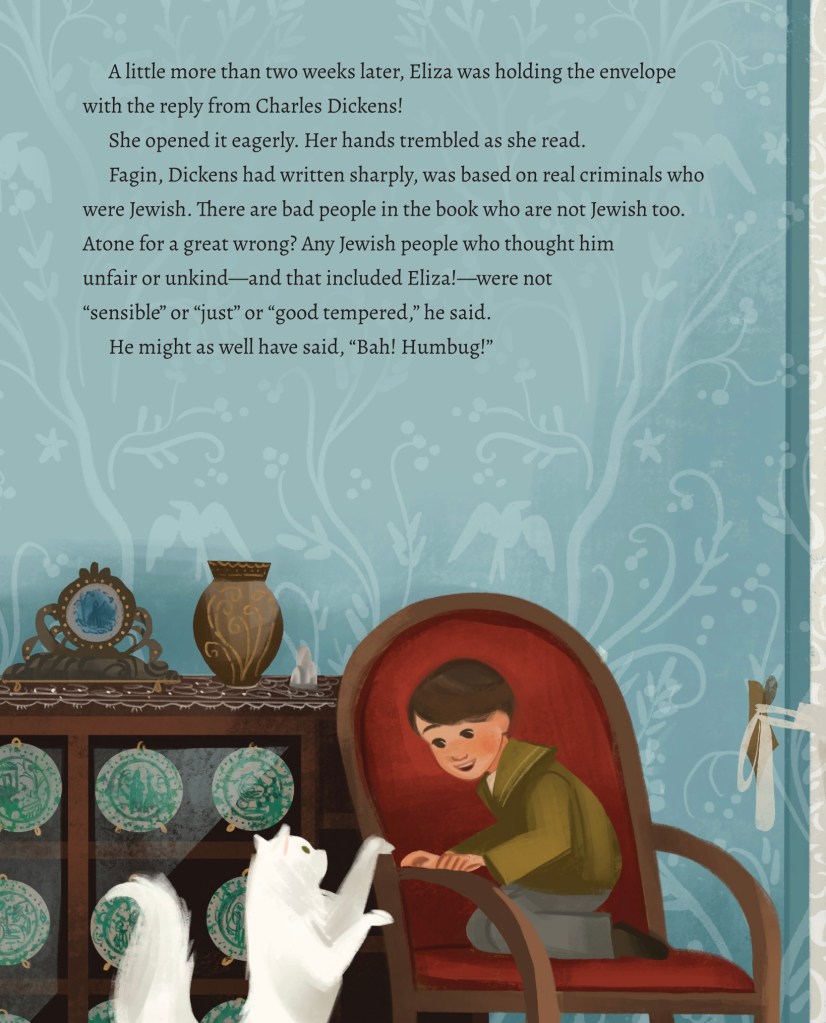
One reader, Eliza Davis, wrote to him, accusing him of portraying her people, those of Jewish ancestry, in stereotypical and negative ways. She cited Fagin, from Oliver Twist, a cruel and selfish man teaching young street urchins to steal. Eliza begged him to show more complexity in his Jewish characters.

Dickens was unimpressed.

Dear Mr. Dickens, By Nancy Churnin

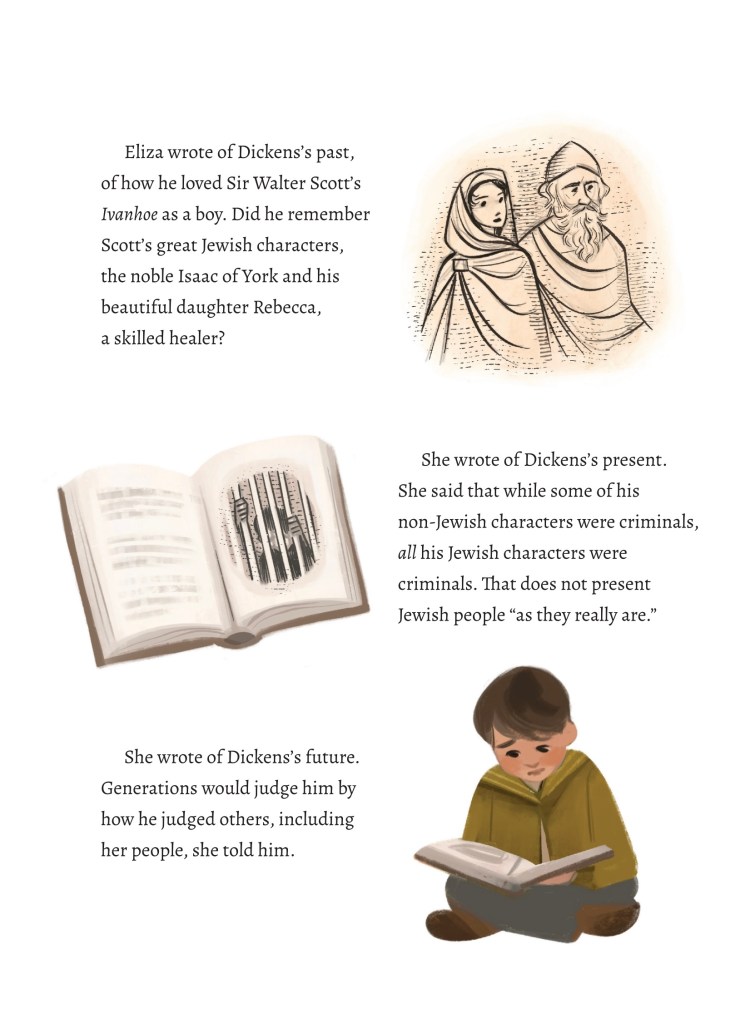
However, taking a page from Dickens’ own, Christmas Carol and the transformation of Ebenezer Scrooge, Eliza wrote him again:

Dear Mr. Dickens, by Nancy Churnin

And this time, Dickens was moved. And changed. From then on, his Jewish characters were complex and kind, and the exchange between Eliza and Dickens is credited for having a part in reducing anti-Semitic views and laws of the day.

Eliza had the same tools at hand as Dickens himself: pen, paper, and a keen sense of justice. While she lacked his fame, she made up for it by essentially teaming with him to bring about change.

What are the injustices of our day? It can be challenging to see them, sometimes, because we’ve been so steeped in things the way they are, that they seem normal. But if we pretend we are explaining our world to an alien, for instance, we might be hard-pressed to answer some of their questions. It is in those places, those places we know to be wrong, that we can strive to be the heroes of our own lives.

Word clutter

I’m not a fan of clutter. I’m also quite challenged to part with stuff. It’s a problem. Like some people avoid carbs or sugar, I avoid ‘collecting’ because I know, given my propensities, it will lead to clutter. But there are many things that are clutter-free that I love to collect. Among these are words. Words are just so delightful— the sound and smack of them, their history, their aptness for a particular purpose.

One of my favorite bits of writing advice is to collect words that might fit for the time and place of your story.

In The Writer’s Portable Mentor, Priscilla Long writes:

The writers of deep and beautiful works spend real time gathering words. They learn the names of weeds, and tools, and types of roof. They make lists of color words (ruby, scarlet, cranberry, brick). They savor not only the meanings, but also the musicality of words. They are hunting neither big words nor pompous words nor Latinate words but mainly words they like. They are not “improving their vocabulary” or studying for the SAT or the GRE. They are not trying to be fancy or decorative. This is a different kind of thing.

She suggests keeping a journal of these words and going on quests to capture more:

HANDS ON: MAKE YOUR OWN LEXICON
Buy a small bound and sewn blank book, with fine paper. This is your Lexicon.
Put in words you like, words that strike your fancy, words you want to own. I suggest giving each word half a page. Put in the word _ lickspittle – and draw a horizontal line dividing the page in half. This way you can put in a word and look it up later. (Under lickspittle write: a contemptible, fawning person; a flatterer or toady.) You will end up with two words per page.
This is not a typical vocabulary list full of horrible Latinate words you don’t know and don’t want to know.
The rule is, put in only the good words, the juicy words, the hot words. From time to time, savor this book. Look up words you’ve put in (something from your reading) and haven’t looked up yet. Be sure to investigate the root. Put in familiar words along with new words. Play with sounds right in your Lexicon: kitchen matches; cord/weird/word/ fired/turd.
From time to time read a big dictionary hunting for a new good word, any word that strikes your fancy: galoot.
On some pages make word lists. Fiddle parts – peg box, button, side rib, bridge. Words for blue – cobalt, woad, sapphire, smalt. Words from an art exhibition you especially loved – bone, tin plate; cotton, cord, silk ribbon, silver, galloon; coconuts, shells, ostrich eggs (from
Moscow Treasures).
Put down things you don’t know the names of. Do you know the parts of a window? (Muntin? Sash?) Do you know the parts of a rocking chair? Draw or describe the thing in your Lexicon and then set about looking (in a book on house repairs or on furniture) for splat or spindle or stile. Do not order your list in any way.

She goes on to discuss making a word trap to fit the piece you are working on, the musicality and derivation of words, the vowel scale, and all sorts of other intriguing ways to add nuance, accuracy, and lilt to your piece. Hers is one of my favorite craft books, of which I have dozens. (See above about my hoarding propensities.)

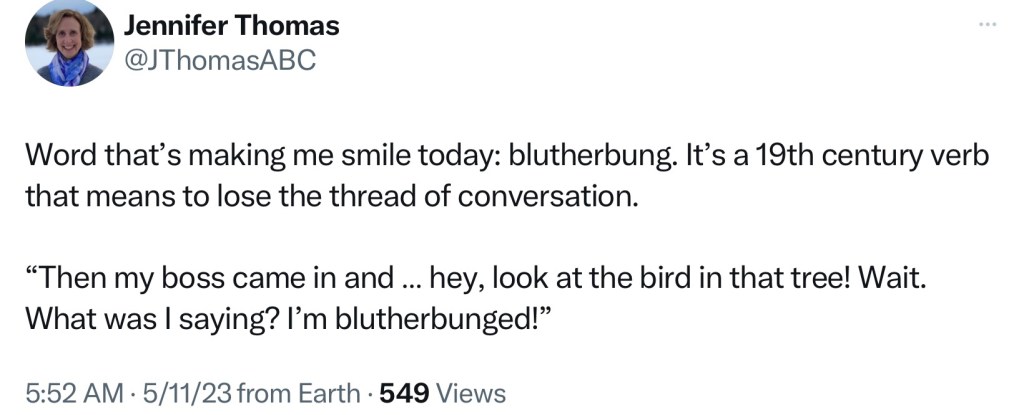
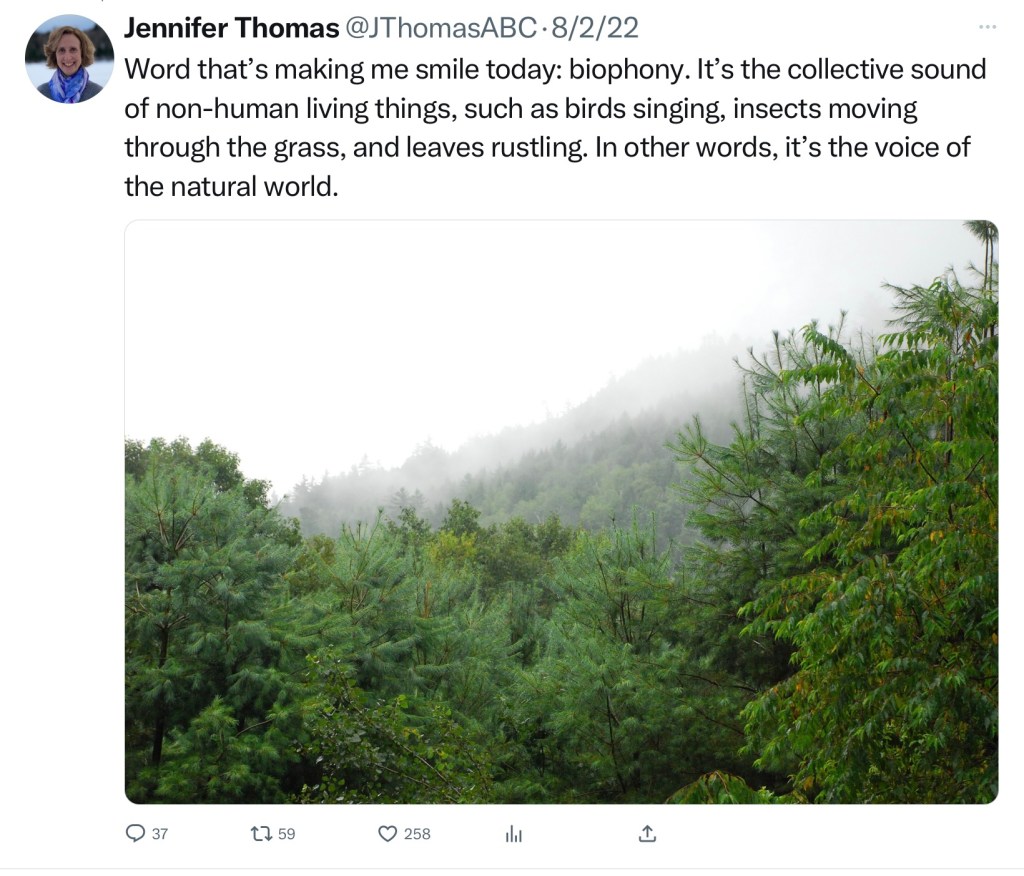
But this intro brings me to my joy for the day. I discovered someone on Twitter who shares this love of words, who posted a word for the day. It’s blutherbung, an appropriate word for me these days as it turns out.

And then I looked at her feed and found another

Lickspittle, blutherbung, biophony. Aren’t these just wonderful? who do you suppose thought these up, studying human nature or the natural world and coming up with just the word to describe that particular confluence of traits? And now I’ve subscribed to her feed to get these delightful tidbits each day.

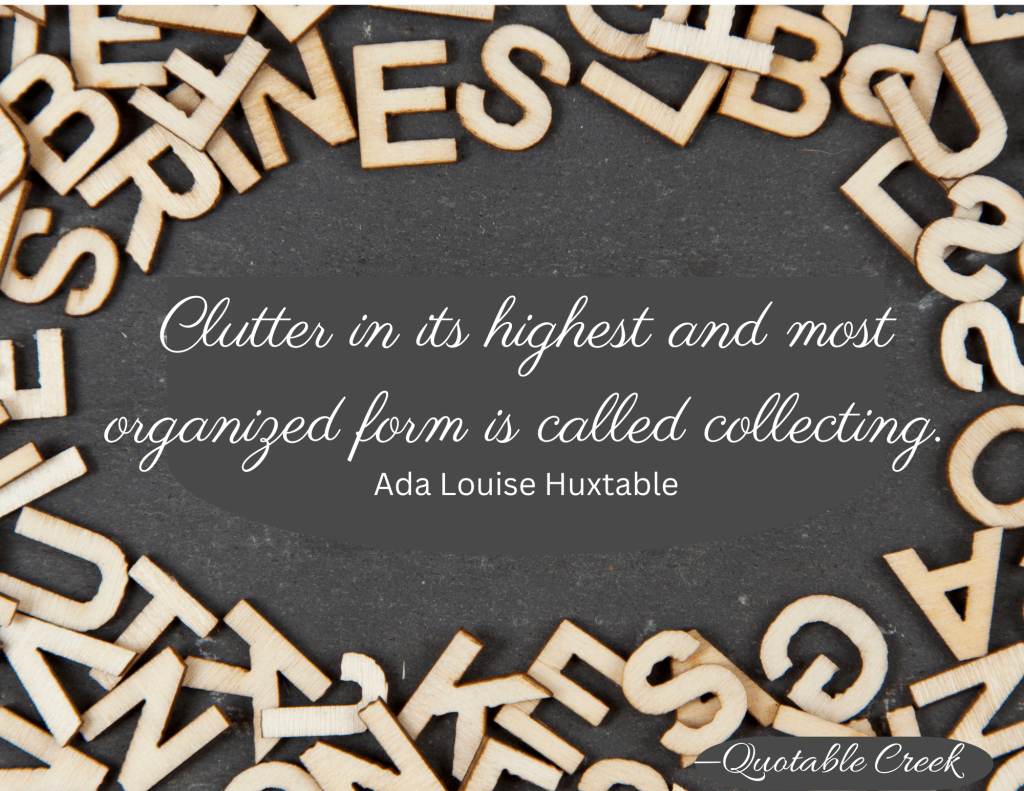
As you can probably guess, another thing I collect is quotations. I have a little book to jot them as I’m reading an article or book. I periodically look through this little book and write my thoughts about them. Which is what brought me here to writing Quotable Creek.

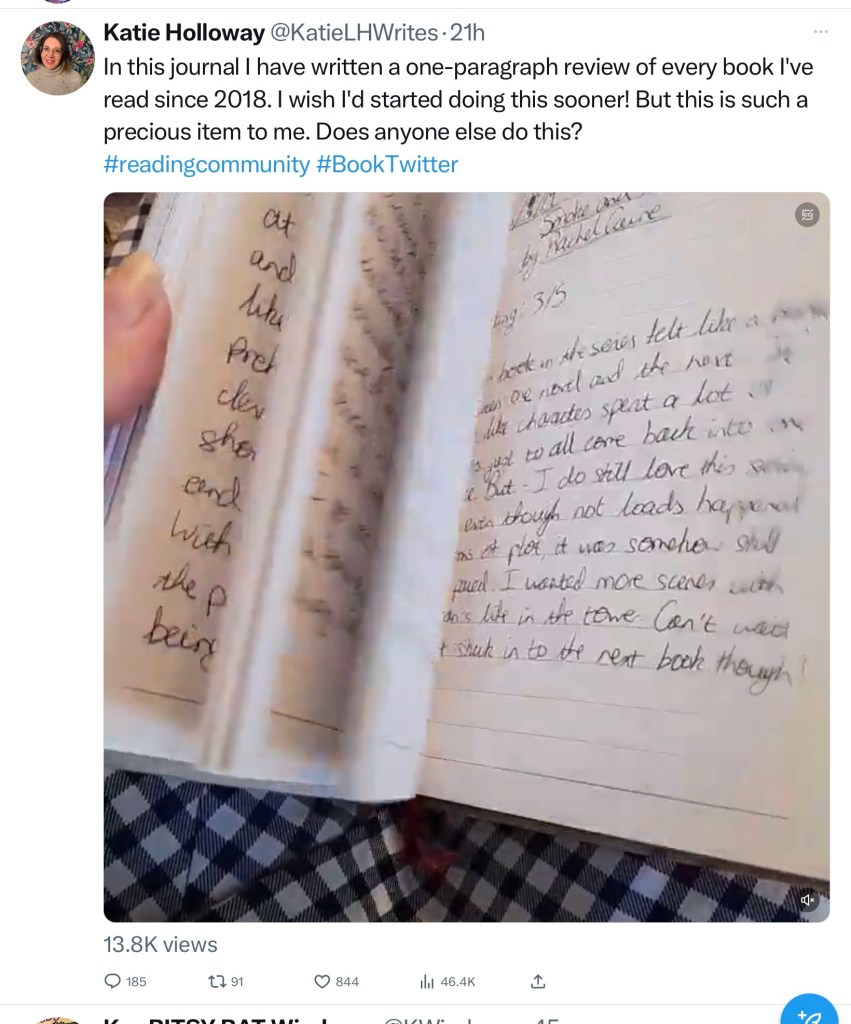
Another thing I ‘collect’ is gratitudes. I write the things I’m thankful for in a gratitude journal, to keep them and remember those moments. My next thing I’m thinking of to collect is book impressions. I read quite a bit, but get blutherbunged and forget about them. Perhaps keeping a little thought about each will bring them back to me. It’s another thing I found on Twitter. Probably when I was reading from the word lady’s thread.

Facing fear

Standing up to fear changes a person. It helps you to put matters in perspective. Where once fear loomed over you, insurmountable, now you can honor the courage it took to move past it into unfamiliar territory.

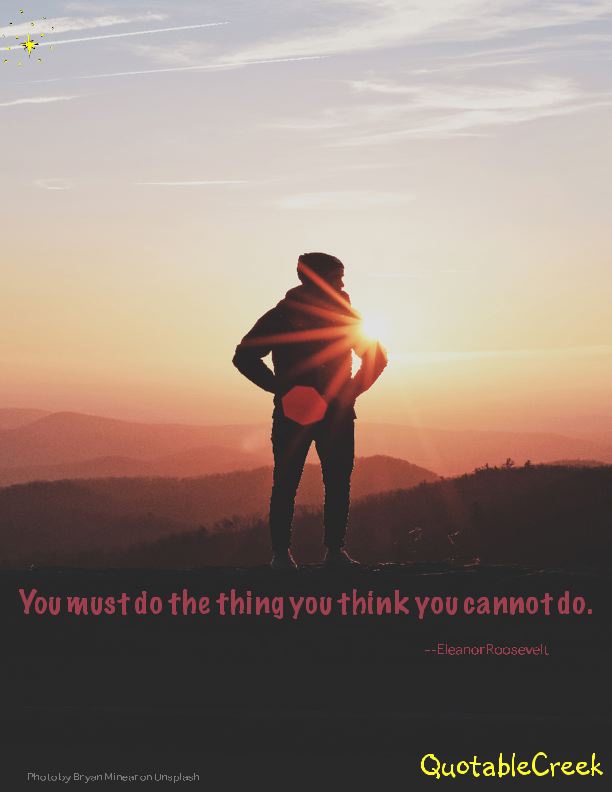
Eleanor Roosevelt was a courageous woman. Despite her husband’s attempts to placate the South, she regularly bucked segregation and was a vocal proponent of civil rights. She was able to call out racism and force others to see it for what it was:

By 1939, ER decided to attack the hypocritical way in which the nation dealt with racial injustice. She wanted her fellow citizens to understand how their guilt in “writing and speaking about democracy and the American way without consideration of the imperfections within our system with regard to its treatment . . . of the Negro” encouraged racism. Americans, she told Ralph Bunche in an interview for Gunnar Myrdal’s American Dilemma, wanted to talk “only about the good features of American life and to hide our problems like skeletons in the closet.” Such withdrawal only fueled violent responses; Americans must therefore recognize “the real intensity of feeling” and “the amount of intimidation and terrorization” racism promotes and act against such “ridiculous” behavior.

You can’t clearly see a problem before you if you are too scared to look at it and call it out for what it is. Where are the injustices in your immediate orbit? Are there people being treated unfairly? How can you add your voice to help identify the problem and move toward healing? These problems are right here, close to home.

As Eleanor Roosevelt said:

Where after do human rights begin? In small places, close to home– so close and so small that they cannot be seen on any map of the world. Yet they are the world of the individual person: The neighborhood he lives in; the school or college he attends; the factory, farm or office where he works. Such are the places where every man, woman, and child seeks equal justice, equal opportunity, equal dignity without discrimination. Unless these rights have meaning there, they have little meaning anywhere. Without concerted citizen action to uphold them close to home, we shall look in vain for progress in the larger world.

-“Remarks at the United Nations,” March 27, 1958

https://erpapers.columbian.gwu.edu/quotations-eleanor-roosevelt

Fear is a crippler. It keeps you rooted in a course of action you know to be wrong. Focusing on the fear helps it to loom even larger before you. Instead, focus on the better world you are trying to help build. Spreading love and justice is exciting and uplifting. Being part of something bigger than yourself, working for a common goal, in an effort to improve people’s circumstance is rewarding.

You don’t have to see the whole path in front of you. Take, and keep taking, that next step forward.

God winks

Often, when we look back at our lives, we will see strange coincidences that came at meaningful times in our life. That person you met, show you watched, book you read, something you overheard that serendipitously was just what you needed in that moment. My pastor calls these God winks. It feels like someone is watching over you and caring.

Of course, these could be just coincidental. But they are important, pivotal, coincidences.

Emma Thompson puts it this way:

I think books are like people, in the sense that they’ll turn up in your life when you most need them. After my father died, the book that sort of saved my life was Gabriel García Márquez’s novel One Hundred Years of Solitude. Because of that experience, I firmly believe there are books whose greatness actually enables you to live, to do something. And sometimes, human beings need story and narrative more than they need nourishment and food.

Emma Thompson in @oprah’s O Magazine.

The most important thing is having the eyes to recognize the impact and the willingness to be open to change and growth.

God winks are everywhere if you develop the eyes to see them.

With friends beside you.

I recently read the book, Remarkable Bright Creatures by Shelby Van Pelt with my book club. It is a wonderful book of, among other things, the friendship between a 70-year old widow and a giant Pacific octopus. The main character has her own group of friends who have been together for decades and call themselves the Knit-wits because they started with knitting in common.

One of my book club members, the youngest (as she often reminds us) asked at our meeting, “Are we the knit-wits?” I smiled. I have known this group of friends for decades. We raised our children together and now are delighting in grand parenthood together. We’ve weathered storms together, celebrated each other’s victories, and helped each other through loss. We meet religiously every week to catch up with each other. What a delight it is to have ‘through thick and thin’ friends.

I found this sweet friendship poem I offer here to them.

A Friend

A person who will listen and not condemn
Someone on whom you can depend
They will not flee when bad times are here
Instead they will be there to lend an ear
They will think of ways to make you smile
So you can be happy for a while
When times are good and happy there after
They will be there to share the laughter
Do not forget your friends at all
For they pick you up when you fall
Do not expect to just take and hold
Give friendship back, it is pure gold.

Gillian Jones

I’m spring

As I age, I have a new appreciation for those poets like Dylan Thomas raging against mortality. I do not want to go gentle into that good night. I like it here.

Here is a new variation on that theme I enjoyed:

Sorrow Is Not My Name
BY ROSS GAY

—after Gwendolyn Brooks

No matter the pull toward brink. No
matter the florid, deep sleep awaits.
There is a time for everything. Look,
just this morning a vulture
nodded his red, grizzled head at me,
and I looked at him, admiring
the sickle of his beak.
Then the wind kicked up, and,
after arranging that good suit of feathers
he up and took off.
Just like that. And to boot,
there are, on this planet alone, something like two million naturally occurring sweet things,
some with names so generous as to kick
the steel from my knees: agave, persimmon,
stick ball, the purple okra I bought for two bucks
at the market. Think of that. The long night,
the skeleton in the mirror, the man behind me
on the bus taking notes, yeah, yeah.
But look; my niece is running through a field
calling my name. My neighbor sings like an angel
and at the end of my block is a basketball court.
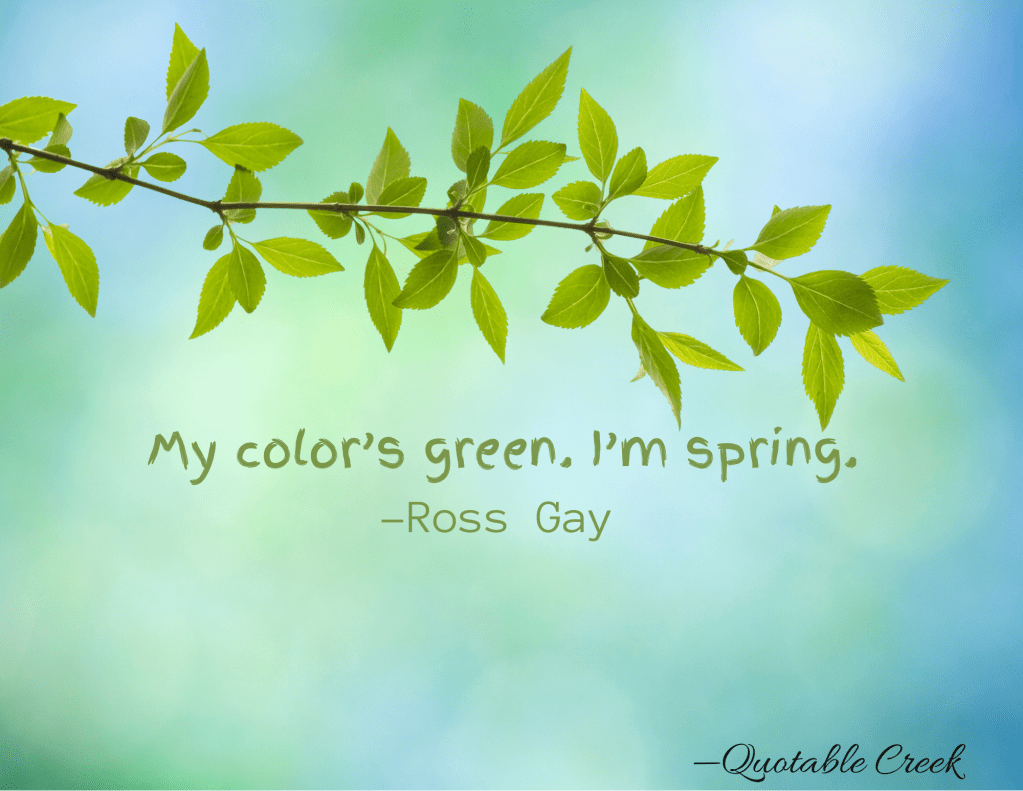
I remember. My color’s green. I’m spring.

Compassion for animals.

Apparently, today is World Penguin Day which reminded me of this delightful story about penguin JinJing and the man who saved his life. Each year, this little penguin swims 5000 miles to be with his friend.

So much is beyond our understanding including heart-warming stories like this about the bonds between a wild animal and a human who showed them kindness.

Enjoy this video.

It’s the details.

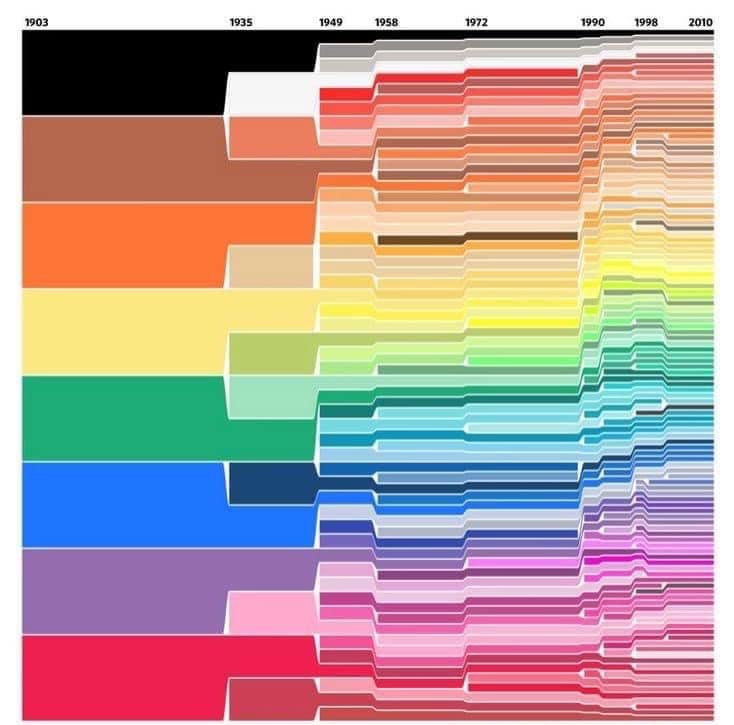
Sometimes things can be startling.

Look, for example, at the evolution of the color choices in the crayon:

Or in ice cream:

We are definitely not living in a plain vanilla, white bobby socks, only primary color world. We are living in a vibrant, color-and-detail everywhere world. Some days it feels wondrous to just soak it all in and enjoy the variety.

Mary Oliver says it best.

Instructions for Living a Life

Pay attention.

Be astonished.

Tell about it.