Yes, even me.

gies

Miep Gies was a young office worker when she hid and supported Anne Frank and her family, protecting them from Nazis and the danger of being sent to a concentration camp. After Anne and her family were betrayed and captured, Miep collected Anne’s diaries and eventually returned them to Anne’s father, Otto, who survived the war. That diary has been read by millions of people now, inspiring acts of heroism and showing, in a very intimate way, the horror of WWII as viewed through the eyes of an innocent, complex, lovely, vibrant girl, Anne.

Miep wasn’t famous or rich or particularly accomplished, yet she managed through her actions to shine a very bright light on hate and replace it with a more powerful portrait of love. Anne, too, wasn’t famous or rich or accomplished, although we can see now how she was a gifted author, but her words have been inspiring and a powerful force against evil in the world.

No matter our position or age or wealth or gender, we each can make a contribution that makes the world more bright.

What is the light you can turn on in a dark room?
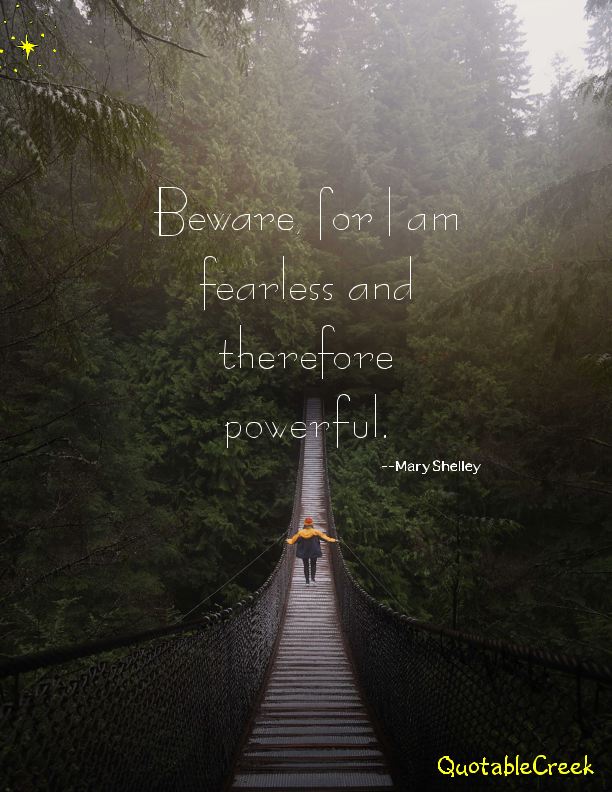
 

Face the fear.

fearbridge

The monster’s threat in Frankenstein by Mary Shelley is chilling: “Beware, for I am fearless and therefore powerful.” What might the monster do to exact revenge if he is truly fearless? Yikes.

But the statement taken out of context can also apply to non-monsters, people hoping to do good but paralyzed by fear to reach out. Fear gets in our way, and sometimes that’s a good thing. Fear can keep us safe from danger– falling, catching diseases, getting broken bones. But fear can also keep us from speaking out against injustice, reaching out to help a neighbor, defending a bully victim, or any one of an endless list of situations where our fighting that fear will result in a greater good. These situations stir us to act and to lay the fear aside because deep down we know the right thing to do, and we know that we are the one who needs to do it.

We are far more powerful than we know.

Reach out to others.

perfection

What are we here for anyway? What’s the point? Some people joke, ‘Life is hard, and then you die’, and there’s some truth to that. We are finite. We struggle. But there is purpose to life, and it lies in what we do for others. Andre Agassi says,

“Remember this. Hold on to this. This is the only perfection there is, the perfection of helping others. This is the only thing we can do that has any lasting value or meaning. This is why we’re here.”

Others joke ‘The one who dies with the most toys wins,’ but those things we do purely for ourselves are vanity. Instead, when we use our gifs and talents to reach out and help others, we’ve upped the good in the world. We’ve made a difference.

Choose kindness.

kindgesture

So much of our suffering is invisible. Loneliness, sorrow, depression, not fitting in. We can bind up our own cuts and scrapes, but how do we bind up those kind of wounds?

There is an old parable about heaven and hell. In both, people are forced to eat with spoons that are too long to feed themselves. In hell, they are starving. In heaven, they feed each other.

When it comes to these invisible hurts, we are healed by kindness, one to another. We don’t know when we are being kind that it may help someone, but it certainly can’t hurt. And it may be just the long-spooned nourishment that someone else needs.

To inspire acts of kindness today, watch this video of a poor baby elephant stuck in a muddy hole. The gratitude its mother shows its rescuers will melt your heart.


Persist.

persist

Sometimes progress is subtle and slow, born of persistence and endurance. Not everything needs to be solved now, today. But we must persist. We must set our goals and work toward them, cognizant that we may stumble and backtrack along the way.

Yet we push on.

For a lovely example of persistence, consider the story of  Jadev Payeng, a simple man who set out to plant trees in a barren stretch of wasteland where no one believed anything would grow. That was in the 1970s. Now that barren wasteland is a forest home to rhinos, elephants, tigers and more. One man, one mission, plus persistence, and now there is a sanctuary for many wild animals bigger than New York’s Central Park.

For a short video of Payeng story, go here. For a deeper dive, watch National Geographic’s look at this remarkable story.

SaveSaveSaveSave

Same kind of different

magnolias

Wouldn’t it be lovely to see with the eyes of a child again? What would we see? How would we see the people around us, the awe of nature, the challenge in a difficulty?

In this not-to-miss video, children are asked to describe how they are alike and different. The video has powerful reverberations for us all.

Never underestimate the power of a ripple.

shakeworld

Have you ever noticed that someone’s words were exactly what you needed to hear at that moment? Perhaps even life-changing. When you are on the receiving end of such words, you have no doubt how important they are.  Those words gave you hope, or let you see another side, or soothed your anger, or gave you purpose.

But sometimes, on the giving end of such words, we forget how important they can be. We forget to tell people how much we like them or how grateful we are for them or how we are in their corner. We rationalize–they’re just words. Who cares? It’s not life-changing.

But, in fact, as those of us who have heard such words at just the right time can attest, those words can indeed be life-changing. When they start a ripple of positivity that doesn’t begin or end with you, those words can set in motion other words and those new words just may reach someone at the right time to provide comfort or solace.

Keep shaking the world. Put kindness out there; the ripples will spread endlessly.

Credit or success?

row

It is a joy to be part of a team—that synergistic thrill of brainstorming, the shared burdens and responsibilities, the excitement of seeing a project take shape. But who among us doesn’t remember a group project from grade school, perhaps, when we did more of the work while our teammates loafed? “The unfairness!” we shrieked. And, of course, once we shrieked, our partners shrieked as well. Couldn’t anyone appreciate what they were doing? And back and forth until the team spirit was gone, and everyone was just grumpy, burdened, or offended.

But if we can manage to not inject a focus on our own contributions and, instead, keep the focus on the work, isn’t it a joy to be part of a team? We have so many teams we are a part of–our families, our towns, our work, our countries, our world. Isn’t it lovely to see cooperative projects take shape? Isn’t it amazing to know that we can make a unique contribution?

The eye doesn’t complain to the foot that it isn’t doing a good enough job seeing. The back doesn’t tell the nose that it is not carrying its weight. Instead they work together, each contributing to the health and success of the body. How can we make a contribution to help get things done for good today?

SaveSave

Justice for all?

sisters

Today, in the United States, we honor our veterans and thank them for their service defending this country and its principles of equality, freedom, and justice for all. Our understanding of those concepts has evolved over time, and taken some steps back, but today let us be grateful for how far we’ve come and consider the steps that we each might take today and every day to make this country move closer to the ideals for which it stands.

Snow monkey or penguin?

sharing

The Japanese Macaques, snow monkeys, are a deeply hierarchical society, their status in the group inherited from their mothers. Living in frigid temperatures, the upper class snow monkeys spend their time in natural hot springs, leaving the rest to huddle in the snow and look on as they luxuriate. The Emperor Penguins also live in frigid conditions, huddled together, but they constantly rotate, letting those most exposed on the outside come to the center for warmth. They take turns. It keeps those in the center from overheating and those on the fringes from freezing.

Sharing is an interesting phenomenon. It’s easy to see that when a society shares its resources, the whole group benefits, but how does that play out in the human species? Do we see the benefit to the whole group from sharing what we have, or do we focus on clutching more and more into our own fists? Some humans are uniquely able, it seems, to rationalize selfish behavior even when looking directly at the needs of others. But others consider their own resources an opportunity to help others. This is true both on an individual level, and on a larger societal level. It’s an interesting matter of perspective.

Some snow monkeys, some penguins. Which are you?