It’s okay to be heartbroken for more than one group of people at the same time. When it comes to showing compassion, we don’t have to pick sides. Sometimes, often really, maybe even always, there is hurt and anguish everywhere, and we can mourn the lot of it.
Beware people who tell you not to be concerned for this group or that group and the hurt they feel.
Beware those who try to dehumanize others.
Beware those who lump you in as the ‘enemy’ for working to assure people are treated humanely.
Beware people who draw lines between us and them.
Beware those who try to limit you to a label or single identity.
Our hearts are big enough to embrace it all. What we must save is love.
How do we read the news and not get overwhelmed or angry, disconnected or depressed? How do we keep showing up with compassion and grace in a world where there is so much hate? How do we keep ourselves on the right path through the midst of it all? How do we continue to show up from a place of compassion, forgiveness, and grace? how do we keep our hearts from growing hard?
In this thoughtful letter, Rabbi Yael Levy shares his insights on how to pray with the news:
The 17th of the Hebrew month Tammuz initiates a three-week period of mourning that leads to Tisha b’Av, which is the day that marks the destruction of the Temples in Jerusalem in 586 BCE and 70 CE.
Tradition teaches that the Temple was destroyed because hatred became the operating principle in the community. The scorn, contempt and disdain that characterized daily interactions caused the Divine Presence to flee and leave the Temple vulnerable to attack.
These next three weeks ask us to reflect on the hatred that we allow to take root in our hearts. The wisdom of the tradition acknowledges that hatred can sometimes feel energizing and “so right,” but allowing it to fill our bodies and guide our actions leads to destruction.
Many years ago I was taught the practice of praying with the news. I have shared it over the years and always find myself returning to it during this season.
In this practice, each time we read or listen to a news report that enrages us, we turn our attention to those harmed by what is happening and pray for their healing and well-being. Doing so encourages us to acknowledge feelings of anger, grief and despair, and at the same time it turns our attention toward connection and compassion. Praying with the news can help us learn to bear witness to devastation and mayhem, while keeping our hearts soft, our minds calm, and our actions clear.
I am struggling mightily with this practice these days in the wake of continued violence and oppression in this country and throughout the world. Hatred can sometimes feel like such a welcome harbor. Not only does it feel so right, it can also act as a shield, creating the illusion that I don’t have to acknowledge the grief and heartbreak I am experiencing.
I need practices to help quiet the rage and fear, to loosen the constriction of hatred and to help me be with overwhelming grief. I need practices to help me return to compassion, love, joy and possibility. I find praying with the news both painful and helpful. It keeps me connected, allows sorrow, and grounds me in care and love.
Are you good at receiving? Giving often comes naturally, but receiving can be challenging. The mom who wears the pasta necklace and hangs the cotton puff ornament on the tree is sending a powerful message that her child matters, that she loves their thoughtfulness, and that she is honored and grateful to receive their gifts.
The host who immediately opens a guest’s gift of wine and serves it is saying that they value their guests’ choices and are welcoming their contributions to the synergistic experience that is a social gathering.
Henri Nouwen offers this powerful insight:
When someone gives us a watch but we never wear it, that watch is not really received. When someone offers us an idea but we do not respond to it, that idea is not truly received. When someone introduces us to a friend but we ignore him or her, that friend does not feel well received.
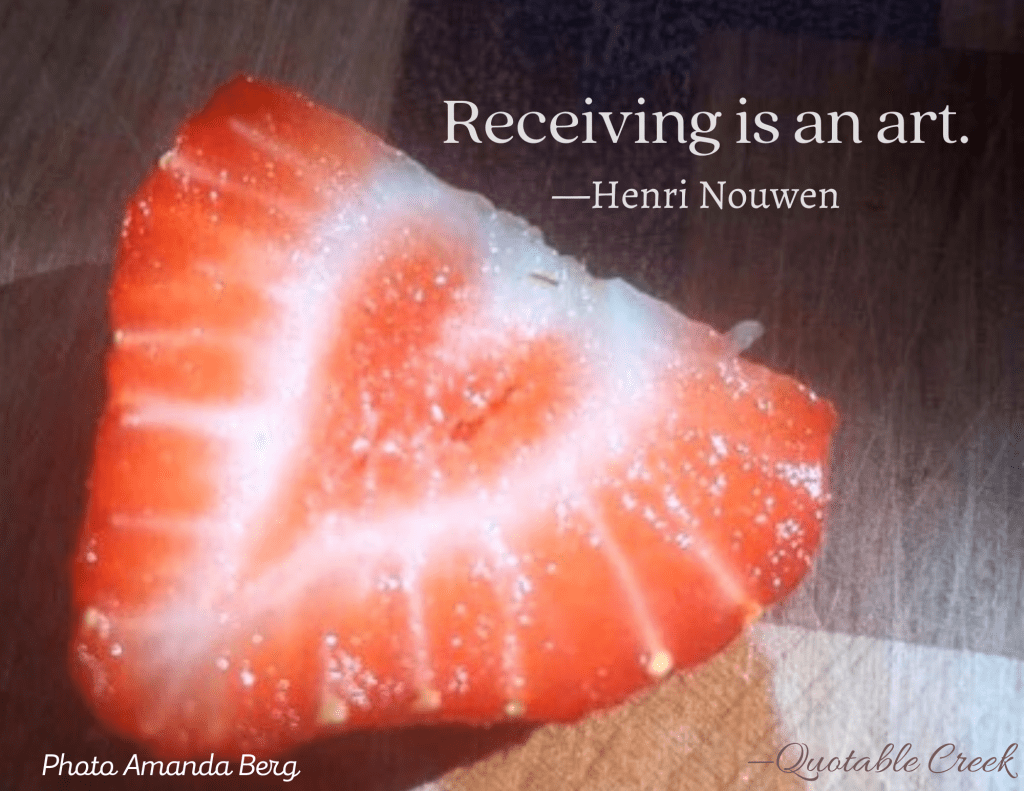
Receiving is an art. It means allowing the other to become part of our lives. It means daring to become dependent on the other. It asks for the inner freedom to say, “Without you I wouldn’t be who I am.” Receiving with the heart is, therefore, a gesture of humility and love. So many people have been deeply hurt because their gifts were not well received. Let us be good receivers.
Henri Nouwen, Bread for the Journey
These words cause us to pause and consider. Are we good receivers? Do we value those gifts and those givers in a way that causes us to open up and expand our walls, and even, perhaps, our sense of self? Can we give up our need to be in control and let our defenses down enough that others around us can share in the very creation of our lives?
When we were kids, we didn’t worry too much about whether we were the best at coloring or pretend or sports. We did things because they were fun and filled us with joy. Later, somehow, we became worried about whether we should continue when we were never going to be competitive in it. We worried about how we looked, whether we would be mocked. Perhaps our parents decided lessons were a waste because we weren’t the stand out they had hoped we would be. The fun of it got lost and gave way to the competition in it.
That’s a shame. Author Kurt Vonnegut had an epiphany about this that changed his life:
When I was 15, I spent a month working on an archeological dig. I was talking to one of the archeologists one day during our lunch break and he asked those kinds of ‘getting to know you’ questions you ask young people: Do you play sports? What’s your favorite subject? And I told him, no I don’t play any sports. I do theater, I’m in choir, I play the violin and piano, I used to take art classes.
“And he went wow. That’s amazing! And I said, ‘Oh no, but I’m not any good at any of them.’
“And he said something then that I will never forget and which absolutely blew my mind because no one had ever said anything like it to me before: ‘I don’t think being good at things is the point of doing them. I think you’ve got all these wonderful experiences with different skills, and that all teaches you things and makes you an interesting person, no matter how well you do them.’
“And that honestly changed my life. Because I went from a failure, someone who hadn’t been talented enough at anything to excel, to someone who did things because I enjoyed them. I had been raised in such an achievement-oriented environment, so inundated with the myth of Talent, that I thought it was only worth doing things if you could ‘win’ at them.
That’s such a liberating mind shift. Doing things for the joy of them! Not the achievement in them. Not the value to your college application. Not the resume value or the competition.
“I’m sorry, but…” Some apologies make things better, and some just don’t. In fact, they might make things worse by blaming the person you hurt or showing that there is just no true awareness of what went wrong.
Generally, the apologies that have an excuse fall in the latter category. A good apology makes you feel seen and heard, that someone has looked at things from your point of view and understood the negative impact they have made. A good apology requires us to stand in the shoes of the person we’ve wronged and feel what they are feeling. Not what we would feel if we were in their shoes, but what they’re feeling.
Then, when we feel the harm we’ve caused, it should change us, make us not want to cause that harm again to that person or others, and make us want to make amends. It shouldn’t leave us where we were. If it does, if we repeat the same hurtful words or behavior, perhaps we haven’t yet done the work that goes into reconciliation.
Back into the other person’s shoes we go until we understand and grow. This is how progress is made, how relationships heal and grow stronger, how trust is restored. And, because we humans are very fallible creatures, it’s not a one and done thing, but a continuing process. Evaluating the effect we are having on people, making sure we are treading softly, taking responsibility and making amends when we don’t. Perhaps two steps forward, one step back, but staying in relationship, rebuilding trust, and moving forward together.
When we are being welcoming, the focus is outward not inward. We look to what would make the other person comfortable, not what would make us comfortable. We don’t invite vegetarians, and then serve meat. Or teetotalers and serve alcohol. We get out of our own perspective and walk in the guest’s shoes to consider what would make them comfortable.
Aesop illustrated this premise with the Tale of the Fox and the Stork:
A fox invites a stork to eat with him and provides soup in a bowl, which the fox can lap up easily; however, the stork cannot drink it with its beak. The stork then invites the fox to a meal, which is served in a narrow-necked vessel. It is easy for the stork to access but impossible for the fox. The moral drawn is that the trickster must expect trickery in return and that the golden rule of conduct is for one to do to others what one would wish for oneself.
The same is true, presumably, when welcoming people to the Lord’s table. What would make others comfortable? How can you reach more people? What about the way you do things might be off putting? How can you step out of your own perspective to consider what would make others in the community feel welcomed and comfortable? Our job isn’t to be a bar to spreading the word but a conduit.
Desmond Tutu talks about the importance of a broad welcome:
We are made for goodness. We are made for love. We are made for friendliness. We are made for togetherness. We are made for all of the beautiful things that you and I know. We are made to tell the world that there are no outsiders. All are welcome: black, white, red, yellow, rich, poor, educated, not educated, male, female, gay, straight, all, all, all. We all belong to this family, this human family, God’s family.
Not every problem can be solved. Not every complaint wants a ‘solution’. Sometimes the heart just craves company, someone to walk beside in trying times.
As Henri Nouwen says,
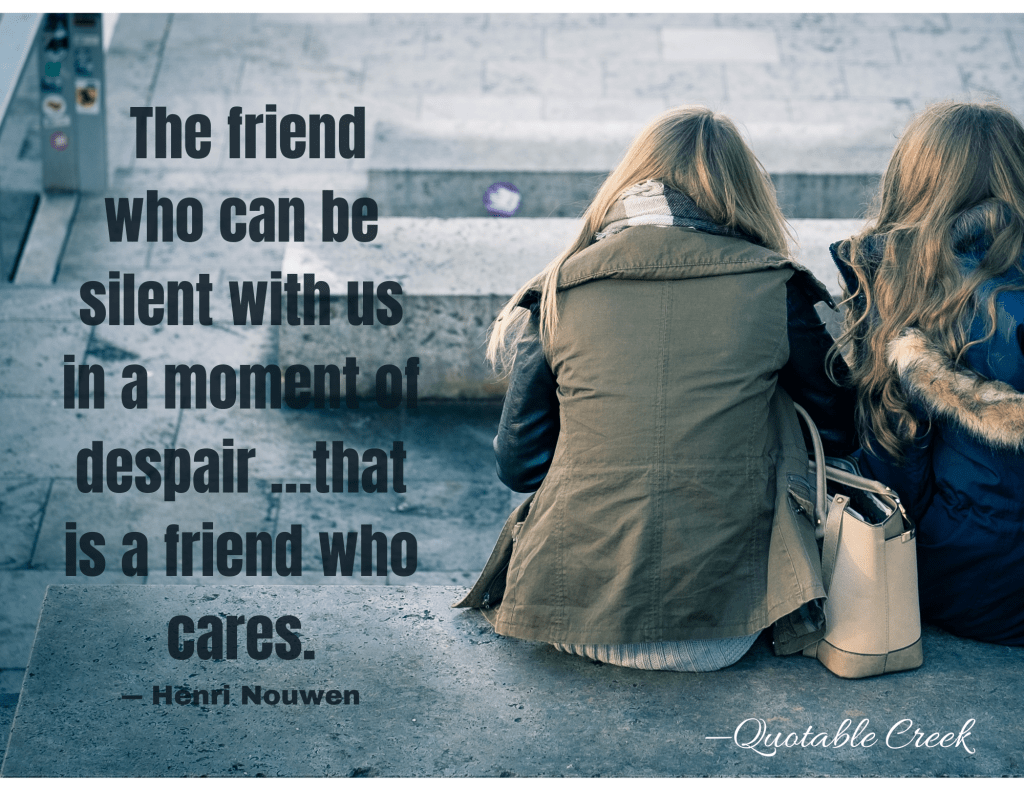
When we honestly ask ourselves which person in our lives means the most to us, we often find that it is those who, instead of giving advice, solutions, or cures, have chosen rather to share our pain and touch our wounds with a warm and tender hand. The friend who can be silent with us in a moment of despair or confusion, who can stay with us in an hour of grief and bereavement, who can tolerate not knowing, not curing, not healing and face with us the reality of our powerlessness, that is a friend who cares.”
― Henri Nouwen, Out of Solitude: Three Meditations on the Christian Life
Sometimes I feel everything in life comes down to the question, ‘Who is my neighbor?’
We are always asking, ‘This one, too?’ And the answer is always, ‘Yes’.
The felon, the refugee, the homeless person, the enemy, the one who hurt you, the one you disagree with, the one who makes your life hard? Yes, always yes.
I recently read the book, Remarkable Bright Creatures by Shelby Van Pelt with my book club. It is a wonderful book of, among other things, the friendship between a 70-year old widow and a giant Pacific octopus. The main character has her own group of friends who have been together for decades and call themselves the Knit-wits because they started with knitting in common.
One of my book club members, the youngest (as she often reminds us) asked at our meeting, “Are we the knit-wits?” I smiled. I have known this group of friends for decades. We raised our children together and now are delighting in grand parenthood together. We’ve weathered storms together, celebrated each other’s victories, and helped each other through loss. We meet religiously every week to catch up with each other. What a delight it is to have ‘through thick and thin’ friends.
I found this sweet friendship poem I offer here to them.
A Friend
A person who will listen and not condemn Someone on whom you can depend They will not flee when bad times are here Instead they will be there to lend an ear They will think of ways to make you smile So you can be happy for a while When times are good and happy there after They will be there to share the laughter Do not forget your friends at all For they pick you up when you fall Do not expect to just take and hold Give friendship back, it is pure gold.
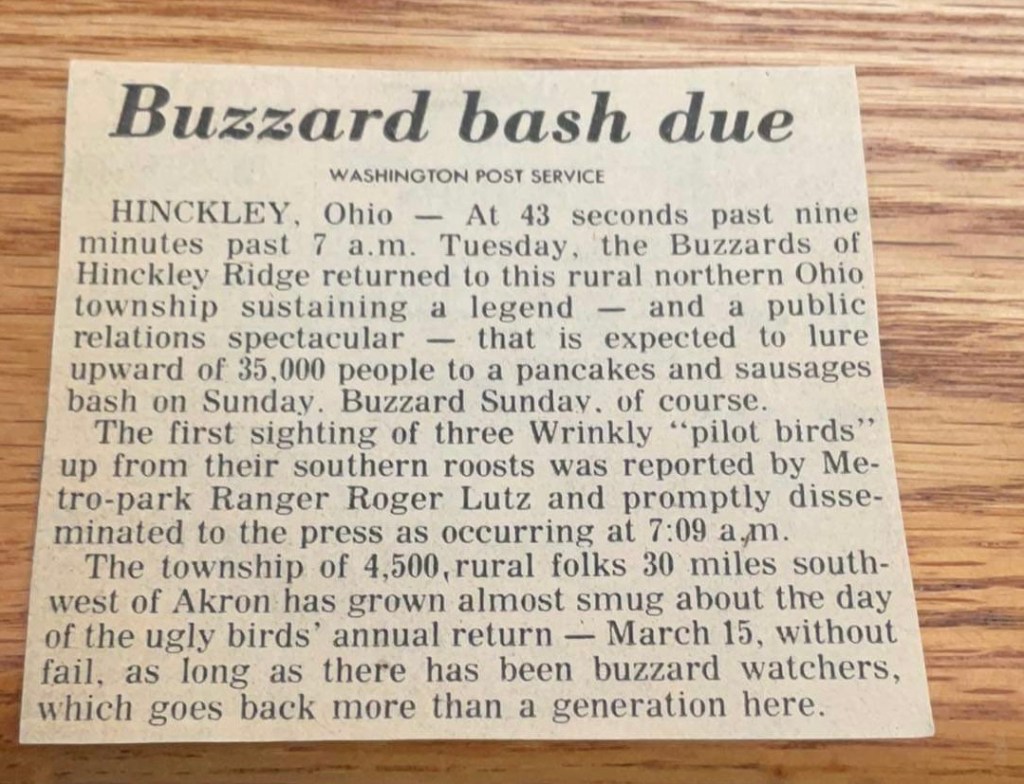
Recently, I pulled down an old scrapbook from my junior high days to show my granddaughter Lily who is just that same age now as I was then. It contained many ‘treasures’. Among the many letters and cards from my late grandmother was one talking about the buzzards coming back home to Hinckley, Ohio, a phenomenon which I remember amused me. Imagine celebrating buzzards!
She wrote:
It should cheer you somewhat to know that the buzzards returned to Hinckley, Ohio, on schedule on March 15th. It is always a comfort to know those gorgeous creatures ‘do their thing’ each year, as anticipated. It would be a bit discouraging to prepare pancakes and sausages for 35,000 eager folks, and have no buzzards to join in the celebration!
Oh, how I loved her, her humor and wit, her warmth and love, her writing style. I have always felt such a kinship with her and reading over her letters makes her feel so close.
Her letter got me thinking. First, about buzzards. Sure enough, a quick bit of googling shows that buzzards are still returning to Hinckley on schedule and have been celebrated since 1818!
And then about the cyclical quality of nature. The monarchs go south and then back. The swallows return to San Juan Capistrano. The elephant seals come back to Cambria. We humans who love animals mark their going and celebrate their homecoming, yes, even the buzzards, and note the steady passage of time.
And finally about how those we’ve lost stay with us even after they’ve gone. Lily has a freckle on her right hand which I’ve told her is her Nana freckle. I load it up with kisses often when I see her. When I’m gone, I hope that freckle will remind her of how very much I loved her. My grandmother and I were separated by thousands of miles, but our letters exchanged helped us stay close. Those letters remind me now to pause and share bits of life, simple moments, with the people I love. Those moments become the memories and precious treasure later.
Even the ones about buzzards.
(I couldn’t quite bring myself to make the lead picture with buzzards. Lol)








 QuotableCreek.com