Erring in the direction of kindness

What do we regret most as we contemplate the end of our time here? Maybe the lesson from that regret can inform our present. In an outstanding commencement speech, George Saunders reflects on his own failures and encourages the graduating students to look for opportunities to be kind. He reflects on a memory haunting him from his childhood:

In seventh grade, this new kid joined our class. In the interest of confidentiality, her Convocation Speech name will be “ELLEN.” ELLEN was small, shy. She wore these blue cat’s-eye glasses that, at the time, only old ladies wore. When nervous, which was pretty much always, she had a habit of taking a strand of hair into her mouth and chewing on it.

So she came to our school and our neighborhood, and was mostly ignored, occasionally teased (“Your hair taste good?” — that sort of thing). I could see this hurt her. I still remember the way she’d look after such an insult: eyes cast down, a little gut-kicked, as if, having just been reminded of her place in things, she was trying, as much as possible, to disappear. After awhile she’d drift away, hair-strand still in her mouth. At home, I imagined, after school, her mother would say, you know: “How was your day, sweetie?” and she’d say, “Oh, fine.” And her mother would say, “Making any friends?” and she’d go, “Sure, lots.”

Sometimes I’d see her hanging around alone in her front yard, as if afraid to leave it.

And then — they moved. That was it. No tragedy, no big final hazing.

One day she was there, next day she wasn’t.

End of story.

Now, why do I regret that? Why, forty-two years later, am I still thinking about it? Relative to most of the other kids, I was actually pretty nice to her. I never said an unkind word to her. In fact, I sometimes even (mildly) defended her.

But still. It bothers me.

So here’s something I know to be true, although it’s a little corny, and I don’t quite know what to do with it:

What I regret most in my life are failures of kindness. 

Those moments when another human being was there, in front of me, suffering, and I responded . . . sensibly. Reservedly. Mildly.

We all have so many opportunities to make a difference, just by simply being kind, offering a smile, reaching out in friendship. And, when we reflect on the kindnesses that have made the difference to each of us in our own lives, we realize those little shows of kindness are what matter.

Saunders continues to remind each of us that our inner selves, our souls, shine as brightly as ever, and, even as we strive for success, to keep checking in with that inner place, and to believe it exists and greet the world from there:

Do all the other things, the ambitious things — travel, get rich, get famous, innovate, lead, fall in love, make and lose fortunes, swim naked in wild jungle rivers (after first having it tested for monkey poop) – but as you do, to the extent that you can, err in the direction of kindness. Do those things that incline you toward the big questions, and avoid the things that would reduce you and make you trivial. That luminous part of you that exists beyond personality — your soul, if you will — is as bright and shining as any that has ever been. Bright as Shakespeare’s, bright as Gandhi’s, bright as Mother Teresa’s. Clear away everything that keeps you separate from this secret luminous place. Believe it exists, come to know it better, nurture it, share its fruits tirelessly.

When you are confronted with a choice, err in the direction of kindness.
To have a friend

I’ve been blessed with good friends, some friendships going back decades. What a gift it is to travel this life in the company of people who know you, warts and all, and love you. And what a sacred thing it is to be someone’s friend, trusted with their stories, their heartaches, their joys. Friendship is the glue that holds this whole crazy thing called life together.

Writer Anaïs Nin opined that “Each friend represents a world in us, a world possibly not born until they arrive, and it is only by this meeting that a new world is born.” As Nin conveys, friendship can elicit joy, companionship, and growth—enriching our entire experience of the world.

https://www.psychologytoday.com/us/basics/friends

And, as it turns out, friendship is good for what ails us:

Strong friendships are a critical aspect of most people’s emotional well-being. Research indicates that close friendships are associated with greater happiness, self-esteem, and sense of purpose. These bonds are even associated with physical outcomes, such as lower blood pressure and a longer lifespan.

https://www.psychologytoday.com/us/basics/friends

So, today, let’s celebrate friendship!

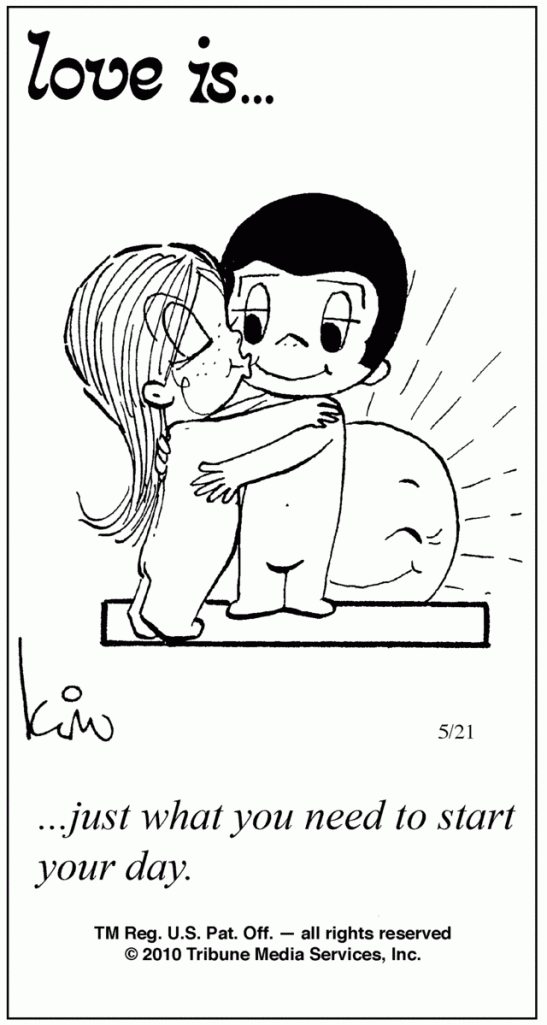
Love is…

While I’m on my nostalgia streak, I’m remembering this comic strip from the 70’s by Kim Casali. I loved these although they perhaps don’t all stand the test of time, the ‘she’ of the partnership always doing the household chores, and picking up after the ‘he’.

Although, to be honest, I do do chores out of love for my family, picking recipes I think they will enjoy, trying to keep a peaceful organized home, cleaning up the little hand smudges on the walls knowing these moments will not last. These acts of service are one of the love languages identified by Gary Chapman in his book, The 5 Love Languages, the others being words of affirmation, gifts, physical touch, and quality time.

Chapman argues that sometimes people in relationship, any relationship not only romantic, get in trouble if they are speaking in a love language their loved one doesn’t hear. For me, my expressions of love are weighted heavily toward acts of service, but knowing that everyone is not on the same wave length in how they receive expressions of love reminds me to use them all, and to listen for them all from the people I love.

Perhaps, as with the ‘Happiness is… ‘ thought exercise from yesterday, today it would be wonderful to stop and consider how you are showing love to the people you care about, and how they are showing it to you, even if it’s not one of the love languages you are good at hearing.

For inspiration and a chuckle, consider this cat mom’s birthday gift for her kitty:

Now that’s love.

Happiness is…

By Charles Schulz

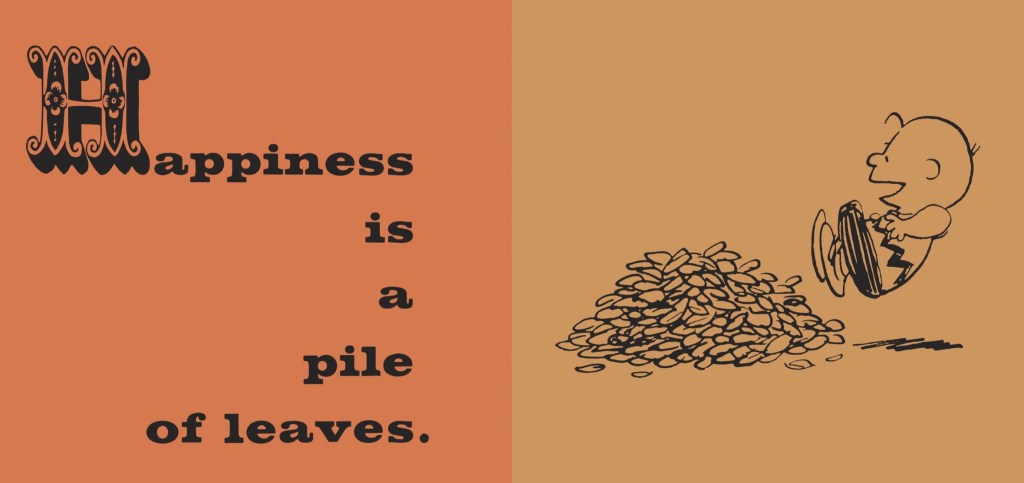
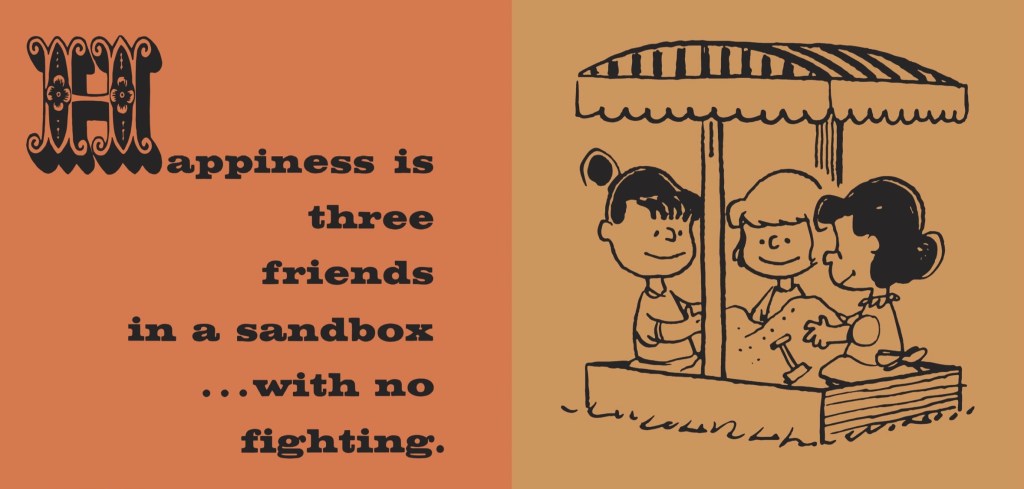
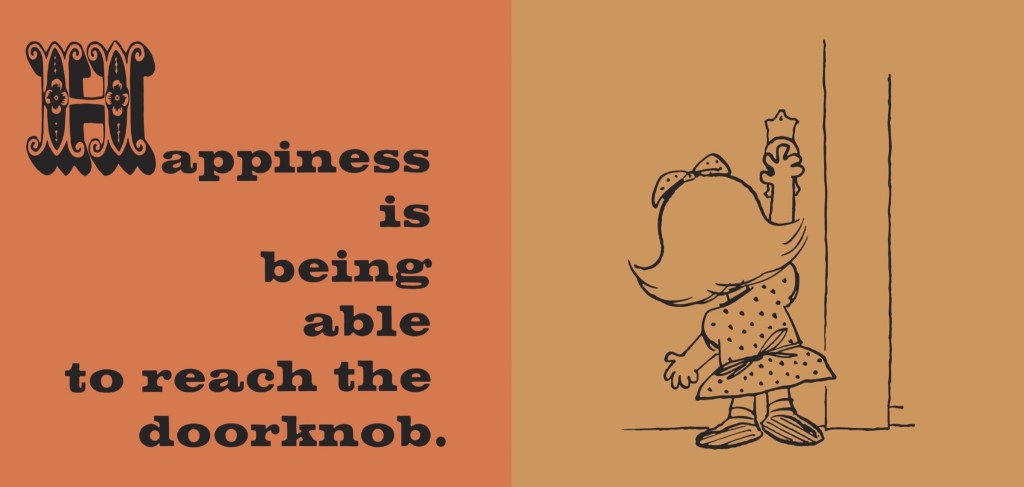
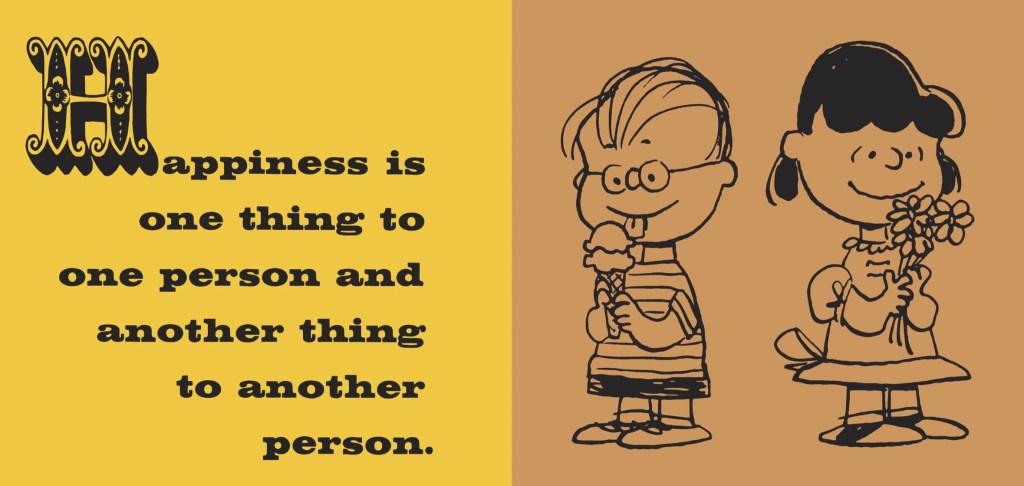
When I was young, I had the book Happiness is a Warm Puppy by Charles Schulz. I was remembering it lately with all the charming little moments it caught:

Each page captures a delightful, sweet, innocent, but meaningful, moment in the life of a child. Each attempting to capture that ineffable notion of happiness. I thought it would be fun to start collecting my own when I feel that surge of happiness, that feeling that all is right in the world, and I’m incredibly lucky and content.

Here are a couple of mine:

Happiness is…

The finches discovering their feeder.

Happiness is….

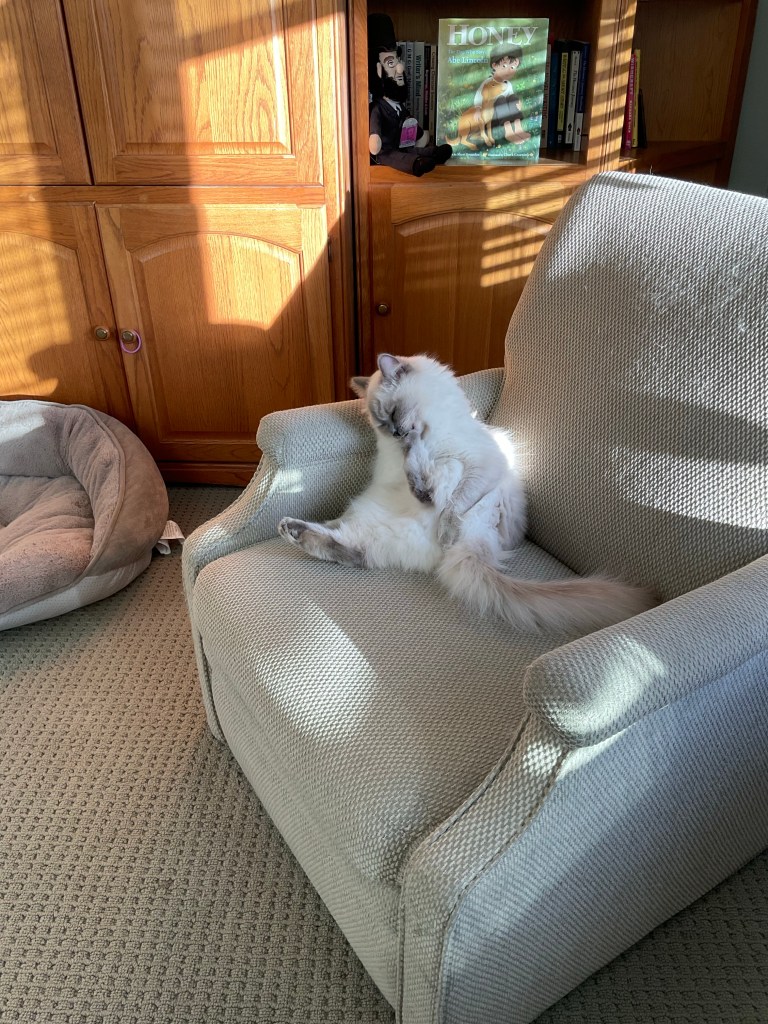
The cat keeping you company while you work.

Happiness is…

Being unable to move because the cat picked your lap.

And the list goes on. We each have moments that fill us with happiness and wonder. They slip away quickly because they’re ephemeral. But if we capture them somehow, in a gratitude journal, with a photo album, a list, we can turn to them later and smile. These are our ‘moments’

Schulz recognized that for each of of us, those moments will be unique and personal.

What are some of yours? If you feel comfortable doing so, I would love it if you shared them.

Keeping Christmas

Love wins.

Isn’t that the bottom line of Christmas? Strip away all the decorations and gifts and songs and celebrations, and what remains is: love wins. It’s about love. God loves us, and we are to love each other. And even in a world divided by hate, blind to oneness, driven by greed, love will win. Because that’s the point of Christmas.

It’s about the love.

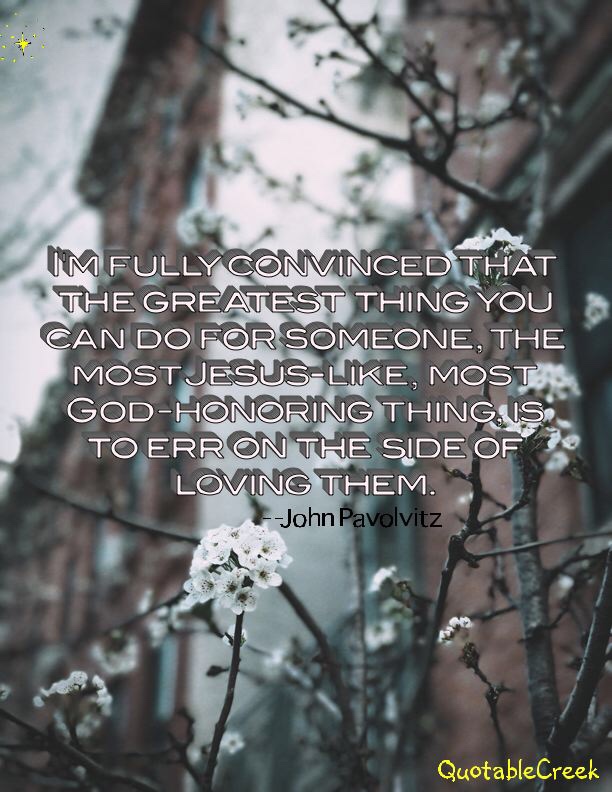
Erring on the side of love.

We tend to judge others by their actions and ourselves by our intentions. What that looks like in practice is forgiving ourselves for a lot of things–selfishness, neglect, mistakes–that we don’t forgive anyone else for when the same harm is done to us.

But what if we flipped that and gave other people the benefit of the doubt and show them the same understanding we give ourselves? What if their statements that seem hurtful are merely ill thought out? What if  what feels like neglect is really just busyness with something else? What if everyone is intending to do their best, but falls short over and over?

Just like we do.

Instead of anger, hurt, and frustration, our relationships would be peppered with compassion and understanding and the ability to grow and blossom.

Seeking opportunities for love.

If you look for thorns, you’ll see thorns. If you look for love, you’ll see it all around you. And if you look for opportunities to make a difference, to shower people with love, and to take a stand for all that is good and right in the world, those opportunities will be there.

What opportunities do you see in the day ahead?

How about a little kindness?

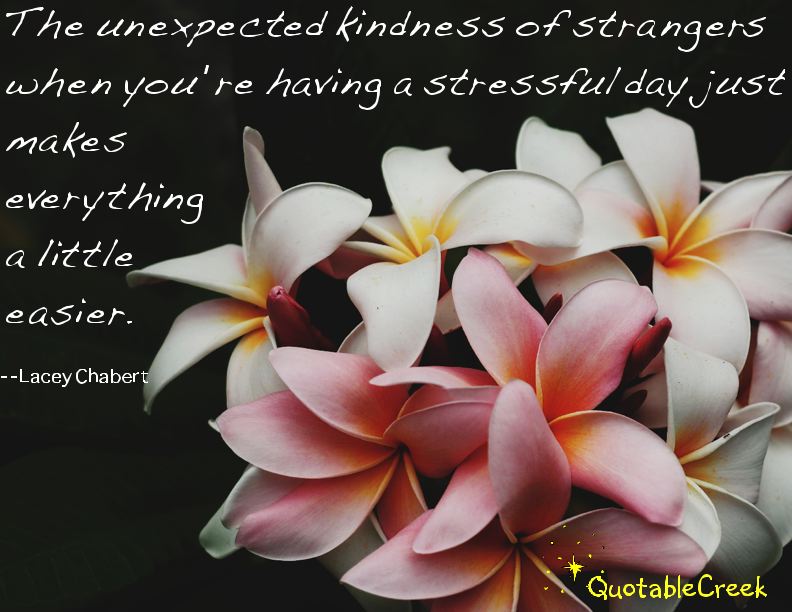
Have you ever been at a restaurant or grocery store with a crying or tantrumming child? It’s awful, that feeling of everyone staring at you and blaming you for somehow disrupting their lives. Not to mention, the criticism and judgment! Some people are only too eager to point out just what you are doing wrong and how you shouldn’t be out in public if you can’t control your children. But, sometimes, a stranger reaches out and helps– offers to amuse the baby, gives you a wink of encouragement, tells you they’ve been there, too, and that things will get better. That little act of kindness makes all the difference.

We can’t control whether we will run into the kind sort of stranger when we are most overwhelmed. But, we can remember what it was like when someone was kind when we were overwrought and BE that kind stranger to someone struggling. When we remember what a difference that type of kindness made in our lives, we realize that simple things–holding a door for someone carrying packages, smiling when someone is overwhelmed with their kids, offering to help pick up fallen papers– matter tremendously.

From Shari:

Have you ever been the beneficiary of a stranger’s kindness? Can you think of a time when you reached out in kindness to someone else? Please share your stories in the comments. I would love to hear them!

I’m broken, too.

What makes some people able to empathize more than others, able to help in dire circumstances, able to put the greater good above the personal good? Bryan Stephenson, founder of the Equal Justice Institute, fierce advocate against systemic racism, and criminal defense attorney for those on death row explains: “I do it because I’m broken, too.” That recognition of a common humanity and brokenness by a system that needs changing propels him to fight.

Who among us isn’t broken? Because we all are bound together, we all suffer in an unjust world. Because we all have known pain, we all have the capacity to put ourselves into the shoes of those hurting.

In his book, Just Mercy, Stephenson explains:

My years of struggling against inequality, abusive power, poverty, oppression, and injustice had finally revealed something to me about myself. Being close to suffering, death, executions and cruel punishments didn’t just illuminate the brokenness of others; in a moment of anguish and heartbreak, it also exposed my own brokenness. You can’t effectively fight abusive power, poverty, inequality, illness, oppression, or injustice and not be broken by it.

We are all broken by something. We have all hurt someone and have been hurt. We all share the condition of brokenness even if our brokenness is not equivalent. I desperately wanted mercy for Jimmy Dill and would have done anything to create justice for him, but I couldn’t pretend that his struggle was disconnected from my own. The ways in which I have been hurt–and have hurt others–are different from the ways Jimmy Dill suffered and caused suffering. But our shared brokenness connected us.

Paul Farmer, the renowned physician who has spent his life trying to cure the world’s sickest and poorest people, once quoted me something that the writer Thomas Merton said: ‘We are bodies of broken bones.’ I guess I’d always known but never fully considered that being broken is what makes us human. We all have our reasons. Sometimes we’re fractured by the choices we make; sometimes we’re shattered by things we would never have chosen. But our brokenness is also the source of our common humanity, the basis for our shared search for comfort, meaning, and healing. Our shared vulnerability and imperfection nurtures and sustains our capacity for compassion.

We all have a choice. We can embrace our humanness, which means embracing our broken natures and the compassion that remains our best hope for healing. Or we can deny our brokenness, forswear compassion, and, as a result, deny our humanity

…So many of us have become afraid and angry. We’ve become so fearful and vengeful that we’ve thrown away children, discarded the disabled, and sanctioned the imprisonment of the sick and the weak–not because they are a threat to public safety or beyond rehabilitation but because we think it makes us seem tough, less broken. …We’ve submitted to the harsh instinct to crush those among us whose brokenness is most visible. But simply punishing the broken–walking away from them or hiding them from sight–only ensures that they remain broken and we do, too. There is no wholeness outside of our reciprocal humanity.

Just Mercy, by Bryan Stephenson

How many of the problems we face today can be mitigated by recognizing our common humanity, by following the Golden Rule of treating others how we would have them treat us, a tenet found in many of the world’s religions? How would we have others treat us if we were the elderly, the sick, the refugee, the hurt, the accused, the other? Each of us would benefit from considering things from this perspective. Bryan Stephenson continues:

Whenever things got really bad, and they were questioning the value of their lives, I would remind them that each of us is more than the worst thing we’ve ever done. I told them that if someone tells a lie, that person is not just a liar. If you take something that doesn’t belong to you, you are not just a thief. Even if you kill someone, you’re not just a killer. I told myself that evening what I had been telling my clients for years. I am more than broken. In fact, there is a strength, a power even, in understanding brokenness, because embracing our brokenness creates a need and desire for mercy, and perhaps a corresponding need to show mercy. When you experience mercy, you learn things that are hard to learn otherwise. You see things you can’t otherwise see; you hear things you can’t otherwise hear. You begin to recognize the humanity that resides in each of us.

…I began thinking about what would happen if we all just acknowledged our brokenness, If we owned up to our weaknesses, our deficits, our biases, our fears. Maybe if we did, we wouldn’t want to kill the broken among us who have killed others. Maybe we would look harder for solutions to caring for the disabled, the abused, the neglected, and the traumatized.

Just Mercy, by Bryan Stephenson

We are all broken. Some of us don’t acknowledge that. We have all hurt and been hurt. It is that humbling insight that can help us recognize our common humanity across all divides. If we just have the eyes to see and the ears to hear. Stephenson refers to an unnamed pastor who would preface singing: “The minister would stand, spread his arms wide, and say, “Make me to hear joy and gladness, that the bones which thou hast broken may rejoice.” Amen to that.

From Shari: It’s probably obvious from the long post how much Stephenson’s book has moved me. I recommend it to anyone and everyone. It is a masterful look behind the scenes of criminal defense work, as documented in the movie, but it also interweaves the history of systemic racism in our country and highlights many areas that need our focus.

I would love to have your thoughts on this in the comments. All thoughts are appreciated. It feels a bit like whispering into the wind to write a blog. I would love to hear your thoughts to build a sense of community.

All best, S

Joy shadow

How wonderful it would be to count all joy– to recognize the gift in the difficulty, to see the growth in the hardship, to see joy as a reflection of sorrow. Grief, despair, hopelessness, loss can hit so hard, it may feel like we will never feel joy again. And yet joy follows us like a shadow if we can pause to be grateful.

Then a woman said, “Speak to us of Joy and Sorrow.” 

And he answered: 

Your joy is your sorrow unmasked. 

And the selfsame well from which your laughter rises was oftentimes filled with your tears. 

And how else can it be? 

The deeper that sorrow carves into your being, the more joy you can contain. 

Is not the cup that hold your wine the very cup that was burned in the potter’s oven? 

And is not the lute that soothes your spirit, the very wood that was hollowed with knives? 

When you are joyous, look deep into your heart and you shall find it is only that which has given you sorrow that is giving you joy. 

When you are sorrowful look again in your heart, and you shall see that in truth you are weeping for that which has been your delight. 

Some of you say, “Joy is greater than sorrow,” and others say, “Nay, sorrow is the greater.” 

But I say unto you, they are inseparable. 

Together they come, and when one sits alone with you at your board, remember that the other is asleep upon your bed. 

Verily you are suspended like scales between your sorrow and your joy. 

Only when you are empty are you at standstill and balanced. 

When the treasure-keeper lifts you to weigh his gold and his silver, needs must your joy or your sorrow rise or fall. 

Khalil Gibran, Joy and Sorrow, Chapter Viii