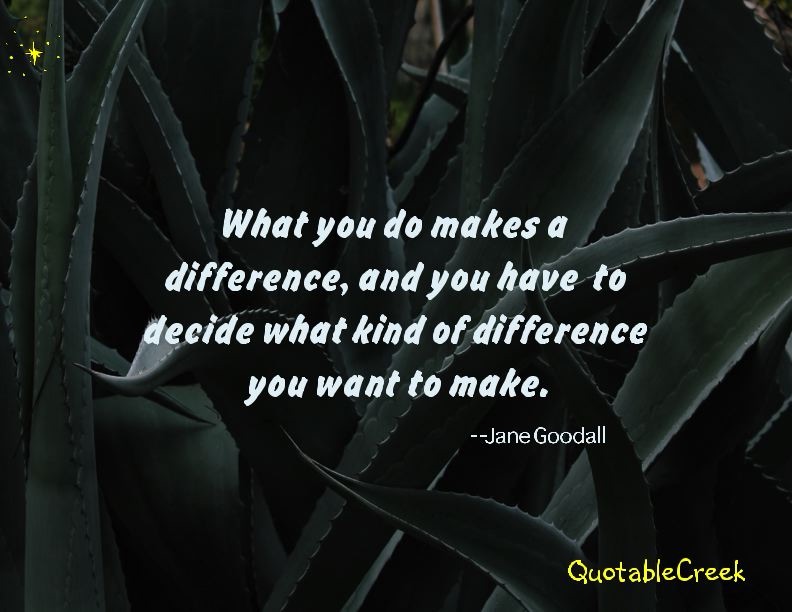
Jane Goodall was an inspiration. She will be missed. Consider her words above today.
Think of all the people you’ve brushed up against as you went about your day today. Were their lives made better by the encounter? Even something as simple as a greeting or smile can brighten someone else’s day, and they in turn will be more encouraged to brighten someone else’s day and so on and so on and so on. Good cheer ripples out into the world endlessly. So, of course, does a dour grumpy mood. But who needs more of that?
Consider your actions today. You’re making ripples of one kind or another.
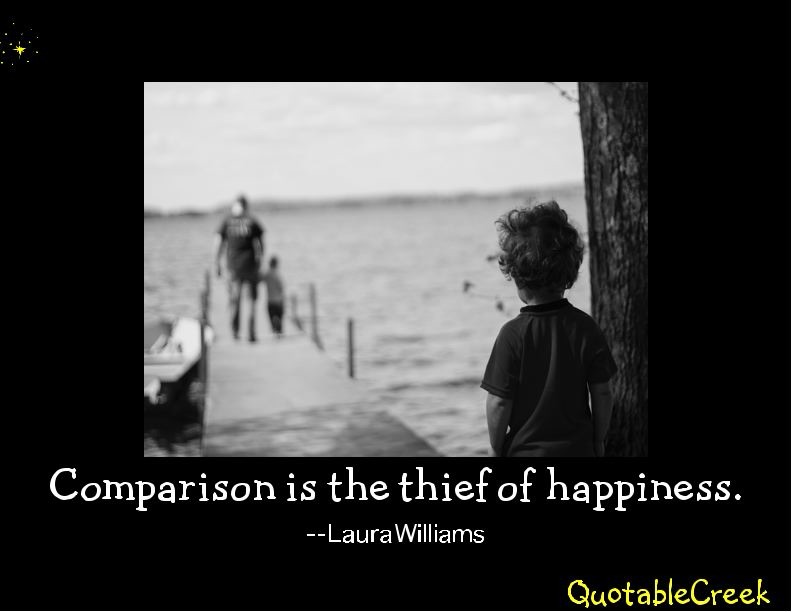
Do you find yourself comparing your life with that of your friends or co-workers? Science says that Facebook and other social media can actually make people feel sad rather than connected because it seems like your friends are having a better time than you are. Often that comparison is misleading.
But always that comparison is beside the point. There will always be someone smarter, richer, more accomplished, happier, etc. than you; just like you will be all those things for someone else.
The challenge is to be happy with what you are and have. At times like these, it is comforting to read Saint Teresa of Calcutta’s words:
People are often unreasonable, irrational, and self-centered. Forgive them anyway.
If you are kind, people may accuse you of selfish, ulterior motives. Be kind anyway.
If you are successful, you will win some unfaithful friends and some genuine enemies. Succeed anyway.
If you are honest and sincere people may deceive you. Be honest and sincere anyway.
What you spend years creating, others could destroy overnight. Create anyway.
If you find serenity and happiness, some may be jealous. Be happy anyway.
The good you do today, will often be forgotten. Do good anyway.
Give the best you have, and it will never be enough. Give your best anyway.
In the final analysis, it is between you and God. It was never between you and them anyway.
Don’t worry about the Joneses. Instead, keep your heart grateful and your actions focussed on making a positive difference in this world.
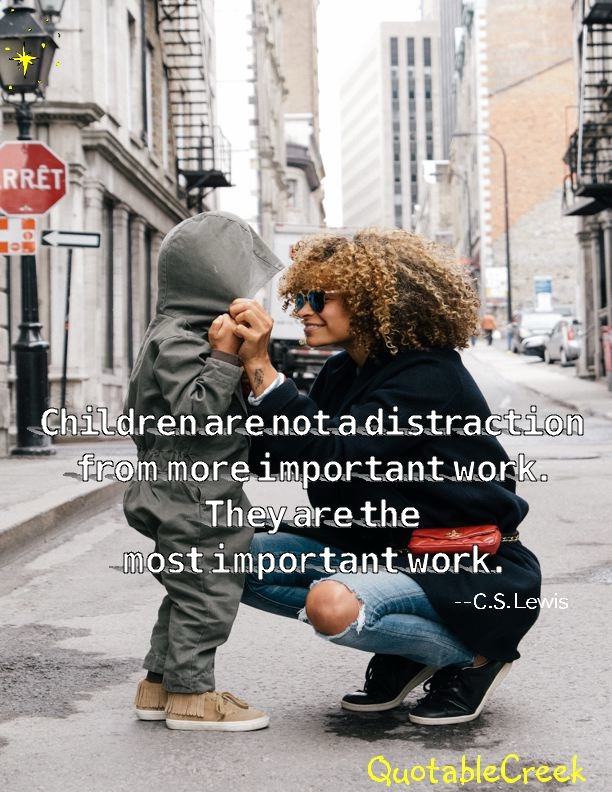
Jaqueline Kennedy once said that, “If you bungle raising your children, I don’t think whatever else you do matters very much.”
Our children are our highest priority. Through our love and attention, they can grow up believing in themselves and their ability to make a difference. For a fascinating discussion on how simple changes in the ways we speak to them and affirm their efforts can make profound differences in their future lives, go here.
It’s not about an A; it’s about engagement. It’s not about learning one skill; it’s about curiosity. It’s not about talent; it’s about effort. Simple shifts, profound results!
“In one of John Muir Laws’s books, I read something profound that changed the way my brain thinks. “As you draw the bird,” he writes, “try to feel the life within it.” So now I look at the bird before me and imagine how it senses the world, how it feels breathing cold air, how it feels to have its feathers ruffling in the wind, how it feels to always have an eye out for possible food and possible predators. The bird sees me and is a nanosecond from flying off, but it stays. Why? By imagining the life within, the bird I am drawing is alive, no longer a shape and its parts, but a thinking, sentient being, always on the brink of doing something. By feeling the life within, I am always conscious that all creatures have personalities, and so do trees and clouds and streams. To feel the life within, I now imagine myself as the bird that is looking at me. I imagine its wariness, the many ways it has almost died in its short life. I worry over its comfort and safety, and whether I will see my little companion the next day, the next year. To feel the life within is to also feel grief in the goneness of a single creature or an entire species. Imagination is where compassion grows. Let us join with children to imagine and wonder, to use curiosity as the guide to miracles in plain sight. Let us enter with them into wild wonder so that we become guardians together of all that is living and all that must be saved.”From Orion Magazine, “The Life Within”.
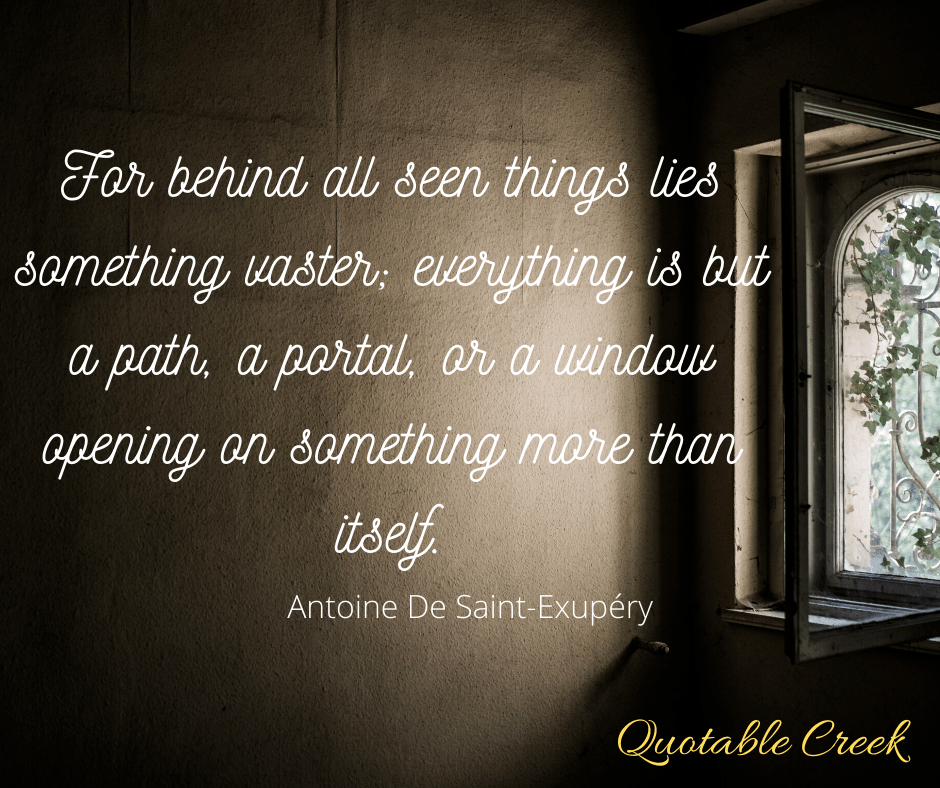
I wonder if we can look at each other that way, as something vaster, as thinking sentient beings with worlds of experience, some harsh. Would that help us to treat each other better? In her book, Dead Man Walking, Sister Helen Prejean describes just this sort of thing as she works with a death row inmate, a man who admittedly committed a heinous act, seeing not just the man but also, though covered with tattoos and bathed in bravado, the little wounded child within. That empathy allowed her to see past the crimes to the human and to feel compassion for him.
Perhaps today we can look with new eyes to see each other as a composite of good and bad, but each fully human and fully deserving of respect and compassion. To paraphrase Amy Tan above, when we consider the person, can we try to picture the life within, the challenges and struggles, hopes and triumphs? Can we become, together, ‘guardians of all that is living and must be saved’ in a place where ‘compassion grows’?
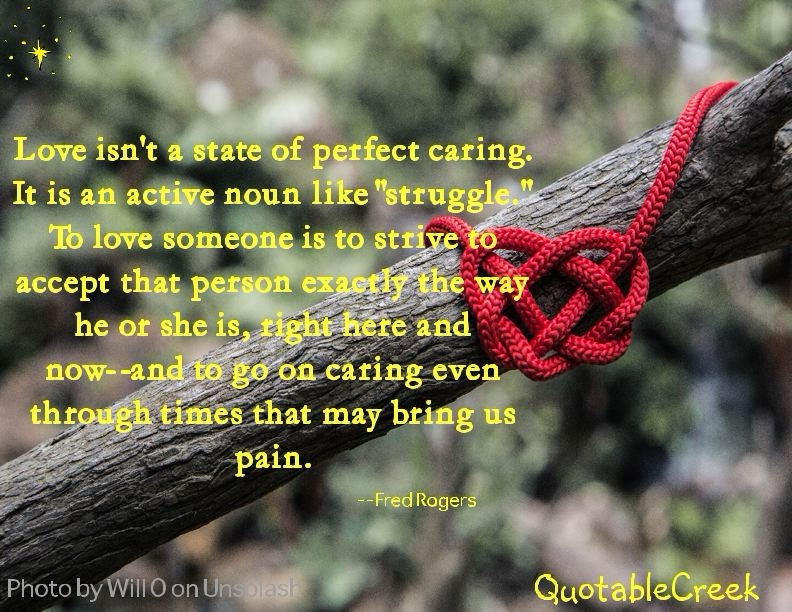
Love isn’t a feeling we fall in and out of. It’s an action we choose to take even when it may be challenging. Sometimes it brings pain. When we think of love as an active verb, like, as Mr. Rogers suggests above, ‘struggle’, rather than as an emotion, it opens our eyes to the fact that we must work at it. It’s a struggle, a constant readjustment and tinkering, constantly expanding our own understanding and empathy.
Love is not molding someone to our vision of what they should be, but accepting who they are and supporting them as they blossom. Thinking of love as something more akin to struggle encourages us to keep looking for new and better ways to show up for the people in our lives, to view the relationships as evolving rather than static, and to appreciate all the little successes and breakthroughs in those relationships along the way.
I discovered a new word the other day that has me soul-searching. Gramnesia, a portmanteau combining ‘grandparent’ and ‘amnesia’. A grandparent experiencing gramnesia trots out recollections of the good, easy times they had raising their children, and brings those up in a way which can be a tacit criticism of the way those children are now raising their grandkids. In other words, someone experiencing gramnesia has forgotten the complete picture of parenthood.
While it’s natural to look fondly back on the years when your children were little, it may be problematic if you make those now grown children feel it is unnatural to struggle.
As Allie McQuaid says:
In a follow-up Instagram Reel, McQuaid explained that the main reason these comments are unhelpful is that they don’t change the things parents of young kids are struggling with and they minimize the very real stress they’re facing.
“Our boomer parents telling us that we didn’t cry ever (whether that’s true or not is up for debate apparently..) doesn’t change the fact that OUR baby now is crying and needs our care,” McQuaid wrote.
Instead of judging or comparing, perhaps it would be more helpful for grandparents to be curious. What might they learn and discover from how their children are showing up now as parents?
Parenting techniques change. Smacking someone with a paddle may have been acceptable once, but now it’s illegal, for instance. Priorities change. Keeping up with the Joneses or maintaining appearances may not be as important to your kids as quality time with their kids. Perhaps the gramnesiac will have something to learn. and perhaps, too, they’ll discover a way to help, something they may have greatly appreciated when they were going through the challenges of raising children.
And also, as hard as it is to be vulnerable and discuss the hard times, those stories, call them ‘momeries’, (portmanteau of mom and memories) may make your child feel hopeful and encouraged as they shoulder parenting duties, that times will be both tough and rewarding beyond their wildest expectation.
Communication can be tough, particularly after a long silence. Finding inroads, healing thaws, rediscovering common ground takes effort.
Sometimes it’s nice to have a game plan before going into what might be an emotionally-charged conversation.
Consider this one:
So often we get lost in who’s right, who’s wrong. But is that really the point? Harsh words are often spoken in just such a competition to be right. Often the words cause more harm than the original conflict. Is right/wrong really the best way? Especially when the objective is to try to get a friendship back on track.
Being gentle, vulnerable, attentive is true strength. Moving through the world with a genuine sense of curiosity rather than an avowed sense of your own rightness can open the door to a better appreciation of someone else’s point of view and a greater chance of improving, rather than destroying, the remnants of a relationship you hope to save.
We don’t let just anyone see us vulnerable, hear our secret stories, watch us struggle. To most of the world, we carry a bit of a shield between them and our tender parts. But there are some few we trust to see the real person behind the mask. We must love those people very much to be so naked and exposed.
Because we need to lay those masks down sometimes, don’t we? We can’t live a life of posture. And so we seek out places where and people with whom we can relax and let down our hair, unafraid of judgment, unconcerned with being deemed eccentric. Perhaps to be part of nature, to rest among creation until we lose sight of where we stop and others begin.
In this poem, Mary Oliver takes us into her sacred space–the woods.
She must love us very much.
How I Go To the Woods
by Mary Oliver
Ordinarily, I go to the woods alone, with not a single friend, for they are all smilers and talkers and therefore unsuitable.
I don’t really want to be witnessed talking to the catbirds or hugging the old black oak tree. I have my way or praying, as you no doubt have yours.
Besides, when I am alone I can become invisible. I can sit on the top of a dune as motionless as an uprise of weeds, until the foxes run by unconcerned. I can hear the almost unhearable sound of the roses singing.
If you have ever gone to the woods with me, I must love you very much.
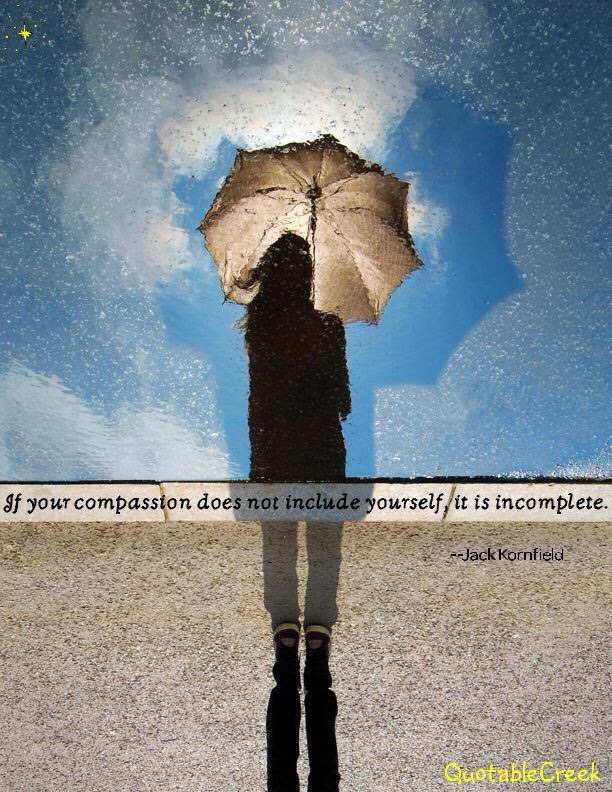
If one of your friends were struggling with the problems you are facing right now, what words would you offer in support? Would you call them names, berate them, remind them of all the other times they messed up just like this and how, honestly, can they ever expect to get anything right, ever?
Probably not. Right? But often this is the way we talk to ourselves. We replay all our other mistakes in our minds, call ourselves stupid, sink into our shells scared to face the world.
But why do we do this? If the words we would offer our friend are what we think would help, why are we so reticent to speak kind encouraging words to ourselves? Maybe today is a good day to try a different approach.
Be a kind friend to yourself. Offer yourself words of support and encouragement. Focus on all the many times you got things right. Tell yourself the truth: you are precious and beloved.
In a difficult and challenging place and time, we are called to continue the fight for what is right and good, true and just, honorable and compassionate. We push forward– listening more, caring more, giving more. We can drown out the din and listen to our hearts which strive for peace and harmony, communion, reconciliation. We must hold fast to our principles and to hope as our anchor, especially now.



 QuotableCreek.com