Patron Saint of Darkness

In 2016, Pope Francis sainted Mother Teresa. She was a beloved paragon of a selfless life, ministering to the poor and dying, shining a light on the importance of the little things and the love of family. After her death, her diaries showed her struggles with doubt. Once feeling clearly called to her mission, in the last several decades of her life she felt God’s absence. She said,

Lord, my God, who am I that You should forsake me? The Child of your Love–and now become as the most hated one–the one–You have thrown away as unwanted–unloved. I call, I cling, I want–and there is no One to answer–no One on Whom I can cling–no, No One.–Alone … Where is my Faith–even deep down right in there is nothing, but emptiness & darkness–My God–how painful is this unknown pain–I have no Faith–I dare not utter the words & thoughts that crowd in my heart–& make me suffer untold agony.

So many unanswered questions live within me afraid to uncover them–because of the blasphemy–If there be God –please forgive me–When I try to raise my thoughts to Heaven–there is such convicting emptiness that those very thoughts return like sharp knives & hurt my very soul.–I am told God loves me–and yet the reality of darkness & coldness & emptiness is so great that nothing touches my soul. Did I make a mistake in surrendering blindly to the Call of the Sacred Heart?

And on until her death, she felt God’s absence, rather than his presence. And yet she persisted doing the work to which she had been called, living a life of faith.

Some may call her a hypocrite to have an outward smile of peace and an inner crisis of faith, but isn’t her struggle every one’s struggle? Who among us doesn’t struggle with doubt? Don’t we all rely on faith when our paths grow dark and twisting?

St. Teresa of Calcutta inspires us to hang on during the dark nights of the soul, to continue to walk the walk, to be faithful and steadfast, and to shine light in the dark places. She can aptly be considered the Patron Saint of Doubters.

Standing where the light is shining.

Sometimes, when we feel down, we need to evaluate the input coming into our lives. Are we steeped in negativity? Maybe not just news, but the vitriol that follows it in the comments? The political back and forth can get ugly and pull us down. And then we can think about the friends we surround ourselves with. Are they upbeat, trying to make things better, or always complaining? 

And, while we don’t want to retreat from fighting the good fight or the friends who are going through a rough patch, it’s so easy for people to tear things down, to find the flaws, to make a conflict, and, when we are around that kind of energy constantly, we can feel beaten down. 

But, there is good news to be had, and there are positive people and opportunities to be found. Sometimes we need to focus our attention there, if only for a break from the storm.

Reteaching loveliness.

You and everyone around you are buds, waiting to fully bloom. Sometimes we need reminders of that fact.

Consider this poem from Galway Kinnell:

Relearning Loveliness

The bud

Stands for all things,

Even for those things that don’t flower,

For everything flowers, from within, of self-blessing:

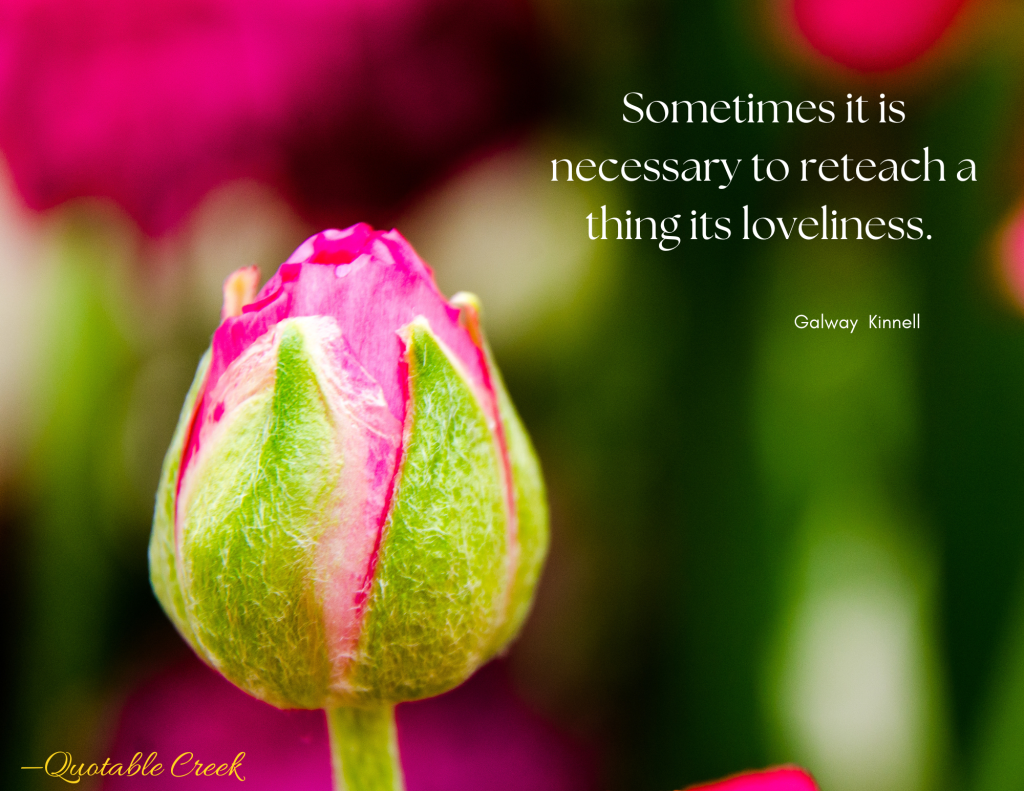
Though sometimes it is necessary to reteach a thing its loveliness,

To put a hand on the brow

Of the flower,

And retell it in words and in touch,

It is lovely

Until it flowers again from within, of self-blessing.

Bless the comforters.

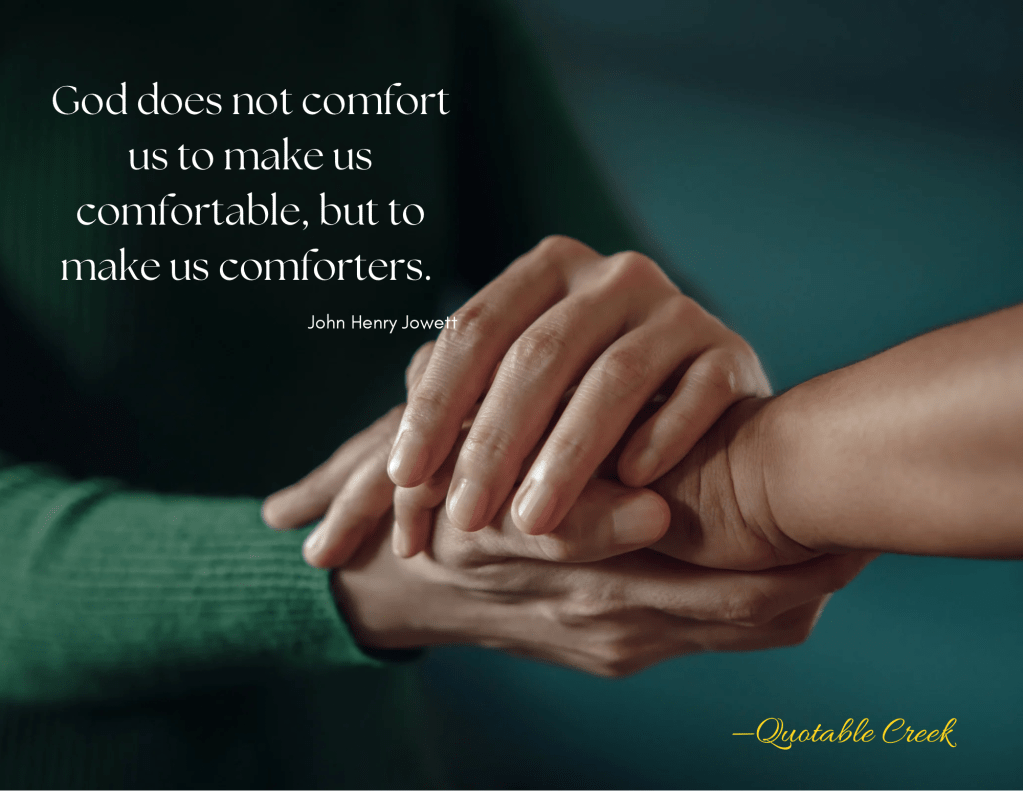
Bless the comforters, those who reach out and see others hurting and grief stricken, and offer them solace. Who sit with those going through difficult times, and give of their presence. Who offer kind, comforting words.

We sometimes think those who are good at comforting don’t know loss of their own, but the opposite is probably true.

As said by Rainer Maria Rilke:

Do not assume that he who seeks to comfort you now lives untroubled among the simple and quiet words that sometimes do you good. His life may also have much sadness and difficulty, that remains far beyond yours. Were it otherwise, he would never have been able to find such words.

Perhaps the only good to come of great loss is the ability to recognize it in others and offer them comfort and companionship.

Bless the comforters.

Pushing through fear.

Fear is a crippler.

Fear keeps us from trying, from stepping out, from baring our hearts. It makes us smaller than we are. When we fear heartbreak, we flee from love or offer only a superficial version of ourselves, practically guaranteeing the relationship will lack depth. When we fear failure, we don’t try, or try only halfheartedly, practically assuring a lack of success. When we fear others, we keep to those we perceive to be like ourselves, thereby ensuring that we will not enrich our relationships with diversity.

Fear tells us to cower, to not show up, to be less than we know we are.

We build our fears and then act in ways that reinforce them until they become self-fulfilling prophecies. Our fears become so much a part of our reality that we begin to accept them as ‘truth’. But when we analyze our fears critically, we can harness our inner strength and step through our limitations. So the antidote to fear may well be truth, cultivating it relentlessly, forcing ourselves to examine our fear with a microscope, and dissect it into harmless pieces.

In this powerful TED talk, Issac Lidsky explores how his fears that blindness would rob him of joy and meaning in his life fell aside when he critically examined them and chose to push through those fears to a full and rich life– lacking in sight, but abundant in vision. He urges us to push through our own fears, challenge our assumptions, and correct our misconceptions:

Hold yourself accountable for every moment, every thought, every detail. See beyond your fears.Recognize your assumptions. Harness your internal strength. Silence your internal critic. Correct your misconceptions about luck and about success. Accept your strengths and your weaknesses, and understand the difference. Open your hearts to your bountiful blessings.

Your fears, your critics, your heroes, your villains — they are your excuses, rationalizations, shortcuts,justifications, your surrender. They are fictions you perceive as reality. Choose to see through them.Choose to let them go. You are the creator of your reality. With that empowerment comes complete responsibility.

Today, consider what’s holding you back and challenge your assumptions.

Love is nearby.

Sometimes a good walk can change your perspective. Consider these words from Anne Lamott:

My husband said something a few years ago that I often quote: 80% of everything that is true and beautiful can be experienced in any ten minute walk. Even in the darkest and most devastating times, love is nearby if you know what to look for. It does not always appear at first to be lovely, but instead may take the form of a hot mess or a snoring old dog. Or someone you have sworn to never, ever forgive (for a possibly very good reason, if you ask me). But mixed in will also be familiar signs of love: wings, good-hearted people, cats (when they are in the right mood), a spray of wild flowers, a cup of tea. What are we even talking about when we talk of love? What is it?

On a ten minute walk anywhere…, love abounds and abides, flirts and weeps with us. It is there for the asking, which is the easy part. Our lives’ toughest work is in the receiving. Love presents most obviously in babies and kids being cuddled, yet also as patience with annoying humans we live or work with or are. We feel love upon seeing our favorite neighbors and first responders, we see it in fund-raising efforts, peace marches, kindergarten classrooms, gardens. When flowers don’t stir feeling of love in me, something is gumming up the works.

What at first unlovely things do you see around you that are really love? What evidence of love do you see on your walk? In your day? In your home?

Love is everywhere. We just sometimes need to make sure to notice.

Love like water.

We hear we should fight fire with fire or get down in the gutter and fight dirty with the rest of them, but is this the best way? Won’t everyone just be hurt? Won’t our young lose role models for the importance of virtue?

What of other, softer, ways to resist?

Consider these words from Richard Rudd:

The Softening

Softness is one of the great secrets of all spiritual practice. 

When we become soft, we become like water. 

We let life come to us. 

We trust in its flow, and we allow ourselves to be taken in whichever direction it chooses. 

This is true power because it comes from love, and love is the softest thing in the universe, and yet it is the most powerful. 

When you soften your attitude to yourself, to others, and to life, you release the natural wisdom that lies within you. 

Your body softens, your thoughts soften, and your heart softens. 

Through softness, you find clarity and purpose without needing to force anything. 

Your life becomes a gentle unfolding rather than a constant battle.

We are needed, that is all we can know.

Do not lose heart. The challenges you see today are the ones you must face. You are strong enough to do your part, and you will find allies everywhere you look.

Do not be afraid.

You may feel you are riding on stormy seas, but look around you. In the words of Dr. Clarissa Pinkola Estes:

Look out over the prow; there are millions of boats of righteous souls on the waters with you. Even though your veneers may shiver from every wave in this stormy roil, I assure you that the long timbers composing your prow and rudder come from a greater forest. That long-grained lumber is known to withstand storms, to hold together, to hold its own, and to advance, regardless.

In any dark time, there is a tendency to veer toward fainting over how much is wrong or unmended in the world. Do not focus on that. There is a tendency, too, to fall into being weakened by dwelling on what is outside your reach, by what cannot yet be. Do not focus there. That is spending the wind without raising the sails.

We are needed, that is all we can know. And though we meet resistance, we more so will meet great souls who will hail us, love us and guide us, and we will know them when they appear. Didn’t you say you were a believer? Didn’t you say you pledged to listen to a voice greater? Didn’t you ask for grace? Don’t you remember that to be in grace means to submit to the voice greater?

Ours is not the task of fixing the entire world all at once, but of stretching out to mend the part of the world that is within our reach. Any small, calm thing that one soul can do to help another soul, to assist some portion of this poor suffering world, will help immensely. It is not given to us to know which acts or by whom, will cause the critical mass to tip toward an enduring good.

You do not need to do everything. Do what you can, where you can, with what you can. Your actions combined with actions from millions of like-minded individuals will make a difference for good.

Do not lose heart.

Be still my soul and steadfast.

No one knows what tomorrow will bring, and that can be frightening. We are in a volatile time. It helps to keep our attention on the present and what we can do here and now.

The great poets help calm our souls. Take comfort today from these tender words from Mary Oliver:

Be still, my soul, and steadfast.
Earth and heaven both are still watching
though time is draining from the clock
and your walk, that was confident and quick,
has become slow.

So, be slow if you must, but let
the heart still play its true part.
Love still as once you loved, deeply
and without patience. Let God and the world
know you are grateful. That the gift has been given.


+ Mary Oliver

We do not know what tomorrow brings, but we will approach it with full souls, grateful and loving, ready to meet the day with a steadfast heart.

For friendship.

How lucky we are to have friends, true friends, who are in our lives just for the delight in it, for the compatibility of spirits, for joy, for shared experience, for knowing in this great big world someone gets us.

Enjoy this poem by Kahlil Gibran:

And a youth said, Speak to us of Friendship. 
    And he answered, saying: 
    Your friend is your needs answered. 
    He is your field which you sow with love and reap with thanksgiving. 
    And he is your board and your fireside.
    For you come to him with your hunger, and you seek him for peace. 

    When your friend speaks his mind you fear not the “nay” in your own mind, nor do you withhold the “ay.” 
    And when he is silent your heart ceases not to listen to his heart; 
    For without words, in friendship, all thoughts, all desires, all expectations are born and shared, with joy that is unacclaimed. 
    When you part from your friend, you grieve not; 
    For that which you love most in him may be clearer in his absence, as the mountain to the climber is clearer from the plain. 
    And let there be no purpose in friendship save the deepening of the spirit. 
    For love that seeks aught but the disclosure of its own mystery is not love but a net cast forth: and only the unprofitable is caught. 

    And let your best be for your friend. 
    If he must know the ebb of your tide, let him know its flood also. 
    For what is your friend that you should seek him with hours to kill? 
    Seek him always with hours to live. 
    For it is his to fill your need but not your emptiness. 
    And in the sweetness of friendship let there be laughter, and sharing of pleasures. 
    For in the dew of little things the heart finds its morning and is refreshed.