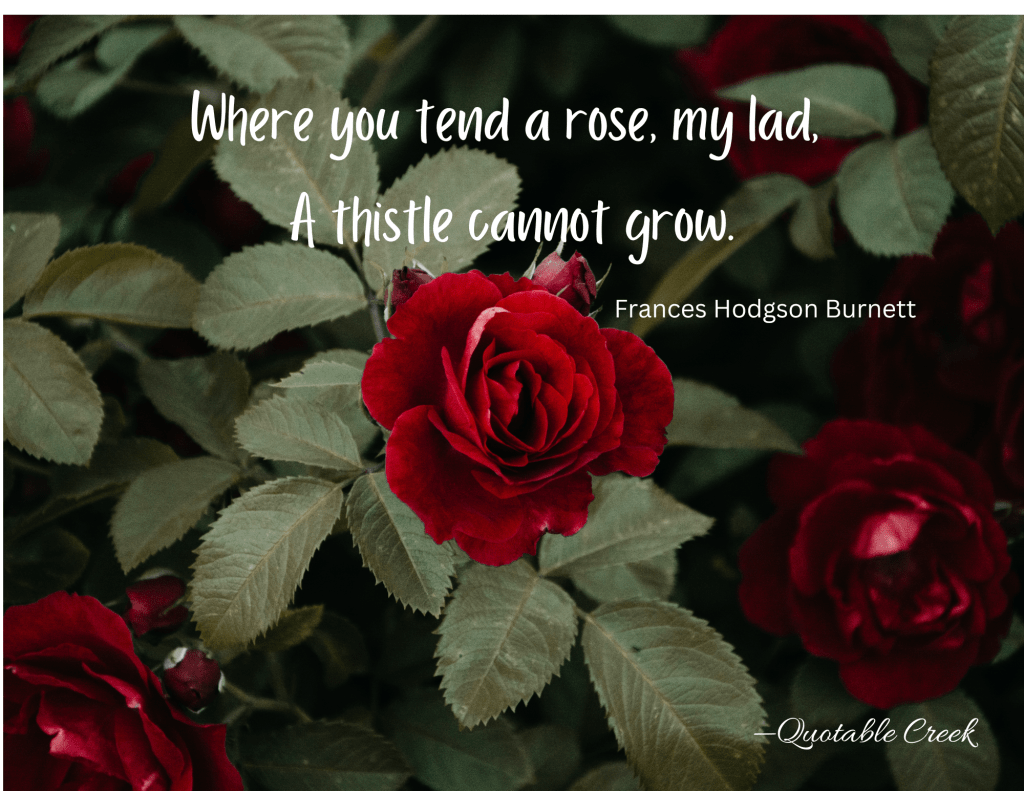
‘If you look the right way, you can see that the whole world is a garden,’ muse the characters in Frances Hodgson Burnett’s The Secret Garden. And, perhaps, on a more intimate level, so our mind is too a garden.
We cultivate our thoughts, enrich them with information, learn, grow, stretch. But weeds can overrun any garden, and we can find our minds overcome with anxiety, negative thinking, and endless catastrophic thinking.
But Burnett notes:
Much more surprising things can happen to any one who, when a disagreeable or discouraged thought comes into his mind, just has the sense to remember in time and push it out by putting in an agreeable determinedly courageous one. Two things cannot be in one place.
When we find ourselves overcome with negative thoughts, we can imagine our mind a garden. Something we can lovingly tend, plucking weeds, nourishing blooms, replacing gloom with gratitude, planting seeds of possibility and promise.
While there are many things in this world we cannot control, we still can control our thoughts and find a way to focus on ones that keep our mental garden thriving.
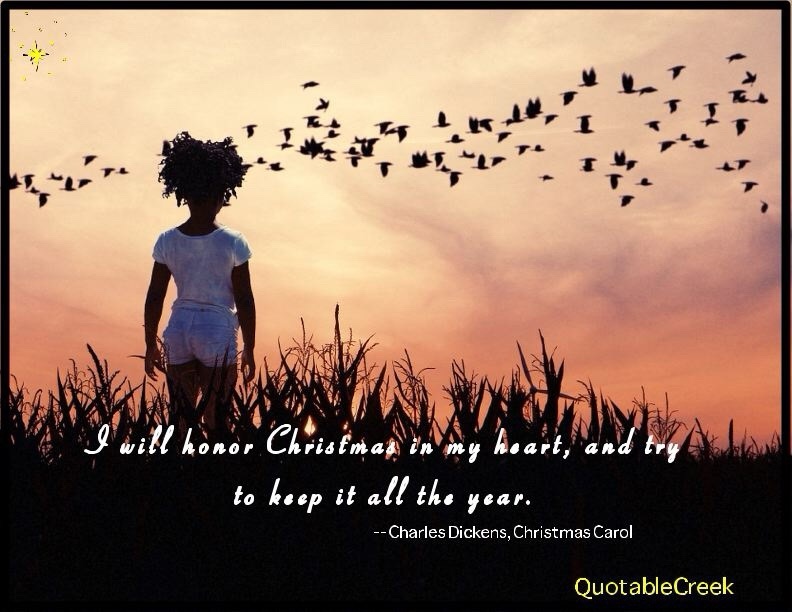
Isn’t that the bottom line of Christmas? Strip away all the decorations and gifts and songs and celebrations, and what remains is: love wins. It’s about love. God loves us, and we are to love each other. And even in a world divided by hate, blind to oneness, driven by greed, love will win. Because that’s the point of Christmas.
Just when we think we get what life is all about, something comes along to knock us upside the head and show us we have it wrong. It forces us to reevaluate our foundational assumptions about the purpose of life and look at things in a whole new way. It’s a paradigm shift.
Stephen Covey tells of a paradigm shift he experienced:
“I remember a mini-Paradigm Shift I experienced one Sunday morning on a subway in New York. People were sitting quietly — some reading newspapers, some lost in thought, some resting with their eyes closed. It was a calm, peaceful scene. Then suddenly, a man and his children entered the subway car. The children were so loud and rambunctious that instantly the whole climate changed.
“The man sat down next to me and closed his eyes, apparently oblivious to the situation. The children were yelling back and forth, throwing things, even grabbing people’s papers. It was very disturbing. And yet, the man sitting next to me did nothing.
“It was difficult not to feel irritated. I could not believe that he could be so insensitive to let his children run wild like that and do nothing about it, taking no responsibility at all. It was easy to see that everyone else on the subway felt irritated, too. So finally, with what I felt was unusual patience and restraint, I turned to him and said, “Sir, your children are really disturbing a lot of people. I wonder if you couldn’t control them a little more?”
“The man lifted his gaze as if to come to a consciousness of the situation for the first time and said softly, ‘Oh, you’re right. I guess I should do something about it. We just came from the hospital where their mother died about an hour ago. I don’t know what to think, and I guess they don’t know how to handle it either.’
“Can you imagine what I felt at that moment? My paradigm shifted. Suddenly I saw things differently, I felt differently, I behaved differently. My irritation vanished. I didn’t have to worry about controlling my attitude or my behavior; my heart was filled with the man’s pain. Feelings of sympathy and compassion flowed freely. “Your wife just died? Oh, I’m so sorry. Can you tell me about it? What can I do to help?” Everything changed in an instant.
“Many people experience a similar fundamental shift in thinking when they face a life-threatening crisis and suddenly see their priorities in a different light, or when they suddenly step into a new role, such as that of husband or wife, parent or grandparent, manager or leader.
“It becomes obvious that if we want to make relatively minor changes in our lives, we can perhaps appropriately focus on our attitudes and behaviors. But if we want to make significant, quantum change, we need to work on our basic paradigms.
“In the words of Thoreau, ‘For every thousand hacking at the leaves of evil, there is one striking at the root.’ We can only achieve quantum improvements in our lives as we quit hacking at the leaves of attitude and behavior and get to work on the root, the paradigms from which our attitudes and behaviors flow.”
(from Stephen Covey’s book, The Seven Habits of Highly Effective People)
Or consider the paradigm shift that Ebenezer Scrooge’s partner, now a ghost, Jacob Marley, recounts to him before the visit of the three Christmas ghosts in Christmas Carol. Both Scrooge and Marley thought they had life figured out–it was all about business and making money, the more the better. But Marley has had a paradigm shift since dying:
“‘But you were always a good man of business, Jacob,’ faltered Scrooge, who now began to apply this to himself.
“‘Business!’ cried the Ghost, wringing its hands again. ‘Mankind was my business; charity, mercy, forbearance, and benevolence, were, all, my business. The deals of my trade were but a drop of water in the comprehensive ocean of my business.’ “
Get ready to get hit upside the head, metaphorically speaking. It may be time for a paradigm shift.
The days before Christmas can be frantic. We sometimes find our tempers short, our tongues loose, and our wits frayed. We think of Christmas as something in the future, speeding toward us, that we need to hurry around and prepare for so that we can enjoy His coming. But a birthday, like Christmas, is a celebration of something that has already happened. And, in the case of Christmas, it is a celebration of a whole new world order that is here. We are His now, not just at Christmas. We need to shine with His love now and everyday. Particularly when the world is harried. We need to reflect the joy and peace that comes with knowing that love conquers all.
It’s getting harder to find the right presents for my granddaughters. I’m keenly feeling their growing up and the fact we are of different generations. Their world now contains so many things that I have so little clue about.
And Christmas for us, with cats in the house, requires a whole new game plan. Making things festive without creating feline hazard zones is challenging.
And, with a family filled with different eating preferences and diets, food is a puzzle.
But, as with the Whos in Whoville, Christmas will come and find us regardless of how decorated we are or how many presents are under the tree, and we will learn the underlying truth again that Christmas isn’t about the stuff. It’s about the love. And that, we have in abundance.
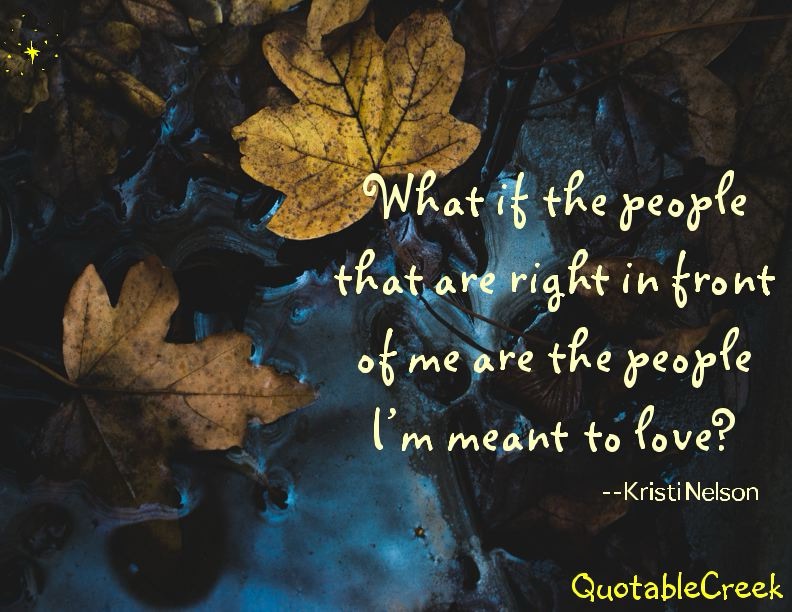
Do you have any disagreeable people in your life? People you avoid, maybe?
What if they are the ones who need love the most?
Most teachers will tell you that the child who acts out is the one most in need of love and attention. but those kids have learned to ask for it in all the wrong ways. And those children grow up, sometimes into disagreeable adults who still ask for love and attention in all the wrong ways. Maybe they have been disappointed so many times, they’ve learned to strike first, to reject you before you reject them.
Do you know anyone like that?
It’s no particular challenge to love the people who love us. But the ones who rile us, who ruffle our feathers, who are caustic and rude? That takes some serious patience and humility. But, perhaps, that is a place you are desperately needed.
The might have beens are a killer. We each take so many forks in the road, it’s easy to wonder how our lives might be if we had taken a different turn—gone to a different school, chosen a different career, picked a different partner. Those might have beens can keep us up late with longing and despair about the life we currently have. And, more importantly, they can strip those lives, the actual lives we are living, of joy.
Consider this poem by Carl Dennis:
The God Who Loves You
BY CARL DENNIS
It must be troubling for the god who loves you To ponder how much happier you’d be today Had you been able to glimpse your many futures. It must be painful for him to watch you on Friday evenings Driving home from the office, content with your week— Three fine houses sold to deserving families— Knowing as he does exactly what would have happened Had you gone to your second choice for college, Knowing the roommate you’d have been allotted Whose ardent opinions on painting and music Would have kindled in you a lifelong passion. A life thirty points above the life you’re living On any scale of satisfaction. And every point A thorn in the side of the god who loves you. You don’t want that, a large-souled man like you Who tries to withhold from your wife the day’s disappointments So she can save her empathy for the children. And would you want this god to compare your wife With the woman you were destined to meet on the other campus? It hurts you to think of him ranking the conversation You’d have enjoyed over there higher in insight Than the conversation you’re used to. And think how this loving god would feel Knowing that the man next in line for your wife Would have pleased her more than you ever will Even on your best days, when you really try. Can you sleep at night believing a god like that Is pacing his cloudy bedroom, harassed by alternatives You’re spared by ignorance? The difference between what is And what could have been will remain alive for him Even after you cease existing, after you catch a chill Running out in the snow for the morning paper, Losing eleven years that the god who loves you Will feel compelled to imagine scene by scene Unless you come to the rescue by imagining him No wiser than you are, no god at all, only a friend No closer than the actual friend you made at college, The one you haven’t written in months. Sit down tonight And write him about the life you can talk about With a claim to authority, the life you’ve witnessed, Which for all you know is the life you’ve chosen.
We have choice and agency in the life we have. It is there we find meaning and purpose. It is there, in the now, that we can find joy. Embrace that life.
We all hurt right now. Our whole world grieves the loss of what once was. The present turmoil and divisiveness weigh us down. Each of us is struggling.
But what of the children? How are they doing? How will they remember this time?
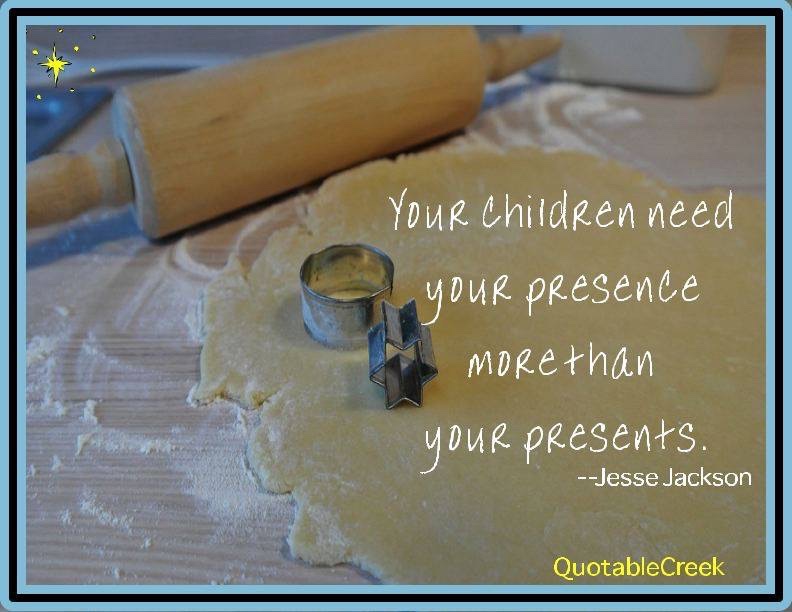
They look to us to keep them safe, to care for them, to put their needs first. They don’t understand the greater turmoil. They see, keenly, what is right in front of them. What is that?
While we may not have a ton of control over world events, we do have control over how we treat the littlest among us. Consider the profound effect your words and actions have on children just starting to be introduced to the world. Temper your anger, your frustration, your dismay. There is no harm in having a full range of emotions, and teaching children that they, too, will be subject to sadness and disappointment, frustration and anger, bewilderment and helplessness as they age. But never let them forget that you love them and are with them and that you will stay in their corners come what may.
What is hope, really, but a persistent insistence that things can be better, that there is more to it, that the final answers are yet to be revealed. Emily Dickinson describes hope as
“Hope” is the thing with feathers –
That perches in the soul –
And sings the tune without the words –
And never stops – at all –
And sweetest – in the Gale – is heard –
And sore must be the storm –
That could abash the little Bird
That kept so many warm –
I’ve heard it in the chillest land –
And on the strangest Sea –
Yet – never – in Extremity,
It asked a crumb – of me.”
And this feels right. Hope sits there perched, singing, warming our souls and keeping us fed. A wordless song because we may not even have the ability to put our emotions into words or know what it is we hope for. And this is a positive, persistent hope, but somewhat passive, waiting.
And yet, we know, too, that hope gets its fingernails dirty because while hope sits on the periphery expectant, it can also be in the fray fighting for a better world. That kind of hope is captured by Matthew @CrowsFault:
“People speak of hope as if it is this delicate ephemeral thing made of whispers and spider’s webs. It’s not. Hope has dirt on her face, blood on her knuckles, the grit of cobblestones in her hair, and just spat out a tooth as she rises for another go.”
And this, too, seems true. Hope keeps our souls fed but also prompts our entering the arena, helping us to do the hard work to make a better world for all.
And yet most of us internalize myths that we are meant to live pain-free lives and that there is always more time. How much more could we accomplish if we embrace the reality instead?
We’re breakable. But our vulnerability is our strength. And when we mend from something painful, we are likely to have tools and skills and sensitivities that may help us and make us more empathic going forward. Breaking and mending is part of growth. Part of change. Part of evolving. To be scared of breaking is to be scared of living.
Time’s short. Now is the time to reach out, apologize, help…whatever it is you’re waiting for a different day to do. There is no promised day. Things don’t just happen. Time doesn’t heal all wounds. We help heal the broken world, and our own broken selves, by continuing to love even in the darkness.



 QuotableCreek.com