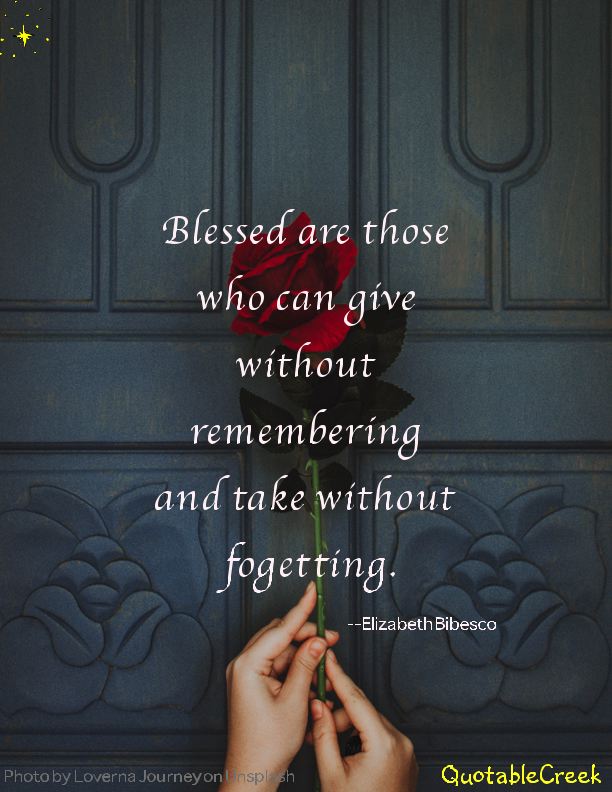
To give without remembering.

give

How many gifts come with strings? The anonymous giver is a rarity. People want attention for doing good things, sometimes more than just attention. Sometimes they want people to feel indebted….forever.

The humble taker is as rare a unicorn as the anonymous giver. The myth of the self-made man is much more palatable than the humility of a man who realizes that all he has, is, and will ever be is founded on the generosity of others, many others, who have helped.

And yet generosity without self-interest and abundant gratitude are two qualities that lead to happiness, to community, to joy. We would do well to remember these things.

For more on Anonymous Giving by this author, go here.


Mind the gap.

certainty

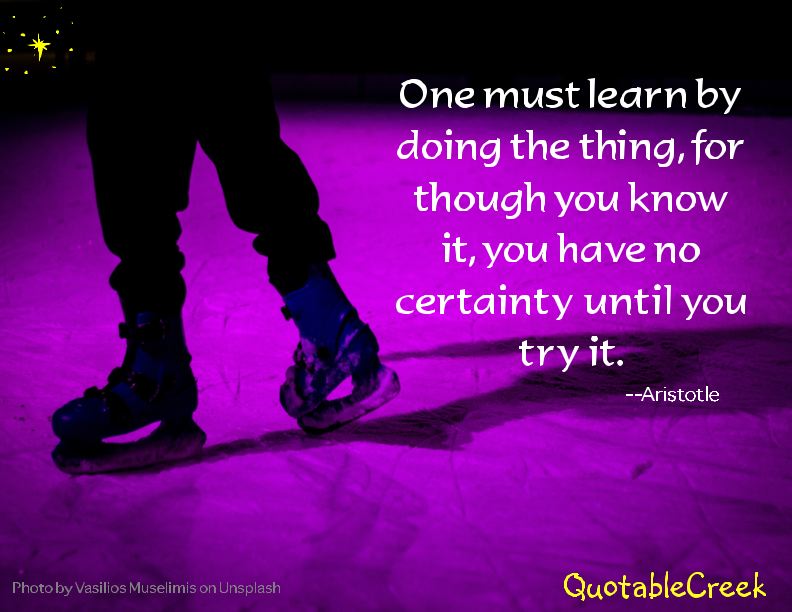
How lovely things would be if the way we picture ourselves doing something in our heads is the way it plays out in real life. The beautiful prose, perfect plotting, and subtle characterization all laying themselves down on the page when pen is lifted rather than being cruelly translated into the awkward phrasing, cliched plots, and stilted characters plaguing a first draft. If perfect leaps, spins, and arabesques just happen rather than the more likely falls on the bum. If we were already perfect rather than striving. If there were no gap between where we are and where we would like to be.

With all the armchair quarterbacks and critics out there on virtually every issue, you’d almost think effort and expertise don’t count for anything. And yet, mastery is always the result of effort. Full stop. Every master painter, skater, dancer, author, was once a novice. In fact, that journey from novice to master is the important thing, and those hacks on the sidelines are missing the point. As Theodore Roosevelt said:

It is not the critic who counts; not the man who points out how the strong man stumbles, or where the doer of deeds could have done them better. The credit belongs to the man who is actually in the arena, whose face is marred by dust and sweat and blood; who strives valiantly; who errs, who comes short again and again, because there is no effort without error and shortcoming; but who does actually strive to do the deeds; who knows great enthusiasms, the great devotions; who spends himself in a worthy cause; who at the best knows in the end the triumph of high achievement, and who at the worst, if he fails, at least fails while daring greatly, so that his place shall never be with those cold and timid souls who neither know victory nor defeat.

So this gap, between where we want to be and where we are, is where we focus our efforts and attention. Not on the critic, because everyone stumbles. But we press on. For to be great at anything takes practice and effort, and our attempt is awkward and halting, ungainly and bumbling at first. But it gets better. And those sitting on the sidelines, afraid or busy criticizing others, aren’t moving forward unless they, too, mind the gap and try.


What are the things you know for sure?

change

What is it that we can hold fast and know for sure? So much changes. Earth isn’t flat and isn’t the center of the universe although generations came and went believing that to be true. Gravity kept the planets in orbit and people from floating off long before anyone noticed and named it. Atoms existed before anyone discovered they could be split.

What is it that may be discovered in the future that can make sense of the way we act and feel now? Is there a key to explaining human behavior? A force, perhaps, that pulls people apart despite a deep desire to connect? What if there is another sense more important than the five we rely on now?

One thing good about change is it keeps you humble. Or should. Knowing that what we know is a minuscule speck in the ocean of all that can be known helps us stay open and curious. Where would the adventure be if we ever knew it all anyway?

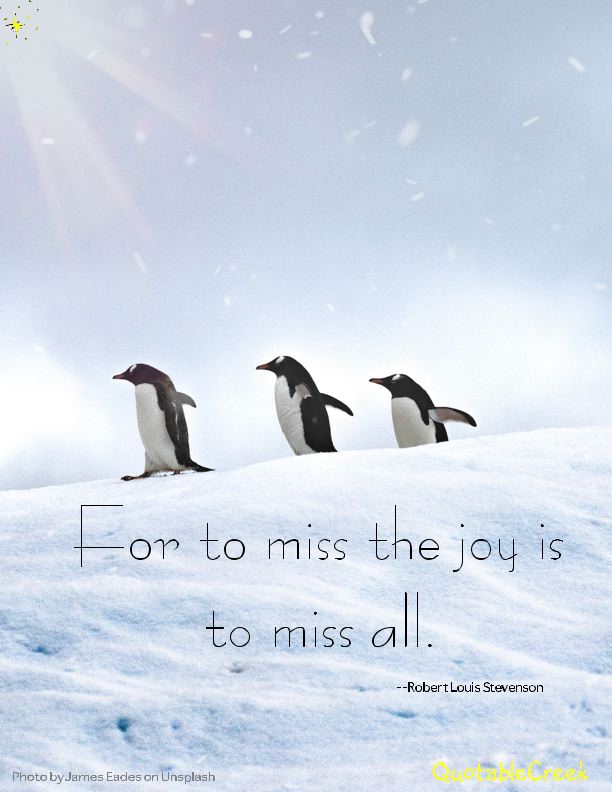
Don’t miss the joy.

penguinjoy

We generally find what we look for. We are good at it, and that skill helps us to recognize that one face in a sea of faces, to ferret out clues at a crime scene, to heed the landmarks that lead us home. But when we are trying to process a barrage of information coming at us all at once and trying to make sense of it without being overcome, we need to look for the unexpected things, the startling things, the beautiful things. We need to seek joy.

In his Book of Delights, Ross Gay goes on a mission to write about something delightful, everyday. And, while he initially thought he would have to scrounge for delights, after a bit of practice, he learned to find them everywhere. The delightful things were abundant and overflowing. More important, those delights made him realize how interconnected we are and that we are caretakers, each for the other. In a world that can seem cold and callous, we are generally good to each other:

I suppose I could spend time theorizing how it is that people are not bad to each other. But that’s really not the point. The point is that in almost every instance of our social lives, we are, if we pay attention, in the midst of an almost constant, if subtle, caretaking – holding doors open, offering elbows at crosswalks, letting someone else go first, helping with the heavy bags, reaching what’s too high or what’s been dropped, pulling someone back to their feet, stopping at the car wreck – at the struck dog, the alternating merge, also known as the zipper. This caretaking is our default mode, and it’s always a lie that convinces us to act or believe otherwise – always.

As we scrounge for our delights, we begin to see them all around us–the groceries grown and harvested for us to enjoy, the clothes crafted and sewn, the traffic signs to keep us safe, the laughter of children, birdsong, smiles from neighbors, our dog eager for her morning walk. As we notice those delights, we metaphorically feel the embrace of a larger community and feel the joy from being lucky enough to be right here, right now, plop in the middle of the mystery of it all.

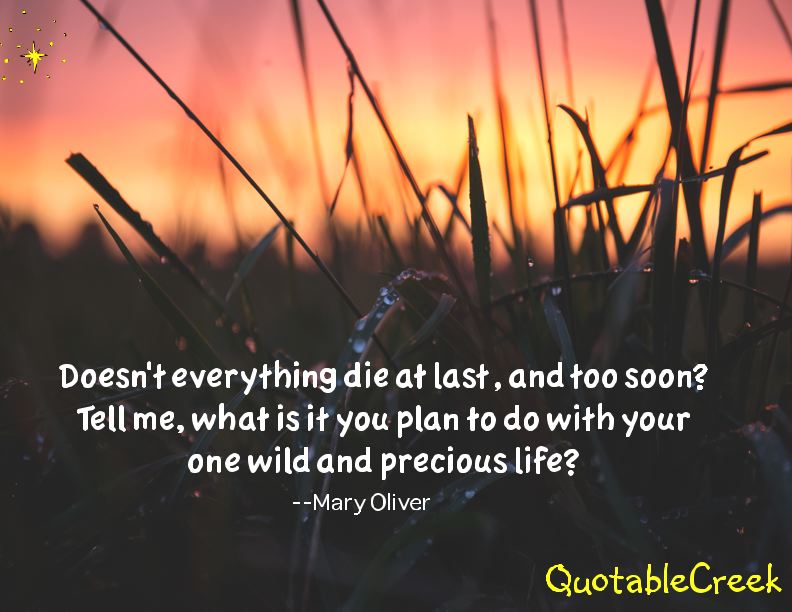
Don’t end up simply having visited this world.

wild-and-precious

Today, we say goodbye to beloved poet, Mary Oliver, but her poems remain to inspire and awaken us, to uplift us and call us to task. She had a gift for seeing the holy in the mundane and for helping each of us open our eyes a bit wider, to see. Who among us doesn’t pause to consider deeply her question: “Tell me, what is it you plan to do with your one wild and precious life?”

We are all on a one-way conveyor belt from birth to grave, but along the way we have opportunities to seize. Today, cherish these words from Mary and make sure to live:

When Death Comes

When death comes
like the hungry bear in autumn;
when death comes and takes all the bright coins from his purse

to buy me, and snaps the purse shut;
when death comes
like the measle-pox;

when death comes
like an iceberg between the shoulder blades,

I want to step through the door full of curiosity, wondering:
what is it going to be like, that cottage of darkness?

And therefore I look upon everything
as a brotherhood and a sisterhood,
and I look upon time as no more than an idea,
and I consider eternity as another possibility,

and I think of each life as a flower, as common
as a field daisy, and as singular,

and each name a comfortable music in the mouth,
tending, as all music does, toward silence,

and each body a lion of courage, and something
precious to the earth.

When it’s over, I want to say: all my life
I was a bride married to amazement.
I was the bridegroom, taking the world into my arms.

When it’s over, I don’t want to wonder
if I have made of my life something particular, and real.
I don’t want to find myself sighing and frightened,
or full of argument.

I don’t want to end up simply having visited this world.

Tickling the funny bone.

dogs

They comfort us, love us, trust us, understand us and make us laugh.We chuckle when they scratch at the door only to steal our seat when we get up to let them out. Sometimes their funny little ways can brighten our days. But what can we do to make them laugh? How can we amuse them? In a blast from the past, very young comic Steve Martin answers this question in a way that is sure to brighten your day.

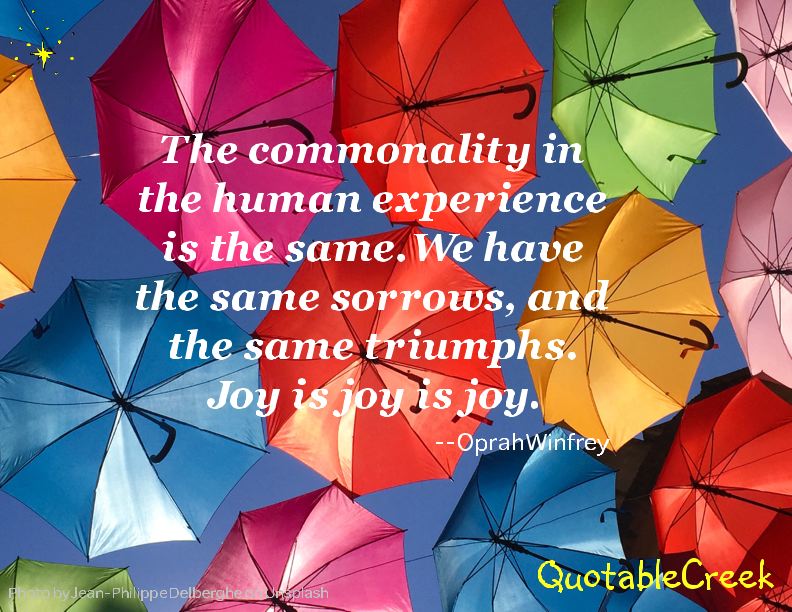
Joy is joy is joy.

joyis

We all are finding our way home. The people we think are the most different from us are really on the same journey. We share this emotional experience that is life–the frustration of setbacks, the joy in birth and creation, the anguish of loss, the delight in discovering a twin soul. If there were some way to view our journeys superimposed on top of each other, so that we could see all the connections we have with each other, that would be a cool eye-opening experience. In the mean time, consider this video of all the different types of creatures using the same foot bridge.

Joy is joy is joy.

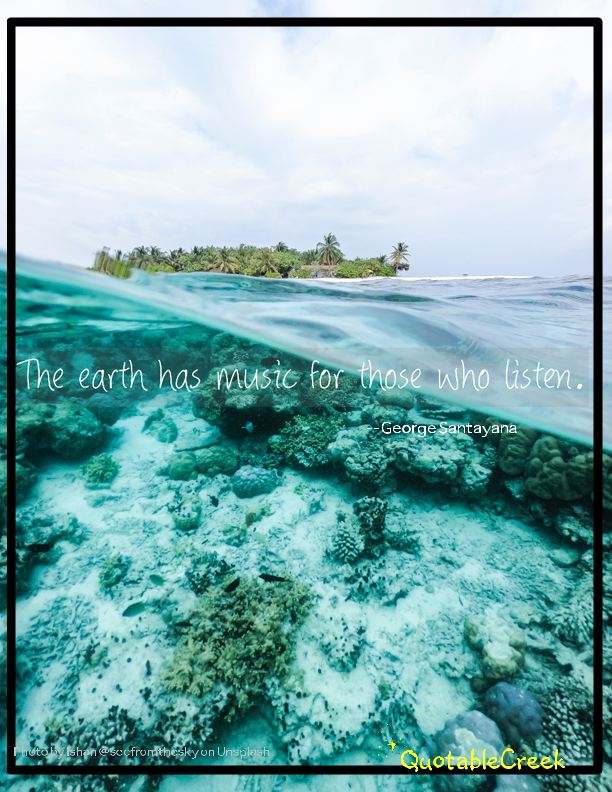
A peek behind the veil.

earth's music


Often life doesn’t make sense. So many petty squabbles, too much injustice, difficulties, disagreements, struggle. Why? What for? What’s the point? And then something remarkable happens, and we can see behind the veil to the beauty of things, the mystery. For a moment we feel a communion with each other and with all living things. We can stand in awe of creation.

For just such a moment, take time to watch this surfer communing with dolphins. It’s beautiful.


Seize the day.

berries

Today is the day. Seize it, use it, enjoy it, fill it up with meaning and truth. Don’t wait until tomorrow. Now. Today. Here. This moment right here, right now, holds all your opportunities for action.

How to keep Christmas.

xmasheart

Love wins.

Isn’t that the bottom line of Christmas? Strip away all the decorations and gifts and songs and celebrations, and what remains is: love wins. It’s about love. God loves us, and we are to love each other. And even in a world divided by hate, blind to oneness, driven by greed, love will win. Because that’s the point of Christmas.

It’s about the love.