Of mists and mellow fruitfulness.

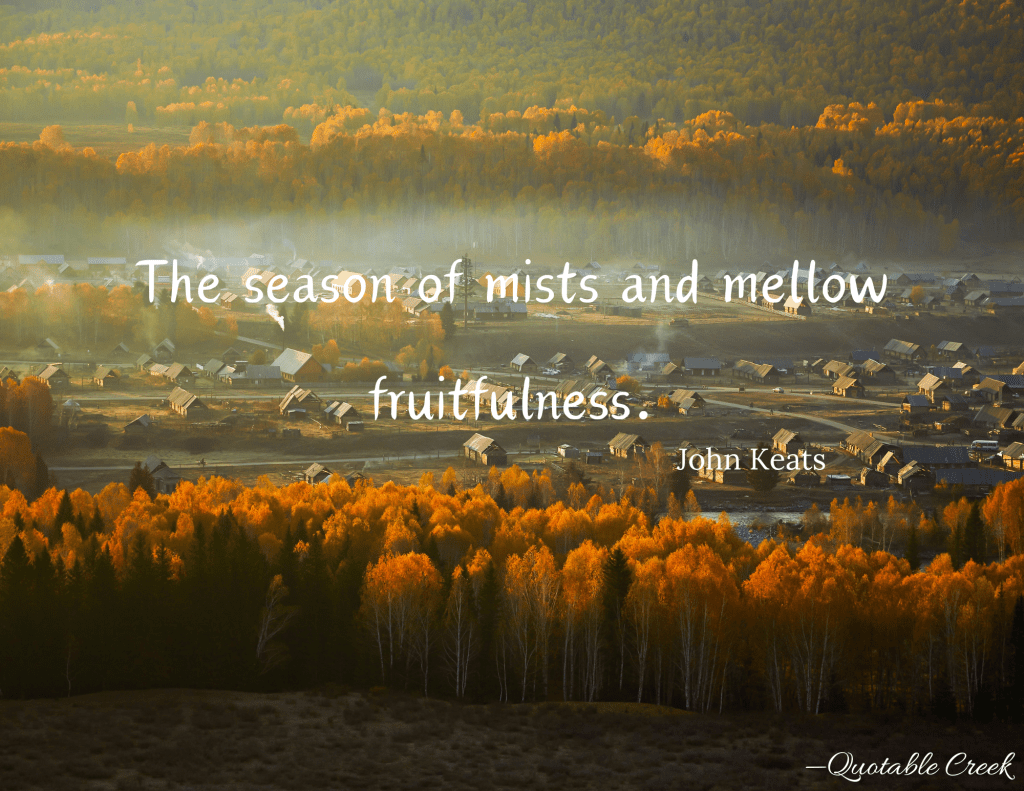
According to Keats, autumn is the season of mists and mellow fruitfulness. Isn’t that a lovely turn of phrase? So evocative. Can’t you feel the cool mist sifting its way through the treetops to settle on the dewy grass?

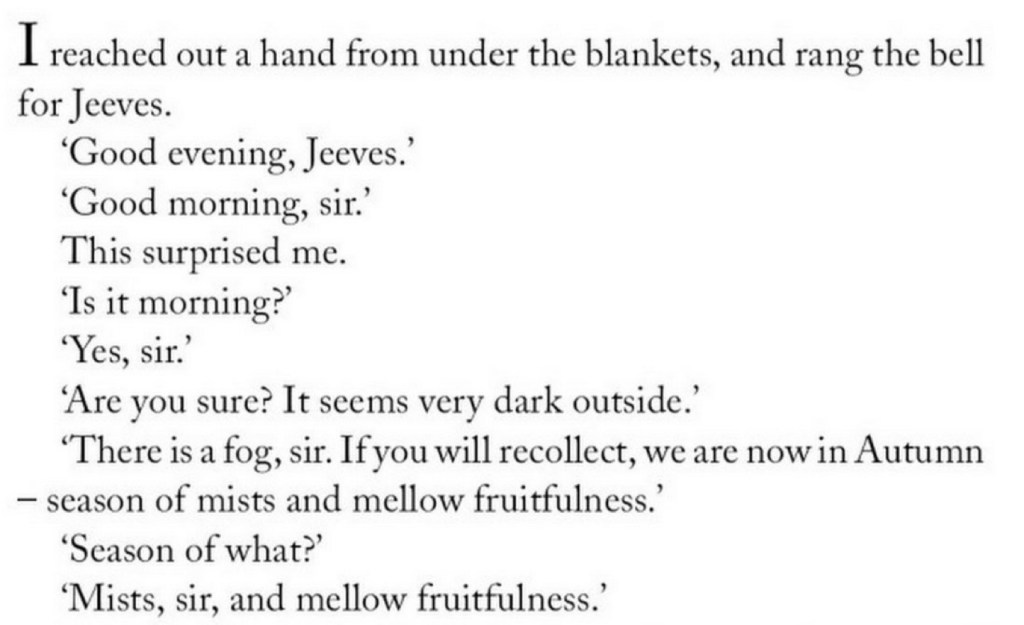
Here that phrase is in fictional conversation in a book by P.G. Wodehouse:

Isn’t that delightful?

Welcome to the season of mists and mellow fruitfulness. Enjoy the poem To Autumn by John Keats:

Season of mists and mellow fruitfulness,

   Close bosom-friend of the maturing sun;

Conspiring with him how to load and bless

   With fruit the vines that round the thatch-evesrun;

To bend with apples the moss’d cottage-trees,

   And fill all fruit with ripeness to the core;

      To swell the gourd, and plump the hazel shells

   With a sweet kernel; to set budding more,

And still more, later flowers for the bees,

Until they think warm days will never cease,

      For summer has o’er-brimm’d their clammy cells.

Who hath not seen thee oft amid thy store?

   Sometimes whoever seeks abroad may find

Thee sitting careless on a granary floor,

   Thy hair soft-lifted by the winnowing wind;

Or on a half-reap’d furrow sound asleep,

   Drows’d with the fume of poppies, while thy hook

      Spares the next swath and all its twined flowers:

And sometimes like a gleaner thou dost keep

   Or by a cyder-press, with patient look,

   Steady thy laden head across a brook;

      Thou watchest the last oozings hours by hours.

Where are the songs of spring? Ay, Where are they?

   Think not of them, thou hast thy music too,—

While barred clouds bloom the soft-dying day,

   And touch the stubble-plains with rosy hue;

Then in a wailful choir the small gnats mourn

   Among the river sallows, borne aloft

      Or sinking as the light wind lives or dies;

And full-grown lambs loud bleat from hilly bourn;

   Hedge-crickets sing; and now with treble soft

   The red-breast whistles from a garden-croft;

      And gathering swallows twitter in the skies.
Everyday saints.

Sometimes I think saints must have been extraordinary people, somehow different from the rest of us lugs, vested, perhaps, with some superior spiritual gifts or insights.

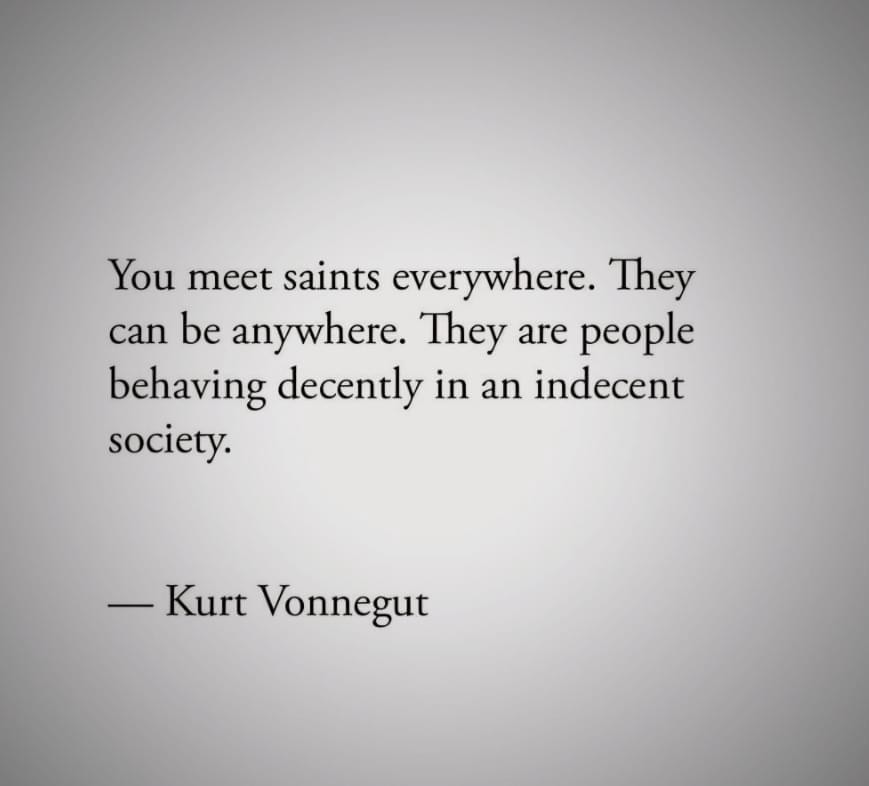
But then I realize, as did Vonnegut below, nope, just people like us, doing their best.

Whether we are ever canonized or not, this is our ‘job,’ isn’t it? To ‘behave decently in an indecent society’.

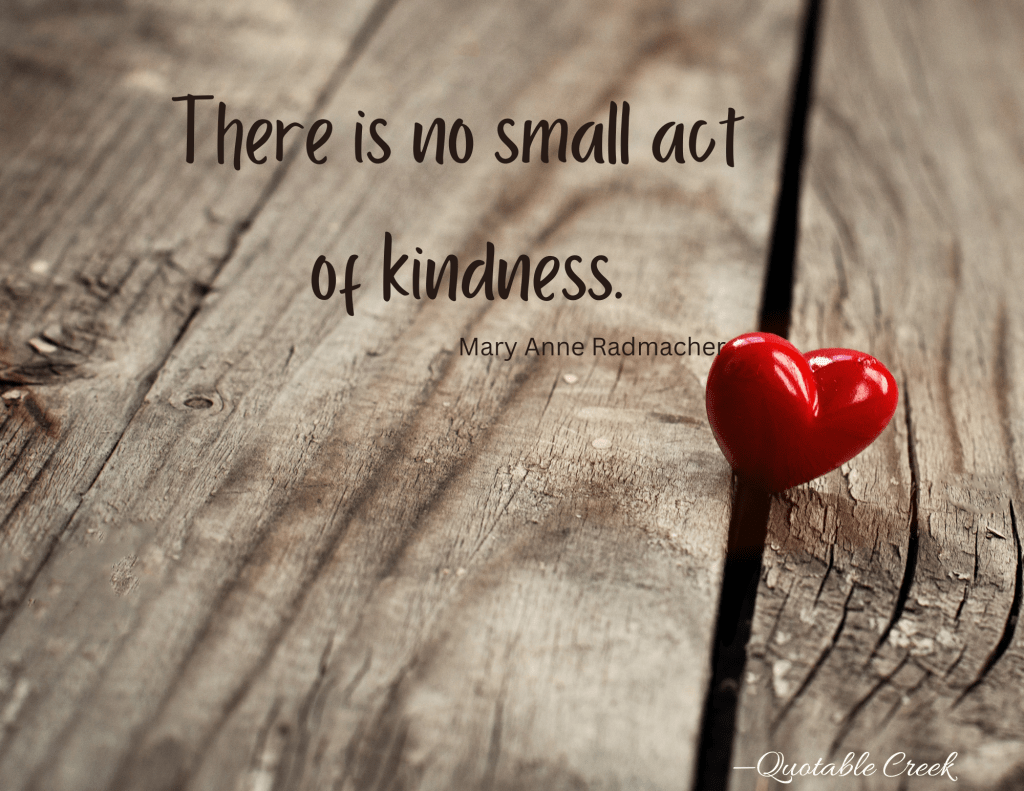
And then comes the hard part, to trust that your behaving decently will make a difference, whether you ever know about it or not.

Just keep making those ripples.

I’m ready.

I’m listening, world. What do you have to teach me? Where should my attention be, to understand and, finally, get it, the great purpose and plan of it all?

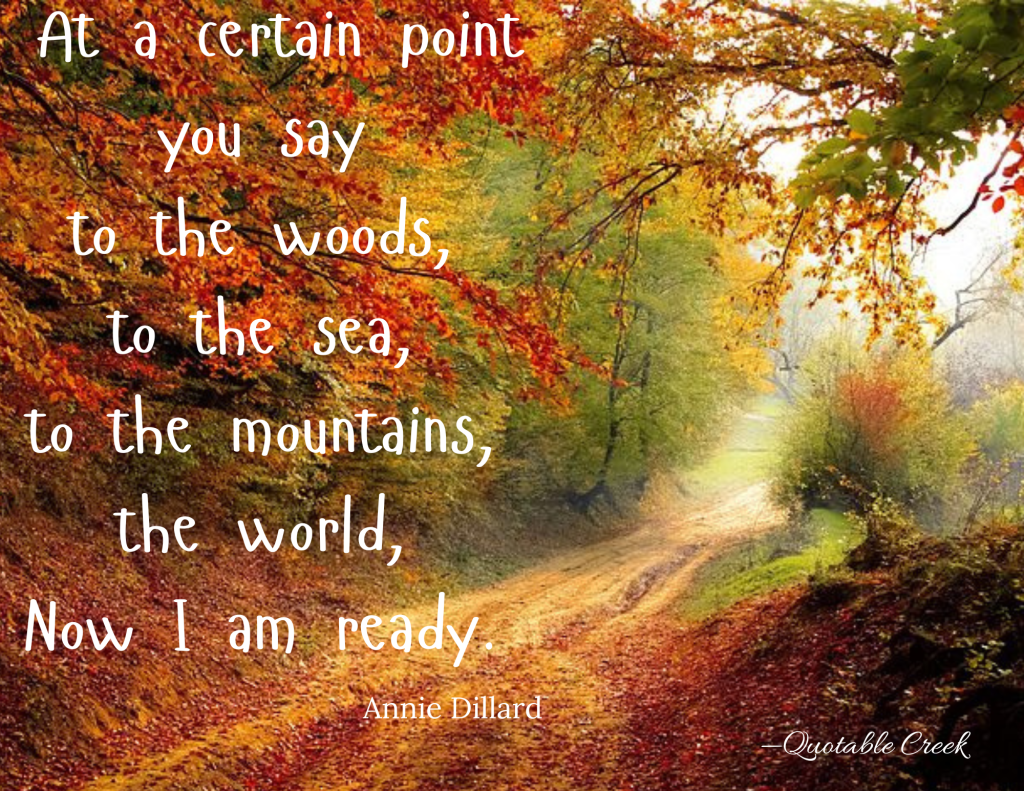
Annie Dillard, in Teaching a Stone to Talk writes:

At a certain point, you say to the woods, to the sea, to the mountains, the world, Now I am ready. Now I will stop and be wholly attentive. You empty yourself and wait, listening. After a time you hear it: there is nothing there. There is nothing but those things only, those created objects, discrete, growing or holding, or swaying, being rained on or raining, held, flooding or ebbing, standing, or spread. You feel the world’s word as a tension, a hum, a single chorused note everywhere the same. This is it: this hum is the silence. Nature does utter a peep – just this one. The birds and insects, the meadows and swamps and rivers and stones and mountains and clouds: they all do it; they all don’t do it. There is a vibrancy to the silence, a suppression, as if someone were gagging the world. But you wait, you give your life’s length to listening, and nothing happens. The ice rolls up, the ice rolls back, and still that single note obtains. The tension, or lack of it, is intolerable. The silence is not actually suppression: instead, it is all there is.

And later:

The silence is all there is. It is the alpha and the omega. It is God’s brooding over the face of the waters; it is the blended note of ten thousand things, the whine of wings. You take a step in the right direction to pray into this silence, and even to address the prayer to ‘World.’ Distinctions blur. Quit your tents. Pray without ceasing.

Perhaps the aha moment isn’t in understanding as much as in being, a part within a vast whole, caught up in the mystery and the magnitude.

Why is beauty?

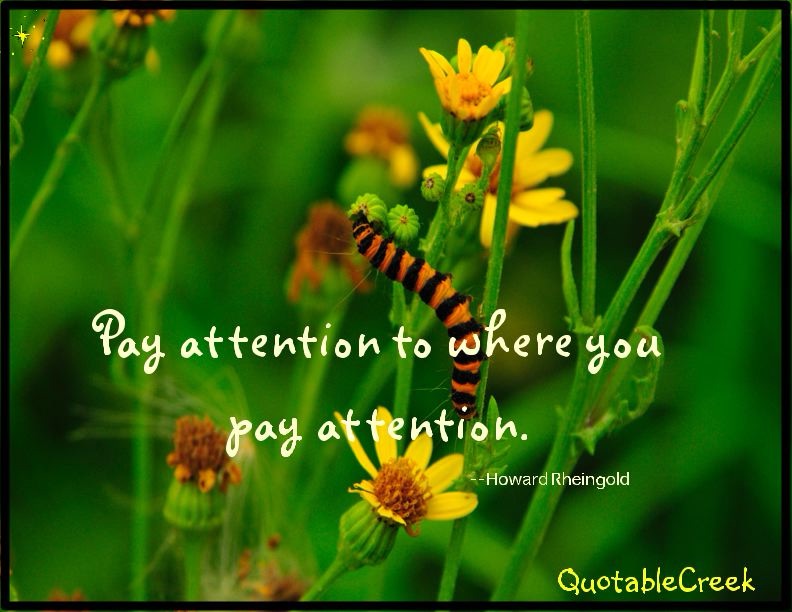
Have you ever wondered why everything is so beautiful? Have you stood rapt in the brilliant colors of a sunset, or listening to birdsong in the morning, or watching the way a caterpillar humps along with all its little feet working together? Perhaps there are logical, book smart reasons, like flowers are beautiful to attract bees, or animals are beautiful to attract mates or to warn predators they’re toxic, or some such thing, but don’t those answers beg the question really? Why is beauty? Could the answer be that it is to inspire awe in us? And our job is to notice.

A master violinist can play Bach on a precious instrument, and most people will just walk by:

We are living in a place filled with beauty if we only stop to notice. For inspiration, consider Mary Oliver’s poem, The Summer Day:

The Summer Day

Who made the world?
Who made the swan, and the black bear?
Who made the grasshopper?
This grasshopper, I mean-
the one who has flung herself out of the grass,
the one who is eating sugar out of my hand,
who is moving her jaws back and forth instead of up and down-
who is gazing around with her enormous and complicated eyes.
Now she lifts her pale forearms and thoroughly washes her face.
Now she snaps her wings open, and floats away.
I don't know exactly what a prayer is.
I do know how to pay attention, how to fall down
into the grass, how to kneel down in the grass,
how to be idle and blessed, how to stroll through the fields,
which is what I have been doing all day.
Tell me, what else should I have done?
Doesn't everything die at last, and too soon?
Tell me, what is it you plan to do
with your one wild and precious life?

What a gift we have been given to have the chance to notice the beauty all around us today!

Tortoise and the hare

I’ve been watching Lessons in Chemistry, based on a wonderful book. One part stood out for me last night. A dog character, Six Thirty, remembers why his person, Calvin, said he loves running. Calvin said even when it is hard or you don’t think you can go on anymore, you just keep putting one foot in front of the other.

“One foot. One foot. And then sure enough, you’ll be home.”.

Isn’t that profound? In this life, we keep putting one foot in front of the other, until we’re home.

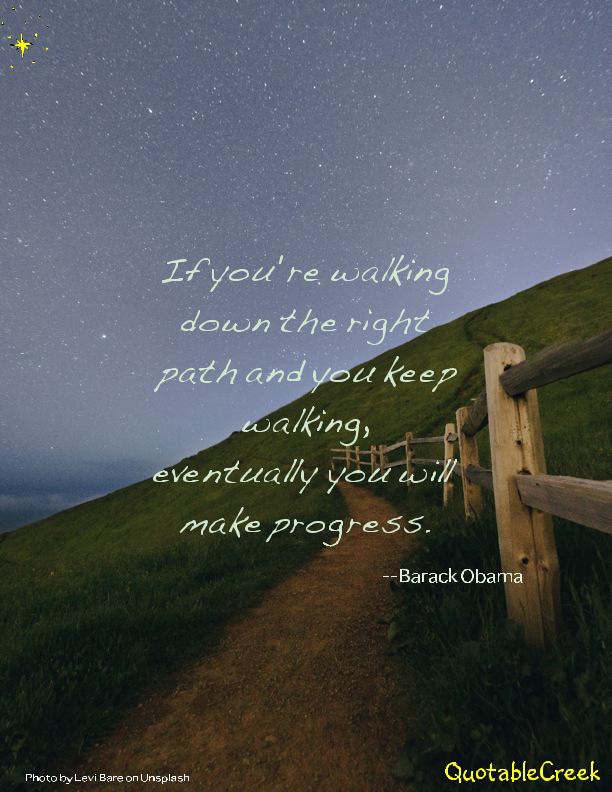
Slow and steady wins the race. We get discouraged and stop, or chase after another enticing goal, or turn back. But, if we stay true, we will make progress. One foot, one foot.

Remember the tortoise and the hare? They had a rematch recently:

This is my yopp.

Sometimes turning off the news is the best form of mental health protection.

But then we remember. In times of darkness, there are always those working to light a path, helping, fighting for the common good, making progress.

And maybe we, too, can help.

Maybe not in large, brokering peace kind of ways. But in small ways that, combined together with the small ways of many, many others, may help to right a wrong or turn a tide.

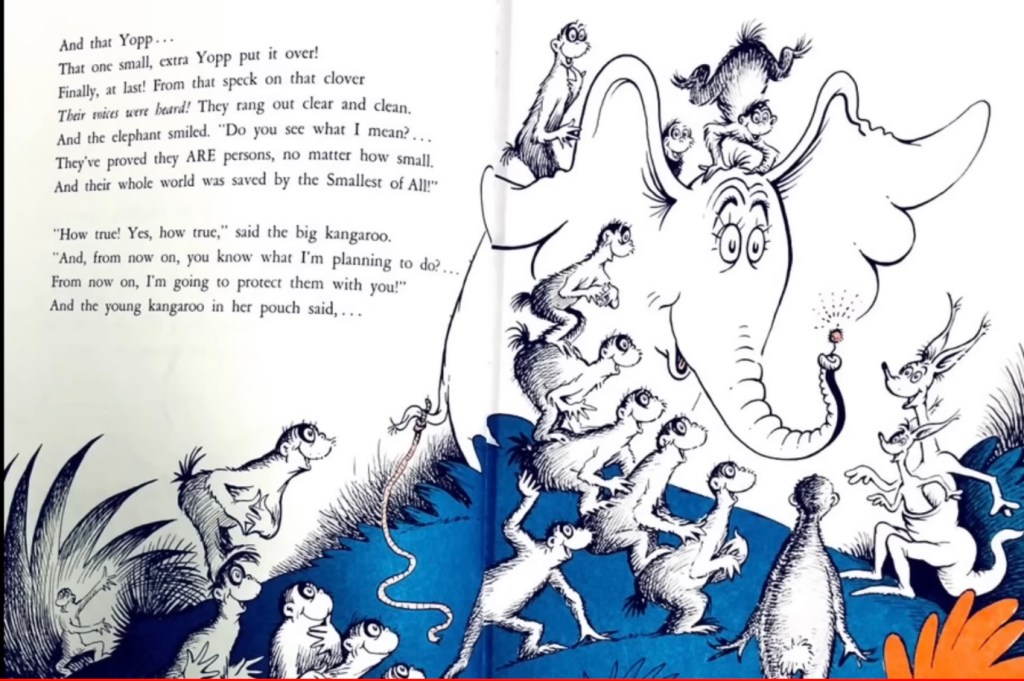
I think of Horton Hears a Who by Dr. Seuss, everyone shouting and banging on pots to be heard, but it is the final Yopp of a child that turns the tide, saving their world.

What is your ‘Yopp’?

The formula of gratitude

What is the formula for a happy life? What are the variables? How do things like gratitude and expectations factor in?

In his essay, The Structure of Gratitude, David Brooks says:

I’m sometimes grumpier when I stay at a nice hotel. I have certain expectations about the service that’s going to be provided. I get impatient if I have to crawl around looking for a power outlet, if the shower controls are unfathomable, if the place considers itself too fancy to put a coffee machine in each room. I’m sometimes happier at a budget motel, where my expectations are lower, and where a functioning iron is a bonus and the waffle maker in the breakfast area is a treat.

Included in, The Way of Gratitude, Readings for a Joyful Life.

He concludes that “Gratitude happens when some kindness exceeds expectations, when it is undeserved.” So, maybe as a formula it would look like “If kindness>expectations= gratitude.” So are our expectations the linchpin variable. To be happy and grateful, we should keep our expectations low? Or is there more to it?

He notes that there are some people who are ‘dispositionally’ grateful:

These people may have big ambitions, but they have preserved small anticipations. As most people get on in life and earn more status, they often get used to more respect and nicer treatment. But people with dispositional gratitude take nothing for granted. They take a beginner’s thrill at a word of praise, at another’s good performance or at each sunny day. These people are present-minded and hyper-responsive. This kind of dispositional gratitude is worth dissecting because it induces a mentality that stands in counterbalance to the mainstream threads of our culture. We live in a capitalist meritocracy. This meritocracy encourages people to be self-sufficient–masters of their own fate. But people with dispositional gratitude are hyperaware of their continual dependence on others. They treasure the way they have been fashioned by parents, friends and ancestors who were in some ways their superiors. They’re glad the ideal of individual autonomy is an illusion.

Included in, The Way of Gratitude, Readings for a Joyful Life

What a powerful way to look at things. In a very real sense, people with dispositional gratitude are able to see behind the veil into a truer, richer reality, full of wonder and generosity beyond anything any one of us deserves or merits. They are witnesses to the abundance we all share but few notice. Any one of us is capable of dropping our expectations and stepping into a magical world full of abundance if only we have the eyes to see.

The invisible essential.

Not long ago, the world shut down, and most people were asked to sequester and stay home while essential workers reported, still, for duty. It was a strange time, involving so many swiftly moving facts to assimilate and assess forward progress.

But that question of ‘essential’ is an interesting one. Some of the jobs labeled ‘essential’ or not were surprising choices.

How does one determine what is ‘essential’? What of the artist? With so many schools cutting art and music programs as non-essential, I wonder what the world would look like filled just with grammarians and mathematicians. Surely, art, though it puts no food on the table and sets no broken bones, is essential to the human spirit.

Such is the theme of Frederick by Leo Lionni. While four mice toil to set up stores of grain for winter, one mouse collects color, and sounds, and words.

And when winter came, and the mice were cold and hungry, Frederick’s words sustained them.

So lift a glass in praise to the artists, the writers, the musicians. Those who lift us up and sustain us and offer us beauty for our souls.

Strong in the broken places

Life can be tough. Even the most charmed of lives has loss and heartbreak, disillusionment and despair. Everyone hurts. But buried deep under the hurt and pain is the little waif you used to be, full of hope and promise, enthusiasm and excitement.

As Irish poet and philosopher John O’Donohue notes:

Your identity is not equivalent to your biography. There is a place in you where you have never been wounded, where there is still a sureness in you, where there’s a seamlessness in you, and where there is confidence and tranquility in you.

The intention of prayer and spirituality and love is now again to visit that inner kind of sanctuary.

Deep in there, behind the daily worries, aches and pains, hurts and disgruntlements, is your soul. Prayer, staying still and letting your mind clear in meditation, will take you there, again and again, a way to connect with both your own individuality and your place in the awesome collective of it all.