In challenging times, there are always bright moments of light to lift us up. People singing from balconies out onto deserted streets in Italy, others joining together to amplify the voices of the unheard, and, in one of the most delightful examples, an out of work sports color commentator putting his talents to use to give people a glimmer of cheer during dark times. Sidelined by the coronavirus and the consequent shut down of sports, Andrew Cotter has been making videos providing the color commentary for his two dogs’ adventures. Meet Olive and Mabel as you make way for a bit of delight:
Have you ever stopped to think about how many little coincidences had to happen for you to be in just the spot that brought you to meet your favorite people? And yet, they seem made for you. They are a blessing to you. What a miracle that is. That all those twists and turns your life has taken has brought you to this place and these people to care about.
The whole poem, excerpted above, is stunning:
Out of the Mist
Out of the mist of a million probable worlds,
Out of the dizziness of a long dream,
Like a bee that found its nectar in a field of stones,
Or a poet who heard his heart’s music amid cries of war;
The precision was that of divine intervention,
Art born of deeper beauty,
And just like birds find home after a long winter,
And a smile finds its way to a melancholy face,
I found you.
by Lahab Asset AlJundi, included in Healing the Divide, Poems of Kindness & Connection, Edited byJames Crews
Today, let us be grateful for all those coincidences that brought us to our people.
“In one of John Muir Laws’s books, I read something profound that changed the way my brain thinks. “As you draw the bird,” he writes, “try to feel the life within it.” So now I look at the bird before me and imagine how it senses the world, how it feels breathing cold air, how it feels to have its feathers ruffling in the wind, how it feels to always have an eye out for possible food and possible predators. The bird sees me and is a nanosecond from flying off, but it stays. Why? By imagining the life within, the bird I am drawing is alive, no longer a shape and its parts, but a thinking, sentient being, always on the brink of doing something. By feeling the life within, I am always conscious that all creatures have personalities, and so do trees and clouds and streams. To feel the life within, I now imagine myself as the bird that is looking at me. I imagine its wariness, the many ways it has almost died in its short life. I worry over its comfort and safety, and whether I will see my little companion the next day, the next year. To feel the life within is to also feel grief in the goneness of a single creature or an entire species. Imagination is where compassion grows. Let us join with children to imagine and wonder, to use curiosity as the guide to miracles in plain sight. Let us enter with them into wild wonder so that we become guardians together of all that is living and all that must be saved.”
From Orion Magazine, “The Life Within”.
I wonder if we can look at each other that way, as something vaster, as thinking sentient beings with worlds of experience, some harsh. Would that help us to treat each other better? In her book, Dead Man Walking, Sister Helen Prejean describes just this sort of thing as she works with a death row inmate, a man who admittedly committed a heinous act, seeing not just the man but also, though covered with tattoos and bathed in bravado, the little wounded child within. That empathy allowed her to see past the crimes to the human and to feel compassion for him.
Perhaps today we can look with new eyes to see each other as a composite of good and bad, but each fully human and fully deserving of respect and compassion. To paraphrase Amy Tan above, when we consider the person, can we try to picture the life within, the challenges and struggles, hopes and triumphs? Can we become, together, ‘guardians of all that is living and must be saved’ in a place where ‘compassion grows’?
Sometimes we clench our jaws and build up our walls so that no one will hurt us or challenge us. We try to protect ourselves this way, but instead we become isolated. The people we’ve locked out feel threatening to us, so we make our guard stronger and more impenetrable. And we grow more isolated and afraid.
Brené Brown describes vulnerability as “uncertainty, risk, and emotional exposure.” It’s that unstable feeling we get when we step out of our comfort zone or do something that forces us to loosen control. But our strength is in our vulnerability, and when we open to pain, we also open to joy and connection. It is our authentic selves that hunger for connection, not the masks and shows we put on. Brenè Brown continues this way:
“I wasn’t taught how to deal with uncertainty or how to manage emotional risk. I spent a lot of years trying to outrun or outsmart vulnerability by making things certain and definite, black and white, good and bad. My inability to lean into the discomfort of vulnerability limited the fullness of those important experiences that are wrought with uncertainty: Love, belonging, trust, joy, and creativity to name a few. Learning how to be vulnerable has been a street fight for me, but it’s been worth it.”
The world isn’t black and white. It is nuanced and a zillion shades of gray. As are people, including you. As we open to our own authentic selves, and risk sharing that self with others, we open more fully to life, to experience, and to genuine connection with others.
For more, here is her original TED talk on vulnerability, a talk that has resonated with millions over the years.
Sometimes everything comes down to how we see a situation. Will we get irritated by something or consider it an opportunity to build community? Often children with their winsome ways and guilelessness cause us to adapt. Take a moment to watch this life-affirming story about a man who took an unusual approach to a child riding a bike in his driveway. What a beautiful neighborhood they are creating together!
In this interview, Brené Brown discusses the complexity of emotions we are experiencing as a result of the pandemic and social isolation. Her words bring comfort and solace to all of us, but particularly those of us raised to believe that only positive emotions should be felt or expressed.
These are tough times. And it’s particularly difficult because this is not an emergency you have to gear up for and get through; it’s a slow burn. As she says:
“Normally, in order to get through a crisis, you know, our bodies are built to respond with a lot of adrenaline, a lot of energy, a lot of super coping surge. And then the waters recede or the fires are out or, you know, the crisis ends and we slog our way through kind of cleanup and trying to find our new normal. But we are not going to be able to depend on the adrenaline surge for this, because it’s going to out- it’s going to outpace us. And I think we are hitting that moment where we are weary in our bones. We are physically tired. We, you know, anxiety, uncertainty take a lot out of us physically. I think, you know, we’re on Zoom calls. I don’t know what happened. Like, I work a lot to begin with, but I feel like I’m on Zoom calls from 6:00 in the morning until midnight. You know, and then we’ve got toddlers crawling up our backs and partners trying to, you know, tell us to be quiet. They’re also are being called. And we’re tired. And I’ll tell you, the other thing that’s exhausting; that we are not acknowledging – again as a collective – is grief.”
And the grief is perhaps more extensive than any we’ve felt before. It’s grieving a loss of everything that was normal to us. Brown explains, “Well, I think it’s a very difficult position we’re in right now because I think we are both grieving the loss of normal and grieving the ordinary moments that make the touchstones for our lives. We’re grieving the loss of those at the very same time we’re having to find and settle into a new normal. And those two things are very difficult to do. At the same time, not mutually exclusive, but as close as it gets without being mutually exclusive. So there’s grief, I think. Grief is the loss of normal.”
And it is ok to experience that grief and mourn those losses. We are vulnerable, and there is no shame in acknowledging that:
“To be alive is to be vulnerable, to be in this pandemic, is to be vulnerable every second of every minute of every day. And the thing about vulnerability is it is difficult, but it’s not weakness. It’s the foundation and the birthplace of courage. There is no courage without risk, uncertainty and exposure. And so, you know, I’ve asked 10000 people that this question, starting with special forces military: give me an example of courage in your life that did not require uncertainty, risk and emotional exposure. And in probably 15 thousand people at this point, not one person has been able to give me an example of courage that did not require vulnerability. So we need to dispel that mess and we need to acknowledge we are in a lot of vulnerability right now. That means we can be our best, bravest selves or we can be our worst selves, and I think the thing about choosing to be our most courageous selves is having to understand this is another method to style that most of us know we’re taught growing up that we’re either brave or afraid, that the truth is we can be brave and afraid at the exact same time. Most of us are in these moments today.”
We can be brave and afraid at the exact same time. We can be strong in our vulnerability. And, even though we are living a new normal, we can choose how we show up there.
Many are on the front lines of this pandemic, either working in health care or in essential jobs to keep the world moving, while others of us are on the sidelines waiting. We worry about ourselves, but also about our friends and family members on the front lines. Will they be safe? What are the right words to encourage them and let them know we love them?
In this interesting article, health care worker Dorothy E. Novick suggests Ring Theory as a way to modulate our expressions of concern. It works like this:
“I came across an article about “Ring Theory,” written by Susan Silk and Barry Goldman. In this construct, we imagine a person who is suffering, like Margi, sitting in a small circle surrounded by concentric rings. Her dearest relatives sit in the circle closest to her. Best friends sit in the next larger circle. More friends and colleagues occupy the next one. And so on.
“According to Ring Theory, a person in any given circle should send love and compassion inward, to those in smaller circles, and process personal grief outward, to those in larger circles. To Margi and her mother, I should have said, “I love you, and I’ll do everything I can to support you.” And only when talking to others should I have said, “Her suffering feels impossible to bear.
“Comfort in, grief out.
“Ring Theory works for supporting health-care providers during the trauma of covid-19. We are grappling with a complex duality of mission plus terror. We are proud of what we can contribute and passionate about our patients’ well-being. But we are frightened — for our safety, for our patients, for the spouses and children we might expose.”
When we speak with people working in positions of danger, practicing Ring Theory makes good sense. Our comfort, praise, and admiration gives those heroes strength and helps them continue. Our hysteria or forwarding doomsday articles simply doesn’t. In all of this, we should strive to do no harm and let our words offer comfort.
Novick relates a message she received that helped give her comfort, a message that gives us a good example for how we can show up for people in dangerous positions right now:
The message read, “I am holding you in my heart being on the front lines of these difficult times. The professional skill, kindness, support and tenacity you give your patients and your medical community I am sure is a comfort in this darkness. Sending much love, appreciation and admiration.
“My heart rate slowed and my skin warmed over as I read the message. Then I pulled my mask over my face and opened the door to the next patient room.”
That, right there, is the power of the right words at the right time. We each have that power to do good right now.
Sometimes we are surprised. Things aren’t as we expect, and that is delightful. Like this story of a male Mandarin wood duck, native to East Asia, in Central Park.
How did it get there? The mystery of it can’t help but raise all sorts of fanciful explanations, and the duck’s beauty can’t help but cause us to stop and marvel. What are we walking right past today? Perhaps we can stop and marvel.
Danny Ursetti put together this delightful musical montage, an ode to this wood duck in Central Park and to joy. Enjoy!
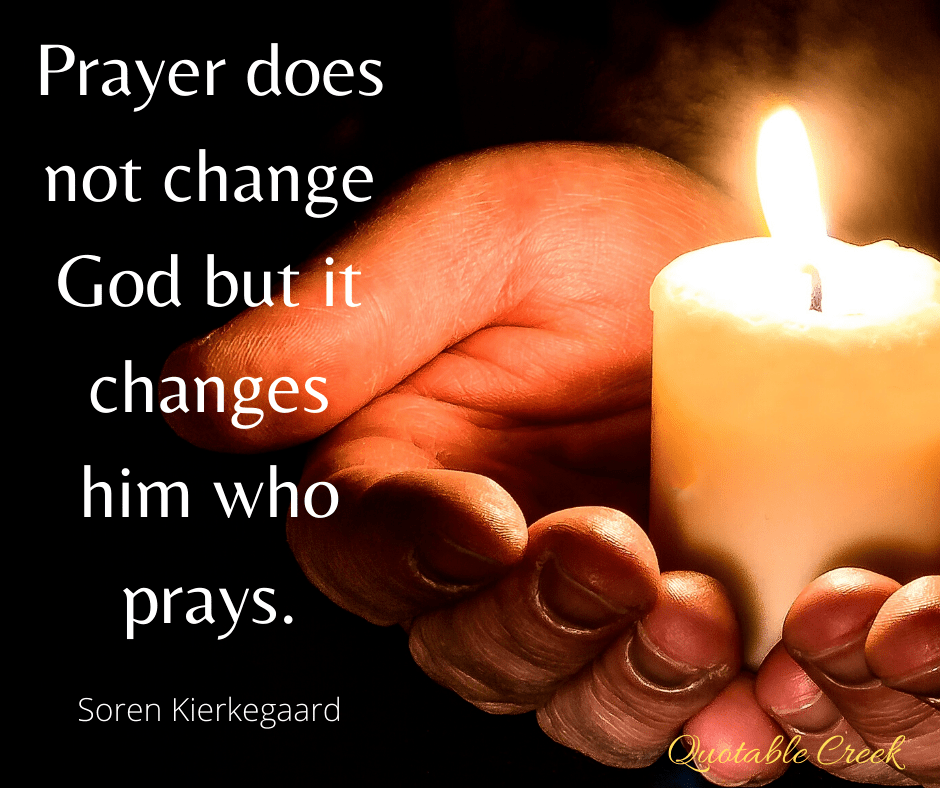
In a grieving, struggling world, we pray. Full of humility, we fall to our knees. Gobsmacked by the fragility of life and the interconnectedness of all creation, we lift our eyes to the Lord and join voices around the world to offer thanks, plead for mercy, and reach for hope.
Never before has it been more obvious that we belong to each other and are all in this together.
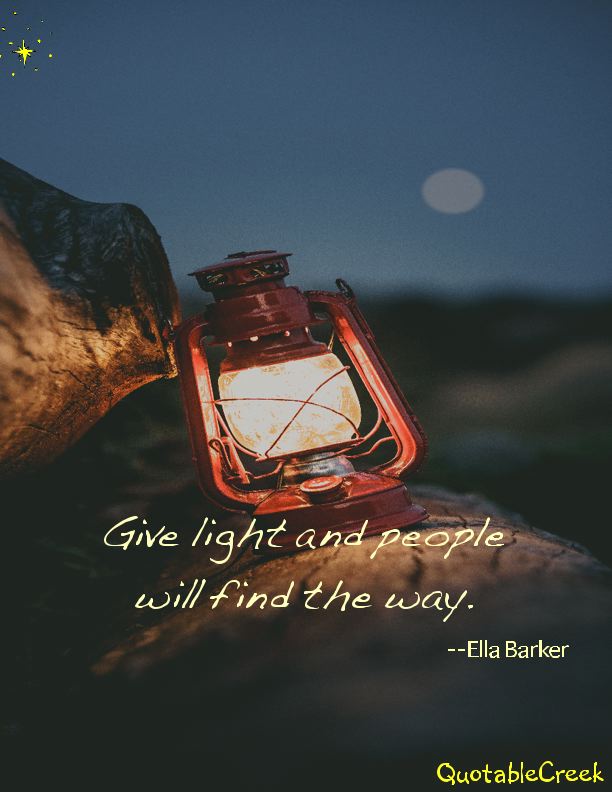
In the darkest of times, people depend on light to find their way. How can we be the light for others? What can we do to inspire hope? How can we help?




 QuotableCreek.com