A lullaby for these times.

Picture a fussy baby, afraid to fall asleep, but then comforted in his mother’s arms by her lilting lullaby, her breath soft against his face, her song sweet to his ears.

Who among us can’t, at times, relate to that child? The future seems particularly uncertain. Worry disrupts sleep. Anxiety weakens our resolve. 

There is something about a lullaby, though, the soft tones, the repetitive melody, the gentleness of the presentation, that can help soothe and relax, comfort and reassure us. The sweet song can reach into our long past baby consciousness and help us rest. 

Take a minute to enjoy this beautiful rendition of Billy Joel’s Goodnight, My Angel, by Social Dissonance with soloist Ryan Nagelmann. May it help you find peace. 

Binding up wounds.

So much of our suffering is invisible. Loneliness, sorrow, depression, not fitting in. We can bind up our own cuts and scrapes, but how do we bind up those kind of wounds?

There is an old parable about heaven and hell. In both, people are forced to eat with spoons that are too long to feed themselves. In hell, they are starving. In heaven, they feed each other.

When it comes to these invisible hurts, we are healed by kindness, one to another. We don’t know when we are being kind that it may help someone, but it certainly can’t hurt. And it may be just the long-spooned nourishment that someone else needs.

To inspire acts of kindness today, watch this video of a poor baby elephant stuck in a muddy hole. The gratitude its mother shows its rescuers will melt your heart.

Dancing animals

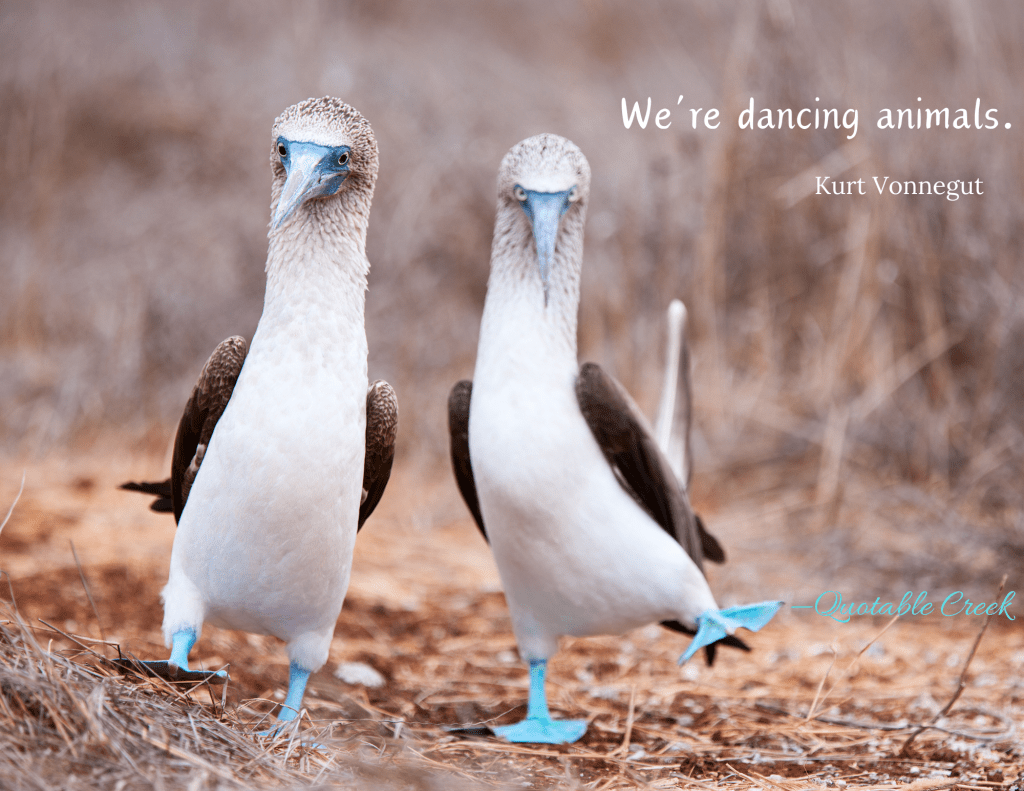
In this age of technology and instant gratification, sometimes we forget the simple pleasures. Like meandering, and chatting people up, and pausing to soak it all in. Kurt Vonnegut used to like to walk into town for a single envelope when he had something to mail, ignoring his wife’s argument that he could buy more than one envelope at a time.

Vonnegut responds, “…And so I pretend not to hear her. And go out to get an envelope because I’m going to have a hell of a good time in the process of buying one envelope. I meet a lot of people. And see some great looking babies. And a fire engine goes by. And I give them the thumbs up. And I’ll ask a woman what kind of dog that is. And, and I don’t know. The moral of the story is – we’re here on Earth to fart around. And, of course, the computers will do us out of that. And what the computer people don’t realize, or they don’t care, is we’re dancing animals. You know, we love to move around. And it’s like we’re not supposed to dance at all anymore.”

Of course, an author depends on immersing themself in the midst of living, noticing details, trying to hold on to it all long enough to capture it in words. But don’t we all benefit from farting around and noticing the little things? Kind of like writing ‘I was here’ in graffiti. We’re here. This is our now.

Time to be a dancing animal.

The right to vote.

Today, in the United States, we vote. We celebrate a country that allows its citizens input into this remarkable experiment of a government of the people, by the people, and for the people. 

We honor this country and its principles of equality, freedom, and justice for all. Our understanding of those concepts has evolved over time, and taken some steps back, but today let us be grateful for how far we’ve come and consider the steps that we each might take today and every day to make this country move closer to the ideals for which it stands. It is both a privilege and a responsibility to vote.

Embracing life.

Reading history is one of the best ways ironically to really enter the present. As James Baldwin says:

One must say Yes to life and embrace it whenever it is found — and it is found in terrible places; nevertheless, there it is.
For nothing is fixed, forever and forever and forever, it is not fixed; the earth is always shifting, the light is always changing, the sea does not cease to grind down rock. Generations do not cease to be born, and we are responsible to them because we are the only witnesses they have.
The sea rises, the light fails, lovers cling to each other, and children cling to us. The moment we cease to hold each other, the moment we break faith with one another, the sea engulfs us and the light goes out. ~James Baldwin

We look at our past and see people making their ways, making mistakes, celebrating triumphs, struggling but then getting back up. And this is true during objectively awful times of war or suffering as well as in more relatively peaceful times. People go on. They find a way to come together, to survive, to do better.

I wonder what historians will say fifty years from now about the times we are in right now. Will they point to the divisions between us or the attempts to heal and grow. Will they see in us the grit and forbearance we can recognize in our ancestors?

Little band of heroes.

All we face now can feel overwhelming. It’s as if everywhere you turn, there is another challenge and another threat. And yet, even if the midst of all that is wrong, there are opportunities to shine the light, to be a voice for good, and to support others. Yes, it looks bleak now, but we are still here to do some good:

“Yes, it looks bleak. But you are still alive now. You are alive with all the others, in this present moment. And because the truth is speaking in the work, it unlocks the heart. And there’s such a feeling and experience of adventure. It’s like a trumpet call to a great adventure. In all great adventures there comes a time when the little band of heroes feels totally outnumbered and bleak, like Frodo in Lord of the Rings or Pilgrim in Pilgrim’s Progress. You learn to say ‘It looks bleak. Big deal, it looks bleak.’”
— Joanna Macy

Choose truth.

We are in the midst of a slander epidemic. In today’s world, someone can publish fake news, and it can go viral, spreading around the world in an instant. People eagerly like and share derogatory information about people they don’t care for or political candidates they oppose. Companies can crumble based on the public’s wrath over a false bit of news. People’s lives can be ruined.

And what of the effect on all of us? It is to the point where we can’t trust much of anything we read unless we do our own diligence with fact checking and research.

What happened to the truth? What happened to accountability?

As with most things, the buck stops with each of us. We can’t control the world, but we can choose whether we want to further lies. Take your time before you believe what you hear. Do your research. And let your words and actions shine with the light of truth.

Honesty legacy

In order to make good decisions, you need the foundation of the truth. Double check, triple check, go directly to the sources. And if your understanding of what is true changes, so must your behavior.

As M. Scott Peck said:

Truth or reality is avoided when it is painful. We can revise our maps only when we have the discipline to overcome that pain. To have such discipline, we must be totally dedicated to truth.

‘Revising our maps’ is his way of saying adjust our world view, our sense of what is right or wrong, our conclusions about happened. Bottom line: We will simply not get anywhere near where we want to go if we are operating with faulty maps.

Too many people these days are trying to adjust the ‘facts’ to conform to their world view (with misinformation or disinformation) rather than the other way around.

Our greatest strength.

Imagine writing to one of your literary heroes and getting a serious letter back. Over 50 years ago, then fifth grader Joel Lipton wrote to Charles Schulz, the creator of the comic strip Peanuts, to ask him what made a good citizen.

And Schulz wrote back:

In 1970, students in a fifth-grade class at Hawthorne School in Beverly Hills were assigned to write a letter to someone they admired, asking them “What makes a good citizen?”

Joel Lipton, 10 years old at the time, wrote to Peanuts cartoonist Charles Schulz.

Fast-forward to this past February, when Lipton and his wife were cleaning out their closet. “And she pulled out a box and started going through some photos,” Lipton says today. “And between some old photos was this letter. I said, ‘Oh, wow, there’s the Charles Schulz letter!’”

Lipton remembers getting a response from the famed cartoonist, typed on official stationery from his Sebastopol studio, and hanging it on his bedroom wall with thumbtacks. But he was amazed when he re-read Schulz’s letter almost 50 years later, and realized how prescient it was.

https://www.kqed.org/arts/13852729/charles-schulzs-letter-about-democracy-discovered-50-years-later

Schulz’s words are no less powerful today as we come together to vote for our future in America, a country defined not by homogeneity of race or religion, but by common principles. Principles of equal justice under the law, of democracy, and of a government of the people, by the people, and for the people.

Misery won’t touch you gentle.

Oh, child. How I wish for you to have a life without misery and heartache, a world without disillusionment and betrayal, a childhood unmarred by neglect or abuse, a journey without conflict. But, alas, that will not be. We do not live in a utopian world, but here in this world, and you will  know sorrow and pain and, as much as I would love to shield and protect you from it, I cannot. There will be dark days, my love.

But you are brighter than the darkness, and, even in your misery, you will find a way to shine. And when you are at your lowest point, I will be there beside you knowing that you will rise again and that this pain will make you more compassionate and humble, more honest and fierce, more determined to make this world a more perfect place, because you, my beautiful child, are not meant to be kept down in the darkness, but to shine.