We all want to succeed, but what is the metric for measuring whether we’ve been successful? There are so many. Money, status, power, bucket lists, fame, travel… but what of the little things? Are you successful if you have enough money to buy a small country but no one to love or trust? Is it success if you are famous but lonely? If you have power but wield it to cause pain and misfortune to others, how can that be considered success? If you’ve traveled the world but not been truly present anywhere, does that count?
Perhaps true success at this thing called life is as simple as Emerson’s thoughts above. To leave the world a bit better, to ease the burdens of others, to look for and bring out the best in others, to do no harm. These all matter, maybe not in measurable concrete ways, but in ways we can all feel and appreciate if not count. More important, these are all things we each can do. We have the ability to be successful beyond our wildest imaginings.
And don’t forget to laugh often and much. Finding the joy and not letting it slip right past you undetected is important, too.
The potential for a loving relationship is in one embrace. The potential for peace is in forgiveness. The potential for harmony is in stillness. The potential for quality conversation is in listening.
Consider the opportunities you have to make your world and the world in general a better kinder place with the actions you sow today.
Listening, truly listening, is rare. Most people are just waiting for their turn to reply. Or maybe not even waiting, but interrupting to say what is on their mind. Two people both talking, but neither listening, and no one, consequently, heard. Too often, we want to avoid the discomfort of listening, particularly if someone is hurting, and so we turn the conversation back to something safe, ourselves.
Celeste Headlee recounts a time when she tried to support her grieving friend, but failed:
A good friend of mine lost her dad some years back. I found her sitting alone on a bench outside our workplace, not moving, just staring at the horizon. She was absolutely distraught and I didn’t know what to say to her. It’s so easy to say the wrong thing to someone who is grieving and vulnerable. So, I started talking about how I grew up without a father. I told her that my dad had drowned in a submarine when I was only 9 months old and I’d always mourned his loss, even though I’d never known him. I just wanted her to realize that she wasn’t alone, that I’d been through something similar and could understand how she felt.
But after I related this story, my friend looked at me and snapped, “Okay, Celeste, you win. You never had a dad, and I at least got to spend 30 years with mine. You had it worse. I guess I shouldn’t be so upset that my dad just died.”
I was stunned and mortified. My immediate reaction was to plead my case. “No, no, no,” I said, “that’s not what I’m saying at all. I just meant that I know how you feel.” And she answered, “No, Celeste, you don’t. You have no idea how I feel.”
She walked away and I stood there helplessly, watching her go and feeling like a jerk. I had totally failed my friend. I had wanted to comfort her, and instead, I’d made her feel worse. At that point, I still felt she misunderstood me. I thought she was in a fragile state and had lashed out at me unfairly when I was only trying to help.
But the truth is, she didn’t misunderstand me at all. She understood what was happening perhaps better than I did. When she began to share her raw emotions, I felt uncomfortable. I didn’t know what to say, so I defaulted to a subject with which I was comfortable: myself.
I may have been trying to empathize, at least on a conscious level, but what I really did was draw focus away from her anguish and turn the attention to me. She wanted to talk to me about her father, to tell me about the kind of man he was, so I could fully appreciate the magnitude of her loss. Instead, I asked her to stop for a moment and listen to my story about my dad’s tragic death.
How often do we do this in our conversations? We listen to the story, only to remember a time when we experienced something similar and then quickly switch focus to our story. Do we sit with a person in their grief, their discomfort, their loneliness? Or do we try to change the topic to something more pleasant?
Headlee continues:
From that day forward, I started to notice how often I responded to stories of loss and struggle with stories of my own experiences. My son would tell me about clashing with a kid in Boy Scouts, and I would talk about a girl I fell out with in college. When a co-worker got laid off, I told her about how much I struggled to find a job after I had been laid off years earlier. But when I began to pay a little more attention to how people responded to my attempts to empathize, I realized the effect of sharing my experiences was never as I intended. What all of these people needed was for me to hear them and acknowledge what they were going through. Instead, I forced them to listen to me and acknowledge me.
Sociologist Charles Derber describes this tendency to insert oneself into a conversation as “conversational narcissism.” It’s the desire to take over a conversation, to do most of the talking and to turn the focus of the exchange to yourself. It is often subtle and unconscious. Derber writes that conversational narcissism “is the key manifestation of the dominant attention-getting psychology in America. It occurs in informal conversations among friends, family and co-workers. The profusion of popular literature about listening and the etiquette of managing those who talk constantly about themselves suggests its pervasiveness in everyday life.” Derber describes two kinds of responses in conversations: a shift response and a support response. The first shifts attention back to yourself, and the second supports the other person’s comment. Here is a simple illustration:
Shift Response Mary: I’m so busy right now. Tim: Me too. I’m totally overwhelmed.
Support Response Mary: I’m so busy right now. Tim: Why? What do you have to get done?
Here’s another example:
Shift Response Karen: I need new shoes. Mark: Me too. These things are falling apart.
Support Response Karen: I need new shoes. Mark: Oh yeah? What kind are you thinking about?
Shift responses are a hallmark of conversational narcissism. They help you turn the focus constantly back to yourself. But a support response encourages the other person to continue their story. These days, I try to be more aware of my instinct to share stories and talk about myself. I try to ask questions that encourage the other person to continue. I’ve also made a conscious effort to listen more and talk less.
I’ve never learned something I didn’t know from talking. It’s in listening that we grow.
While our leaders model interrupting, our children are watching. What are they learning? If constant interruptions become the norm, how will this effect public discourse and civility? How will we work together without listening to each other’s points of view?
Today, perhaps we can model listening. Allowing people to feel heard is a gift we can freely give.
We start so little and helpless, not knowing much of anything, but responding to love, comfort, care, concern. As we grow, there have been people who have brought joy to our lives, people who have helped us step out and grow.
For these people, we offer thanks.
As Mr. Rogers explained:
From the time you were very little, you’ve had people who have smiled you into smiling, people who have talked you into talking, sung you into singing, loved you into loving. So, on this extra special day, let’s take some time to think of those extra special people.
And we have them now, don’t we? Those people who smile us into smiling and love us into loving?
How many angels can dance on the head of a pin? Is there any way we could ever truly know?
There are so many issues for which we may never have answers, true answers, like who’s ‘right’ and who’s ‘wrong’, and yet we cling to our answers as if our lives depend on it. And we cling to our questions, from our points of view, without realizing there are so many other questions that have equal or even more merit.
Consider Mary Oliver’s poem, Angels:
Is it possible that we aren’t even asking the right questions? Is there room for Perhaps in our edges?
I am a huge fan of birdsong. It is so joyful. Listening to a little bird, so unassuming, singing with all it has to welcome the day reminds us of what it is like to be alive—vibrant and grateful, blessed with a day ahead to sing our song however that might manifest itself in each individual life. Open. Ready. Eager even.
And yet life can bring us low. Consider Shakespeare’s 29th Sonnet below. He certainly gets what it is like to feel outcast and alone, bemoaning our fate, jealous of others’ future and friends, their talents and possibilities, when we feel we have none.
And yet,
There is, or maybe was, someone who brightened our spirits. Someone who loved us and, like the simple lark singing its joyful song, that love can change an outlook in a blink. And next to that love, all the treasure of kings is paltry.
For a perfect, tear-jerking read of this Sonnet, take a listen to Judi Dench in the clip below. and take a minute, sometime today, to listen to a bird singing its heart out and remember those you love and those who love you.
When, in disgrace with fortune and men’s eyes,
I all alone beweep my outcast state,
And trouble deaf heaven with my bootless cries,
And look upon myself and curse my fate,
Wishing me like to one more rich in hope,
Featured like him, like him with friends possessed,
Crocodile tears. Derived from an ancient anecdote that crocodiles shed tears for the creature they are eating; the phrase has come to refer to a hypocritical display of false emotion. Insincerity. Sometimes worse– a show of emotion to lull someone in to sharing their story or revealing their vulnerabilities only to use that information against them. Dante reserved his 8th circle of Hell (out of 9, with 9 being worst) for the fraudulent–the hucksters, the corrupt politicians, the panderers and seducers, the false teachers, the perjurers and liars.
Why are they so bad? Perhaps it is because trust is so sacred, a bridge to community, a link between people that keeps us all from chucking it and living like recluses behind a bush. But also, perhaps it is because we do not come with built in BS meters. We are born trusting; we have to learn cynicism. And the way we learn that is to be let down, over and over, by the insincere. And when that harm makes us close off and guard, we become less than what we really are.
So the solution, it seems, is to fight back, not with insincerity of our own, but with authenticity and vulnerability come what may, to keep putting it out there every day, in every circumstance with truth and love and a whole heart. To be sincere. Authenticity and sincerity will help heal those damaged by crocodile tears, and they definitely won’t land us in one of Dante’s circles.
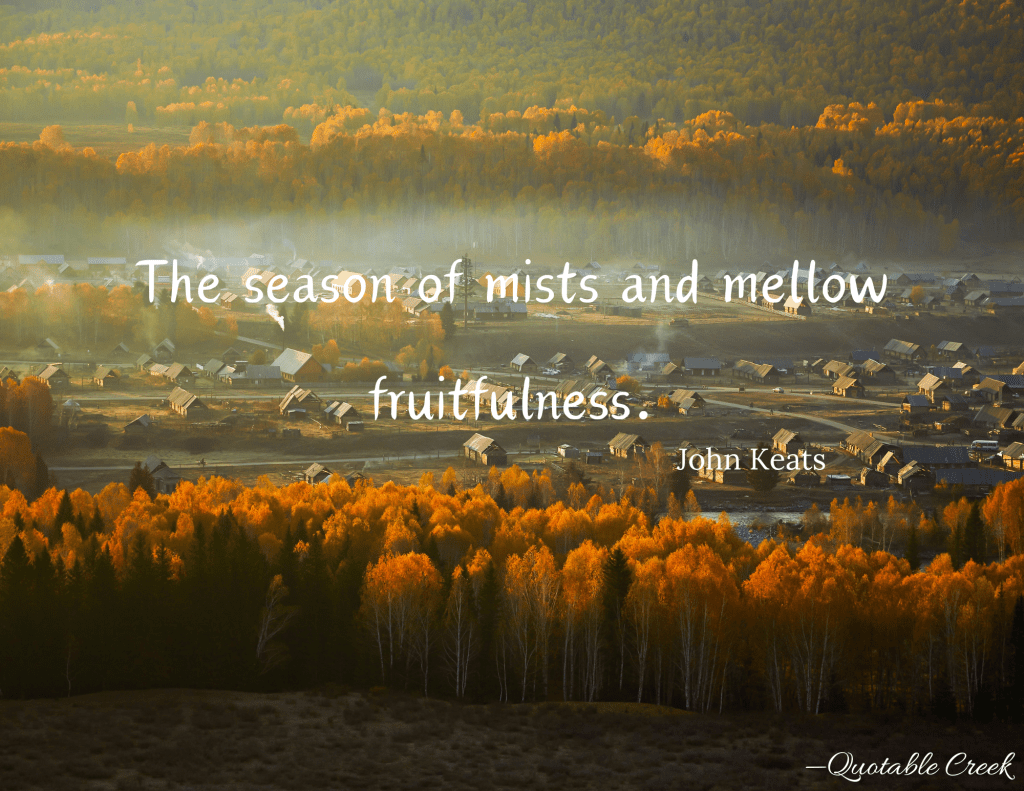
According to Keats, autumn is the season of mists and mellow fruitfulness. Isn’t that a lovely turn of phrase? So evocative. Can’t you feel the cool mist sifting its way through the treetops to settle on the dewy grass?
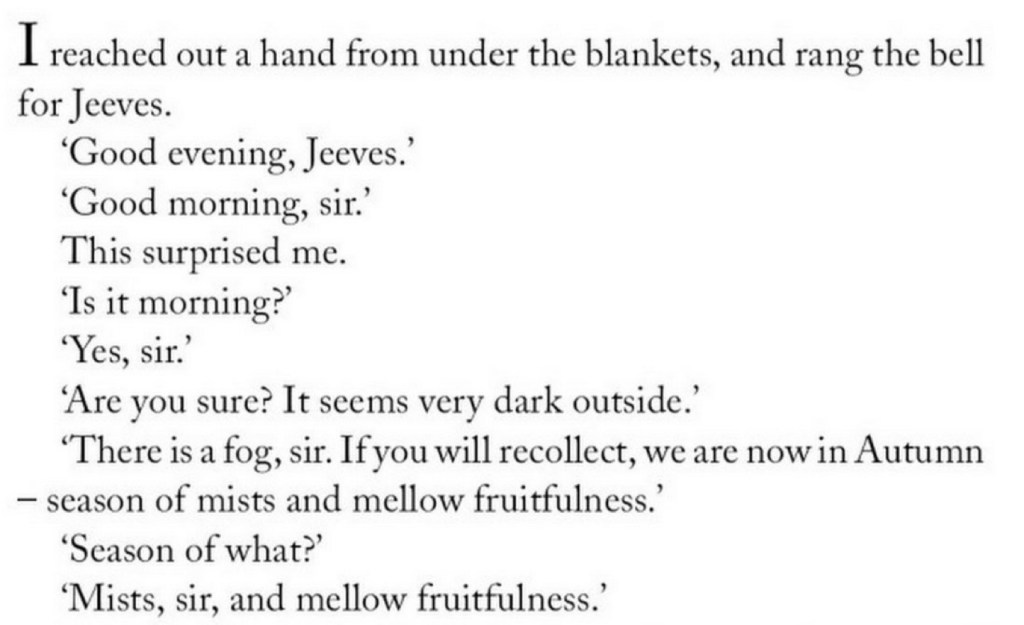
Here that phrase is in fictional conversation in a book by P.G. Wodehouse:
Isn’t that delightful?
Welcome to the season of mists and mellow fruitfulness. Enjoy the poem To Autumn by John Keats:
Season of mists and mellow fruitfulness,
Close bosom-friend of the maturing sun;
Conspiring with him how to load and bless
With fruit the vines that round the thatch-evesrun;
To bend with apples the moss’d cottage-trees,
And fill all fruit with ripeness to the core;
To swell the gourd, and plump the hazel shells
With a sweet kernel; to set budding more,
And still more, later flowers for the bees,
Until they think warm days will never cease,
For summer has o’er-brimm’d their clammy cells.
Who hath not seen thee oft amid thy store?
Sometimes whoever seeks abroad may find
Thee sitting careless on a granary floor,
Thy hair soft-lifted by the winnowing wind;
Or on a half-reap’d furrow sound asleep,
Drows’d with the fume of poppies, while thy hook
Spares the next swath and all its twined flowers:
And sometimes like a gleaner thou dost keep
Or by a cyder-press, with patient look,
Steady thy laden head across a brook;
Thou watchest the last oozings hours by hours.
Where are the songs of spring? Ay, Where are they?
What can you tell us? With all of your experiences to date, what have you learned that you can pass on to help others? How would you advise your younger self?
For many of us, that advice would be: don’t be afraid. In this delightful video, elders counsel their juniors with some gems on how to negotiate this crazy world.





 QuotableCreek.com