Falling is an appropriate metaphor for love. Exhilaration, yes, but also a loss of control, fear, vulnerability, chance of being hurt. And yet, as a relationship develops, and we become more and more entwined in each other’s lives, often we have expectations of how that should go. We proceed with plans and agendas.
When the love is of a child, often control is a substitute for teaching and patience. Molding them rather than letting them blossom is easier.
But is that still love?
Tenzen Palmo says:
Attachment is the very opposite of love. Love says, ‘I want you to be happy.’ Attachment says, ‘I want you to make me happy.’
In any loving relationship, we need to constantly remind ourselves to put the other first, to want what is best for them, to cheer their successes and mourn their failures, to encourage and support. And, hopefully, our loved one will love us in that same way right back.
Toni Morrison had a gift for complexity and nuance in her writing. Multi-dimensional characters and lots of gray area rule the day in her work.
I found it interesting to hear this perspective from her:
I just think goodness is more interesting. Evil is constant. You can think of different ways to murder people, but you can do that at age five. But you have to be an adult to consciously, deliberately be good — and that’s complicated.
It’s an age-old question whether people are inherently good, whether altruism is learned or instinctive, whether selflessness develops naturally.
But there definitely is an intentionality to doing good, choosing kindness, forgiving, welcoming, holding your tongue. And as we grow older and cast off our childish ways, we learn the wisdom of restraint and forbearance.
And we learn the power of good because often we are on the receiving end of it and know how much it matters.
And then when it’s our turn, we want to pass it on.
What are the things you love, the things you hate, the things that keep you up at night? What are your favorite smells, sounds, tastes, sights, things to touch? How are you inhabiting that body you’ve been given and finding joy?
Whatever your combination of answers to these questions is, it is uniquely your own. It is what makes you, you.
For each of us, that answer will be different, but all part of the same global struggle for individualism. Here is George Bernard Shaw’s answer to some of these questions:
So long as I remain alive and well, I shall continue to feel strongly about prose style, to love the surface of the earth, and to take a pleasure in solid objects and scraps of useless information.
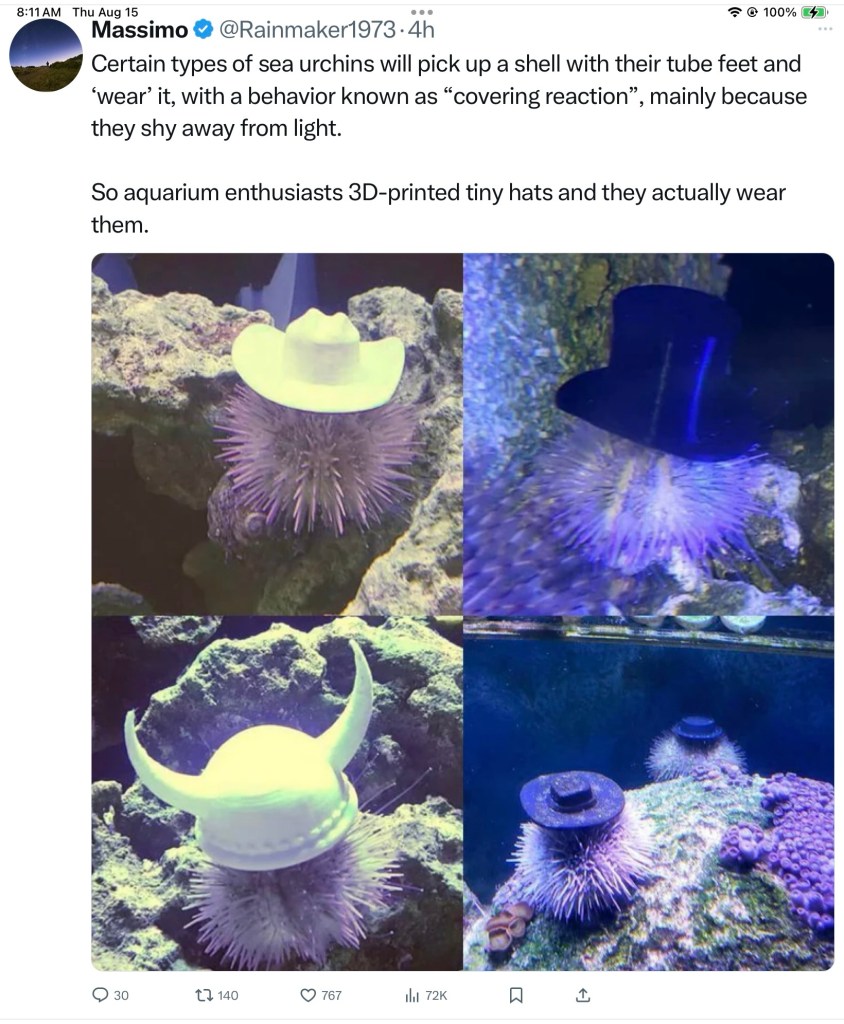
It doesn’t matter how old we get. There is always something that captures our attention and imagination, and, maybe even, holds us rapt in awe. Often it’s in nature, but sometimes it’s in human inventiveness. Or, maybe, a combination of the two.
This is something that captured my attention recently and held my fascination. First in amusement, then in wonder, and, finally, awe.
We have many words for lies: white lies, fudging, fibs, whoppers, but what is at the heart of each is knowingly substituting a different version of the facts for what we know is the truth. Sometimes, like with Wells Fargo and Bernie Madoff, the lies result in substantial financial gain for the liar and substantial loss for the victim.
What propels someone to lie so extravagantly or, even, at all?
Studies show that the big whoppers evolve from the littlest of lies: our brain changes as we lie, making us more and more willing to tell bigger and bigger lies:
A new study claims to provide the first empirical evidence showing that dishonesty gradually increases over time. By using scans that measured the brain’s response to lying, researchers saw that each new lie resulted in smaller and smaller neurological reactions ― especially in the amygdala, which is the brain’s emotional core.
In effect, each new fib appeared to desensitize the brain, making it easier and easier to tell more lies.
This is alarming, not just because it can lead to widespread fraud but also because a liar begins to live in an alternate reality. Over time, people can begin to believe the lies they tell themselves and others, putting them in a position where their beliefs just don’t square with the world they’re living in. They are constantly confronted with the disconnect between their altered reality and reality itself, leading to greater and greater anger and frustration. Sometimes those lies are self-delusional, leading people to never adequately address and progress beyond their own problems. In short, lies lead to fragmentation, discord, breach of trust, chaos.
Now, truth doesn’t always lead to harmony. Some truths lead to a road of very hard work, reconciliation, and compromise. But at the heart of telling the truth is an increase in trust which is the glue that binds a couple, a family, a community, a country, and is necessary for any true progress.
None of us knows what the future holds. But we do know the values we hold dear—honesty, integrity, love, compassion, empathy, respect, tolerance. As we raise our children, we instill these values. As adults, we model these values whether we win or lose, succeed or fail, sink or swim. Watching us, they learn, and, as they go forward into their futures, they will bring these values to their own decisions. If each of us does this, we will leave the world a better brighter place for our having been here.
Humans are complicated creatures. Sometimes we feel emotions and have no idea why. And perhaps that is for good reason because much of what affects us is hidden. Consider, for example, subliminal advertising. People would go to the movies and watch reels that had ‘Buy Popcorn’ hidden in a few frames, not enough to consciously notice, but enough so that people watching got the sudden urge for popcorn. Or perhaps you’ve been watching a show where the characters are sharing a cup of coffee and, suddenly, felt an urge for a cup of Joe. Model homes are designed and staged in such a way that you can easily imagine yourself living there and stepping into the life reflected in the art and photographs of that fictional happy family, if only you buy the house.
Or consider the influence of color. Pink has been associated with a calming effect and has been used in drunk tanks and visiting team locker rooms in an effort to sway human behavior.And it works so well that now the Western Athletic Conference has a rule that the lockers rooms can be painted any color, including pink, but both teams must have the same color.
It behooves us to pay attention to what we are paying attention to. Are our emotions being stirred up? Take a minute and consider why. Is someone trying to manipulate us in some way? It happens often in advertising and politics. Being aware of the ways we can be influenced, and opening our eyes to those manipulations, helps keep us in the driver’s seats of our own lives.
It’s remarkable how powerful words, just words, are. Most of us can remember a criticism that hurt, maybe more than we can remember a compliment.
In the hands of a parent, words can be deflating or encouraging, critical or comforting. A parent who is never satisfied no matter the child’s achievement can inflict lifelong damage. And the effect of those words will last with that child well into adulthood and inform how they, in turn, will talk with their own children. A sad cycle.
These days, lies have a horrible power to cause almost irreversible damage. Social media can amplify those lies, and, before you can think twice, your words can become venom.
No doubt words have power. The question becomes how do we want to use that power. In this award-winning speech, Mohammed Qahtani makes a case for choosing wisely.
How broad is your focus? On your own needs and wants, or broader? It seems that a broad focus, on others as much or more than ourselves increases empathy and happiness.
As Daniel Goleman said:
Self-absorption in all its forms kills empathy, let alone compassion. When we focus on ourselves, our world contracts as our problems and preoccupations loom large. But when we focus on others, our world expands. Our own problems drift to the periphery of the mind and so seem smaller, and we increase our capacity for connection – or compassionate action.
Does this seem true as you think about the people in your life?
The other thing that happens when you turn your concern to others is the whole world opens up. There is so much to learn, to do, to care about. So many places to put your time and efforts. So many people to love and help.
Joy is a fascinating emotion. It often springs up in us at surprising times. There is something of a wellspring vibe to it, as if it bubbles up in us with little bearing to our circumstance in life or particular experience. As C. S. Lewis notes,
“I call it Joy. ‘Animal-Land’ was not imaginative. But certain other experiences were… The first is itself the memory of a memory. As I stood beside a flowering currant bush on a summer day there suddenly arose in me without warning, and as if from a depth not of years but of centuries, the memory of that earlier morning at the Old House when my brother had brought his toy garden into the nursery. It is difficult to find words strong enough for the sensation which came over me; Milton’s ‘enormous bliss’ of Eden (giving the full, ancient meaning to ‘enormous’) comes somewhere near it. It was a sensation, of course, of desire; but desire for what?…Before I knew what I desired, the desire itself was gone, the whole glimpse… withdrawn, the world turned commonplace again, or only stirred by a longing for the longing that had just ceased… In a sense the central story of my life is about nothing else… The quality common to the three experiences… is that of an unsatisfied desire which is itself more desirable than any other satisfaction. I call it Joy, which is here a technical term and must be sharply distinguished both from Happiness and Pleasure. Joy (in my sense) has indeed one characteristic, and one only, in common with them; the fact that anyone who has experienced it will want it again… I doubt whether anyone who has tasted it would ever, if both were in his power, exchange it for all the pleasures in the world. But then Joy is never in our power and Pleasure often is.” The Shape of My Early Life
Joy is distinct from pleasure and happiness. It is an abundance, a bliss, an immeasurable gratitude for the privilege of being. It isn’t meant to be ignored, but embraced, relished, cherished. Not as a byproduct of some other experience, but in itself.
As Mary Oliver says,
“If you suddenly and unexpectedly feel joy,
don’t hesitate.
Give in to it.
There are plenty of lives and whole towns destroyed or about to be.
We are not wise, and not very often kind.
And much can never be redeemed.
Still life has some possibility left.
Perhaps this is its way of fighting back,
that sometimes something happened better than all the riches or power in the world.
It could be anything, but very likely you notice it in the instant when love begins.
Anyway, that’s often the case.
Anyway, whatever it is,
don’t be afraid of its plenty. Joy is not made to be a crumb.
Swan, Poems and Prose Poems
If you should be lucky enough to feel joy bubbling up, savor it. Don’t hesitate.