Are you lonely?

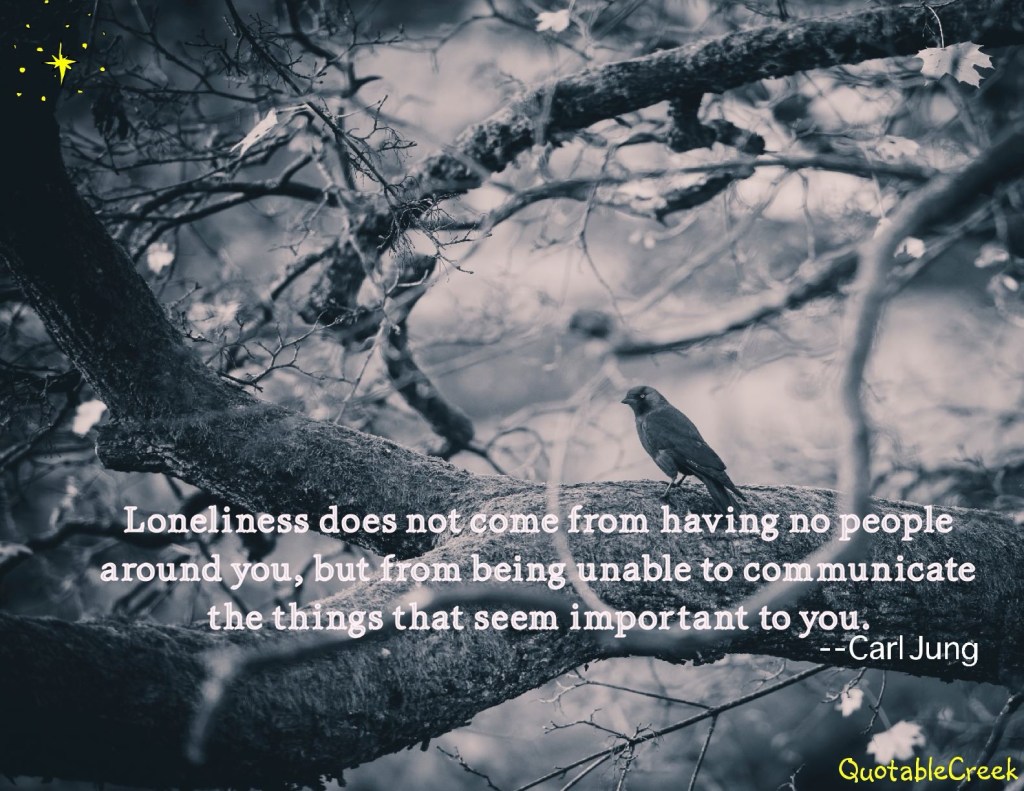
Are you lonely? Does your heart long to be heard and understood? For someone to get you? And for you to really hear someone in return? Are you yearning to share your heart’s stories with someone else?

Loneliness has nothing to do, really, with being alone. In fact, the worst way to be lonely might be when you are with someone else but not feeling connected.

Is there a way to ease our heart’s loneliness?

One possibility is to open yourself up. Share your true thoughts and feelings, not the masks you wear in the world, but your true self. And then be a safe place for someone else to be naked emotionally with you. Scary, yes. But what good is it if you’re not being yourself in your own relationships?

To speak to that loneliness in all of us, take a moment to savor this beautiful poem by Mary Oliver and listen for the world calling you into your place in the family of things.

Wild Geese

by Mary Oliver

You do not have to be good.
You do not have to walk on your knees
For a hundred miles through the desert, repenting.
You only have to let the soft animal of your body
love what it loves.
Tell me about despair, yours, and I will tell you mine.
Meanwhile the world goes on.
Meanwhile the sun and the clear pebbles of the rain
are moving across the landscapes,
over the prairies and the deep trees,
the mountains and the rivers.
Meanwhile the wild geese, high in the clean blue air,
are heading home again.
Whoever you are, no matter how lonely,
the world offers itself to your imagination,
calls to you like the wild geese, harsh and exciting —
over and over announcing your place
in the family of things.

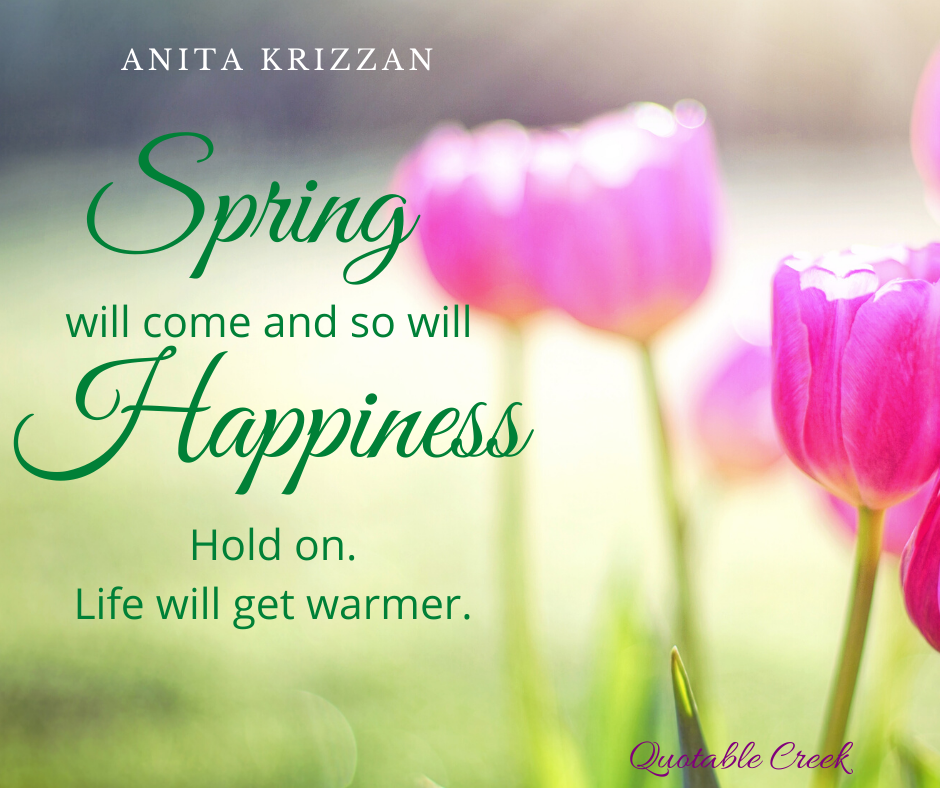
Spring is still on.

Patience is tough. But even in the most aggravating times of waiting, nature keeps going and sends us messages of hope. Dead looking trees budding, flowers blossoming, birds singing and looking for places to build their nests. Warmth seeping back into the frigid ground. 

Spring hasn’t been cancelled. 

Hold on.

Little miracles.

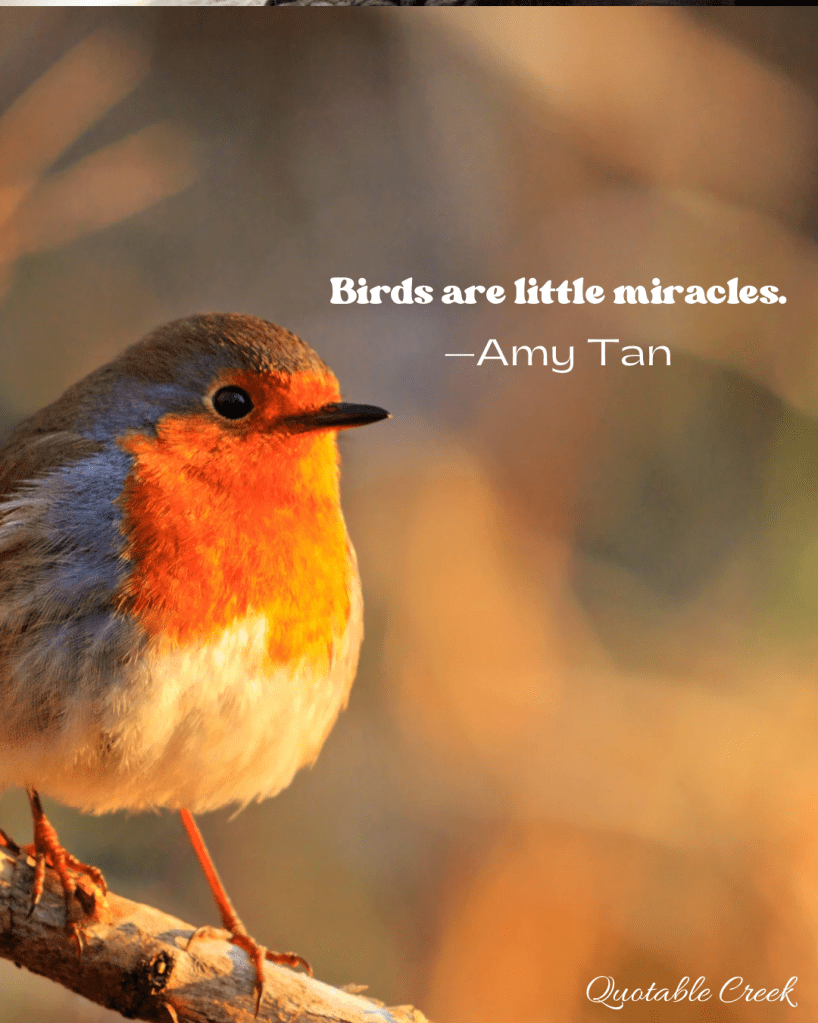
Never forget you are surrounded by miracles. Like, for instance, birds.

Amy Tan writes:

No waiting for doom. Try waiting for a bird to come to your backyard instead. Any bird. They are all little miracles. They fly. They sing. Some migrate thousands of miles. And they are the descendants of dinosaurs.

This Purple Finch is a rare bird in my yard. I used to see one every few years and now I have four, two males and two females. Seeing them makes any day a lucky day.

Those twitters and peeps, that honking or quacking overhead, evidence of miracles around you.

Read.

Nowhere can you experience life from someone else’s point of view better than in a book. You can feel what it is like to be another gender, race, lifeform. Time is no limitation–you might experience life now, in the past, in the future. Opening those pages allows you to step inside someone else’s shoes. And that can’t help but change you, stretch your empathy, and expand your experience.

What would it be like if you could talk over things with those characters? Ask them about life in their shoes?

In a very cool project, doing exactly that, library patrons have the chance to check out a human book. Hopefully the human book they check out will be someone with a different life experience and perspective.

So check out a book, or maybe talk with someone as unlike from you as you can find. You’ll be surprised at all the things you have in common.

Loving your neighbor.

When you have the power, or are on top, or when everything is going your way, it’s only natural to want to strut. You don’t want to think about a time when you might be powerless, on the bottom, or have the world against you.

That’s a downer, isn’t it?

But that’s exactly where religion urges us to go, to think about the world from other perspectives, to consider what life is like for people without your privilege, to have empathy with the unfortunate. Because, after all, if you were in their shoes, wouldn’t you hope they would look out for you?

Listen.

Have you ever had a conversation where what you have to say doesn’t even seem to be part of the conversation? Someone can ask you how you are, and you reply, and they just go on talking about whatever is on their mind as if you’ve not said anything? It’s really more a monologue than a dialogue, since only their concerns are discussed.

It’s frustrating. And lonely to be in that kind of conversation.

Listening is such an easy way to show concern and care for someone else. Responding to what they say, being engaged, asking questions, actually including them in the conversation rather than treating them like they’re only there to hear what you have to say.

In this world of increasing narcissism, self-absorption, and loneliness, listening needs to make a comeback. Not just listening while you’re thinking up what your response will be or how you can divert the conversation back to you and your concerns, but listening. Real listening.

Perhaps the person you’re talking to could really use an opportunity to be heard.

Starting now.

What tools do we need before we start to improve the world? What are we waiting for? Perhaps we are waiting for extra money or time. Perhaps we are waiting for retirement. Perhaps we are waiting to get all our own issues squared away first before we start thinking about helping someone else with theirs. Perhaps we are waiting for someone to ask us for help.

But consider Anne Frank. Forced to live in hiding to avoid the Nazi round-up and murder of Jews, she had little contact with the outside world. She, herself, was in mortal danger around the clock. She was just a kid, really, someone we think of helping rather than being the helper. And yet her attitude was so full of optimism and hope, it continues to shine now, decades later, lighting a weary world.

What a difference an attitude makes! She didn’t wait for the right time or resources. She didn’t wait until she could have a huge impact on the world. She didn’t wait until she was old or famous or wealthy. She didn’t even wait until she was safe. She started right then with what she had. A cheerful disposition, a concern for her family and the others in hiding with her, a willingness to step forward and try to make the world a better place.

What can you do to improve the world? Isn’t it wonderful that you can start right now?

Shining light in dark places.

Miep Gies was a young office worker when she hid and supported Anne Frank and her family, protecting them from Nazis and the danger of being sent to a concentration camp. After Anne and her family were betrayed and captured, Miep collected Anne’s diaries and eventually returned them to Anne’s father, Otto, who survived the war. That diary has been read by millions of people now, inspiring acts of heroism and showing, in a very intimate way, the horror of WWII as viewed through the eyes of an innocent, complex, lovely, vibrant girl, Anne.

Miep wasn’t famous or rich or particularly accomplished, yet she managed through her actions to shine a very bright light on hate and replace it with a more powerful portrait of love. Anne, too, wasn’t famous or rich or accomplished, although we can see now how she was a gifted author, but her words have been inspiring and a powerful force against evil in the world.

No matter our position or age or wealth or gender, we each can make a contribution that makes the world more bright.

What is the light you can turn on in a dark room?

Happy day.

What is one bright thing in your day? One shining star or saving grace? Sometimes the simplest of things can light up our mood and day, and start things in the right direction.

For inspiration, consider this poem:

Success 
by Ralph Waldo Emerson
To laugh often and much;
To win the respect of intelligent people and the affection of children;
To earn the appreciation of honest critics and endure the betrayal of false friends;
To appreciate beauty,
To find the best in others,
To leave the world a bit better, whether by a healthy child,
A garden patch or a redeemed social condition;
To know even one life has breathed easier because you have lived.
This is to have succeeded.

Happy this day.