Perfection can be the enemy of progress. When we need to move forward, we often wait until we come up with a perfect solution, sometimes so long that the opportunity to make our contribution passes. It is not only ok to be fallible, it is all we’ve got to work with: Our imperfect, fallible, often short-sighted selves doing our best to make the world a better place right here, right now, with what is right in front of us.
Take a minute to watch this lovely video of Leonard Cohen singing a reminder that perfection isn’t an option; we must do our best now.
Have you ever been lost? Perhaps in a crowd when you look up and realize all the people you know are gone, and, despite the crowd, you are alone. Or maybe driving when nothing is familiar, and you are getting farther and farther from your destination. Or maybe you’ve been lost emotionally, confronted with too many choices and unsure of which way to move forward.
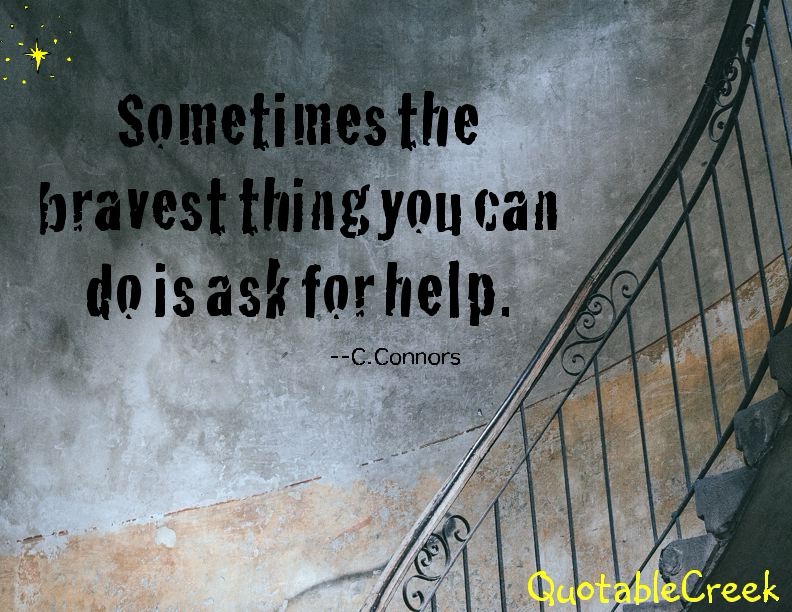
In most of these scenarios, when we are deeply and profoundly lost, we need help. There is someone who knows where you are and where you are trying to be and can help point out the way for you. Or someone who can make an announcement over the PA that they are holding on to a lost child. Or someone who can help you walk through your choices and make the best decision.
There are times when asking for help is our best option. And despite all our tendencies to want to solve the problem ourselves or keep the problem hidden from the world or to tough it out, seeking help is a brave and rewarding choice.
If you are feeling lost, do not be afraid to ask for help. And for a heart-warming video that demonstrates how rewarding it is both to be found and to help someone who is lost, go here to see a baby bird stuck in a PVC pipe and separated from its parents get reunited through the help of a young man who finds the experience one of the most meaningful he has ever lived.
There is an elephant in the room. We don’t talk about it, we try not to think about it, we pretend it doesn’t exist. That elephant is the fact that we are all on a one way journey through this life. Our time is limited. None of us knows in advance when our end of the journey will come, but that end will come.
When we pull ourselves out of denial and gaze directly at this elephant, we can realize something important: our opportunities should be seized now. That good we can do? Don’t put it off. That kind word? Say it. That gift or remembrance? Give it now.
We will not have this place and time and opportunity to make a difference again.
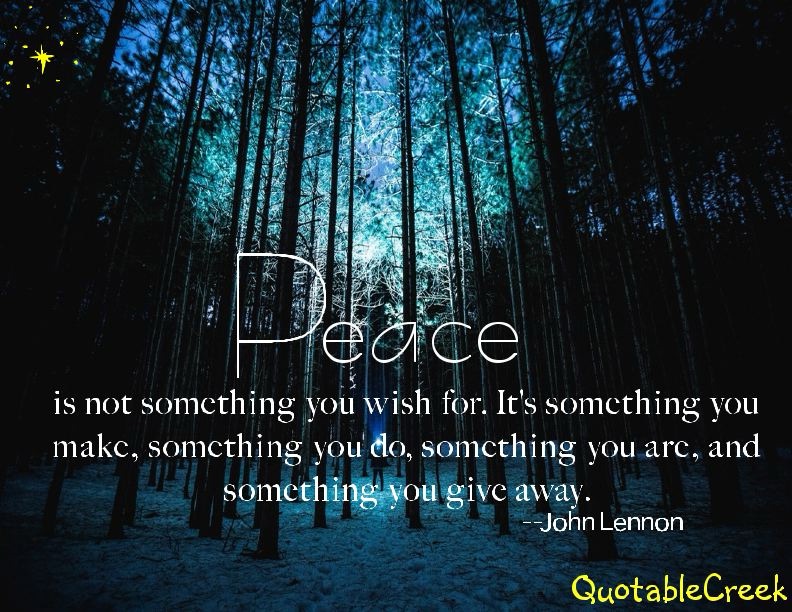
We wish for peace but quarrel with our neighbor. We tremble from talk of war but allow ourselves to respond to others with hate, sarcasm, anger, and animosity. We expect leaders to be the adults in the room, but mock and deride them mercilessly. Peace, it seems, is something for other people out there to do and strive for because we are angry and fed up and impatient, and peace isn’t in our everyday lexicon at the moment.
But we can fight for peace, by controlling ourselves, treating each other respectfully, and speaking out against injustice. Take a minute to watch this beautiful video.
Let there be peace on earth And let it begin with me Let there be peace on earth The peace that was meant to be With God as our father Brothers all are we Let me walk with my brother In perfect harmony
Let peace begin with me Let this be the moment now With every step I take Let this be my solemn vow To take each moment And live each moment To take each moment And live each moment To take each moment And live each moment In peace eternally Let there be peace on earth Let there be peace on earth Let there be peace on earth And let it begin With me (me) With me
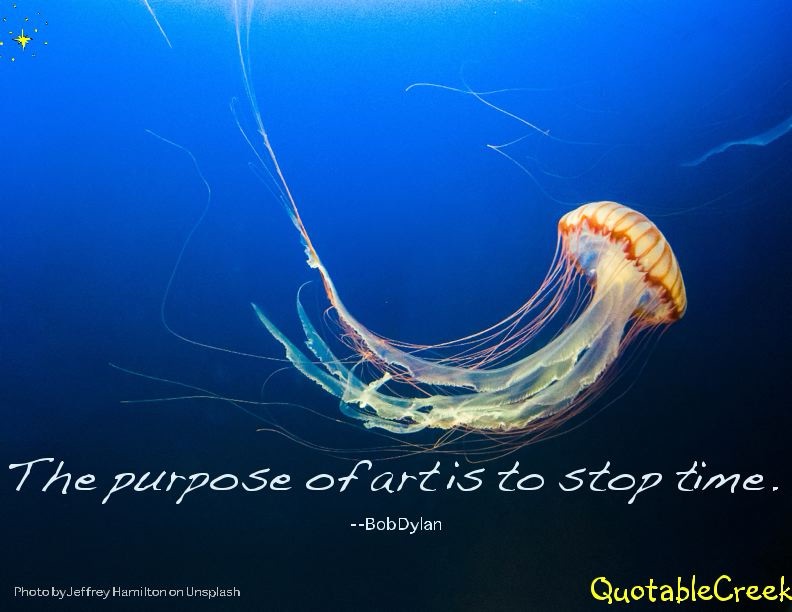
We are caught in the steady, persistent, ruthless flow of time. And yet there are moments when we can step out of time to pause, focus, and gain perspective. The arts do that. As you admire a piece of art, whether photograph, painting, novel, poem, film, dance and so on, we are grounded in detail. We can observe intricacy. We pause in the captured emotion and can rest there awhile. We are transported.
When the cares of the world become too great, we can pause and admire the detail in a jelly fish, the sweetness in bird song, or read soothing words such as these by Wendell Barry:
The Peace of Wild Things
When despair for the world grows in me
and I wake in the night at the least sound
in fear of what my life and my children’s lives may be,
I go and lie down where the wood drake
rests in his beauty on the water, and the great heron feeds.
I come into the peace of wild things
who do not tax their lives with forethought
of grief. I come into the presence of still water.
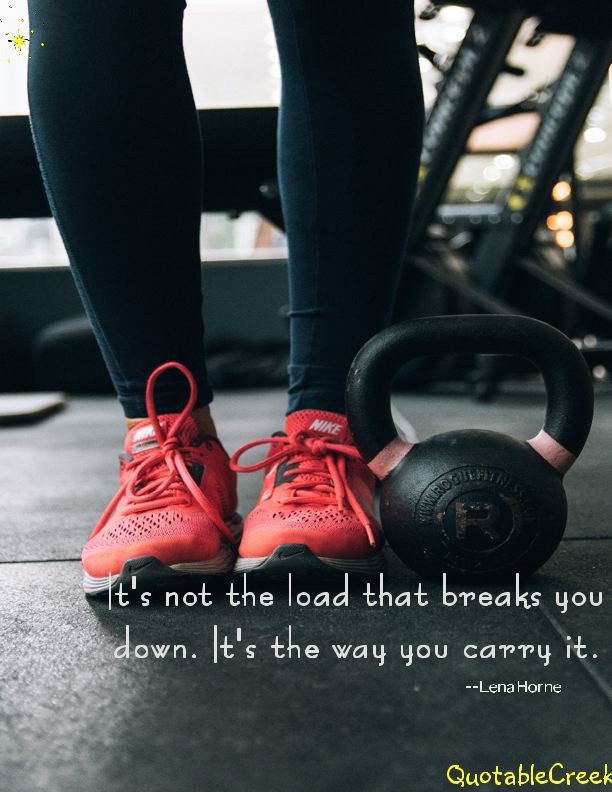
We are weighed down. The tasks ahead seem dauntless; the burdens great. There is so much to be done, and seemingly so little time. Yet, we know that others before us have been able to carry heavy burdens with grace and inner strength. How do they do it? Some ideas:
Evaluate your load. Is it really yours to carry? Holding on to other people’s problems is debilitating because we have no control over their actions. Similarly, feeling like you’re bearing the weight of a global problem on just our own shoulders is both unrealistic and unnecessary. We can help and support someone struggling, and work with others toward a common goal on larger problems, and those are properly our burdens, but we can’t force someone to behave as we would have them, and we, alone, cannot solve a problem like world hunger and peace that is so much greater than any one person. We must discern how best to offer our support and efforts, but realize that, sometimes, the ultimate solutions are beyond our control.
Focus on the gift of that present moment. It is easy to get overwhelmed in a crisis. We see or experience them daily, but when we focus on the present moment as an opportunity to help others, our perception shifts away from the weight of the burden to the lightness that comes from helping others. Yes, there is a refugee crisis, but perhaps we can help. Yes, we’ve lost our job, but perhaps that is an opportunity to do something we’ve dreamed about. Part of the burden that comes from bad things happening is trying to hold on to the world as it existed before the crisis. We mourn the loss and rail against the unfairness. But when we lay that down, and focus on the new reality and challenges present now, in the life we have now, we feel lighter.
Recognize a larger perspective. We will not always be here in this dark place. A new day will come bringing new possibilities and circumstances. We must hold on and look for the bigger picture, remembering that there are ebbs and flows to life, and that this too shall pass.
Ask for help. Sometimes we best carry our burdens by letting someone else share them. We are made to support each other. Perhaps helping you with your burden is the answer to someone else who feels that they lack purpose. Win-win. Life will surprise you that way.
Yes, we are burdened. Life can be hard. As M. Scott Peck says in The Road Less Traveled,
“Life is difficult. This is a great truth, one of the greatest truths. It is a great truth because once we truly see this truth, we transcend it. Once we truly know that life is difficult–once we truly understand and accept it–then life is no longer difficult. Because once it is accepted, the fact that life is difficult no longer matters.”
Amaze yourself. We are stronger than we realize and braver and smarter and more capable, and sometimes we just have to close our eyes and push forward.
It is so easy to get discouraged when living a creative life. Your words are criticized; your paintings don’t sell. “They” don’t believe you have any promise. Sometimes the struggle to be commercially successful in a creative field can be so daunting that you abandon the art. But then you remember that art isn’t about “them” or “success” or “critical acclaim” at all. It’s about bringing your truths into the light, being creative, pushing yourself, being you.
Nowhere is this better illustrated than in the case of Henri Rousseau, a forty year old toll collector who wanted to paint. His work was derided, and yet he continued. He found joy in the painting. Not until the end of his life did anyone take his work seriously. As summarized by Maria Popova:
Long before history came to celebrate him as one of the greatest artists of his era, long before he was honored by major retrospectives by such iconic institutions as the MoMA and the Tate Museum, long before Sylvia Plath began weaving homages to him into her poetry, he spent a lifetime being not merely dismissed but ridiculed. And yet Rousseau — who was born into poverty, began working alongside his plumber father as a young boy, still worked as a toll collector by the age of forty, and was entirely self-taught in painting — withstood the unending barrage of harsh criticism with which his art was met during his entire life, and continued to paint from a deep place of creative conviction, with an irrepressible impulse to make art anyway…. [Rousseau’s life is] an emboldening real-life story, and a stunningly illustrated one, of remarkable resilience and optimism in the face of public criticism, of cultivating a center so solid and a creative vision so unflinching that no outside attack can demolish it and obstruct its transmutation into greatness.
The message from Rousseau’s life speaks to all of us: he was a success all along. He persevered with a remarkable resilience to produce work that spoke to him and pursued a passion that made him happy. That, the pursuit of great art, rather than the financial success was what gave his journey depth and meaning and lifted up his soul.
Consider the story of The Tenth Goose told by Richard R. Powell in his book Wabi Sabi for Writers:
Nine Canada geese lift off a clear mountain lake; droplets from their wings cast lines of rings behind them on the glassy surface as they rise. Light gray feathers reflect amber light from the early morning sun, a clean glow off each curved body. You watch their broad wings grip air, watch nine bodies rise and fall in rhythm against the dark forest behind them. Each bird’s neck kinks in counter-time to its wing beats so that all nine heads remain level and each set of eyes gazes steadily out at the cool dawn, bright mystery of sight amid the shiny black head feathers. Closer now, you make out the expressionless curve of their beaks, see one goose’s thin moist tongue as she honks; hear the whistle of air across wing feathers as they pass over your head. Then you notice that there is a tenth goose far back, low to the water, working hard to catch up, honking softly, as if each wing beat hurts. This goose loses a feather as she passes close over you and you watch the feather spiral and glide to the ground. You pick it up and it looks perfect, each barbule lying neatly against its neighbor, the tiny whorl of fluff near the calamus soft to the touch. Then you see that the shaft is not perfect; it is cracked open from the middle to the tip.
You keep that feather, tuck it under the strap around your car’s sun visor, look at it every day you drive to work and remember the tenth goose. Remember your own efforts to keep up. And somehow, that tenth goose gives you courage. You wonder if she will find enough food or if winter will separate her from the rest, separate her from life. She speaks to you in a dream one night. In the distracted moments of the day she speaks to you, in the elevator or while you wait in traffic. Then one night she is there in your dream again, as silent as her feather in your car. She tips her head at you and that beak, with its lumpy prominence like a Roman nose, bobs up and down and you realize she is giving you permission to speak. In the dream you speak and she turns her head to hear you and you tell her your fear of dying and your hopes while living and she comes and rattles her beak between your fingers.
There is beauty and strength in the broken places, a beauty that continues on even when everything is a struggle, that faces setbacks with determination. Sometimes we are one of the nine geese, sure and strong, in sync, but sometimes we are the tenth goose struggling to keep up. And there is beauty in that, too:
It is a kind of beauty on the edge of defeat, a beauty tenacious and brave, and it is the beauty left behind when the warm, honking goose is gone. And not just flown away–but dead and gone. That feather remains as a testament to the beauty in living; and even when the feather dries and cracks and is eventually eaten by insects or the drab extension of time, it will live on in the imaginations of those who hear the story of the tenth goose.
Remember the Story of the Tenth Goose and take heart.
Last week at the DNC, we glimpsed Gus, the son of vice-presidential candidate Tim Walz, in an unguarded, moment, filled with pride and love, crying, and saying, ‘That’s my dad!’ For me and millions of others, that raw, unfiltered emotion choked us up. It was a beautiful moment, such a clear window into a pure love.
But for many others, trained perhaps to hide their own emotions and toughen up as they age, that moment led to mockery and cruel responses.
What accounts for such wildly different responses?
Perhaps the difference lies in how we view vulnerability, which in turn, colors how we trust others. Do we feel like we must mask our emotions and vulnerabilities? Do we feel like we must project only a polished and tough persona?
Brené Brown says,
Vulnerability is not winning or losing; it’s having the courage to show up and be seen when we have no control over the outcome. Vulnerability is not weakness; it’s our greatest measure of courage.
Do we really believe the bully is the strong one? Perhaps the strong one is the one brave enough to be honest and true.
How wonderful it would be to count all joy– to recognize the gift in the difficulty, to see the growth in the hardship, to see joy as a reflection of sorrow. Grief, despair, hopelessness, loss can hit so hard, it may feel like we will never feel joy again. And yet joy follows us like a shadow if we can pause to be grateful.
Then a woman said, “Speak to us of Joy and Sorrow.”
And he answered:
Your joy is your sorrow unmasked.
And the selfsame well from which your laughter rises was oftentimes filled with your tears.
And how else can it be?
The deeper that sorrow carves into your being, the more joy you can contain.
Is not the cup that hold your wine the very cup that was burned in the potter’s oven?
And is not the lute that soothes your spirit, the very wood that was hollowed with knives?
When you are joyous, look deep into your heart and you shall find it is only that which has given you sorrow that is giving you joy.
When you are sorrowful look again in your heart, and you shall see that in truth you are weeping for that which has been your delight.
Some of you say, “Joy is greater than sorrow,” and others say, “Nay, sorrow is the greater.”
But I say unto you, they are inseparable.
Together they come, and when one sits alone with you at your board, remember that the other is asleep upon your bed.
Verily you are suspended like scales between your sorrow and your joy.
Only when you are empty are you at standstill and balanced.
When the treasure-keeper lifts you to weigh his gold and his silver, needs must your joy or your sorrow rise or fall. Khalil Gibran, Joy and Sorrow, Chapter Viii


 QuotableCreek.com