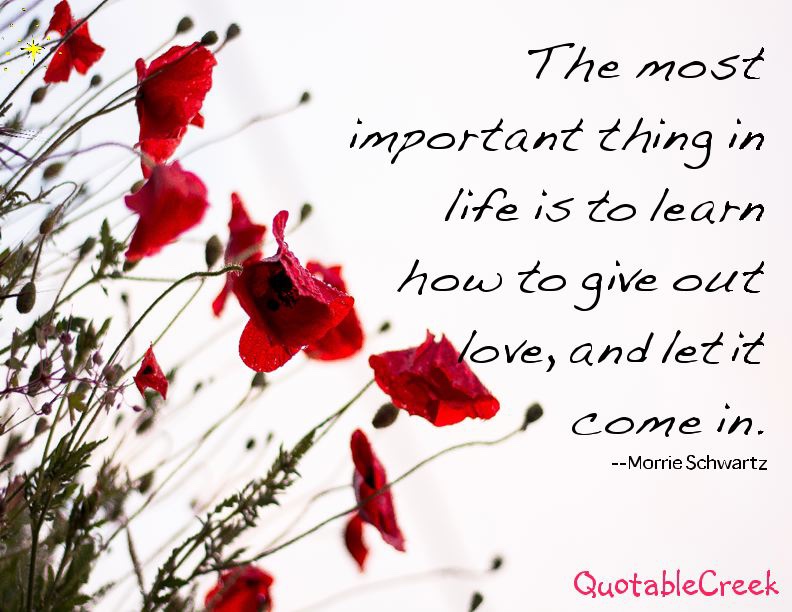
Sometimes we just need to get out of the way. What if we think of ourselves as vessels to collect love and then pour it out–not just on ourselves and those close to us, but on everyone and everything? What would our days look like if every encounter with someone else was an opportunity to be loving and thoughtful? What would our world look like if we used our time and energy to love it? What would our relationships look like if we laid down all our weapons–anger, resentment, hurt, selfishness–and just took the time to love each other, as if our very lives depended on it? They just may.
What do we regret most as we contemplate the end of our time here? Maybe the lesson from that regret can inform our present. In an outstanding commencement speech, George Saunders reflects on his own failures and encourages the graduating students to look for opportunities to be kind. He reflects on a memory haunting him from his childhood:
In seventh grade, this new kid joined our class. In the interest of confidentiality, her Convocation Speech name will be “ELLEN.” ELLEN was small, shy. She wore these blue cat’s-eye glasses that, at the time, only old ladies wore. When nervous, which was pretty much always, she had a habit of taking a strand of hair into her mouth and chewing on it.
So she came to our school and our neighborhood, and was mostly ignored, occasionally teased (“Your hair taste good?” — that sort of thing). I could see this hurt her. I still remember the way she’d look after such an insult: eyes cast down, a little gut-kicked, as if, having just been reminded of her place in things, she was trying, as much as possible, to disappear. After awhile she’d drift away, hair-strand still in her mouth. At home, I imagined, after school, her mother would say, you know: “How was your day, sweetie?” and she’d say, “Oh, fine.” And her mother would say, “Making any friends?” and she’d go, “Sure, lots.”
Sometimes I’d see her hanging around alone in her front yard, as if afraid to leave it.
And then — they moved. That was it. No tragedy, no big final hazing.
One day she was there, next day she wasn’t.
End of story.
Now, why do I regret that? Why, forty-two years later, am I still thinking about it? Relative to most of the other kids, I was actually pretty nice to her. I never said an unkind word to her. In fact, I sometimes even (mildly) defended her.
But still. It bothers me.
So here’s something I know to be true, although it’s a little corny, and I don’t quite know what to do with it:
What I regret most in my life are failures of kindness.
Those moments when another human being was there, in front of me, suffering, and I responded . . . sensibly. Reservedly. Mildly.
We all have so many opportunities to make a difference, just by simply being kind, offering a smile, reaching out in friendship. And, when we reflect on the kindnesses that have made the difference to each of us in our own lives, we realize those little shows of kindness are what matter.
Saunders continues to remind each of us that our inner selves, our souls, shine as brightly as ever, and, even as we strive for success, to keep checking in with that inner place, and to believe it exists and greet the world from there:
Do all the other things, the ambitious things — travel, get rich, get famous, innovate, lead, fall in love, make and lose fortunes, swim naked in wild jungle rivers (after first having it tested for monkey poop) – but as you do, to the extent that you can, err in the direction of kindness. Do those things that incline you toward the big questions, and avoid the things that would reduce you and make you trivial. That luminous part of you that exists beyond personality — your soul, if you will — is as bright and shining as any that has ever been. Bright as Shakespeare’s, bright as Gandhi’s, bright as Mother Teresa’s. Clear away everything that keeps you separate from this secret luminous place. Believe it exists, come to know it better, nurture it, share its fruits tirelessly.
When you are confronted with a choice, err in the direction of kindness.
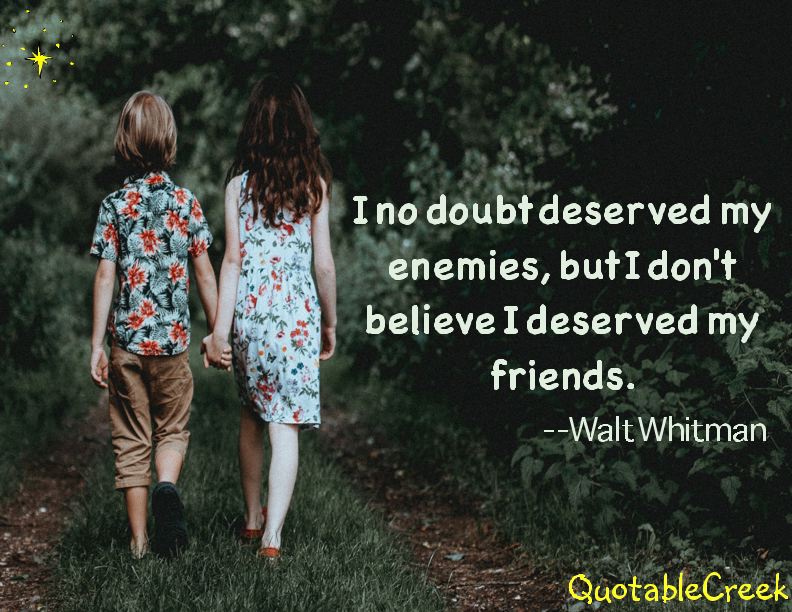
I’ve been blessed with good friends, some friendships going back decades. What a gift it is to travel this life in the company of people who know you, warts and all, and love you. And what a sacred thing it is to be someone’s friend, trusted with their stories, their heartaches, their joys. Friendship is the glue that holds this whole crazy thing called life together.
Writer Anaïs Nin opined that “Each friend represents a world in us, a world possibly not born until they arrive, and it is only by this meeting that a new world is born.” As Nin conveys, friendship can elicit joy, companionship, and growth—enriching our entire experience of the world.
And, as it turns out, friendship is good for what ails us:
Strong friendships are a critical aspect of most people’s emotional well-being. Research indicates that close friendships are associated with greater happiness, self-esteem, and sense of purpose. These bonds are even associated with physical outcomes, such as lower blood pressure and a longer lifespan.
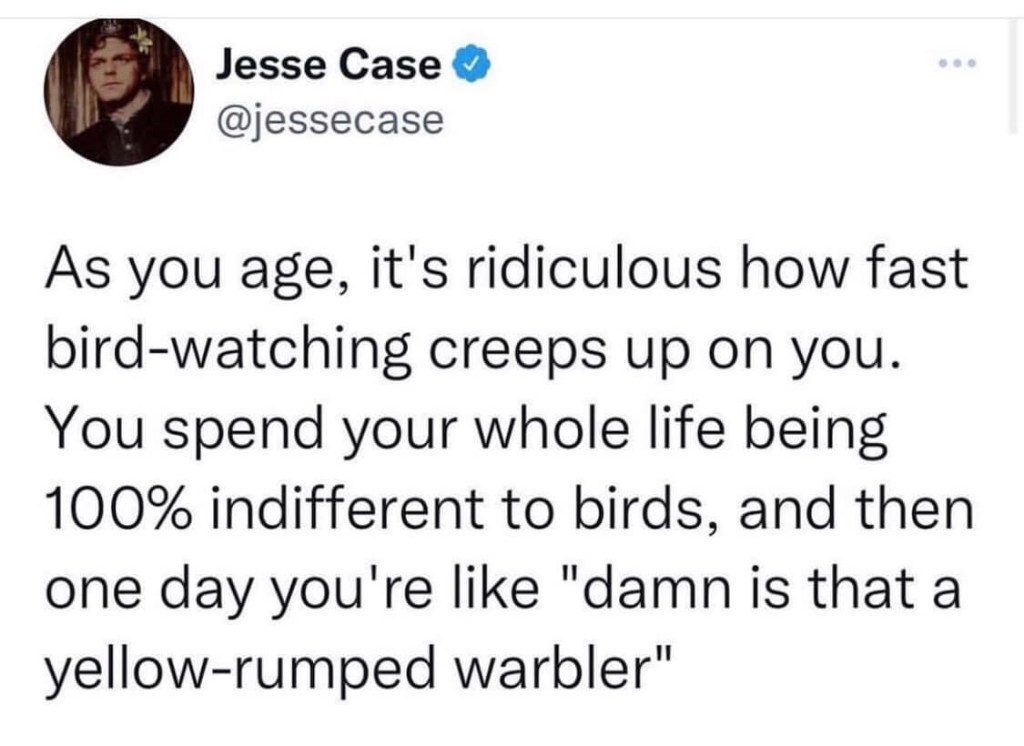
Some of my friends and I are noticing our interests shift these days. This tweet sums up the phenomenon perfectly.
And it’s not just birds, but the weather, the garden, the laugh of a child. The little moments bear a new luster. And of course it makes sense. As our lives are rushing by in our younger years, the little things can get lost. We always will have the time to stop and look, to smell the roses, we reason, so we put it off. But as we feel our time here becoming more finite, our attention hones. We pause. We marvel. We are constantly astonished.
As it turns out, this experience isn’t so much a reflection of our age as it is our perception of time. When we feel time vast, spreading out before us, our focal point is on the future, but when we feel a possible end to our time here, our attention draws close and we appreciate the little things. So even someone young facing death will have this urge to stop and soak in the little things.
In his book, Being Mortal; Medicine and What Matters in the End, Atul Gawande summarizes research on this experience:
“…how we seek to spend our time may depend on how much time we perceive ourselves to have. When you are young and healthy, you believe you will live forever. You do not worry about losing any of your capabilities. People tell you “the world is your oyster,” “the sky is the limit,” and so on. And you are willing to delay gratification—to invest years, for example, in gaining skills and resources for a brighter future, you seek to plug into bigger streams of knowledge and information. You widen your networks of friends and connections, instead of hanging out with your mother. When horizons are measured in decades, which might as well be infinity to human beings, you most desire all that stuff at the top of Maslow’s pyramid- achievement, creativity, and other attributes of ‘self-actualization,” but as your horizons contract—when you see the future ahead of you as finite and uncertain—your focus shifts to the here and now, to everyday pleasures and the people closest to you.”
Being Mortal: Medicine and What Matters in the End, by Atul Gawande
But our ‘knowledge’ of the time we have is far from certain. Sometimes our belief we will always have another day keeps us from appreciating the days we have. Practices like mindfulness and meditation, reading poetry, help ground us in the present so we can capture those moments, but it’s difficult to keep our own mortality enough in our consciousness to really grasp the preciousness of each moment.
In the play, Our Town, by Thornton Wilder, the lead character Emily, a young woman who loses her life early in childbirth, is given the opportunity to revisit one day in her life, and she sees it all with new eyes:
Emily: Oh, Mama, look at me one minute as though you really saw me. Mama, fourteen years have gone by. I’m dead. You’re a grandmother, Mama! Wally’s dead, too. His appendix burst on a camping trip to North Conway. We felt just terrible about it – don’t you remember? But, just for a moment now we’re all together. Mama, just for a moment we’re happy. Let’s really look at one another!…I can’t. I can’t go on.It goes so fast. We don’t have time to look at one another. I didn’t realize. So all that was going on and we never noticed. Take me back — up the hill — to my grave. But first: Wait! One more look. Good-bye , Good-bye world. Good-bye, Grover’s Corners….Mama and Papa. Good-bye to clocks ticking….and Mama’s sunflowers. And food and coffee. And new ironed dresses and hot baths….and sleeping and waking up. Oh, earth, you are too wonderful for anybody to realize you. Do any human beings ever realize life while they live it–every, every minute? Stage Manager: No. (pause) The saints and poets, maybe they do some. Emily: I’m ready to go back.”
Our Town, by Thornton Wilder
Today is that day, a day for us to realize life while we’re living it, every, every minute as much and as best as we can.
There are as many ways to pray as there are people praying. But what is it, exactly? Maybe it’s easier to answer what it isn’t: a flamboyant show, a chance to pose and preen publicly, a subterfuge, a droning recitation of memorized but not considered words.
What prayer actually is, though, is more complicated: a bridge between ourselves and the mysterious, a chance to become small, and yet fully individual, in a vastness, an experience of awe. Mary Oliver’s definition above in her poem Praying is lovely: a doorway into thanks. Consider the whole poem:
Praying
It doesn’t have to be
The blue iris, it could be
Weeds in a vacant lot, or a few
Small stones; just
Pay attention, then patch
A few words together and don’t try
To make them elaborate,
This isn’t a contest but the doorway
Into thanks, and a silence in
Which another voice may speak.
Pay attention; see the beauty around you; give thanks. Rinse and repeat.
Rob Kenney has a YouTube channel Dad, How Do I? where he teaches his nearly 3 million viewers how to do stuff. He got the idea for his channel wondering about the kids growing up without dads and wanting to help fill that space for them, teaching them how to tie their tie, do their taxes, check their oil, plant a tree, and so on. He tells them he’s proud of them.
What a sweet idea. And resource! But, more importantly, how wonderful it is to see someone consciously being a positive role model, using his know-how to help others, and trying to fill a void.
The truth is we all have the potential to be role models. Whether it’s how we behave under pressure, handle a crowded line, or talk with someone who disagrees, our actions matter. People will see us and think about whether they want to follow our example. We have a responsibility to be a good one.
Sy Montgomery’s delightful book, How To Be a Good Creature, is a ‘Memoir in Thirteen Animals‘. What an interesting way to organize a memoir, focusing on the impact various animals have made on her life and what they have taught her about co-existing as fellow creatures on this planet! It is a profound, yet simple, book.
If you were to write a memoir of your life through that lens, who would the animals be that impacted your life in meaningful and enriching ways? What life lessons did you learn? How were your limits expanded from sharing space with that fellow creature?
For inspiration, consider Montgomery’s words:
All the animals I’ve known–from the first bug I must have spied as an infant, to the moon bears I met in Southeast Asia, to the spotted hens I got to know in Kenya–have been good creatures. Each individual is a marvel and perfect in his or her own way. Just being with any animal is edifying, for each has a knowing that surpasses human understanding. A spider can taste the world with her feet. Birds can see colors we can’t begin to describe. A cricket can sing with his legs and listen with his knees. A dog can hear sounds above the level of human hearing, and can tell if you’re upset even before you’re aware of it yourself. Knowing someone who belongs to another species can enlarge your soul in surprising ways.
I often wish I could go back in time and tell my young, anxious self that my dreams weren’t in vain and my sorrows weren’t permanent. I can’t do that, but I can do something better. I can tell you that teachers are all around to help you: with four legs or two or eight or even none, some with internal skeletons, some without. All you have to do is recognize them as teachers and be ready to hear their truths.
Today, consider the wonder of creation around you and thank your teachers of the non-human persuasion.
We each decide if we are to be the hero of the story our lives are writing. We each will hear calls to adventure and must decide whether we will rise to the occasion. We each struggle with challenges and learn, or not, from the experience. What will your story be? How will you meet the challenges you encounter?
In this short film, Matthew Winkler outlines Joseph Campbell’s Hero Journey, a path we all must take.
In a week of mass shootings and other discouraging news, we need a dose of Mr. Rogers, a man who believed passionately in the value of children, just as they are, and dedicated his life to teaching them to manage and express their feelings. What a hero he was.
In this clip from 1969, he makes his case. His lessons are as important today as they were then. Take a listen.
The Parable of the Good Samaritan is well known. In short, a man lies helpless and injured in the road. Religious leaders rush past offering no assistance, while a Samaritan stops and offers the wounded man succor and solace.
What makes one person stop to help while others rush by? Is it the belief that helping is the right way to show up in the world? A religious mandate even? Or is there more to it?
In a famous study at Princeton, researchers evaluated a group of seminarians, specifically discussing the Parable of the Good Samaritan, and then sending them to a task, indeed to lecture on the very parable, where they would necessarily walk right past someone needing help. Even with the parable fresh on their minds, the future pastors for the most part walked right by. Presumably these were nice people who intended to spend a lifetime in service. And yet, they walked right by. They acted in a way incongruent with their professed beliefs.
A surprising result to say the least. But the conclusion from the experiment was that the biggest influencer in whether they stopped to help was not their religious beliefs or their innate kindness, but their perception of time. The more of a hurry they were in, the less likely they were to help.
So how does this inform our choices?
A general kind intent to help is not enough. We are all the Princeton Divinity Students rushing to our next important task and potentially neglecting the plight of others right in our path. We must slow down the clock and really see the people around us. And we need to be ok with the idea that our plans and schedules might be disrupted. Surely stopping to help someone in need will change your day, will inconvenience you, and cause you to spend time and perhaps money in an unplanned way.
But the help you might be able to offer someone in need could be invaluable.