Thank you.

exquisite

How do we thank someone for the big things? The REALLY big things? Like saving your life? Or seeing promise in you when no one else did? Or for lifting you up when you had nothing left to offer?

Whatever the big thing is that makes your breath catch in your throat and your eyes well up with tears when you think about what your life would be like without that person in it?

Thank yous like that call for something bigger than a note or flowers. They call for your whole self. A thank you from your heart in whatever way most clearly can show the enormity of your gratitude.

In these two heartwarming videos, a man thanks his dog for being his beloved companion, and a mother dog thanks the woman who rescued her pregnant self. These over-the-top gestures cross language and even species barriers.

Thank you!

Welcome home.

ache

Something there is in each of us that yearns for home.  Sometimes we confuse that yearning with a physical place. We travel back to that place and wonder why it feels different. What has changed? Why doesn’t it still feel like home? Sometimes we confuse that yearning with a particular time, a past perhaps that wasn’t complicated with today’s troubles, and lose ourselves in nostalgia. Sometimes we confuse that yearning with a particular person and, if we lose that person, wonder if we will ever feel at home again.

But what if home is not a particular place in time but a feeling we can take steps to cultivate?

What is it, really, that ache for home? Perhaps it is a longing for a time and place when you felt welcome and that someone cared if you were there and was happy to see you. A longing for community, for fitting in. Life is difficult and we are all vulnerable, but that feeling of home makes the burden lighter somehow. Someone cares.

And, while we can’t travel backwards to any particular place or time when we felt at home, we can take steps right now today and every day from now on to be welcoming to others. The people shouting ‘Norm’ felt just as much a part of the community as Norm did when he walked into the bar in the old sitcom Cheers. 

To welcome others and to be welcomed both feel like home. There is as much community in reaching out to others as there is in someone reaching out to you. So consider who may be feeling adrift, in need of a community or a welcoming hand. And then reach out because, when your hands meet, you will both feel a bit more comfortable in this wild unpredictable and often inhospitable world.

Welcome home!

Take a nature bath.

deepnature

When was the last time you hiked? Or paused to admire the intricacy of a flower? Or listened to birds sing? Or felt the breeze tousle your hair?

When times are tough, the tough immerse themselves in nature. It soothes us, comforts us, leads us back to our bearings. While many benefits of nature are unsurprising–relaxation, bliss, awe–some are downright startling. Studies show spending time in nature makes us more altruistic and helps us be more social creatures.

Now, a large body of research is documenting the positive impacts of nature on human flourishing—our social, psychological, and emotional life. Over 100 studies have shown that being in nature, living near nature, or even viewing nature in paintings and videos can have positive impacts on our brains, bodies, feelings, thought processes, and social interactions. In particular, viewing nature seems to be inherently rewarding, producing a cascade of position emotions and calming our nervous systems. These in turn help us to cultivate greater openness, creativity, connection, generosity, and resilience.

Take time today to dip your toe in nature. It’s good for whatever ails you.

We’re hitched.

hitched

Where do you stop?

Is it at your skin, that organ holding all your pieces all together? If it’s there, at your skin, how do your words fly out into the air and touch, maybe even wound, someone else? Does your you stop when your physical self passes away? If so, how do memories of you inspire your grandchildren to smile long after your death?

When did you start? Was is at your birth? If so, how do you carry the genetic material of all your ancestors that have come before? How are you influenced by events that occurred long before you were born?

Is your you sufficient and complete in itself? Or does your you depend on many others, both human and not human? The plants and trees for oxygen? Other people for companionship? The air, the moon, the stars, the sun, plants, animals, gravity……a giant web of life, really?

It is hard to isolate our actions. Instead they ripple out into the world around us, resulting in things sometimes seen but more often unseen.  In this delightful video, we see an orangutan preschool, a learning community. But, at the heart of the delight in these darling animals is a cold truth: they were orphaned, probably by people that walked and talked like we do. Instead of spending the first seven or eight years of life with their mothers, they are spending it with people trying to teach them how to be orangutans.

When we put out our ripples into this world, let our words be gentle and kind and our touch soft. Let us keep in mind that we are not separate from each other and nature, but that we all share this place we call home. We are all hitched.

Listen.

listenduty

When was the last time you felt heard?

Listening, truly listening–without an agenda, without interrupting, without offering solutions or fixes, without criticism or judgment–is a rare thing. But it is vital to relationships. And it is a gift to be in a position to listen. Someone is trusting you with their story, their feelings, their hurts and hopes. That is precious. How can we best listen to each other?

In this thoughtful article, Martha Caldwell offers advise for listening compassionately in the classroom that really applies well to any situation. As a compassionate environment transforms a classroom, it too transforms any relationship. Consider her suggestions:

1. Be fully present. We bear witness to someone’s felt experience by giving them our complete and undivided attention. Paying full attention when someone is speaking creates safety and focus in the classroom. Compassionate listeners maintain complete silence and pay attention not only to words they hear, but also to facial expressions, body language, and tone of voice, noticing even the silences between words.

2. Know listening is enough. Listening with deep attention involves a calm, relaxed state of mind, free of the desire to “fix” someone or solve their problems for them. It does not involve giving advice or intervening in any way. If our minds are busy coming up with solutions for the speaker, we fail to truly listen.

3. Respond with acceptance. Deep listeners are motivated by the desire to understand how others feel and how their experiences have affected them. Their genuine interest and heartfelt concern make it safe for others to share their vulnerabilities because they sense that what they say will be received without judgement.

4. Understand conflict as part of real-life learning. A learning community in which people are encouraged to be honest and express how they feel involves a degree of risk. Conflict may arise. Sometimes this happens, and working through difficult feelings may take time. However, when we stay connected and stick with the process, conflict can be a catalyst for positive change. When conflict can be resolved, relationships often become stronger.

5. Ask authentic questions to learn more. By asking open-ended questions like “What was that like for you?,” “Can you tell me more about that?,” or “What were you experiencing?,” compassionate listeners guide speakers to share more deeply. These questions are motivated by the desire to honestly learn more (as opposed to reinforcing preconceived notions). If they think they may not have understood something, listeners can repeat back what they think they heard and ask for clarification. “Did I hear that right?”

6. Be gentle with yourself. Deep listening involves compassion for yourself as well as for others. Accept yourself and your internal feeling responses without judgement. Allow yourself time to process and learn.

7. Treat the candidness of others as a gift. Honor the trust others have placed in you and keep what you hear confidential.

Today, listen deeply and be grateful that someone is trusting you with their story.

What’s next?

next.jpg

Are you overwhelmed? Sometimes our To Do lists are so long, the tasks too complex or difficult, the road ahead too winding, that we get paralyzed. We freeze not sure which way to turn or what to do. Sometimes that leads us to choose doing nothing at all.

Try this instead: ask yourself “What’s next?” and then sit quietly. Breathe deeply. Listen. Be patient.

We don’t have to see the whole path. We don’t have to know the answers to all life’s questions. We may never be able to see more than one dimly lit footstep ahead.

But sometimes when we are harried, we can see the next step, and then the next, one at a time leading us forward out of being stuck and onto the next thing. One foot in front of another, forward. Try to let the uncertain or overwhelming future move to the fringe of your imagination and focus on just that one step.

Right here. Right now. That one step.

And then again.

Touch eternity.

eternity

Have you ever stepped out of time? Have you ever looked about and literally seen connections between things– the trees, the grass, the wind, the birds– like a giant web of life, with you right there among it all?

Perhaps you’ve lost yourself in conversation and looked up to realize hours had passed. Perhaps you’ve been enjoying a sunset to blink and realize the night stars were twinkling. Perhaps you’ve been creating or building and felt a life force thrum inside you that felt somehow bigger and more powerful than just your own body and thoughts churning away. Perhaps a baby has curled his tiny hand around your finger.

Perhaps you’ve experienced eternity.

William Blake wrote,

To see a world in a grain of sand

And a heaven in a wild flower,

Hold infinity in the palm of your hand,

and eternity in an hour.

How? How do we do it? How do we step out of the present moment and feel a part of something greater, something infinite? How do we hold infinity in the palm of our hands?

The trick is to let go of the past and future and to focus on the present. The right here and now. Who or what is in front of you right now? Attend to that. Focus there. In the now lies everything.


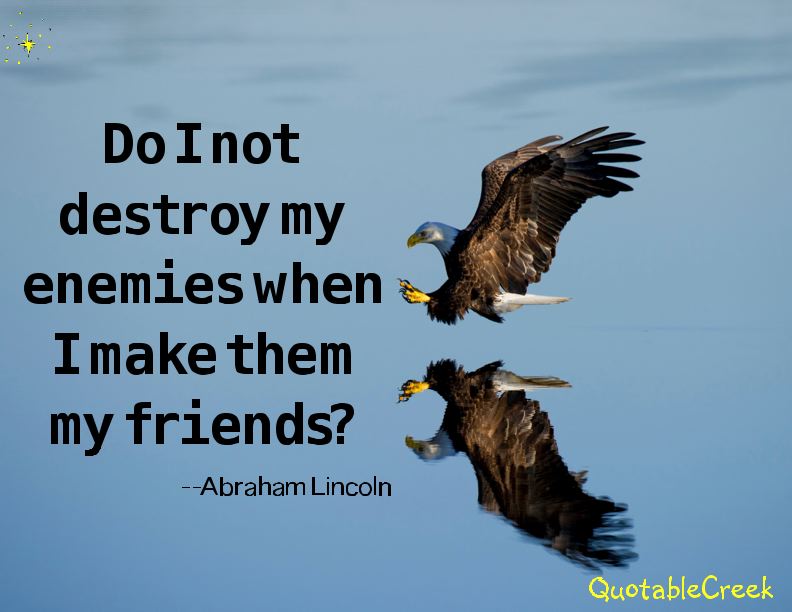
Befriend away.

eaglefriend

It’s not particularly challenging to love people who look, act, and think just like us. The more we insulate ourselves within that group, the more we think in terms of us and them, in and out. We ‘other’ people. We see only the things we think divide us and gloss over all the commonalities.

What if we were to take a different approach?

What if we were to struggle to see from a different perspective? What if we were to build on common ground that exists between all people? What if we were to delight in our differences? What if we were to reach out our hands in kindness?

What then?

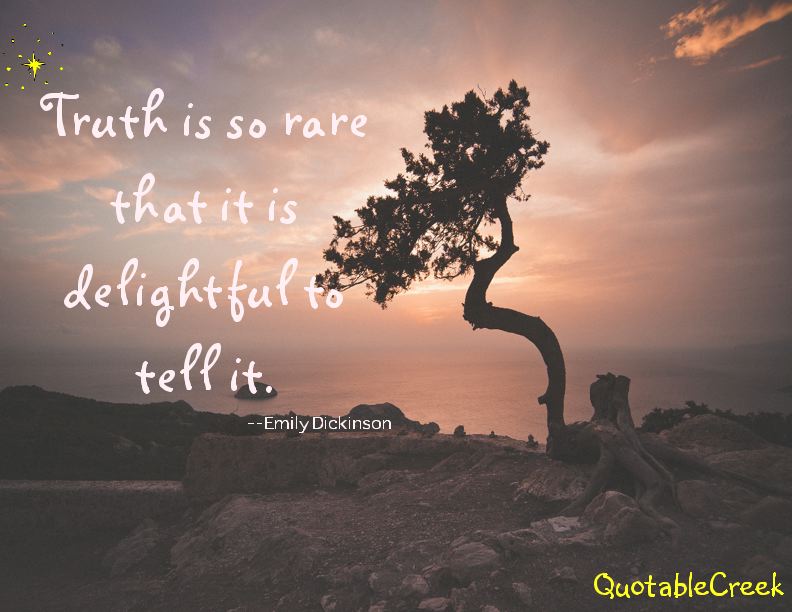
Fess up

truthrare

Why do we lie? Why is the truth so difficult?

Maybe we are worried we are not enough. We arm ourselves with masks and layers to project a more successful, more perfect self. Meanwhile, the real self inside feels chagrinned. “Why is it necessary to puff. Am I not enough?” it whispers.

Maybe we are afraid. We don’t know so much–the future, the complexities of life, the secrets of our fellow journeyers. So maybe it makes us feel safer to pretend we know all the answers.

Maybe we don’t really want to tackle the problem at hand. We ignore it; we pretend it isn’t there; we sugarcoat it. If we don’t acknowledge it, maybe it doesn’t exist.  (But we keep stumbling against it, don’t we?)

Think what power there is in the truth. It provides a foundation that is stable enough to approach any problem head-on.  It testifies that each of us is enough, and, not only enough, but that the very weakness we are trying to hide is the vulnerability that gives our voices authenticity and value, that draws others to us as a source of comfort and strength.

No one really expects perfection from you. If they say they do, it’s because they are not fully grounded in the truth themselves. There isn’t perfection. It doesn’t exist. There is just all different versions and varieties of real.  That is your truth. Your real. Own it.

Have courage.

couragemuscle

What frightens you? Is it holding you back from trying new things, meeting new people, going new places? Fear is a crippler. Your mind is extremely good at playing worst case scenarios for you in the wee hours. Habit seems safe, so we stick to the same things, day in and day out.

But at what cost?

What is out there waiting to be discovered? Who is a friend you have yet to meet?

Sometimes we have to push against our fear, take the first step, even if it is just a baby step. And then keep walking. Keep exploring. Keep learning. Keep opening up to new people and new possibilities. The world is full of opportunities waiting to be experienced. You are capable of growing and blossoming and stretching.

Take that step.