Lessons from an iguana.
In 2006 a high school English teacher asked students to write to a famous author and ask for advice. Kurt Vonnegut was the only one to respond – and his response is magnificent:

“Dear Xavier High School, and Ms. Lockwood, and Messrs Perin, McFeely, Batten, Maurer and Congiusta:


I thank you for your friendly letters. You sure know how to cheer up a really old geezer (84) in his sunset years. I don’t make public appearances any more because I now resemble nothing so much as an iguana.


What I had to say to you, moreover, would not take long, to wit: Practice any art, music, singing, dancing, acting, drawing, painting, sculpting, poetry, fiction, essays, reportage, no matter how well or badly, not to get money and fame, but to experience becoming, to find out what’s inside you, to make your soul grow.


Seriously! I mean starting right now, do art and do it for the rest of your lives. Draw a funny or nice picture of Ms. Lockwood, and give it to her. Dance home after school, and sing in the shower and on and on. Make a face in your mashed potatoes. Pretend you’re Count Dracula.


Here’s an assignment for tonight, and I hope Ms. Lockwood will flunk you if you don’t do it: Write a six line poem, about anything, but rhymed. No fair tennis without a net. Make it as good as you possibly can. But don’t tell anybody what you’re doing. Don’t show it or recite it to anybody, not even your girlfriend or parents or whatever, or Ms. Lockwood. OK?


Tear it up into teeny-weeny pieces, and discard them into widely separated trash receptacals. You will find that you have already been gloriously rewarded for your poem. You have experienced becoming, learned a lot more about what’s inside you, and you have made your soul grow.
God bless you all!” ~Kurt Vonnegut

There is something soul-stretching about entering the zone, that timelessness we find in creating art. Writing, drawing, dancing, singing. All of it. Lose yourself in creating and find yourself a bit different on the other end.

Painting with your soul.

We wear our souls on our sleeves really, especially those of us who are artists. The created work sings of hope or despair, love or hate, trust or deceit. Much of what we believe about life is reflected in our created worlds.

But each of us is an artist, really. Consider the curated worlds each of us makes with our online presence. Do we share stories of hope and unity or of despair and dissension? Do we seek to unify or to tear apart? Do we spread the beautiful or the ugly? What are we putting out there into the world with our words and actions?

When we share with the world, are we sharing the best of ourselves?

Wiping the dust off our souls.

It is so easy to get discouraged when living a creative life. Your words are criticized; your paintings don’t sell. “They” don’t believe you have any promise. Sometimes the struggle to be commercially successful in a creative field can be so daunting that you abandon the art. But then you remember that art isn’t about “them” or “success” or “critical acclaim” at all. It’s about bringing your truths into the light, being creative, pushing yourself, being you.

Nowhere is this better illustrated than in the case of Henri Rousseau, a forty year old toll collector who wanted to paint. His work was derided, and yet he continued. He found joy in the painting. Not until the end of his life did anyone take his work seriously. As summarized by Maria Popova:

Long before history came to celebrate him as one of the greatest artists of his era, long before he was honored by major retrospectives by such iconic institutions as the MoMA and the Tate Museum, long before Sylvia Plath began weaving homages to him into her poetry, he spent a lifetime being not merely dismissed but ridiculed. And yet Rousseau — who was born into poverty, began working alongside his plumber father as a young boy, still worked as a toll collector by the age of forty, and was entirely self-taught in painting — withstood the unending barrage of harsh criticism with which his art was met during his entire life, and continued to paint from a deep place of creative conviction, with an irrepressible impulse to make art anyway…. [Rousseau’s life is] an emboldening real-life story, and a stunningly illustrated one, of remarkable resilience and optimism in the face of public criticism, of cultivating a center so solid and a creative vision so unflinching that no outside attack can demolish it and obstruct its transmutation into greatness.

The message from Rousseau’s life speaks to all of us: he was a success all along. He persevered with a remarkable resilience to produce work that spoke to him and pursued a passion that made him happy. That, the pursuit of great art, rather than the financial success was what gave his journey depth and meaning and lifted up his soul.

Doing things for the joy of doing them

When we were kids, we didn’t worry too much about whether we were the best at coloring or pretend or sports. We did things because they were fun and filled us with joy. Later, somehow, we became worried about whether we should continue when we were never going to be competitive in it. We worried about how we looked, whether we would be mocked. Perhaps our parents decided lessons were a waste because we weren’t the stand out they had hoped we would be. The fun of it got lost and gave way to the competition in it.

That’s a shame. Author Kurt Vonnegut had an epiphany about this that changed his life:

When I was 15, I spent a month working on an archeological dig. I was talking to one of the archeologists one day during our lunch break and he asked those kinds of ‘getting to know you’ questions you ask young people: Do you play sports? What’s your favorite subject? And I told him, no I don’t play any sports. I do theater, I’m in choir, I play the violin and piano, I used to take art classes.

“And he went wow. That’s amazing! And I said, ‘Oh no, but I’m not any good at any of them.’

“And he said something then that I will never forget and which absolutely blew my mind because no one had ever said anything like it to me before: ‘I don’t think being good at things is the point of doing them. I think you’ve got all these wonderful experiences with different skills, and that all teaches you things and makes you an interesting person, no matter how well you do them.’

“And that honestly changed my life. Because I went from a failure, someone who hadn’t been talented enough at anything to excel, to someone who did things because I enjoyed them. I had been raised in such an achievement-oriented environment, so inundated with the myth of Talent, that I thought it was only worth doing things if you could ‘win’ at them.

That’s such a liberating mind shift. Doing things for the joy of them! Not the achievement in them. Not the value to your college application. Not the resume value or the competition.

The joy! Imagine that.

The invisible essential.

Not long ago, the world shut down, and most people were asked to sequester and stay home while essential workers reported, still, for duty. It was a strange time, involving so many swiftly moving facts to assimilate and assess forward progress.

But that question of ‘essential’ is an interesting one. Some of the jobs labeled ‘essential’ or not were surprising choices.

How does one determine what is ‘essential’? What of the artist? With so many schools cutting art and music programs as non-essential, I wonder what the world would look like filled just with grammarians and mathematicians. Surely, art, though it puts no food on the table and sets no broken bones, is essential to the human spirit.

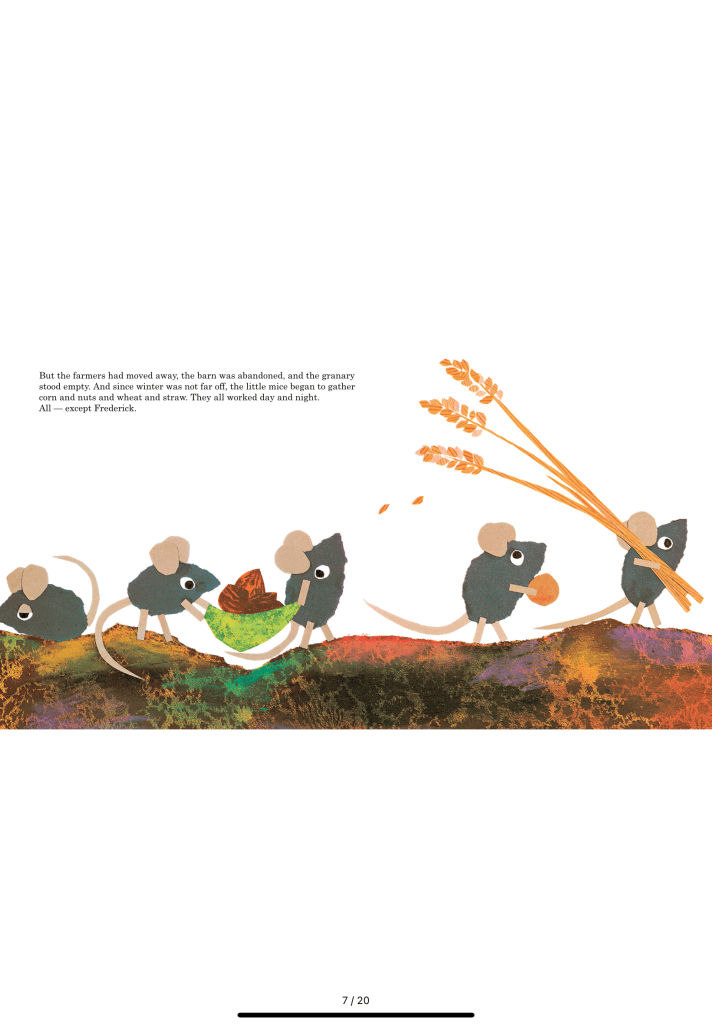
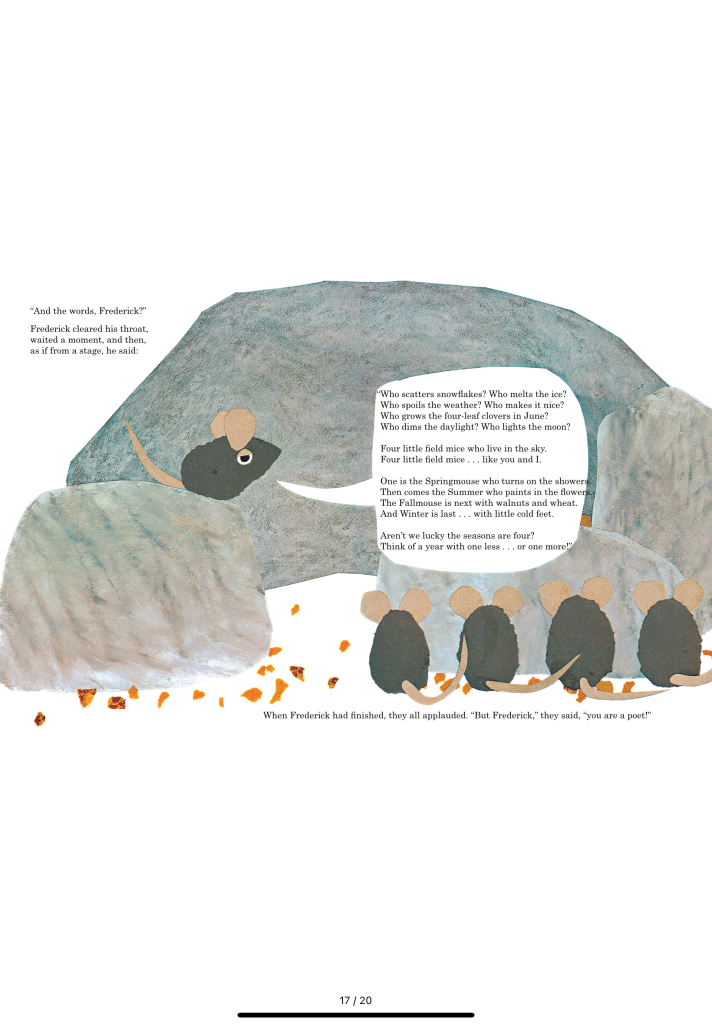
Such is the theme of Frederick by Leo Lionni. While four mice toil to set up stores of grain for winter, one mouse collects color, and sounds, and words.

And when winter came, and the mice were cold and hungry, Frederick’s words sustained them.

So lift a glass in praise to the artists, the writers, the musicians. Those who lift us up and sustain us and offer us beauty for our souls.

Create.

artist

How do you define success?

Is it in a purely monetary way or is it more nuanced and complex?

A creative life expands the heart and sharpens the senses. It opens the creator to insight and wisdom. It constantly pushes the creator to new levels. It is a fountain of youth and immortality all in one.

Pause.

jellyfish

We are caught in the steady, persistent, ruthless flow of time. And yet there are moments when we can step out of time to pause, focus, and gain perspective. The arts do that. As you admire a piece of art, whether photograph, painting, novel, poem, film, dance and so on, we are grounded in detail. We can observe intricacy. We pause in the captured emotion and can rest there awhile. We are transported.

When the cares of the world become too great, we can pause and admire the detail in a jelly fish, the sweetness in bird song, or read soothing words such as these by Wendell Barry:

The Peace of Wild Things

When despair for the world grows in me

and I wake in the night at the least sound

in fear of what my life and my children’s lives may be,

I go and lie down where the wood drake

rests in his beauty on the water, and the great heron feeds.

I come into the peace of wild things

who do not tax their lives with forethought

of grief. I come into the presence of still water.

And I feel above me the day-blind stars

waiting with their light. For a time

I rest in the grace of the world, and am free.


Take a moment to pause on something beautiful.

Wipe the dust off your soul.

soulwash

It is so easy to get discouraged when living a creative life. Your words are criticized; your paintings don’t sell. “They” don’t believe you have any promise. Sometimes the struggle to be commercially successful in a creative field can be so daunting that you abandon the art. But then you remember that art isn’t about “them” or “success” or “critical acclaim” at all. It’s about bringing your truths into the light, being creative, pushing yourself, being you.

Nowhere is this better illustrated than in the case of Henri Rousseau, a forty year old toll collector who wanted to paint. His work was derided, and yet he continued. He found joy in the painting. Not until the end of his life did anyone take his work seriously. As summarized by Maria Popova:

Long before history came to celebrate him as one of the greatest artists of his era, long before he was honored by major retrospectives by such iconic institutions as the MoMA and the Tate Museum, long before Sylvia Plath began weaving homages to him into her poetry, he spent a lifetime being not merely dismissed but ridiculed. And yet Rousseau — who was born into poverty, began working alongside his plumber father as a young boy, still worked as a toll collector by the age of forty, and was entirely self-taught in painting — withstood the unending barrage of harsh criticism with which his art was met during his entire life, and continued to paint from a deep place of creative conviction, with an irrepressible impulse to make art anyway…. [Rousseau’s life is] an emboldening real-life story, and a stunningly illustrated one, of remarkable resilience and optimism in the face of public criticism, of cultivating a center so solid and a creative vision so unflinching that no outside attack can demolish it and obstruct its transmutation into greatness.

The message from Rousseau’s life speaks to all of us: he was a success all along. He persevered with a remarkable resilience to produce work that spoke to him and pursued a passion that made him happy. That, the pursuit of great art, rather than the financial success was what gave his journey depth and meaning and lifted up his soul.


No worries.

halfface

It turns out artists make a lot of mistakes. We only think they are wonderfully talented, with perfect products immediately dripping off their paintbrushes or keyboards, because we see the finished product and not all of the drafts and abandoned projects along the way. So when we sit down to write or draw or craft or hum out a melody, we can set aside the worry that we aren’t up for the task if our first efforts are less than perfect. Mistakes are the training ground. The more the better because each teaches us what doesn’t work or how something could work better. It is all practice making us more perfect. What’s a failure is being scared to start.