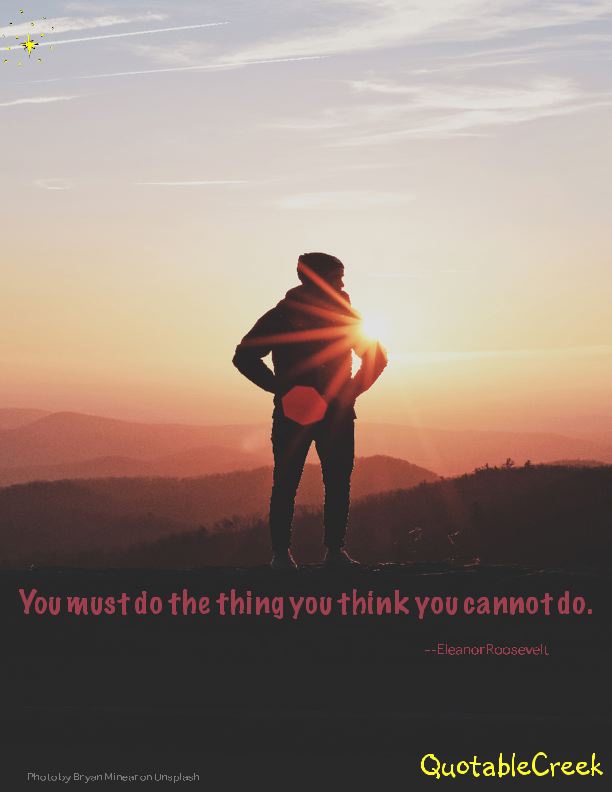
Facing fear

Standing up to fear changes a person. It helps you to put matters in perspective. Where once fear loomed over you, insurmountable, now you can honor the courage it took to move past it into unfamiliar territory.

Eleanor Roosevelt was a courageous woman. Despite her husband’s attempts to placate the South, she regularly bucked segregation and was a vocal proponent of civil rights. She was able to call out racism and force others to see it for what it was:

By 1939, ER decided to attack the hypocritical way in which the nation dealt with racial injustice. She wanted her fellow citizens to understand how their guilt in “writing and speaking about democracy and the American way without consideration of the imperfections within our system with regard to its treatment . . . of the Negro” encouraged racism. Americans, she told Ralph Bunche in an interview for Gunnar Myrdal’s American Dilemma, wanted to talk “only about the good features of American life and to hide our problems like skeletons in the closet.” Such withdrawal only fueled violent responses; Americans must therefore recognize “the real intensity of feeling” and “the amount of intimidation and terrorization” racism promotes and act against such “ridiculous” behavior.

You can’t clearly see a problem before you if you are too scared to look at it and call it out for what it is. Where are the injustices in your immediate orbit? Are there people being treated unfairly? How can you add your voice to help identify the problem and move toward healing? These problems are right here, close to home.

As Eleanor Roosevelt said:

Where after do human rights begin? In small places, close to home– so close and so small that they cannot be seen on any map of the world. Yet they are the world of the individual person: The neighborhood he lives in; the school or college he attends; the factory, farm or office where he works. Such are the places where every man, woman, and child seeks equal justice, equal opportunity, equal dignity without discrimination. Unless these rights have meaning there, they have little meaning anywhere. Without concerted citizen action to uphold them close to home, we shall look in vain for progress in the larger world.

-“Remarks at the United Nations,” March 27, 1958

https://erpapers.columbian.gwu.edu/quotations-eleanor-roosevelt

Fear is a crippler. It keeps you rooted in a course of action you know to be wrong. Focusing on the fear helps it to loom even larger before you. Instead, focus on the better world you are trying to help build. Spreading love and justice is exciting and uplifting. Being part of something bigger than yourself, working for a common goal, in an effort to improve people’s circumstance is rewarding.

You don’t have to see the whole path in front of you. Take, and keep taking, that next step forward.

God winks

Often, when we look back at our lives, we will see strange coincidences that came at meaningful times in our life. That person you met, show you watched, book you read, something you overheard that serendipitously was just what you needed in that moment. My pastor calls these God winks. It feels like someone is watching over you and caring.

Of course, these could be just coincidental. But they are important, pivotal, coincidences.

Emma Thompson puts it this way:

I think books are like people, in the sense that they’ll turn up in your life when you most need them. After my father died, the book that sort of saved my life was Gabriel García Márquez’s novel One Hundred Years of Solitude. Because of that experience, I firmly believe there are books whose greatness actually enables you to live, to do something. And sometimes, human beings need story and narrative more than they need nourishment and food.

Emma Thompson in @oprah’s O Magazine.

The most important thing is having the eyes to recognize the impact and the willingness to be open to change and growth.

God winks are everywhere if you develop the eyes to see them.

A very buzzard homecoming.

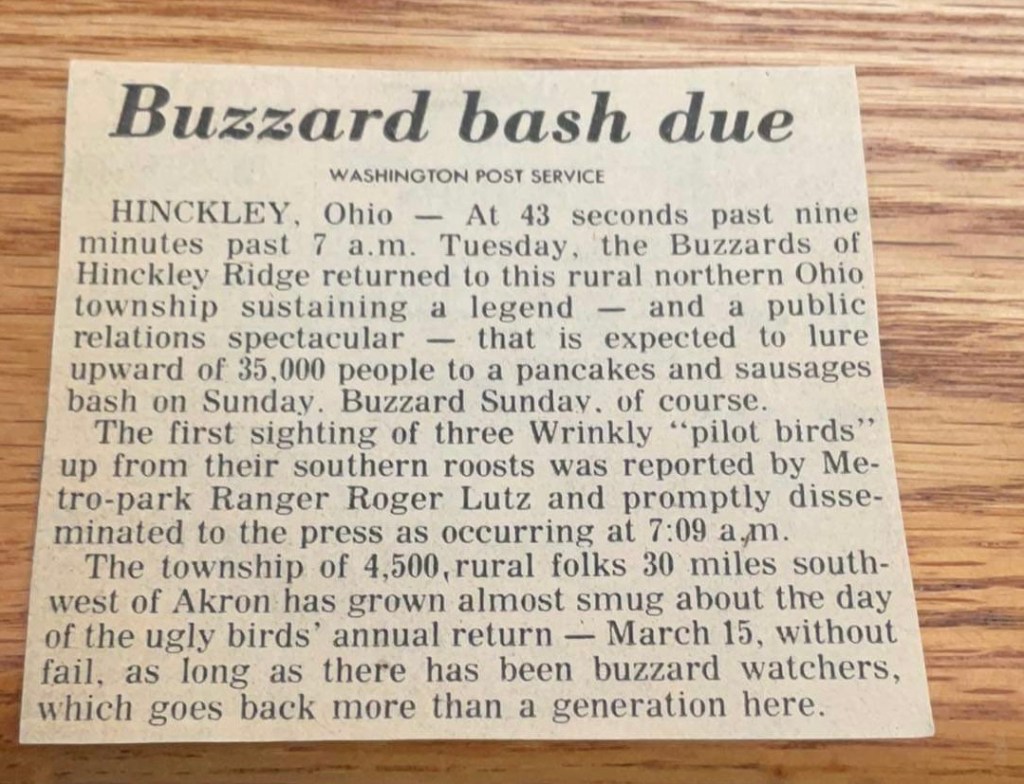
Recently, I pulled down an old scrapbook from my junior high days to show my granddaughter Lily who is just that same age now as I was then. It contained many ‘treasures’. Among the many letters and cards from my late grandmother was one talking about the buzzards coming back home to Hinckley, Ohio, a phenomenon which I remember amused me. Imagine celebrating buzzards!

She wrote:

It should cheer you somewhat to know that the buzzards returned to Hinckley, Ohio, on schedule on March 15th. It is always a comfort to know those gorgeous creatures ‘do their thing’ each year, as anticipated. It would be a bit discouraging to prepare pancakes and sausages for 35,000 eager folks, and have no buzzards to join in the celebration!

Oh, how I loved her, her humor and wit, her warmth and love, her writing style. I have always felt such a kinship with her and reading over her letters makes her feel so close.

Her letter got me thinking. First, about buzzards. Sure enough, a quick bit of googling shows that buzzards are still returning to Hinckley on schedule and have been celebrated since 1818!

And then about the cyclical quality of nature. The monarchs go south and then back. The swallows return to San Juan Capistrano. The elephant seals come back to Cambria. We humans who love animals mark their going and celebrate their homecoming, yes, even the buzzards, and note the steady passage of time.

And finally about how those we’ve lost stay with us even after they’ve gone. Lily has a freckle on her right hand which I’ve told her is her Nana freckle. I load it up with kisses often when I see her. When I’m gone, I hope that freckle will remind her of how very much I loved her. My grandmother and I were separated by thousands of miles, but our letters exchanged helped us stay close. Those letters remind me now to pause and share bits of life, simple moments, with the people I love. Those moments become the memories and precious treasure later.

Even the ones about buzzards.

(I couldn’t quite bring myself to make the lead picture with buzzards. Lol)

Bird chirping weather.

Every day this week, I’ve woken up to birdsong, which is a particularly delightful way to pass from dreams to reality. I’ve been working on the garden—planting, pruning, weeding, trying to make a pretty space. Birds singing out there make me feel like they approve and they’re calling me to the adventure of creating ‘our’ space together. It’s a party out there, and I’m both the host and an invited guest.

Those singing birds make me feel so hopeful.

‘Hope’ is the thing with feathers –
That perches in the soul –
And sings the tune without the words –
And never stops – at all …

By Emily Dickinson

Loving what’s mortal

As we age, there is loss. That loss is like a presence that follows us relentlessly like a shadow. No avoiding it. No pretending. We are mortal. The people we love are mortal, perhaps imminently so. This is part of the rules of engagement. And while most of us avoid thinking too much about it, poets like Mary Oliver offer life instructions:

To live in this world, you must be able to do three things:

To love what is mortal

To hold it against your bones knowing your own life depends on it;

And, when the time comes, to let it go, to let it go.

I honestly don’t know which of these three rules is the hardest. Right now, they each seem nearly impossible. But having the courage to follow these instructions feels like the answer.

Her full poem is below.

Look, the trees
are turning
their own bodies
into pillars

of light,
are giving off the rich
fragrance of cinnamon
and fulfillment,

the long tapers
of cattails
are bursting and floating away over
the blue shoulders

of the ponds,
and every pond,
no matter what its
name is, is

nameless now.
Every year
everything
I have ever learned

in my lifetime
leads back to this: the fires
and the black river of loss
whose other side

is salvation,
whose meaning
none of us will ever know.
To live in this world

you must be able
to do three things:
to love what is mortal;
to hold it

against your bones knowing
your own life depends on it;
and, when the time comes to let it go,
to let it go.

“In Blackwater Woods” by Mary Oliver, from American Primitive. © Back Bay Books, 1983.

Just as you are

Mr. Rogers had a gift for seeing each child he encountered as an individual, a neighbor, someone worthy of respect just as they are. No need to impress him, or to put on an act, or to pretend. He accepted children. Period. No strings attached.

How wonderful.

Do you feel you are enough, just as you are? Sometimes our families, friends, or societies give us the message that we aren’t. That we need to be thinner, richer, smarter, younger, more attractive. Something different from what we are. That we must think the same as they do and fall in line. It’s exhausting.

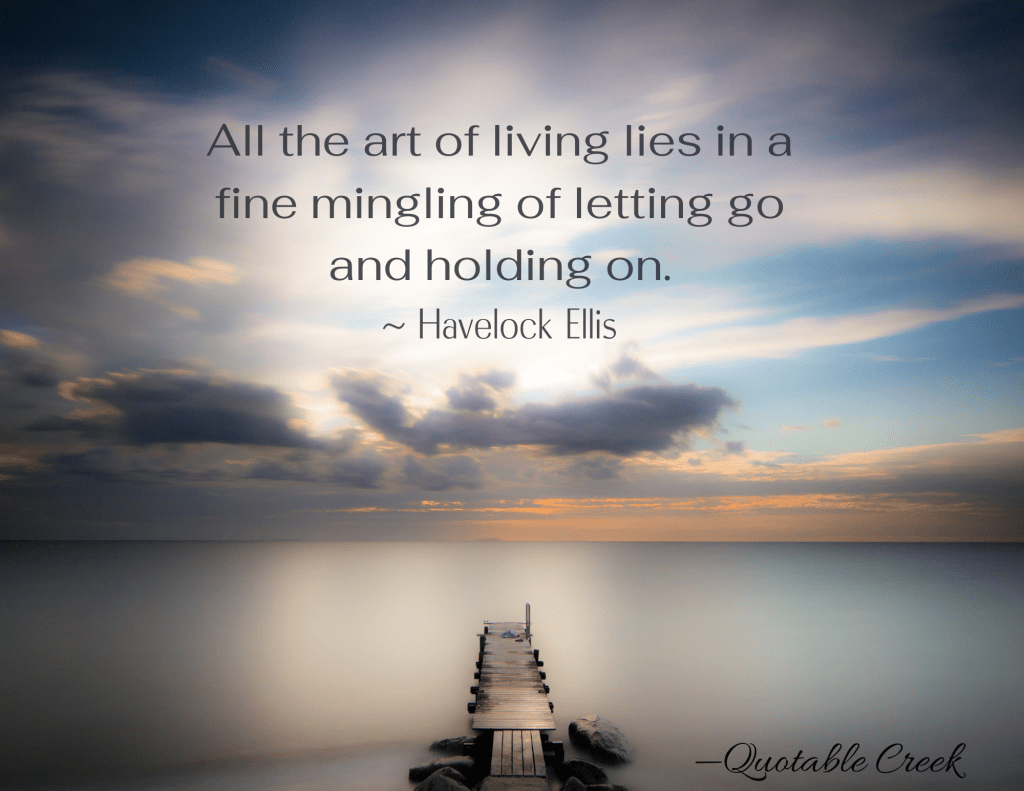
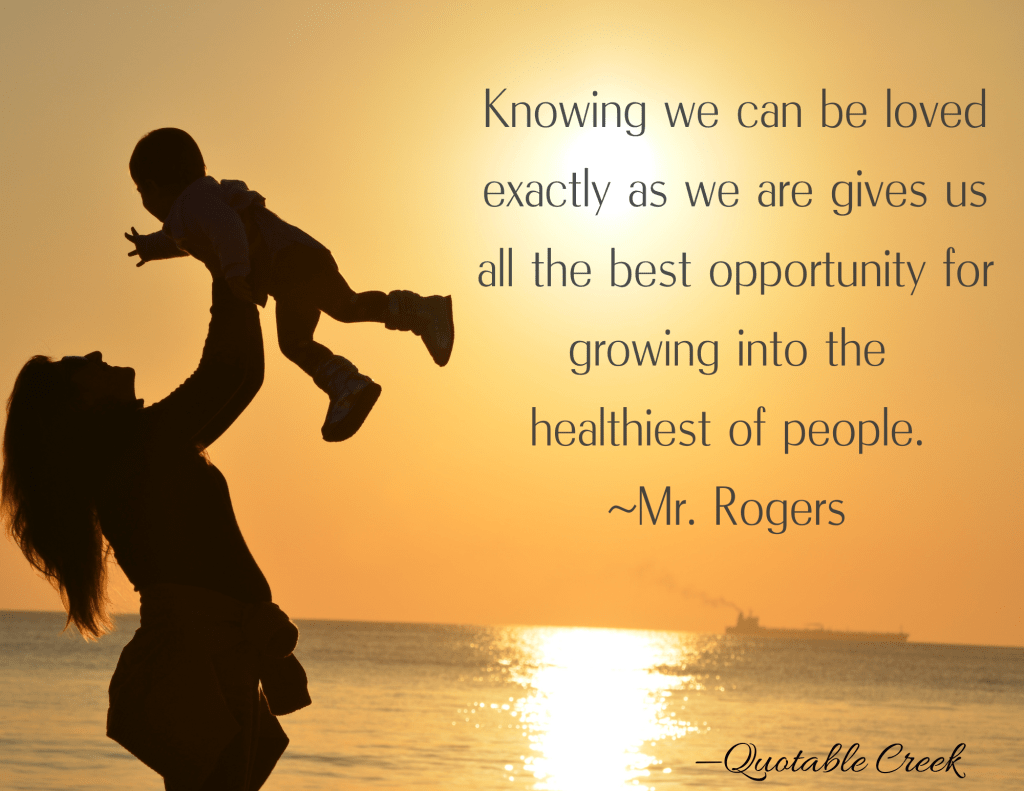
What a gift it is to accept people, including ourselves, just as is. No one is perfect, so why pretend we are? We each have strengths and weaknesses, things we’re working on and things we’ve got sorted. Instead of finding flaws, we can look at ourselves and each other as complicated works in progress, with value just as we are, giving ourselves and each other ‘the best opportunity for growing into the healthiest of people.’

Thankful for the whole everything.

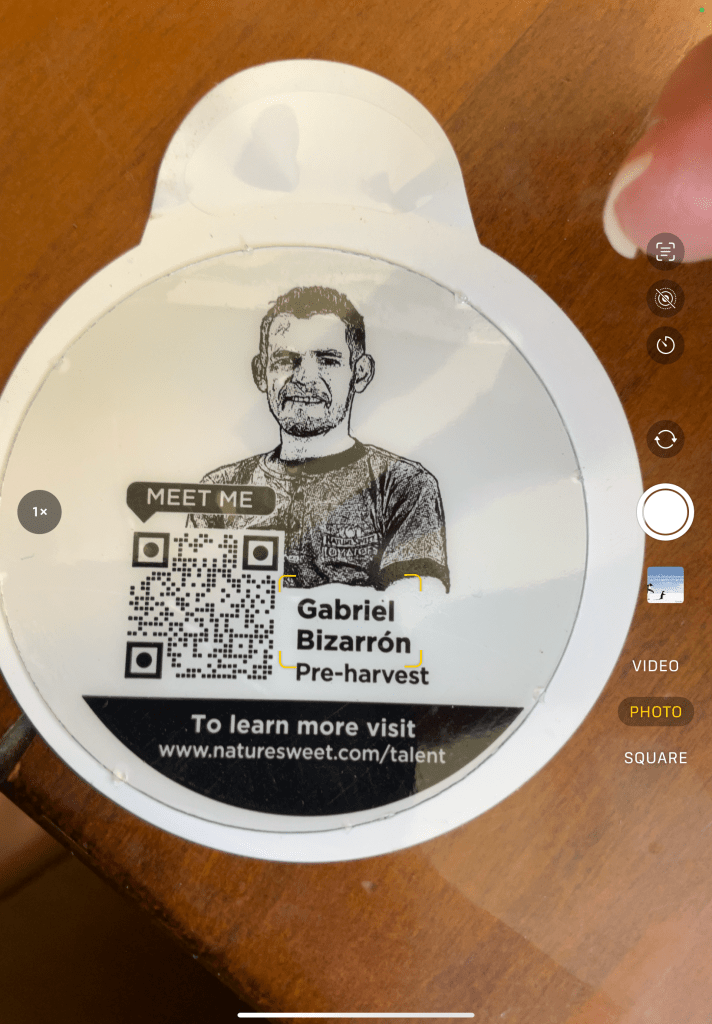
Yesterday, I was minding my business, making a quick salad for lunch. As I peeled the sticker top off the little plastic tub of cherry tomatoes, I was caught by surprise. On the back of the sticker was a picture of a man and a scan code to learn more about him.

It turns out Gabriel Bizarrón helps to make sure my tomatoes are bug free and have the right nutrients, He is working toward a degree in agribusiness. Gabriel is one of the many people responsible for helping me have a delicious healthy lunch, and I’m thankful for him.

Which got me thinking about all the other people in the chain of bringing these tomatoes to my belly, and there are so many. Stopping and imagining all the hands and minds that went into bringing my meals into existence, and being grateful for each of them, was quite a fun exercise. There are so many! What a wonderful invisible web of people there are behind the scenes to bring each of us food, clean water, electricity, and so on. Not to mention being grateful for businesses, like this and like Snapple with their hidden quotes, that take time to make their packaging inspirational. It is staggering once you start thinking about it, and really no end in sight, because each ‘thankful for’ leads to another, infinitely.

What a wonderful world!

It’s the details.

Sometimes things can be startling.

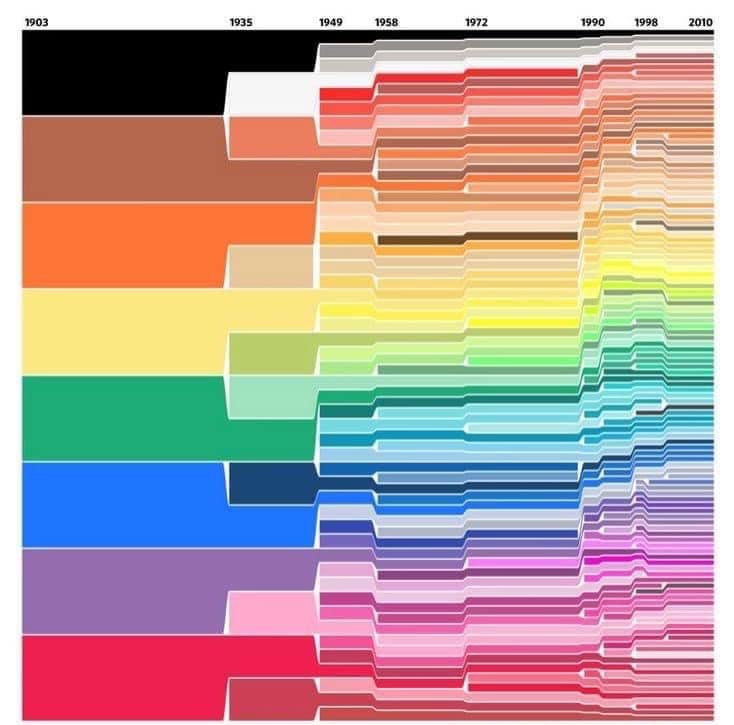
Look, for example, at the evolution of the color choices in the crayon:

Or in ice cream:

We are definitely not living in a plain vanilla, white bobby socks, only primary color world. We are living in a vibrant, color-and-detail everywhere world. Some days it feels wondrous to just soak it all in and enjoy the variety.

Mary Oliver says it best.

Instructions for Living a Life

Pay attention.

Be astonished.

Tell about it.

Book magic

There is a certain alchemy in writing a book. Where do ideas come from? How do they knit together to form a story? What elevates words to resonate with a reader’s inner self? An author may seem like a bit of a magician conjuring elements, or perhaps a conductor taming orchestral components together to make music.

But reading can be even more magical. Words written by a stranger maybe years ago can resonate deeply and touch your soul. Fictional characters can be more real to you than the people you see every day. You can curl up on your couch with a book and be completely transported into another place and time in a way that feels so astonishingly real that when you put down the book, you temporarily lose your bearings. And sometimes you can read something that travels through time and space to speak directly to your troubled heart and give you peace.

W.B. Yeats put it this way:

Where My Books Go

All the words that I gather,
And all the words that I write,
Must spread out their wings untiring,
And never rest in their flight,
Till they come where your sad, sad
heart is,
And sing to you in the night,
Beyond where the waters are moving,
Storm darkened or starry bright.

Our last chance to be alive.

Now is our time to be alive. It will not come again. This is our last chance to savor nature and all of its wonder, to spend time with loved ones, to do good, to spread joy. This is it. This is our opportunity.

In the movie, Michael, an angel comes to Earth to influence the course of events. He, apparently, smells of cookies. But there is a scene, after ‘battle’ (he’s that kind of angel), when he is savoring the day. He is soaking it in, just enjoying being corporeal, waltzing with the breeze.

If only we could hold on to that wonder, awe, and appreciation, live in the moment, truly appreciate all we’ve been given here. What a fine world that would be.