It’s okay to be heartbroken for more than one group of people at the same time. When it comes to showing compassion, we don’t have to pick sides. Sometimes, often really, maybe even always, there is hurt and anguish everywhere, and we can mourn the lot of it.
Beware people who tell you not to be concerned for this group or that group and the hurt they feel.
Beware those who try to dehumanize others.
Beware those who lump you in as the ‘enemy’ for working to assure people are treated humanely.
Beware people who draw lines between us and them.
Beware those who try to limit you to a label or single identity.
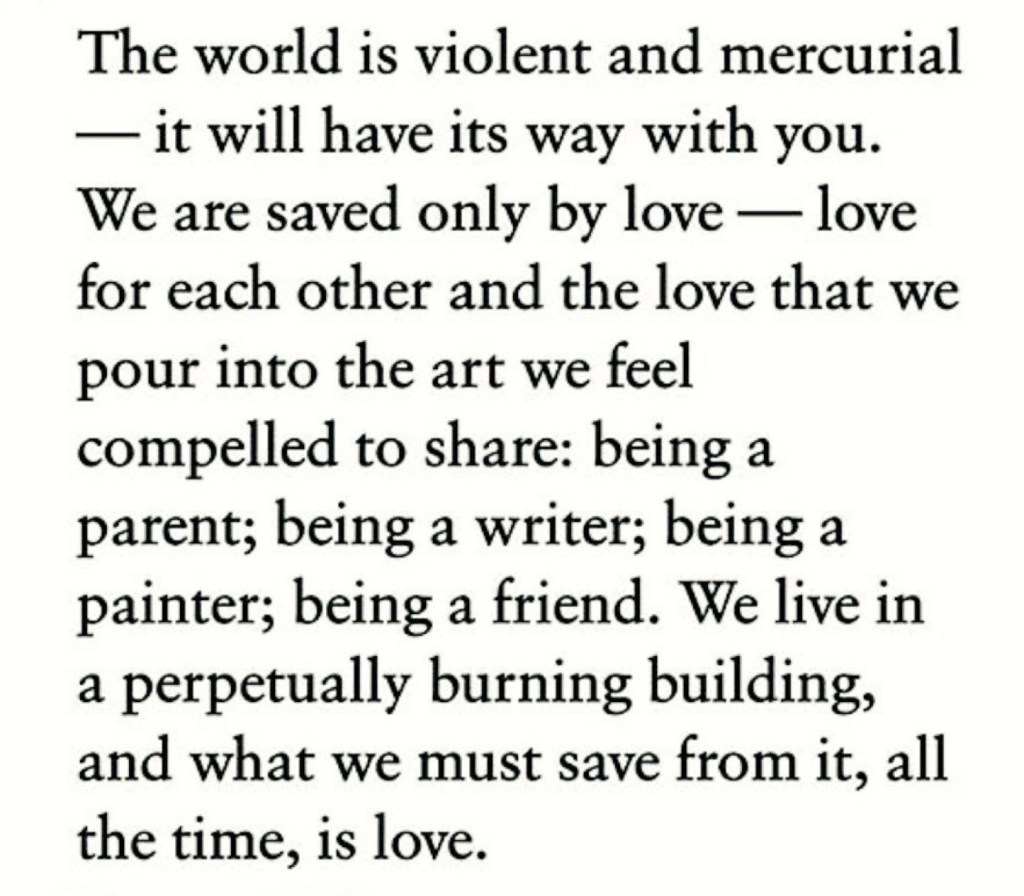
Our hearts are big enough to embrace it all. What we must save is love.
A guy cuts you off in traffic. How do you see him? Is he an inconsiderate lout caring little for the aggravation he causes you or a distracted hapless soul, perhaps late for an emergency? How we see this situation, or any situation, can have a profound effect on our lives.
In this thoughtful essay, Elizabeth Gilbert considers the power of perception. She recounts a time when her father and his siblings were reminiscing about their late mother and how she used to take a sip from any glass of milk she poured for them. They agreed on the fact, that she took a sip, but wildly disagreed on their perception of that fact:
At one point, they found themselves sitting around the old kitchen table, eating sandwiches and talking about the past. My uncle, the baby of the family, looked at the refrigerator and said, “I can still see Mom standing there, pouring me a glass of milk. Do you remember that sweet thing she always used to do whenever she got us a glass of milk? Remember how she’d take a tiny sip first, to make sure it wasn’t spoiled? Always looking out for us.”
My father, the analytical engineer of the family, raised his eyebrows. “No,” he said. “You are so wrong. Mom wasn’t sipping our milk to test it for freshness. She was sipping our milk because she always overfilled the glass. She had no sense of spatial relations. It used to drive me crazy.”
My brilliantly sardonic aunt looked at her two brothers like they were the biggest idiots she’d ever seen.
“You’re both wrong,” she said. “Mom was stealing our damn milk.”
So, what have we learned about my grandmother from this story? Was she a devoted caregiver, an incompetent dunderhead or someone who would steal the milk out of the mouths of her children? (Or maybe just an exceptionally thirsty woman.) The world will never know the truth.
But does the truth really matter?
I don’t think so.
Wow! What a remarkable difference in what each brings to the encounter. Now imagine yourself in each of those mindsets: hostile, critical, or grateful. Which would lead to the happier life?
We don’t have control over facts, but we sure have a tremendous amount of control over how we perceive those facts. We owe it to ourselves to try to see the facts in the most favorable light even if that means consciously going over all the possible interpretations of something and actively selecting the best one to pick.
Speaking to graduating law students, Julian Aguon said
No offering is too small. No stone unneeded. All of us – whether we choose to become human rights lawyers or corporate counsel, or choose never to practice law at all but instead become professors or entrepreneurs or disappear anonymous among the poor or stay at home and raise bright, delicious children – all of us, without exception, are qualified to participate in the rescue of the world.
And this is true for any profession, calling, or vocation. We each matter. We each contribute to the mix. We each are qualified to rescue this world.
In any time in history, including our own in which we now find ourselves, some individuals stand apart from the crowd on behalf of what is right. Their example inspires others from that moment forward in time.
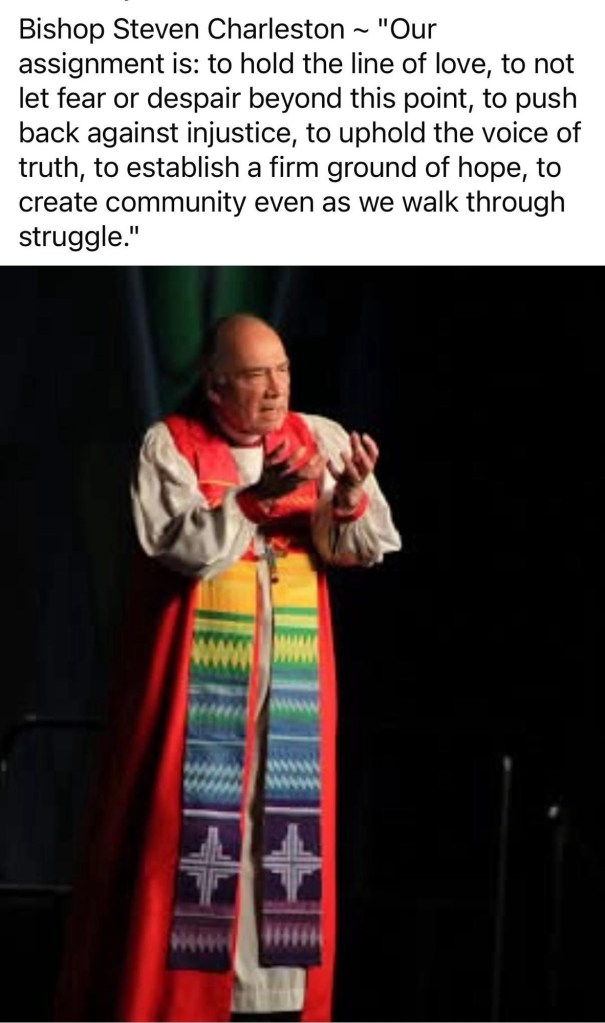
What is our job in these troubled times? During any times, but particularly during times where we are seeing peoples’ rights eroded and trampled, when legal safeguards are flouted, and when authoritarianism is on the rise, our job is to hold the line. Continue to be a place of comfort and succor to the hurting, feed the hungry, grieve with the mourning.
Friendships are taking a hit these days. Politics, world views, differing opinions are tearing people apart.
What is it that holds people together instead?
One thing is an abiding concern for the other person, despite your differences. If you can advocate against the death penalty on behalf of a stranger, couldn’t you bring yourself to see what is good and redeemable inside a former friend? Inside an enemy even? Searching for common ground is hard work, but really the main point of living in community. Isn’t it?
I was recently reminded about a story from 2017 where two little boys were caught in a rip tide and swept out to sea. Their entire family and four woud-be rescuers tried to swim out to save them but ended up similarly stranded. Officials on shore stood, helpless, waiting for a rescue boat while the family and would-be rescuers floundered.
But then the people on the beach did a remarkable thing. People from all walks of life, across every possible difference or division, linked arms together and formed a human chain stretching out into the ocean until they reached those stuck and and then passed them person to person, beginning with the little boys, Noah (11) and Stephen (8), and ending with their grandmother who had tried to save them, back to safety.
Stories like this don’t get a lot of press. But it’s why we’re here.
Children have a way of shaking things up. Don’t they? They see things we’ve stopped noticing. They question things we’ve started to take for granted. They cause us to stop and notice. They hold up a giant mirror to us and cause us to do some soul-searching.
That is, if we take the time to listen.
Why is that person asking for money? Why are people starving? Why do some people get treated better? Why do you say one thing in public but do another in private? Is this fair? Does everyone cheat? Does everyone lie? Is there a better way?
They force us to confront the gap between what we say they should do and what we do, or what society does, or what their friends do. Most adults suffer from some degree of cognitive dissonance: the mental discomfort from holding two or more differing beliefs, ideas or values at the same time. We value honesty but cheat on our taxes. We tell them not to bully others but then bully them or laugh as others are bullied. We tell them never to hit someone else while spanking them. We tell them all children are precious but then harbor racial or gender biases.
They notice.
And they point it out.
For those of us listening, this is a time to ask ourselves what we do, in fact, stand for and then work to align our lives with those values, to be internally and externally consistent.
For an unbelievably uplifting video of a diverse group of kids singing their hearts out, please watch this video. It will start your day off with hope and promise and excitement for the future of our nation and world.
Maybe you’re older, or weaker, or not quite as sharp as you used to be. Maybe your energy is fading, or you’ve gotten depressed and overwhelmed. Maybe all your ducks aren’t in a row, and all your bells don’t ring. Maybe you don’t think you can make a difference.
It is in just such times that you must press on. Your gifts are needed. The world doesn’t need you to be perfect; it needs you to show up.
Do not lose heart. The challenges you see today are the ones you must face. You are strong enough to do your part, and you will find allies everywhere you look.
Look out over the prow; there are millions of boats of righteous souls on the waters with you. Even though your veneers may shiver from every wave in this stormy roil, I assure you that the long timbers composing your prow and rudder come from a greater forest. That long-grained lumber is known to withstand storms, to hold together, to hold its own, and to advance, regardless.
In any dark time, there is a tendency to veer toward fainting over how much is wrong or unmended in the world. Do not focus on that. There is a tendency, too, to fall into being weakened by dwelling on what is outside your reach, by what cannot yet be. Do not focus there. That is spending the wind without raising the sails.
We are needed, that is all we can know. And though we meet resistance, we more so will meet great souls who will hail us, love us and guide us, and we will know them when they appear. Didn’t you say you were a believer? Didn’t you say you pledged to listen to a voice greater? Didn’t you ask for grace? Don’t you remember that to be in grace means to submit to the voice greater?
Ours is not the task of fixing the entire world all at once, but of stretching out to mend the part of the world that is within our reach. Any small, calm thing that one soul can do to help another soul, to assist some portion of this poor suffering world, will help immensely. It is not given to us to know which acts or by whom, will cause the critical mass to tip toward an enduring good.
You do not need to do everything. Do what you can, where you can, with what you can. Your actions combined with actions from millions of like-minded individuals will make a difference for good.
I wonder about Christians responding to the challenges confronting our world right now. How does worshipping a humble carpenter, a servant, a loving non-violent man, inform our choices now?
He shunned power. He empathized with the suffering of others. He humbled himself even unto death.
I wonder about the choices he made while tempted in the desert before embarking on his ministry:
Then Jesus was led by the Spirit into the wilderness to be tempted by the devil. 2 After fasting forty days and forty nights, he was hungry. 3 The tempter came to him and said, “If you are the Son of God, tell these stones to become bread.”
4 Jesus answered, “It is written: ‘Man shall not live on bread alone, but on every word that comes from the mouth of God.’”
5 Then the devil took him to the holy city and had him stand on the highest point of the temple.6 “If you are the Son of God,” he said, “throw yourself down. For it is written:
“‘He will command his angels concerning you, and they will lift you up in their hands, so that you will not strike your foot against a stone.’”
7 Jesus answered him, “It is also written: ‘Do not put the Lord your God to the test.’”
8 Again, the devil took him to a very high mountain and showed him all the kingdoms of the world and their splendor. 9 “All this I will give you,” he said, “if you will bow down and worship me.”
10 Jesus said to him, “Away from me, Satan! For it is written: ‘Worship the Lord your God, and serve him only.’”
11 Then the devil left him, and angels came and attended him.
Matthew 4:1-11
Would Christians today think he made the right decision to eschew power? A while back, WWJD (What would Jesus do?) was a common question. It’s still worth thinking about now.
We see Jesus saving the lost, healing the sick, speaking truth to power, standing up for the marginalized, refusing to grab power. Isn’t that what he would expect those of us who follow him to do now?
And he would, of course, tell us, as he told so many when he walked this Earth,