Do your little bit.
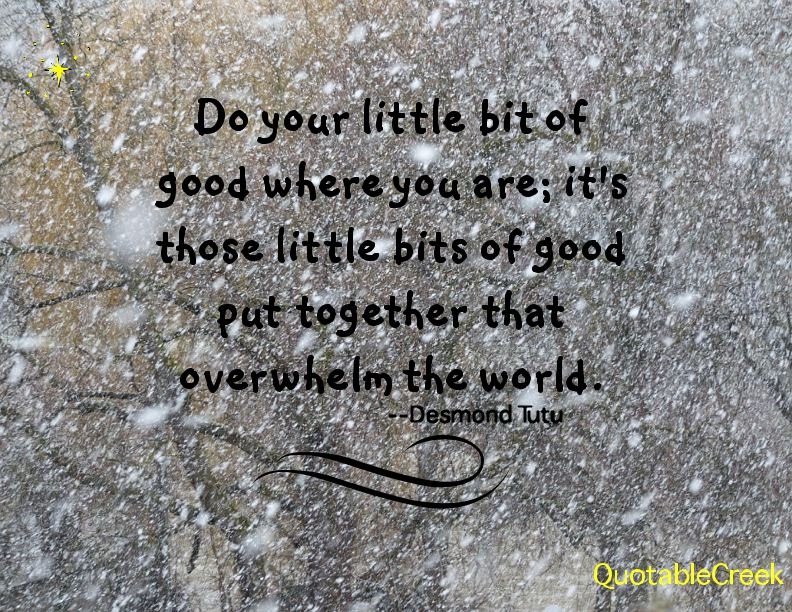
What is your little bit of good?
What is that thing that you can do to make….
the lives of those around you a bit better,
your world a bit brighter,
the day a bit merrier?
Do that thing.
What is your little bit of good?
What is that thing that you can do to make….
the lives of those around you a bit better,
your world a bit brighter,
the day a bit merrier?
Do that thing.
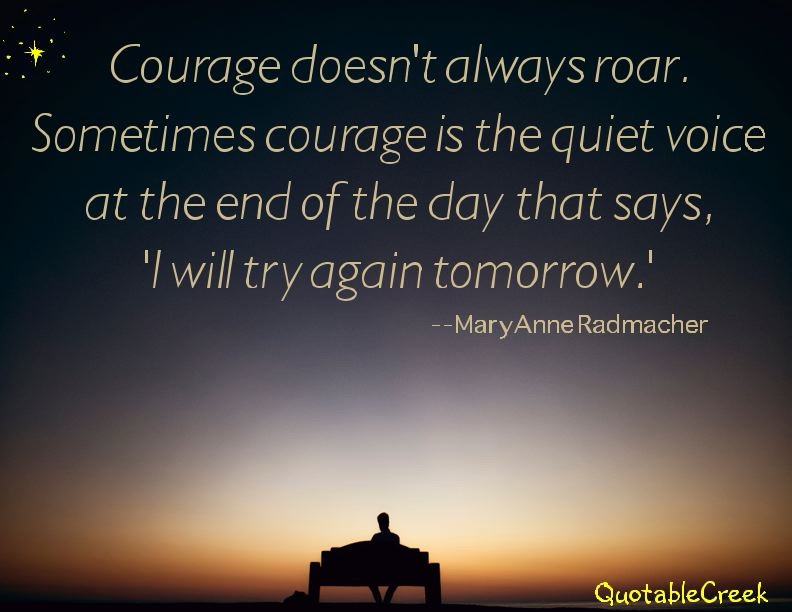
What is worth fighting for? Sometimes a battle is won in a courageous show of strength and derring do. A fireman runs into a burning building to save a child. A passerby stops to help victims of an accident. A pilot steers a damaged plane to safety.
But sometimes the battle requires showing up time after time with love, kindness, and patience. Not giving up on someone. Having faith that love will win. Believing that relationships can be salvaged.
That takes courage, too.

We wear many masks and fluff ourselves up with many props, but how’s that working for us? Nikki Giovanni notices:
A lot of people refuse to do things because they don’t want to go naked, don’t want to go without a guarantee. But that’s what’s got to happen. You go naked until you die.
What guarantees do we have in this life anyway? To health, to wealth, to job security, to happiness? Not so much. There really aren’t any guarantees to anything we do, and we delude ourselves to think otherwise. When we ‘go naked’ we engage from a place of authenticity, without the masks and props. We, our actual selves, enter into this thing called life.
J.K. Rowling notes:
It is impossible to live without failing at something, unless you live so cautiously that you might as well not have lived at all– in which case, you fail by default.
This is it, our one shot, our one life, and we owe it to ourselves to go into it as ourselves and with gusto.
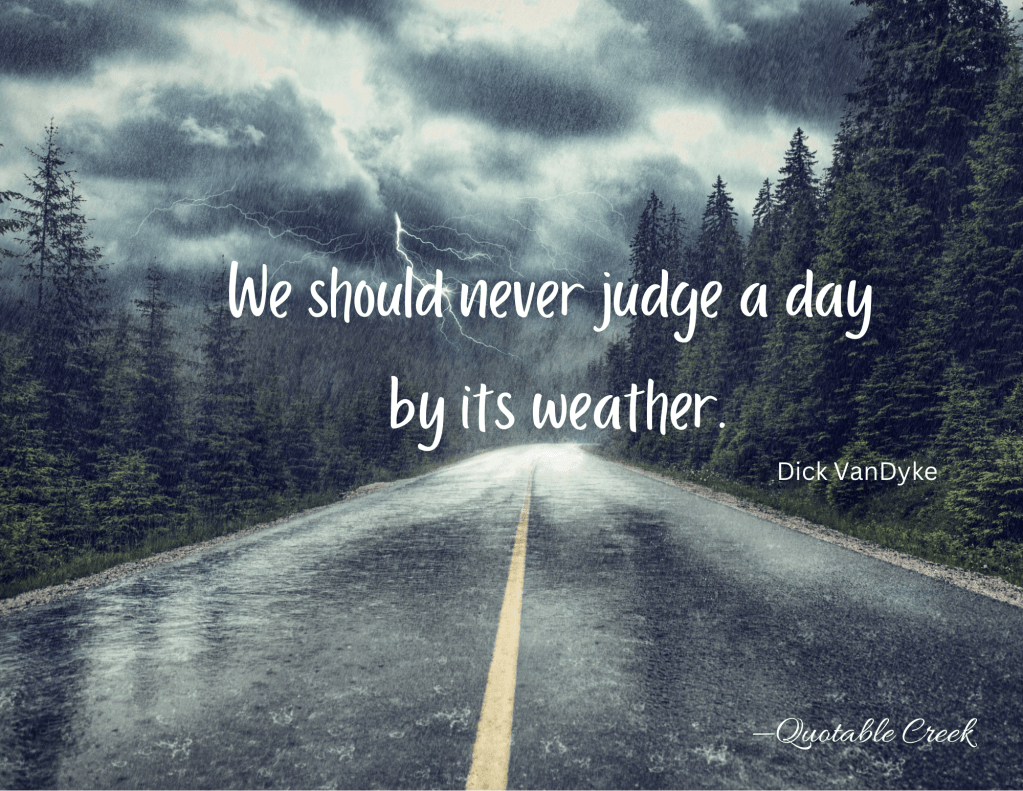
Dick Van Dyke is a national treasure, still singing and dancing his way through life at nearly 100. He reminds us that there are dark times, but behind the clouds the sun still shines. We show up. We do our best. And we realize that not everything is within our control.
He says,
We should never judge a day by its weather. It means you never know what’s going to happen,’ I said. ‘You do your best, then take your chances. Everything else is beyond our control.
Enjoy this lovely interaction between Van Dyke and Chris Martin, a balm for any troubled soul.
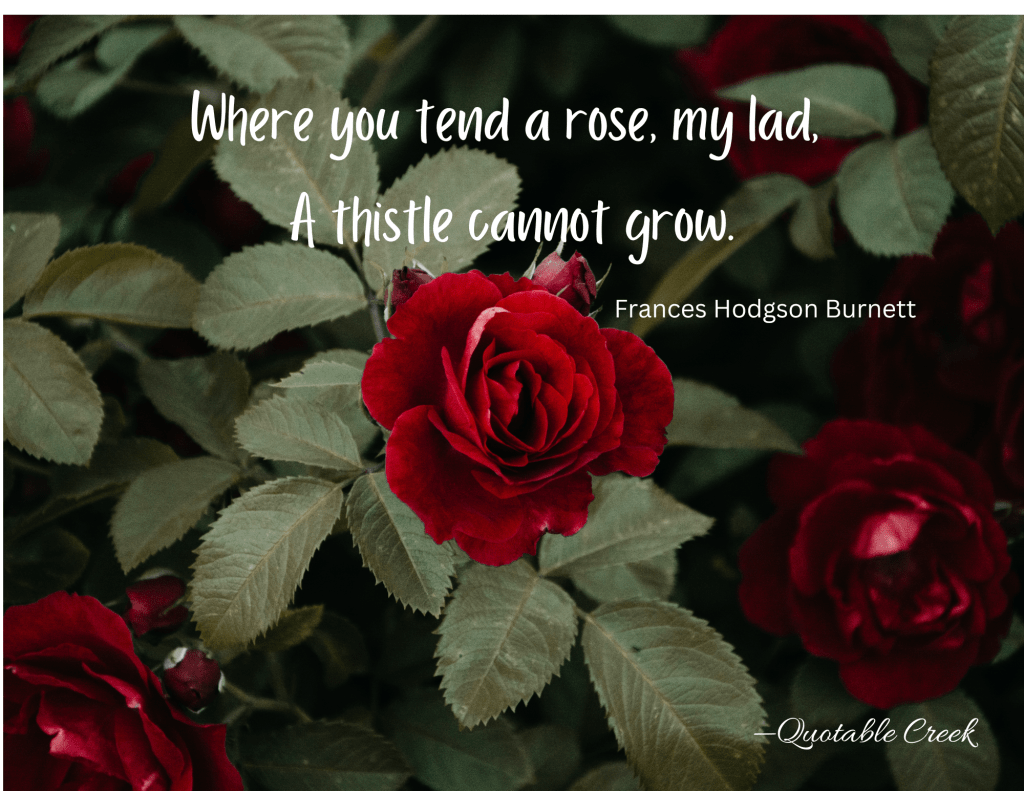
‘If you look the right way, you can see that the whole world is a garden,’ muse the characters in Frances Hodgson Burnett’s The Secret Garden. And, perhaps, on a more intimate level, so our mind is too a garden.
We cultivate our thoughts, enrich them with information, learn, grow, stretch. But weeds can overrun any garden, and we can find our minds overcome with anxiety, negative thinking, and endless catastrophic thinking.
But Burnett notes:
Much more surprising things can happen to any one who, when a disagreeable or discouraged thought comes into his mind, just has the sense to remember in time and push it out by putting in an agreeable determinedly courageous one. Two things cannot be in one place.
When we find ourselves overcome with negative thoughts, we can imagine our mind a garden. Something we can lovingly tend, plucking weeds, nourishing blooms, replacing gloom with gratitude, planting seeds of possibility and promise.
While there are many things in this world we cannot control, we still can control our thoughts and find a way to focus on ones that keep our mental garden thriving.
How do we read the news and not get overwhelmed or angry, disconnected or depressed? How do we keep showing up with compassion and grace in a world where there is so much hate? How do we keep ourselves on the right path through the midst of it all? How do we continue to show up from a place of compassion, forgiveness, and grace? how do we keep our hearts from growing hard?
In this thoughtful letter, Rabbi Yael Levy shares his insights on how to pray with the news:
The 17th of the Hebrew month Tammuz initiates a three-week period of mourning that leads to Tisha b’Av, which is the day that marks the destruction of the Temples in Jerusalem in 586 BCE and 70 CE.
Tradition teaches that the Temple was destroyed because hatred became the operating principle in the community. The scorn, contempt and disdain that characterized daily interactions caused the Divine Presence to flee and leave the Temple vulnerable to attack.
These next three weeks ask us to reflect on the hatred that we allow to take root in our hearts. The wisdom of the tradition acknowledges that hatred can sometimes feel energizing and “so right,” but allowing it to fill our bodies and guide our actions leads to destruction.
Many years ago I was taught the practice of praying with the news. I have shared it over the years and always find myself returning to it during this season.
In this practice, each time we read or listen to a news report that enrages us, we turn our attention to those harmed by what is happening and pray for their healing and well-being. Doing so encourages us to acknowledge feelings of anger, grief and despair, and at the same time it turns our attention toward connection and compassion. Praying with the news can help us learn to bear witness to devastation and mayhem, while keeping our hearts soft, our minds calm, and our actions clear.
I am struggling mightily with this practice these days in the wake of continued violence and oppression in this country and throughout the world. Hatred can sometimes feel like such a welcome harbor. Not only does it feel so right, it can also act as a shield, creating the illusion that I don’t have to acknowledge the grief and heartbreak I am experiencing.
I need practices to help quiet the rage and fear, to loosen the constriction of hatred and to help me be with overwhelming grief. I need practices to help me return to compassion, love, joy and possibility. I find praying with the news both painful and helpful. It keeps me connected, allows sorrow, and grounds me in care and love.Weekly reading from the Awakin.org newsletter.
What is hope, really, but a persistent insistence that things can be better, that there is more to it, that the final answers are yet to be revealed. Emily Dickinson describes hope as
“Hope” is the thing with feathers –
That perches in the soul –
And sings the tune without the words –
And never stops – at all –
And sweetest – in the Gale – is heard –
And sore must be the storm –
That could abash the little Bird
That kept so many warm –
I’ve heard it in the chillest land –
And on the strangest Sea –
Yet – never – in Extremity,
It asked a crumb – of me.”
And this feels right. Hope sits there perched, singing, warming our souls and keeping us fed. A wordless song because we may not even have the ability to put our emotions into words or know what it is we hope for. And this is a positive, persistent hope, but somewhat passive, waiting.
And yet, we know, too, that hope gets its fingernails dirty because while hope sits on the periphery expectant, it can also be in the fray fighting for a better world. That kind of hope is captured by Matthew @CrowsFault:
“People speak of hope as if it is this delicate ephemeral thing made of whispers and spider’s webs. It’s not. Hope has dirt on her face, blood on her knuckles, the grit of cobblestones in her hair, and just spat out a tooth as she rises for another go.”
And this, too, seems true. Hope keeps our souls fed but also prompts our entering the arena, helping us to do the hard work to make a better world for all.

It’s okay to be heartbroken for more than one group of people at the same time. When it comes to showing compassion, we don’t have to pick sides. Sometimes, often really, maybe even always, there is hurt and anguish everywhere, and we can mourn the lot of it.
Beware people who tell you not to be concerned for this group or that group and the hurt they feel.
Beware those who try to dehumanize others.
Beware those who lump you in as the ‘enemy’ for working to assure people are treated humanely.
Beware people who draw lines between us and them.
Beware those who try to limit you to a label or single identity.
Our hearts are big enough to embrace it all. What we must save is love.
All things break.
Including us.
Nothing lasts.
Including us.
And yet most of us internalize myths that we are meant to live pain-free lives and that there is always more time. How much more could we accomplish if we embrace the reality instead?
We’re breakable. But our vulnerability is our strength. And when we mend from something painful, we are likely to have tools and skills and sensitivities that may help us and make us more empathic going forward. Breaking and mending is part of growth. Part of change. Part of evolving. To be scared of breaking is to be scared of living.
Time’s short. Now is the time to reach out, apologize, help…whatever it is you’re waiting for a different day to do. There is no promised day. Things don’t just happen. Time doesn’t heal all wounds. We help heal the broken world, and our own broken selves, by continuing to love even in the darkness.
In this age of technology and instant gratification, sometimes we forget the simple pleasures. Like meandering, and chatting people up, and pausing to soak it all in. Kurt Vonnegut used to like to walk into town for a single envelope when he had something to mail, ignoring his wife’s argument that he could buy more than one envelope at a time.
Vonnegut responds, “…And so I pretend not to hear her. And go out to get an envelope because I’m going to have a hell of a good time in the process of buying one envelope. I meet a lot of people. And see some great looking babies. And a fire engine goes by. And I give them the thumbs up. And I’ll ask a woman what kind of dog that is. And, and I don’t know. The moral of the story is – we’re here on Earth to fart around. And, of course, the computers will do us out of that. And what the computer people don’t realize, or they don’t care, is we’re dancing animals. You know, we love to move around. And it’s like we’re not supposed to dance at all anymore.”
Of course, an author depends on immersing themself in the midst of living, noticing details, trying to hold on to it all long enough to capture it in words. But don’t we all benefit from farting around and noticing the little things? Kind of like writing ‘I was here’ in graffiti. We’re here. This is our now.
Time to be a dancing animal.
 QuotableCreek.com