It’s so interesting to think about all the different ways we can show up in this world. On stage, as in this quote. Or behind the scenes.
What motivates you to get out there and shine your light?
What do you think of the phrase ‘The world is your oyster’? Full of possibilities, and maybe a pearl. Treasure! But also something born inside the oyster as a result of grit or sand, an irritant, inside the oyster, around which the oyster builds the pearl.
Life is full of irritants, and pearls, runways and behind the scenes. It’s a big complicated world.
One of my personal heroes, Jimmy Carter, almost 100 years old, is trying to hang on to vote in this election. He has been such a wonderful example of walking the walk. He says:
“My faith demands – this is not optional – my faith demands that I do whatever I can, wherever I can, whenever I can, for as long as I can with whatever I have to try to make a difference.”
What a wonderful way to look at our possible impact. Using what we have, not waiting until we have more or better resources or to be older and wiser, or wishing we were younger and stronger. Right now with what’s available.
And wherever we find ourselves, adopting a bloom where you’re planted attitude. Even if we are in our own harsh spot. Considering what can we do here.
And always looking for opportunities to do good. Not necessarily solving the world’s problems, but doing your own little bit of good. Right here, right now.
It certainly changes things depending on your perspective. Someone who thinks of life as a contest is always striving, comparing what he has to others. The one who views life as a burden might sigh a lot. And so on.
But what if we thought of life as a gift? Unearned, given out of love, no strings attached. Something to be grateful for. Something to savor and enjoy but also something to treasure. Would that affect what we see when we open our eyes in the morning? Face challenges? Greet people? Pick a career?
Brian Zhand says:
Most of us are scripted to think that life is a game and the purpose of life is to win. But the divine truth is that life is a gift and the purpose of life is to learn to love well.
The truth is being here is a gift, an opportunity, a chance to do some good. Open your gift.
Not gonna lie. These days are wild. The news cycle is intense, and it can feel dizzying. I wonder what students in school in the future will study about these years. It will definitely be a large chapter with tons of footnotes! And yet, as we work our way through this present, how can we keep our psyches from spinning out of control right with the swirls of events?
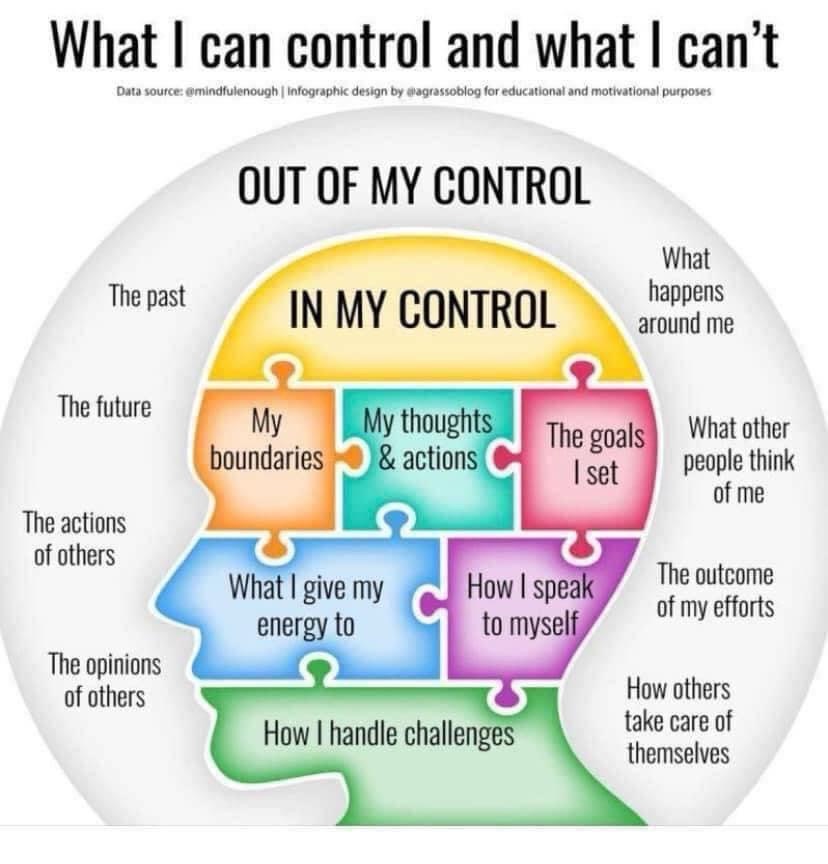
One thing to keep in mind is to focus our attention and efforts on the things over which we have control.
Consider this graphic:
Try to let the things in the gray area consume less of your time and attention, focusing on what is in your control. It can be frustrating, no doubt, but therein lies our sanity in crazy times.
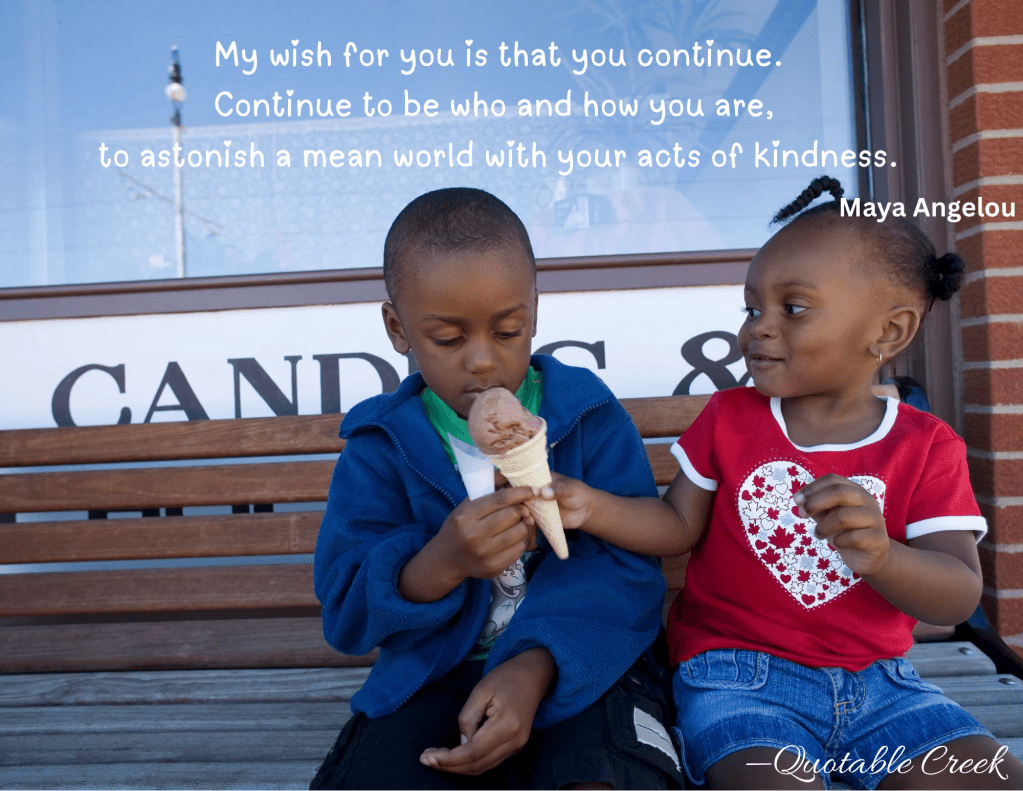
Astonishing a mean world is quite the life goal. Flipping the script. Not buying in to the smallness, pettiness, and cruelty you see around you.
Imagine the ripple effects of such kindness.
Perhaps you’ve heard the story of the man and the starfish. In sum, a man is walking along the beach at low tide finding starfish that have landed too far above the water line to survive. He dislodges them and throws them back into the ocean. A bystander is astonished and scolds him, saying that he will never be able to make a difference as there are miles and miles of beach with hundreds of stranded starfish. The man responds, tossing another back into the ocean, “Made a difference to that one,” he remarks.
Making a difference doesn’t have to be a grand gesture. It can be quite small, perhaps only affecting the person in front of you right now. Perhaps the difference is choosing an unexpected response to cruelty. Perhaps the response is to not lose hope.
Hang in there. The starfish are right in front of you on your path if you choose to see them.
This moment we are in is but one in the collection of moments that make a life, a story, a history. Each moment building on the last, forward toward a powerful culmination. To stay hopeful and earnest in each moment, no matter how dire, is a testament to what we hold dear, to hope, to a belief that all things will ultimately work together for good.
As Howard Zinn says,
TO BE HOPEFUL in bad times is not just foolishly romantic. It is based on the fact that human history is a history not only of cruelty, but also of compassion, sacrifice, courage, kindness. What we choose to emphasize in this complex history will determine our lives. If we see only the worst, it destroys our capacity to do something. If we remember those times and places—and there are so many—where people have behaved magnificently, this gives us the energy to act, and at least the possibility of sending this spinning top of a world in a different direction. And if we do act, in however small a way, we don’t have to wait for some grand utopian future. The future is an infinite succession of presents, and to live now as we think human beings should live, in defiance of all that is bad around us, is itself a marvelous victory.
Do not give up on the beliefs you have. To be decent, kind, not returning hate for hate, to speak truth to power, to retain hope for a brighter future, a future willing to work for. That is a marvelous victory.
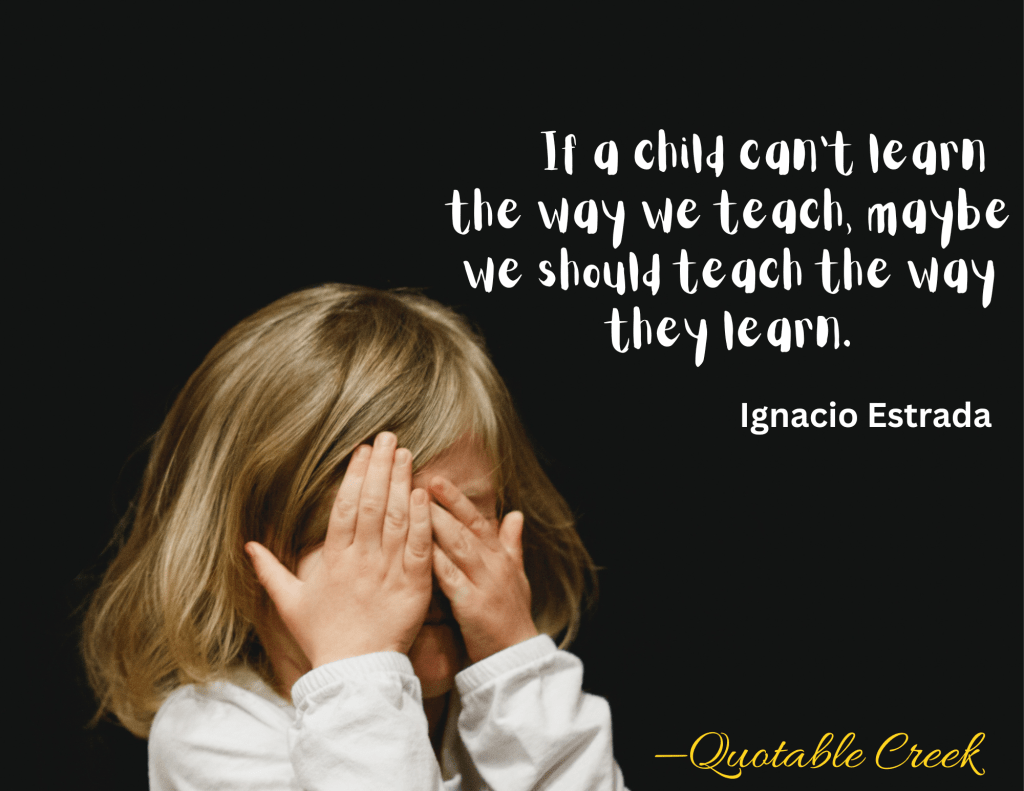
One of the most joyful things about teaching is finding the method that leads to a particular child learning where perhaps they struggled before. Finding the right key for the lock. Teaching, in this way, is one of the most creative and challenging jobs because each child is unique. Not every child can simply sit at a desk and listen to their teacher drone on and somehow absorb and master the material. In fact, a student who would prefer this lecture method is rare.
A vibrant classroom is filled with hands-on, group work, mentoring, art, music, activities, and so on. There are so many ways to teach and pair the right method with the right child. This is why a good teacher will always feel they learn as much as they teach. Of course, implicit in this challenge is having as the goal, helping the child learn. When obedience and regiment replaces learning as the goal, and the teaching method is rigid and unyielding, often students will struggle and fall through the gaps.
Teachers need to always keep their eye on the ball. The bottom line, the mission, is helping children learn.
There are so many areas where the same analysis applies. Where perhaps we fail to keep our eye on the right ball.
My pastor posted the following:
The method v. The mission. There are many ‘This is the way we’ve always done it’ or ‘Technology isn’t our thing’ or ‘Let’s just keep to ourselves’ sentiments behind each failing church. And misplaced beliefs that perhaps there’s just no space for church anymore in today’s world.
And yet.
In both teaching and ministry, there remains the mission. To help children learn. To help God’s people. And these needs in the world are growing, not shrinking.
So then the question becomes, and really always has been, how can we adapt our methods to fulfill our mission?
In his letter to the early church at Corinth, Paul sets out how love shows up in the world in his effort to help them get along. It is a frequent text for weddings:
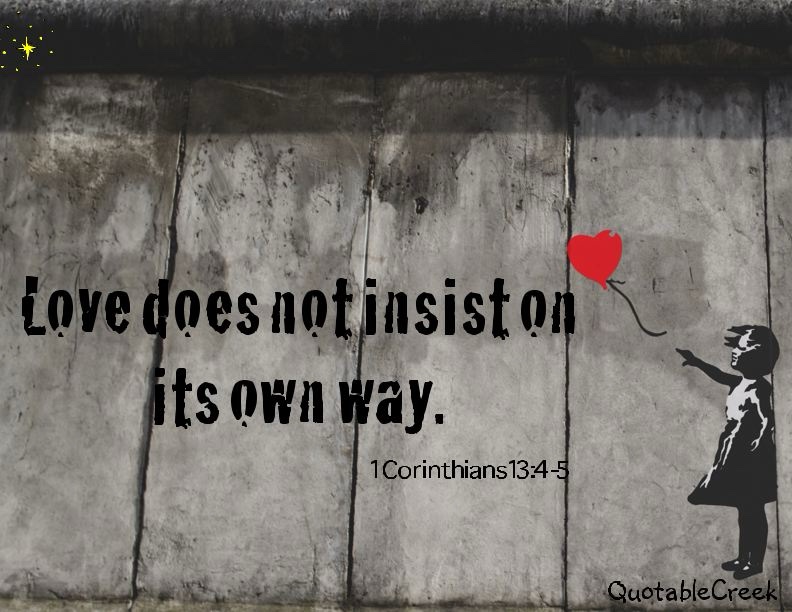
“Love is patient and kind; love does not envy or boast; it is not arrogantor rude. It does not insist on its own way; it is not irritable or resentful…” 1 Corinthians 13:4-5.
To those about to marry, an interesting exercise is to substitute the name of your beloved each time the word ‘Love’ appears. And an even more interesting exercise, for all of us, is to substitute our own names instead of the word ‘love’:
I am patient and kind; I do not envy or boast; I am not arrogant or rude. I do not insist on my own way; I am not irritable or resentful….
How did you do? For many of us, this simple recitation shows us the exact ways and times we are being less than loving and calls us to consider those actions. Must we insist on our own way? How do we know what is right? Isn’t it possible that someone else may be right, too? Are we becoming impatient with others? Can we take a minute to rein ourselves in, breathe deeply, and begin again? Are we holding grudges? Can we let the past go and try to make our present the best possible? And so on.
These checks we can do to measure our progress and monitor our moods against the ideal of love can be very helpful to keep us on track showing up in this world as close to lovingly as we can get.






 QuotableCreek.com