Staying alive with joy.

How do we make sure we aren’t just staying alive but staying vibrant? Making our moments count? Making an impact and difference in the lives of those we care about? Making our lives matter?

Consider Virginia Woolf’s words:

Whatever happens, stay alive. Don’t die before you’re dead. Don’t lose yourself, don’t lose hope, don’t lose direction.

Stay alive, with yourself, with every cell of your body, with every fiber of your skin.

Stay alive, learn, study, think, read, build, invent, create, speak, write, dream, design.

Stay alive, stay alive inside you, stay alive also, outside, fill yourself with colors of the world, fill yourself with hope, with Wow Scenery.

Stay alive with joy.

There is only one thing you should not waste in life, and that’s life itself.

How do we become hard-hearted as we age, focused so much on ourselves and our own needs? How do we deaden ourselves to community and lives being lived around us, turning inward and reclusive, dying really to the fabric of life?

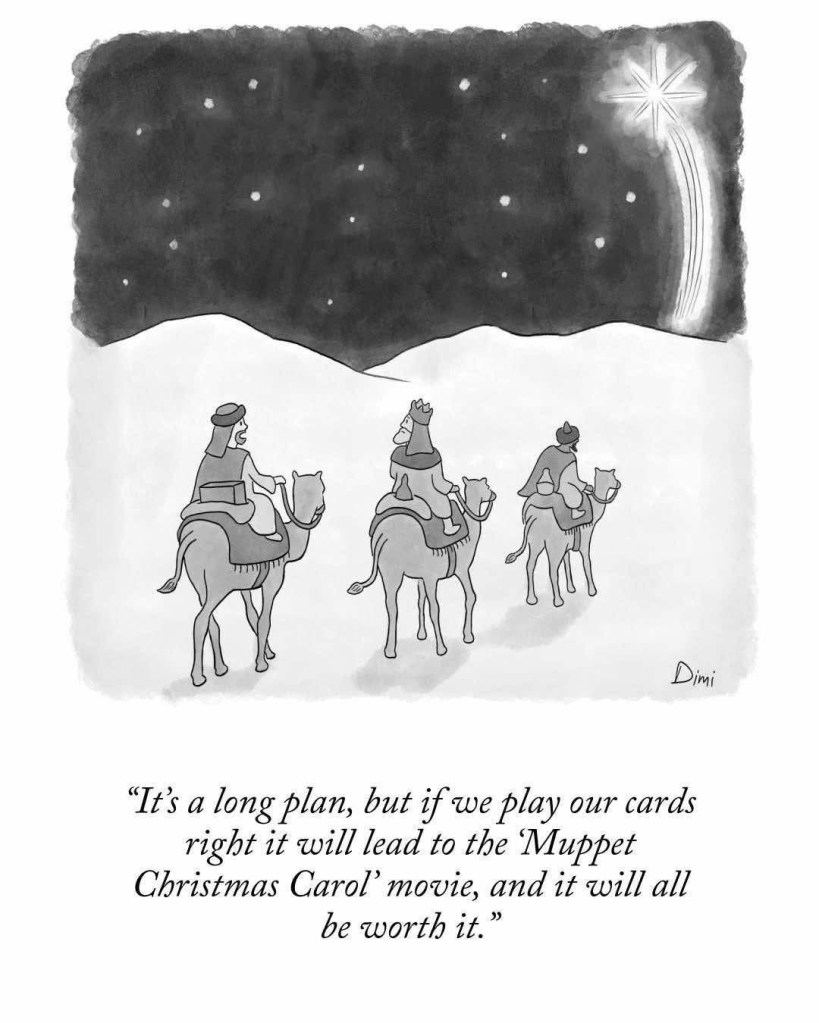
I just watched the muppet version of Christmas Carol which did a great job of capturing Charles Dickens’s classic story about the transformation of Ebenezer Scrooge, first his turning in, the selfishness, the greed, the callousness to those around him, his miserliness in spirit and deed.

But then, with the spirits’ intervention, Scrooge has an epiphany and realization that life is a looking out, a contributing, a generosity and an overflowing of joy. His life becomes filled with vibrancy and exuberance and a realization of the difference he can make in the here and now. At that moment, he becomes part of something larger than himself, alive with possibility and connection.

Each of us faces Scrooge’s dilemma. We may not be miserable misers, but perhaps we have turned in to focus on ourselves. Perhaps we’ve become callous to the suffering around us and blind to the good we can do. Perhaps we’ve lost the joy.

Scrooge’s story reminds us all that it isn’t too late to turn over a new leaf, to reach out to those around us, to wear our love and concern on our sleeves, to care. And by spreading joy, we find ourselves drenched in it as well.

Life’s a schoolroom.

schoolroomJust when we think we get what life is all about, something comes along to knock us upside the head and show us we have it wrong. It forces us to reevaluate our foundational assumptions about the purpose of life and look at things in a whole new way. It’s a paradigm shift.

Stephen Covey tells of a paradigm shift he experienced:

“I remember a mini-Paradigm Shift I experienced one Sunday morning on a subway in New York. People were sitting quietly — some reading newspapers, some lost in thought, some resting with their eyes closed. It was a calm, peaceful scene. Then suddenly, a man and his children entered the subway car. The children were so loud and rambunctious that instantly the whole climate changed.

“The man sat down next to me and closed his eyes, apparently oblivious to the situation. The children were yelling back and forth, throwing things, even grabbing people’s papers. It was very disturbing. And yet, the man sitting next to me did nothing.

“It was difficult not to feel irritated. I could not believe that he could be so insensitive to let his children run wild like that and do nothing about it, taking no responsibility at all. It was easy to see that everyone else on the subway felt irritated, too. So finally, with what I felt was unusual patience and restraint, I turned to him and said, “Sir, your children are really disturbing a lot of people. I wonder if you couldn’t control them a little more?”

“The man lifted his gaze as if to come to a consciousness of the situation for the first time and said softly, ‘Oh, you’re right. I guess I should do something about it. We just came from the hospital where their mother died about an hour ago. I don’t know what to think, and I guess they don’t know how to handle it either.’

“Can you imagine what I felt at that moment? My paradigm shifted. Suddenly I saw things differently, I felt differently, I behaved differently. My irritation vanished. I didn’t have to worry about controlling my attitude or my behavior; my heart was filled with the man’s pain. Feelings of sympathy and compassion flowed freely. “Your wife just died? Oh, I’m so sorry. Can you tell me about it? What can I do to help?” Everything changed in an instant.

“Many people experience a similar fundamental shift in thinking when they face a life-threatening crisis and suddenly see their priorities in a different light, or when they suddenly step into a new role, such as that of husband or wife, parent or grandparent, manager or leader.

“It becomes obvious that if we want to make relatively minor changes in our lives, we can perhaps appropriately focus on our attitudes and behaviors. But if we want to make significant, quantum change, we need to work on our basic paradigms.

“In the words of Thoreau, ‘For every thousand hacking at the leaves of evil, there is one striking at the root.’ We can only achieve quantum improvements in our lives as we quit hacking at the leaves of attitude and behavior and get to work on the root, the paradigms from which our attitudes and behaviors flow.”

(from Stephen Covey’s book, The Seven Habits of Highly Effective People)

Or consider the paradigm shift that Ebenezer Scrooge’s partner, now a ghost, Jacob Marley, recounts to him before the visit of the three Christmas ghosts in Christmas Carol. Both Scrooge and Marley thought they had life figured out–it was all about business and making money, the more the better. But Marley has had a paradigm shift since dying:

“‘But you were always a good man of business, Jacob,’ faltered Scrooge, who now began to apply this to himself.

“‘Business!’ cried the Ghost, wringing its hands again. ‘Mankind was my business; charity, mercy, forbearance, and benevolence, were, all, my business. The deals of my trade were but a drop of water in the comprehensive ocean of my business.’ “

Get ready to get hit upside the head, metaphorically speaking. It may be time for a paradigm shift.