Everyday heroes choosing to do the right thing.
Whom we claim as our heroes is telling. Today, in these troubled, divided times, who is acting heroically? We don’t know how our or this story will end, but we do know the values we hold to be worth fighting for: honesty, self-sacrifice, honor, integrity, the common good. As we enter the day, let us hold true to our values to meet life’s challenges in hope that those everyday interactions spread ripples of good.

Enjoy these words from Heather Cox Richardson in honor of MLK, Jr. Day:

You hear sometimes, now that we know the sordid details of the lives of some of our leading figures, that America has no heroes left.

When I was writing a book about the Wounded Knee Massacre, where heroism was pretty thin on the ground, I gave that a lot of thought. And I came to believe that heroism is neither being perfect, nor doing something spectacular. In fact, it’s just the opposite: it’s regular, flawed human beings choosing to put others before themselves, even at great cost, even if no one will ever know, even as they realize the walls might be closing in around them.

It means sitting down the night before D-Day and writing a letter praising the troops and taking all the blame for the next day’s failure upon yourself in case things went wrong, as General Dwight D. Eisenhower did.

It means writing in your diary that you “still believe that people are really good at heart,” even while you are hiding in an attic from the men who are soon going to kill you, as Anne Frank did.

It means signing your name to the bottom of the Declaration of Independence in bold script, even though you know you are signing your own death warrant should the British capture you, as John Hancock did.

It means defending your people’s right to practice a religion you don’t share, even though you know you are becoming a dangerously visible target, as Sitting Bull did.

Sometimes it just means sitting down, even when you are told to stand up, as Rosa Parks did.

None of those people woke up one morning and said to themselves that they were about to do something heroic. It’s just that when they had to, they did what was right.

On April 3, 1968, the night before the Reverend Doctor Martin Luther King Jr. was assassinated by a white supremacist, he gave a speech in support of sanitation workers in Memphis, Tennessee. Since 1966, King had tried to broaden the civil rights movement for racial equality into a larger movement for economic justice. He joined the sanitation workers in Memphis, who were on strike after years of bad pay and such dangerous conditions that two men had been crushed to death in garbage compactors.

After his friend Ralph Abernathy introduced him to the crowd, King had something to say about heroes: “As I listened to Ralph Abernathy and his eloquent and generous introduction and then thought about myself, I wondered who he was talking about.”

Dr. King told the audience that if God had let him choose any era in which to live, he would have chosen the one in which he had landed. “Now, that’s a strange statement to make,” King went on, “because the world is all messed up. The nation is sick. Trouble is in the land; confusion all around…. But I know, somehow, that only when it is dark enough, can you see the stars.” Dr. King said that he felt blessed to live in an era when people had finally woken up and were working together for freedom and economic justice.

He knew he was in danger as he worked for a racially and economically just America. “I don’t know what will happen now. We’ve got some difficult days ahead. But it doesn’t matter…because I’ve been to the mountaintop…. Like anybody, I would like to live a long life…. But I’m not concerned about that now. I just want to do God’s will. And He’s allowed me to go up to the mountain. And I’ve looked over. And I’ve seen the promised land. I may not get there with you. But I want you to know tonight, that we, as a people, will get to the promised land!”

People are wrong to say that we have no heroes left.

Just as they have always been, they are all around us, choosing to do the right thing, no matter what.

Wishing us all a day of peace for Martin Luther King Jr. Day 2026.
Take your time.

Have you ever been at your wits’ end, and then someone’s kind words literally change your whole day and outlook? We can forget how simple words can make profound differences.

Consider this story from NPR:

STEPHANIE COLE: There I was in my black skirt and my white blouse and ready to go the first day. And I had been trained but very, very quickly. And as is true in a department store during Christmas, it was just bustling. You know how it is at Christmas, when everybody’s out shopping and everybody’s in a hurry and all these people around. This woman comes up to me with, I think, a Christmas tree ornament she wanted to buy, and I freeze. I just freeze. All of a sudden, I can’t remember anything. I can’t remember how to run the cash register. I can’t remember anything about the transactions. I am just absolutely frozen – and probably very close to tears. Just – I so wanted this to go right, and it was going so wrong.

She looked at me and paused and, with such a kind expression on her face, said, it’s all right. Take your time. I’m not in a hurry. And that was the release. All of a sudden, I could breathe, I could wait till somebody else could help me. It was going to be OK. It made such an impression that all these years later, not only do I still remember it, but I find myself – those words coming out of my mouth on numerous, many, many occasions over the years. You know, you encounter somebody whose first day on the job or they’re just having a bad day and things are really – you can tell they’re in a bad place. And you can say, it’s OK. I’m not in a hurry. Take your time. And it always makes the situation better. Always, always.

And so this woman, I can’t really remember her face – and certainly, she’s probably dead by now, given how old I was and how old she was – but she gave me that gift without knowing she gave me that gift, and it’s lasted all these years.

https://www.npr.org/2025/12/15/nx-s1-5640144/a-customers-patience-60-years-ago-was-a-gift-that-changed-a-womans-life

Maybe today you’ll have the chance to be the person remembered 60 years from now for the kind words you say and patience you show to a stranger today!

Love in this place.

It’s okay to be heartbroken for more than one group of people at the same time. When it comes to showing compassion, we don’t have to pick sides. Sometimes, often really, maybe even always, there is hurt and anguish everywhere, and we can mourn the lot of it. 

Beware people who tell you not to be concerned for this group or that group and the hurt they feel. 

Beware those who try to dehumanize others. 

Beware those who lump you in as the ‘enemy’ for working to assure people are treated humanely.

Beware people who draw lines between us and them. 

Beware those who try to limit you to a label or single identity. 

Our hearts are big enough to embrace it all. What we must save is love.

Entering into wild wonder.

Author Amy Tan shares this remarkable insight: 

“In one of John Muir Laws’s books, I read something profound that changed the way my brain thinks. “As you draw the bird,” he writes, “try to feel the life within it.” So now I look at the bird before me and imagine how it senses the world, how it feels breathing cold air, how it feels to have its feathers ruffling in the wind, how it feels to always have an eye out for possible food and possible predators. The bird sees me and is a nanosecond from flying off, but it stays. Why? By imagining the life within, the bird I am drawing is alive, no longer a shape and its parts, but a thinking, sentient being, always on the brink of doing something. By feeling the life within, I am always conscious that all creatures have personalities, and so do trees and clouds and streams. To feel the life within, I now imagine myself as the bird that is looking at me. I imagine its wariness, the many ways it has almost died in its short life. I worry over its comfort and safety, and whether I will see my little companion the next day, the next year. To feel the life within is to also feel grief in the goneness of a single creature or an entire species. Imagination is where compassion grows. Let us join with children to imagine and wonder, to use curiosity as the guide to miracles in plain sight. Let us enter with them into wild wonder so that we become guardians together of all that is living and all that must be saved.”From Orion Magazine, “The Life Within”.

I wonder if we can look at each other that way, as something vaster, as thinking sentient beings with worlds of experience, some harsh. Would that help us to treat each other better? In her book, Dead Man Walking, Sister Helen Prejean describes just this sort of thing as she works with a death row inmate, a man who admittedly committed a heinous act, seeing not just the man but also, though covered with tattoos and bathed in bravado, the little wounded child within. That empathy allowed her to see past the crimes to the human and to feel compassion for him.

Perhaps today we can look with new eyes to see each other as a composite of good and bad, but each fully human and fully deserving of respect and compassion. To paraphrase Amy Tan above, when we consider the person, can we try to picture the life within, the challenges and struggles, hopes and triumphs? Can we become, together, ‘guardians of all that is living and must be saved’ in a place where ‘compassion grows’?

Guarding your heart.

In this world of instant ‘news’ and polarized camps, it is difficult to siphon off the untrue, inflammatory, and malicious from the true, helpful, and conciliatory. 

This is particularly true when we learn that one of the goals of social media is to monetize our attention. In the stunning must-see documentary, The Social Dilemma on Netflix, creators of popular social media sites like Facebook and Pinterest discuss how they have monetized their apps to drive profit. The apps are free to use. What is for sale is…you. Your attention. Your time. Your behavior. 

What you click on, how long you look at it, and how you react is all measured. Complex algorithms calculate what data to show you based on what you are most likely to click. If you click on articles on empathy, you’ll be shown more stories on empathy. And if you click on dark or divisive articles, you will get more of same. Meanwhile, each of those clicks is a pay out from those seeking to put their messages into your head. The algorithms aren’t based on whether the content is good for you to view; they are based on what you are most likely to click. It is not hard to see how someone can become radicalized if they follow one of the darker holes further and further down.

So what to do? First, maybe affirm a universal truth. We want to make our decisions based on reality, not lies. We want to conform our understanding to facts, not alter the facts to fit our understanding. It’s as if there is a map to our destination. When we realize we are off course to a place we want to be, we change course, we don’t rewrite the map.

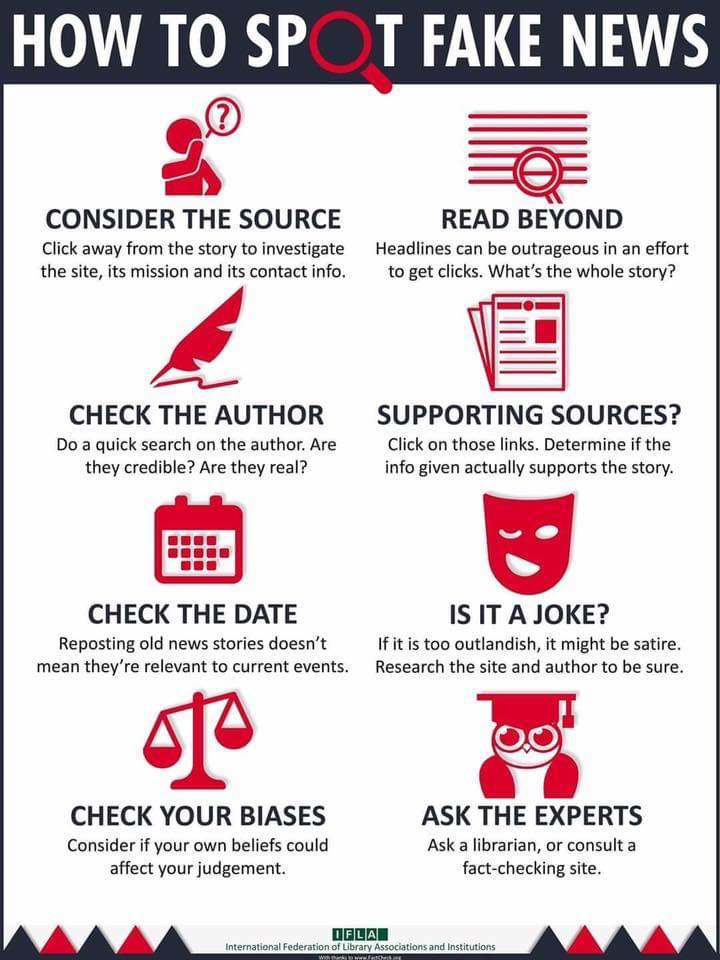
Second, consider your sources. Are they reputable? Rather than feeding the narrative you may want to hear, do they present the issues fairly and with minimal bias? If you are constantly being fed information that doesn’t square with what you see and hear happening around you, change up your sources.

Finally, read broadly. Don’t rely on a single person or news source. With respect to social media, seek out reliable sources directly and go to their sites to read the articles rather than clicking on a tempting link. We can be better informed than ever before, but we need to be intentional about it rather than passively wait for ‘news’ articles to pop up on your Facebook feed.

Social media is a powerful tool, but, like any tool, it can be a force for both good and bad. We need to be wary consumers and protect ourselves from being manipulated solely by advertisers trying to make a dime without regard to whether what they are showing us is true or decent. We need to guard our hearts, not to shelter ourselves from bad news or hurt in the world, but to keep ourselves from falling victim to fraud and deceit and unwittingly perpetuating false narratives ourselves.

Have you fallen for fake news lately? What steps have you taken to make sure you are reading and passing on reliable information? 

I recently clicked on an article purporting to be a response from someone who had been silent on a current political issue. I fell for the ‘Check the Date’ problem above. The article was from about four years ago. That person was still being silent on the current issue, so I didn’t get any new information, but that duplicitous advertiser made some money off my click. 

How about you?

No offering too small.

Speaking to graduating law students, Julian Aguon said

No offering is too small. No stone unneeded. All of us – whether we choose to become human rights lawyers or corporate counsel, or choose never to practice law at all but instead become professors or entrepreneurs or disappear anonymous among the poor or stay at home and raise bright, delicious children – all of us, without exception, are qualified to participate in the rescue of the world.

And this is true for any profession, calling, or vocation. We each matter. We each contribute to the mix. We each are qualified to rescue this world.

In any time in history, including our own in which we now find ourselves, some individuals stand apart from the crowd on behalf of what is right. Their example inspires others from that moment forward in time.

Who are those role models giving us strength now?

How can we shine the light for those to come?

Hold the line of love.

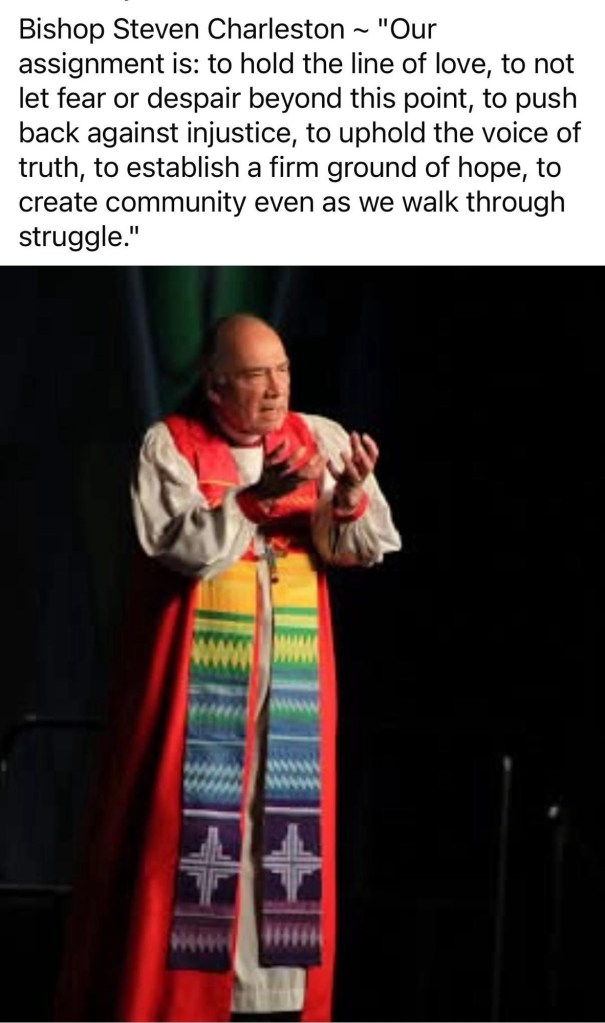
What is our job in these troubled times? During any times, but particularly during times where we are seeing peoples’ rights eroded and trampled, when legal safeguards are flouted, and when authoritarianism is on the rise, our job is to hold the line. Continue to be a place of comfort and succor to the hurting, feed the hungry, grieve with the mourning.

Hold on to your loving and generous spirit.

In the words of Bishop Charleson:

Snow monkey or penguin?

The Japanese Macaques, snow monkeys, are a deeply hierarchical society, their status in the group inherited from their mothers. Living in frigid temperatures, the upper class snow monkeys spend their time in natural hot springs, leaving the rest to huddle in the snow and look on as they luxuriate. The Emperor Penguins also live in frigid conditions, huddled together, but they constantly rotate, letting those most exposed on the outside come to the center for warmth. They take turns. It keeps those in the center from overheating and those on the fringes from freezing.

Sharing is an interesting phenomenon. It’s easy to see that when a society shares its resources, the whole group benefits, but how does that play out in the human species? Do we see the benefit to the whole group from sharing what we have, or do we focus on clutching more and more into our own fists? Some humans are uniquely able, it seems, to rationalize selfish behavior even when looking directly at the needs of others. But others consider their own resources an opportunity to help others. This is true both on an individual level, and on a larger societal level. It’s an interesting matter of perspective.

Some snow monkeys, some penguins. Which are you?

Friendship in these times.

Friendships are taking a hit these days. Politics, world views, differing opinions are tearing people apart.

What is it that holds people together instead?

One thing is an abiding concern for the other person, despite your differences. If you can advocate against the death penalty on behalf of a stranger, couldn’t you bring yourself to see what is good and redeemable inside a former friend? Inside an enemy even? Searching for common ground is hard work, but really the main point of living in community. Isn’t it?

Look out for each other.

I was recently reminded about a story from 2017 where two little boys were caught in a rip tide and swept out to sea. Their entire family and four woud-be rescuers tried to swim out to save them but ended up similarly stranded.  Officials on shore stood, helpless, waiting for a rescue boat while the family and would-be rescuers floundered.

But then the people on the beach did a remarkable thing. People from all walks of life, across every possible difference or division, linked arms together and formed a human chain stretching out into the ocean until they reached those stuck and and then passed them person to person, beginning with the little boys, Noah (11) and Stephen (8), and ending with their grandmother who had tried to save them, back to safety.

Stories like this don’t get a lot of press. But it’s why we’re here.

To help each other. To make a difference.