Mr. Rogers had a gift for seeing each child he encountered as an individual, a neighbor, someone worthy of respect just as they are. No need to impress him, or to put on an act, or to pretend. He accepted children. Period. No strings attached.
How wonderful.
Do you feel you are enough, just as you are? Sometimes our families, friends, or societies give us the message that we aren’t. That we need to be thinner, richer, smarter, younger, more attractive. Something different from what we are. That we must think the same as they do and fall in line. It’s exhausting.
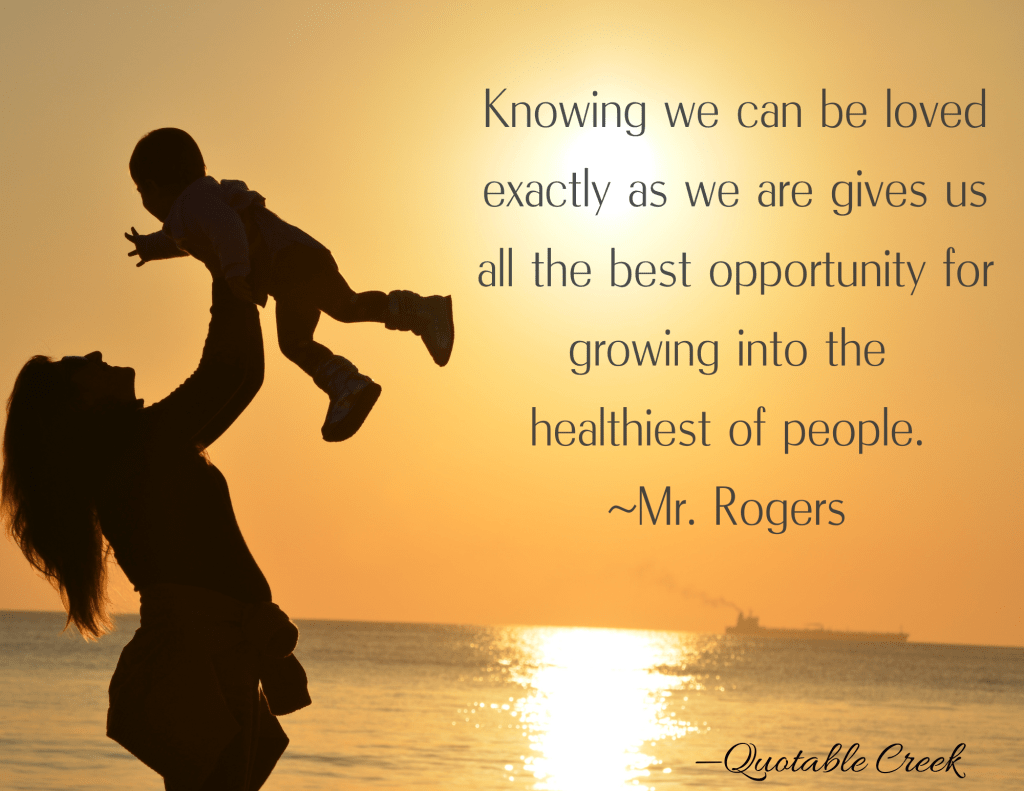
What a gift it is to accept people, including ourselves, just as is. No one is perfect, so why pretend we are? We each have strengths and weaknesses, things we’re working on and things we’ve got sorted. Instead of finding flaws, we can look at ourselves and each other as complicated works in progress, with value just as we are, giving ourselves and each other ‘the best opportunity for growing into the healthiest of people.’
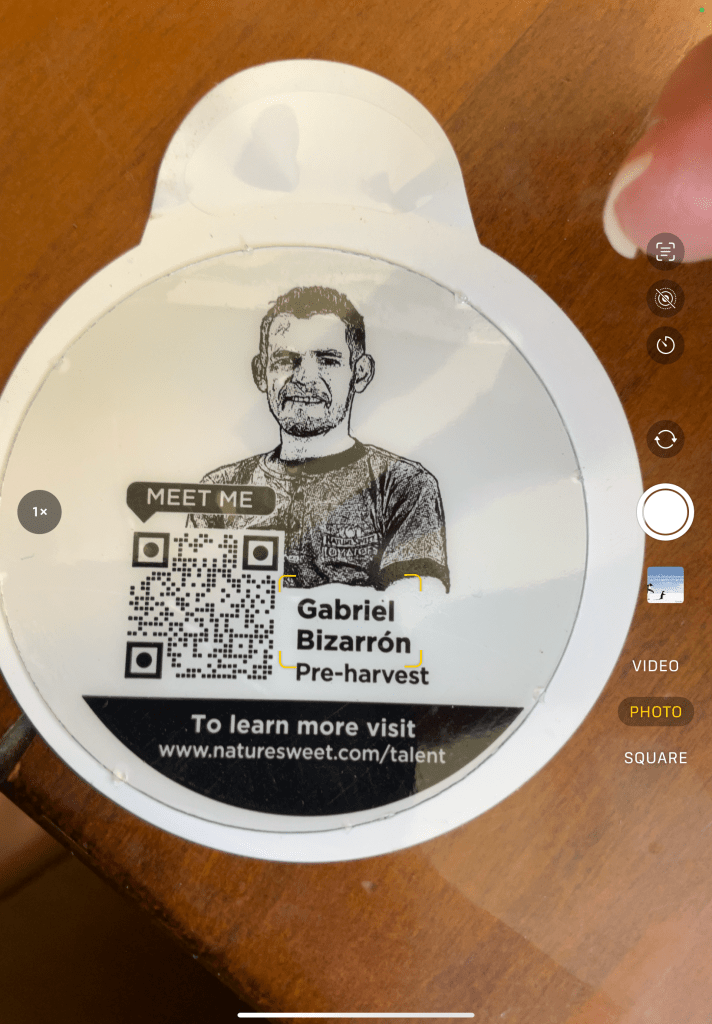
Yesterday, I was minding my business, making a quick salad for lunch. As I peeled the sticker top off the little plastic tub of cherry tomatoes, I was caught by surprise. On the back of the sticker was a picture of a man and a scan code to learn more about him.
It turns out Gabriel Bizarrón helps to make sure my tomatoes are bug free and have the right nutrients, He is working toward a degree in agribusiness. Gabriel is one of the many people responsible for helping me have a delicious healthy lunch, and I’m thankful for him.
Which got me thinking about all the other people in the chain of bringing these tomatoes to my belly, and there are so many. Stopping and imagining all the hands and minds that went into bringing my meals into existence, and being grateful for each of them, was quite a fun exercise. There are so many! What a wonderful invisible web of people there are behind the scenes to bring each of us food, clean water, electricity, and so on. Not to mention being grateful for businesses, like this and like Snapple with their hidden quotes, that take time to make their packaging inspirational. It is staggering once you start thinking about it, and really no end in sight, because each ‘thankful for’ leads to another, infinitely.
There is a certain alchemy in writing a book. Where do ideas come from? How do they knit together to form a story? What elevates words to resonate with a reader’s inner self? An author may seem like a bit of a magician conjuring elements, or perhaps a conductor taming orchestral components together to make music.
But reading can be even more magical. Words written by a stranger maybe years ago can resonate deeply and touch your soul. Fictional characters can be more real to you than the people you see every day. You can curl up on your couch with a book and be completely transported into another place and time in a way that feels so astonishingly real that when you put down the book, you temporarily lose your bearings. And sometimes you can read something that travels through time and space to speak directly to your troubled heart and give you peace.
W.B. Yeats put it this way:
Where My Books Go
All the words that I gather, And all the words that I write, Must spread out their wings untiring, And never rest in their flight, Till they come where your sad, sad heart is, And sing to you in the night, Beyond where the waters are moving, Storm darkened or starry bright.
People have always told stories. Plopped down on this earth with so much beyond our understanding, we struggle to make sense of things, to find cohesion and purpose, and to fit. We long for meaning outside of our circumstance and kinship beyond our borders.
Stories help. They comfort and guide us, inspire and warn, and make us feel less alone. Others feel the way you feel. And, at the root of story, is a turning away from ourselves toward something greater.
My book GERTIE, THE DARLING DUCK OF WWII, was just released. It tells the non-fiction story of a time during WWII when things were bleak, hopes worn raw, when a little duck built her nest on a high pole above a foul river. A hopeless place, really, for keeping the ducklings alive. Yet, the city of Milwaukee rallied around this little duck and saved her brood. Stories about Gertie’s struggles captured the attention of the entire world, comforted soldiers overseas, and gave everyone a glimpse of a better day. Stories about Gertie shared the front page with stories about Hitler, kamikaze pilots, and concentration camps.
For me, Gertie’s story will always be an embodiment of Psalm 91:4, “He will cover you with his feathers, and under his wings you will find refuge; his faithfulness will be your shield and rampart.” To me, her story feels like a message of hope in the darkest of times, a prayer and response.
At heart, most stories are a prayer—a way of reaching for something more, a hope, a yearning, a plea. Stories help connect us and give us peeks behind the curtain.
Have you been somewhere new recently? Maybe somewhere where everyone knows each other but you? Was there someone there who made you feel welcome?
When we remember what it feels like to be an outsider, we realize how powerful a warm welcome is. How generous the welcomer was to look outside of their usual orbit to notice a stranger and invite them in. A smile is the first step.
For today, consider this lovely poem on smiles and consider who you might welcome. How lucky you are to be in the position to welcome another!
In The Adventure of Tom Sawyer, Tom and Huck attend their own funeral, overhearing all the nice things the town members had to say about them, the kinds of things they rarely heard in life.
As the service proceeded, the clergyman drew such pictures of the graces, the winning ways, and the rare promise of the lost lads that every soul there, thinking he recognized these pictures, felt a pang in remembering that he had persistently blinded himself to them always before, and had as persistently seen only faults and flaws in the poor boys. The minister related many a touching incident in the lives of the departed, too, which illustrated their sweet, generous natures, and the people could easily see, now, how noble and beautiful those episodes were, and remembered with grief that at the time they occurred they had seemed rank rascalities, well deserving of the cowhide. The congregation became more and more moved, as the pathetic tale went on, till at last the whole company broke down and joined the weeping mourners in a chorus of anguished sobs, the preacher himself giving way to his feelings, and crying in the pulpit.
There was a rustle in the gallery, which nobody noticed; a moment later the church door creaked; the minister raised his streaming eyes above his handkerchief, and stood transfixed! First one and then another pair of eyes followed the minister’s, and then almost with one impulse the congregation rose and stared while the three dead boys came marching up the aisle, Tom in the lead, Joe next, and Huck, a ruin of drooping rags, sneaking sheepishly in the rear! They had been hid in the unused gallery listening to their own funeral sermon!
Aunt Polly, Mary, and the Harpers threw themselves upon their restored ones, smothered them with kisses and poured out thanksgivings, while poor Huck stood abashed and uncomfortable, not knowing exactly what to do or where to hide from so many unwelcoming eyes. He wavered, and started to slink away, but Tom seized him and said:
“Aunt Polly, it ain’t fair. Somebody’s got to be glad to see Huck.”
“And so they shall. I’m glad to see him, poor motherless thing!” And the loving attentions Aunt Polly lavished upon him were the one thing capable of making him more uncomfortable than he was before.
Suddenly the minister shouted at the top of his voice: “Praise God from whom all blessings flow — Sing! — and put your hearts in it!”
And they did. Old Hundred swelled up with a triumphant burst, and while it shook the rafters Tom Sawyer the Pirate looked around upon the envying juveniles about him and confessed in his heart that this was the proudest moment of his life.
The Adventures of Tom Sawyer, by Mark Twain
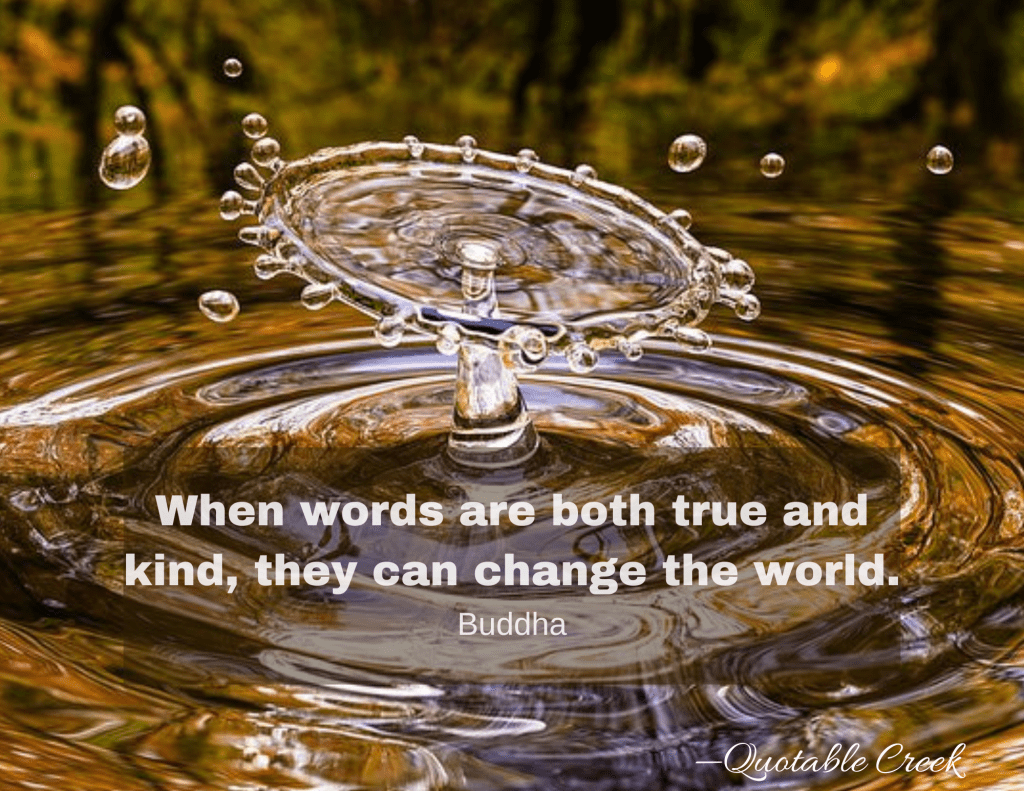
I wonder why we save the kind words for funerals. Eulogies, literally translated ‘good words’, are maybe needed even more before our loved ones pass, at a time when relationships can be mended and people thanked. Before opportunities are lost. When the ripple effects from the kindness can travel far and wide.
What kinds of things get in the way of saying the kind words now? Fear, stubbornness, pride, anger? What if we could lay these all down now, before our opportunity to be heard is gone?
Before his crucifixion, Jesus told his disciples: “Peace I leave with you; my peace I give you. I do not give to you as the world gives. Do not let your hearts be troubled and do not be afraid.” (John 14:27.)
Today, as we celebrate Easter, remember his words and his sacrifice. For a lovely story and song in the Easter spirit, go here:
Grace is upon us Open your heart It is done
Grace is upon us Open your heart This is love,
The Lord is here This is love
Come to the highest point of the mountain At the earliest possible moment
With appreciation to MovedByLove.com, consider this beautiful parable of a saint:
The story of the Holy Shadow Osho
There once lived a saint so good that the angels came from heaven to see how a man could be so godly. This saint went about his daily life diffusing virtue as the stars diffuse light and the flowers scent, without being aware of it. His day could be summed up by two words — he gave, he forgave — yet these words never passed his lips. They were expressed in his ready smile, his kindness, forbearance, and charity.
The angels said to God, “Lord, grant him the gift of miracles.”
God replied, “Ask what it is that he wishes.”
They said to the saint, “Would you like the touch of your hands to heal the sick?”
“No,” answered the saint. “I would rather God do that.”
“Would you like to convert guilty souls and bring back wandering hearts to the right path?”
“No, that is the angels’ mission. It is not for me to convert.”
“Would you like to become a model of patience, attracting men by the luster of your virtues, and thus glorifying God?”
“No,” replied the saint. “If men should be attracted to me, they would become estranged from God.” “What is it that you desire, then?” asked the angels.
“What can I wish for?” asked the saint smiling. “That God gives me his grace; with that would I not have everything?”
The angels said, “You must ask for a miracle, or one will be forced upon you.”
“Very well,” said the saint. “That I may do a great deal of good without ever knowing it.”
The angels were perplexed. They took counsel and resolved upon the following plan: every time the saint’s shadow fell behind him or to either side, so that he could not see it, it would have the power to cure disease, soothe pain, and comfort sorrow.
When the saint walked along, his shadow, thrown on the ground on either side or behind him, made arid paths green, caused withered plants to bloom, gave clear water to dried-up brooks, fresh color to pale children, and joy to unhappy men and women.
The saint simply went about his daily life diffusing virtue as the stars diffuse light and the flowers scent, without being aware of it. The people, respecting his humility, followed him silently, never speaking to him about his miracles. Soon they even forgot his name, and called him “The Holy Shadow.”
This is the ultimate: one has to become the holy shadow, just a shadow of God. This is the greatest revolution that can happen to a human being: the transfer of the center. You are no longer your own center; God becomes your center. You live like his shadow. You are not powerful, because you don’t have any center to be powerful. You are not virtuous; you don’t have any center to be virtuous. You are not even religious; you don’t have any center to be religious. You are simply not, a tremendous emptiness, with no barriers and blocks, so the divine can flow through you unhindered, uninterpreted, untouched — so the divine can flow through you as he is, not as you would like him to be. He does not pass through your center — there is none. The center is lost.
This is the meaning of this sutra: that finally you have to sacrifice your center so you cannot think in terms of the ego again, you cannot utter “I,” to annihilate yourself utterly, to erase yourself utterly. Nothing belongs to you; on the contrary, you belong to God. You become a holy shadow.
These days there is a lot of noise—everyone has a soapbox—but I wonder how much is really heard. This article explores the problem of autobiographical listening, listening with the hope of injecting a story about yourself into the mix. There are levels to this. The matcher, who always has a similar vacation or achievement to switch the conversation to. The topper who has an even better vacation or achievement to turn the conversation to. And the outright conversation narcissist where really all parts of the conversation somehow turn on him.
But if our goal is connection, we really need to learn how to better listen:
“Listen with curiosity. Speak with honesty. Act with integrity. The greatest problem with communication is we don’t listen to understand. We listen to reply. When we listen with curiosity, we don’t listen with the intent to reply. We listen for what’s behind the words.”
Roy T. Bennett, The Light in the Heart
Practice listening to understand. Avoid autobiographical listening:
“When we fail to listen from the other person’s perspective, we are listening through our own lens and tend to pass more judgments compared to simply listening,” Reigstad added. “There are four types of autobiographical listening ― evaluate, probe, advise and interpret. These responses tend to have us asking questions based on our experiences, offering advice to fix the problem and so on. It’s important to resist the urge and allow the other person to speak.”
Today, I want to lift up the caregivers. Whether for an aging parent, ailing spouse, struggling child, or young grandchildren, or all or some of these together. It takes a good person to care and do their best to help.
Rosalyn Carter made this insight:
There are only four kinds of people in the world: Those who have been caregivers. Those who are currently caregivers. Those who will be caregivers. And those who will need a caregiver.
We are all interconnected. We all will experience a time when we need help and times when we can offer help. It is a blessing to care about others and to let others care for us. Caring is at the heart of every good thing done in the world.
So, to the caregivers: may God bless you. Your work is making a better world.
It’s raining here. Again. My drought tolerant landscape must be wondering what’s up. But I am safe, warm, and grateful. Today is a good day for comfort and the things that warm us. Enjoy this poem.











 QuotableCreek.com