This moment we are in is but one in the collection of moments that make a life, a story, a history. Each moment building on the last, forward toward a powerful culmination. To stay hopeful and earnest in each moment, no matter how dire, is a testament to what we hold dear, to hope, to a belief that all things will ultimately work together for good.
As Howard Zinn says,
TO BE HOPEFUL in bad times is not just foolishly romantic. It is based on the fact that human history is a history not only of cruelty, but also of compassion, sacrifice, courage, kindness. What we choose to emphasize in this complex history will determine our lives. If we see only the worst, it destroys our capacity to do something. If we remember those times and places—and there are so many—where people have behaved magnificently, this gives us the energy to act, and at least the possibility of sending this spinning top of a world in a different direction. And if we do act, in however small a way, we don’t have to wait for some grand utopian future. The future is an infinite succession of presents, and to live now as we think human beings should live, in defiance of all that is bad around us, is itself a marvelous victory.
Do not give up on the beliefs you have. To be decent, kind, not returning hate for hate, to speak truth to power, to retain hope for a brighter future, a future willing to work for. That is a marvelous victory.
When we find ourselves in challenging times and are unsure which way to turn, let these words help guide you.
Do justice. Peace, justice, love are things we do and bring about, not things we wait for. With our best discernment, we offer ourselves to the world, hoping to make a difference. Kind words, loving hearts, calm demeanors, patience, forbearance, and forgiveness. The way of the One we follow. A servant’s heart but a leader’s strength.
Love mercy. Oh, how the world loves vengeance, cancelling, grudges, getting even, punishment. To love mercy is a kinder, gentler path, one that believes in the redeem-ability of every last one of us. One that doesn’t insist on being avenged or having the last word. One that delights in forgiveness and healing.
Walk humbly. No matter how hard we try to do or be right, we may be wrong. The other guy might be right. And, get this, God loves the other guy as much as God love you.
Black white. Up down. Left right. In out. We are a people who love to categorize. Categories simplify things and help us to sort out our place in the world.
But then there’s that puggle, a baby platypus. Classified as a mammal but laying eggs with a duck-like bill, aquatic, poisonous. No wonder the platypus astounded the scientific community when it was first discovered in 1799. Indeed, the skin of the first platypus discovered, preserved in the British museum of Natural History, still bears the marks made by the curator at the time who tried to pry off the bill, convinced the creature was a fake.
The puggle doesn’t categorize easily.
While categorizing can be helpful, it can also be limiting if we fail to see outside the norms and lines we draw. And when it comes to humans, where do we draw the lines? We humans are nearly impossible to sort into classifications because we have so many unique characteristics. Categorizing might even keep us from looking for and seeing the individuals behind the label.
We can find differences and commonalities among any group of people.
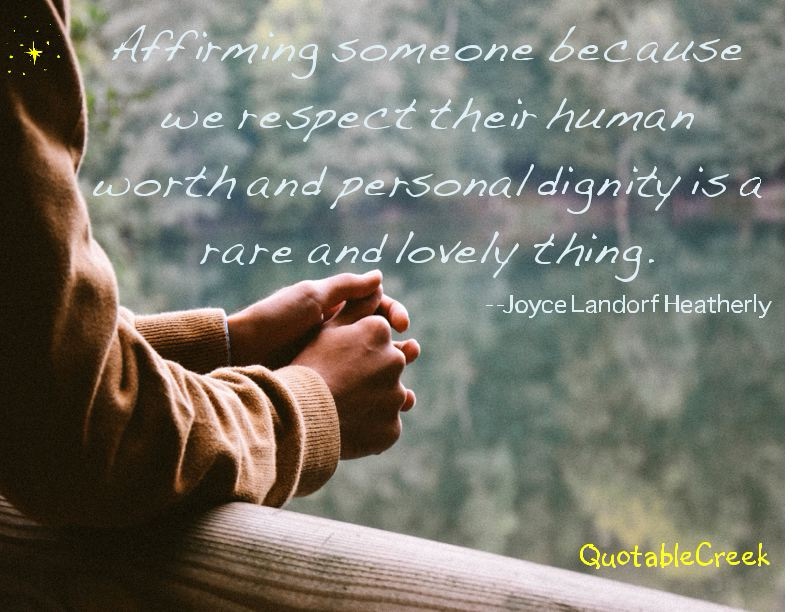
Are there people in your life who encourage you and make you feel stronger and lifted up? Are there some who drag you down or take the wind out of your sails? In her book, Balcony People, Joyce Landor Heatherley argues there are two types of people: the evaluators and the affirmers. She suggests:
I am sure, if there were a way to view a movie and see instant replays of all the strategic change points in our lives, that we’d instantly spot the people who either broke our spirits by their critical or judgmental evaluations, or who healed us by their loving, perceptive affirmations.
To be honest, I seem to be able to remember the negative comments of evaluators faster and more clearly than the positive remarks of the affirmers. I’m not alone in this ability to recall the negative….I suspect that not far from anyone’s conscious level of thinking lies the memory of an evaluator who pulled on his or her spiked boots and stomped deliberately over our bare soul and personhood.
Do you have any of these evaluators in your life? Maybe you can recognize the voice in your head that tells you that you can’t do something. In her book The Artist’s Way: A Spiritual Path to Higher Creativity, Julia Cameron calls these the censors. Maybe you have many censors, a rogue’s gallery of them.
So what do we do with these evaluators and censors to keep them from stifling our blossoming with their negative talk or opinions? Heatherley suggests leaving them in the past, even if that past was five minutes ago:
We all have the choice to replay the harmful remarks from evaluators, or we can choose to let them pass on. We can even choose to make allowances for their discouraging, destructive words. But best of all is the choice to willingly focus our minds and hearts on today’s person who is affirming us.
So who are these affirmers in our lives? Think back…
Who by one small sentence or more, has changed and lifted your opinion of yourself? Who was the person early in your life who recognized the first sparks of originality in the labyrinths of your mind and soul and saw what no one else saw? And who is the special affirmer who catches quick glimpses of the flames from the fires of your potential and tells you so? Who, by his or her words, helps you to respect and believe in your own value as a person? And who is the affirmer who encourages you to stretch and dream beyond your self-imposed limits and capabilities?
These affirmers are your Balcony People, cheering you on to blossom and stretch. These are the people whose words you must cling to when working toward your goal. These affirmers see you “by a clearer, truer light. They [are] able to peel back the layers of pretense [you] wear like like costumes for a bad play. Most of the time they [see] through and past the masks [you] hide behind. Then, once having broken through to [you] they’d get on with the business of motivating [you] to be all [you] can be.”
Affirmation is vital to our health and progress:
When others discern the good, the noble, the honorable, and the just tenets of our character (no matter how minuscule they may be) and proceed to tell us how they admire those traits, we feel visible. We begin to ‘see’ ourselves and our worth. We feel nurtured and nourished, but mostly we feel loved.
The Basement People do just the opposite. With their words they cause you to doubt and shrink. They focus on your flaws or failings. They encourage you to not try, to stay where you are, to wallow in the “murky waters of failure and discouragement.” We don’t need to linger on their words.
Who is in your Balcony? Who cheers you on and sees your unique worth? Who do you admire in history for their accomplishments or moral victories?
When you struggle, picture these people, your Balcony People. Remember their words. Let their affirmations encourage and comfort you in defeat and to keep pressing onward in your goals.
You are meant to blossom not wither. You are meant to shine not lurk in the shadows.
It’s okay to be heartbroken for more than one group of people at the same time. When it comes to showing compassion, we don’t have to pick sides. Sometimes, often really, maybe even always, there is hurt and anguish everywhere, and we can mourn the lot of it.
Beware people who tell you not to be concerned for this group or that group and the hurt they feel.
Beware those who try to dehumanize others.
Beware those who lump you in as the ‘enemy’ for working to assure people are treated humanely.
Beware people who draw lines between us and them.
Beware those who try to limit you to a label or single identity.
Our hearts are big enough to embrace it all. What we must save is love.
“In one of John Muir Laws’s books, I read something profound that changed the way my brain thinks. “As you draw the bird,” he writes, “try to feel the life within it.” So now I look at the bird before me and imagine how it senses the world, how it feels breathing cold air, how it feels to have its feathers ruffling in the wind, how it feels to always have an eye out for possible food and possible predators. The bird sees me and is a nanosecond from flying off, but it stays. Why? By imagining the life within, the bird I am drawing is alive, no longer a shape and its parts, but a thinking, sentient being, always on the brink of doing something. By feeling the life within, I am always conscious that all creatures have personalities, and so do trees and clouds and streams. To feel the life within, I now imagine myself as the bird that is looking at me. I imagine its wariness, the many ways it has almost died in its short life. I worry over its comfort and safety, and whether I will see my little companion the next day, the next year. To feel the life within is to also feel grief in the goneness of a single creature or an entire species. Imagination is where compassion grows. Let us join with children to imagine and wonder, to use curiosity as the guide to miracles in plain sight. Let us enter with them into wild wonder so that we become guardians together of all that is living and all that must be saved.”
From Orion Magazine, “The Life Within”.
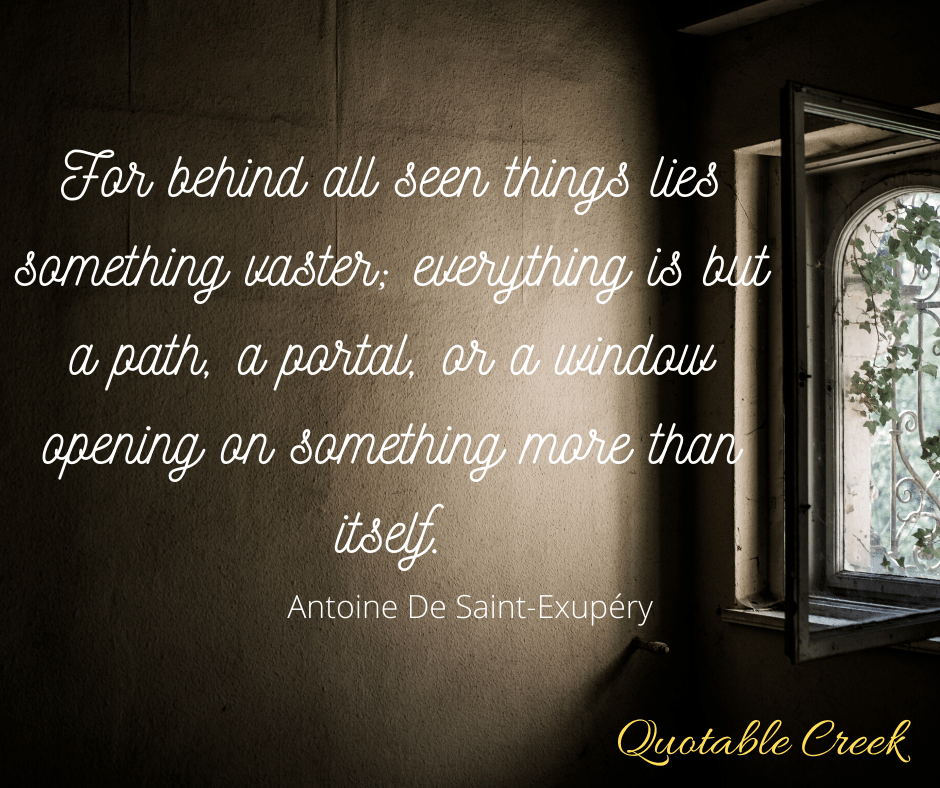
I wonder if we can look at each other that way, as something vaster, as thinking sentient beings with worlds of experience, some harsh. Would that help us to treat each other better? In her book, Dead Man Walking, Sister Helen Prejean describes just this sort of thing as she works with a death row inmate, a man who admittedly committed a heinous act, seeing not just the man but also, though covered with tattoos and bathed in bravado, the little wounded child within. That empathy allowed her to see past the crimes to the human and to feel compassion for him.
Perhaps today we can look with new eyes to see each other as a composite of good and bad, but each fully human and fully deserving of respect and compassion. To paraphrase Amy Tan above, when we consider the person, can we try to picture the life within, the challenges and struggles, hopes and triumphs? Can we become, together, ‘guardians of all that is living and must be saved’ in a place where ‘compassion grows’?
Sometimes turning off the news is the best form of mental health protection.
But then we remember. In times of darkness, there are always those working to light a path, helping, fighting for the common good, making progress.
And maybe we, too, can help.
Maybe not in large, brokering peace kind of ways. But in small ways that, combined together with the small ways of many, many others, may help to right a wrong or turn a tide.
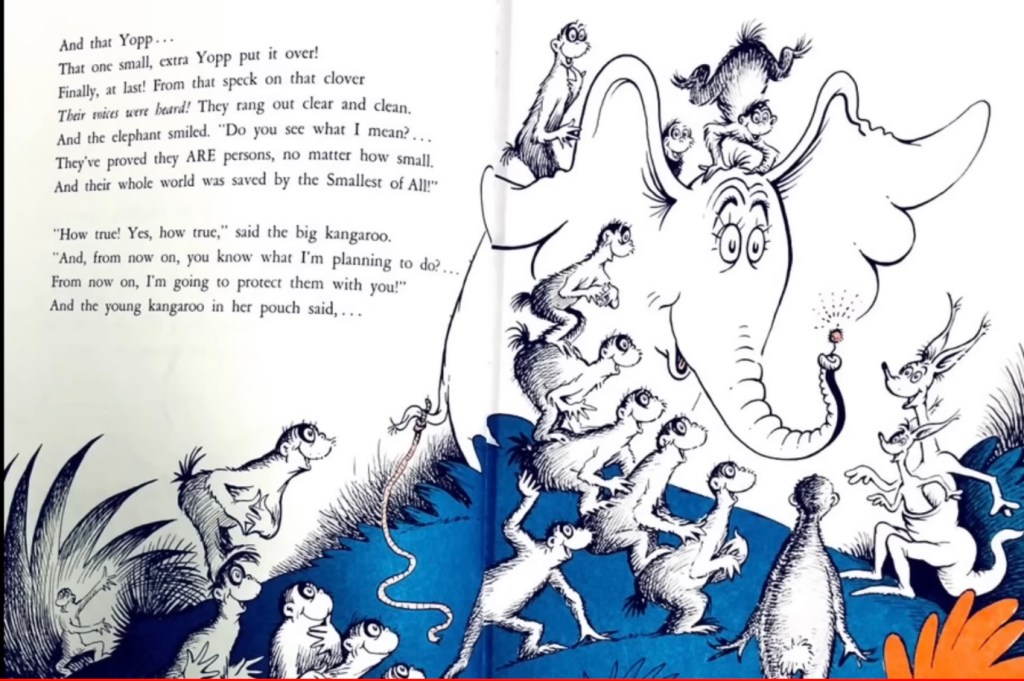
I think of Horton Hears a Who by Dr. Seuss, everyone shouting and banging on pots to be heard, but it is the final Yopp of a child that turns the tide, saving their world.
How do we read the news and not get overwhelmed or angry, disconnected or depressed? How do we keep showing up with compassion and grace in a world where there is so much hate? How do we keep ourselves on the right path through the midst of it all? How do we continue to show up from a place of compassion, forgiveness, and grace? how do we keep our hearts from growing hard?
In this thoughtful letter, Rabbi Yael Levy shares his insights on how to pray with the news:
The 17th of the Hebrew month Tammuz initiates a three-week period of mourning that leads to Tisha b’Av, which is the day that marks the destruction of the Temples in Jerusalem in 586 BCE and 70 CE.
Tradition teaches that the Temple was destroyed because hatred became the operating principle in the community. The scorn, contempt and disdain that characterized daily interactions caused the Divine Presence to flee and leave the Temple vulnerable to attack.
These next three weeks ask us to reflect on the hatred that we allow to take root in our hearts. The wisdom of the tradition acknowledges that hatred can sometimes feel energizing and “so right,” but allowing it to fill our bodies and guide our actions leads to destruction.
Many years ago I was taught the practice of praying with the news. I have shared it over the years and always find myself returning to it during this season.
In this practice, each time we read or listen to a news report that enrages us, we turn our attention to those harmed by what is happening and pray for their healing and well-being. Doing so encourages us to acknowledge feelings of anger, grief and despair, and at the same time it turns our attention toward connection and compassion. Praying with the news can help us learn to bear witness to devastation and mayhem, while keeping our hearts soft, our minds calm, and our actions clear.
I am struggling mightily with this practice these days in the wake of continued violence and oppression in this country and throughout the world. Hatred can sometimes feel like such a welcome harbor. Not only does it feel so right, it can also act as a shield, creating the illusion that I don’t have to acknowledge the grief and heartbreak I am experiencing.
I need practices to help quiet the rage and fear, to loosen the constriction of hatred and to help me be with overwhelming grief. I need practices to help me return to compassion, love, joy and possibility. I find praying with the news both painful and helpful. It keeps me connected, allows sorrow, and grounds me in care and love.
What can take us out of our gloom and melancholy? Sometimes the veil is pulled back and we can glimpse a larger picture, a connection between all things, an appreciation for the here and now, and we are grateful.
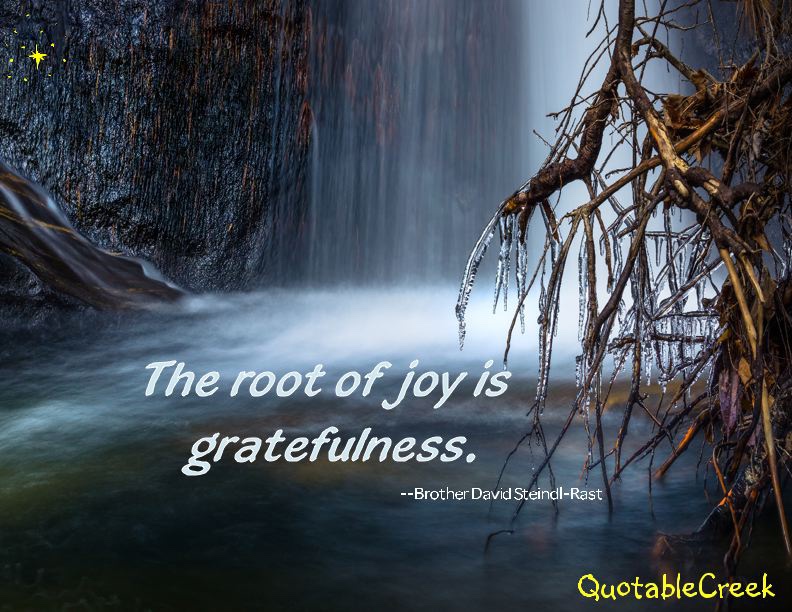
Brother David Steindl-Rast explains how these jolts into a different reality can change a day, and, perhaps, even a world:
My vision of the world? My hope for the future? This topic sounds a bit big. Allow me to start small—say, with crows. They are my special friends. Just as I am writing these lines, one of them, the shy one among my three regular guests, is gobbling up the Kitty Fritters I put out for them. This brings to mind a short poem by Robert Frost that might provide a stepping-stone for our deliberations about world-vision and hope for the future—if any.
The way a crow Shook down on me The dust of snow From a hemlock tree Has given my heart A change of mood And saved some part Of a day I had rued.
Surely you will remember a similar experience of your own: some quirky little incident made you smile, changed your mood, and suddenly the world looked brighter. If this ever happened to you, the key for understanding a causal chain of great consequence is in your hand: any change in attitude changes the way one sees the world, and this in turn changes the way one acts. When Robert Frost claims that the crow’s little trick “saved” part of a day he had rued, or of which he repented, he means this in the full sense of a redeeming change of heart. When he got home, I’m sure he greeted Mrs. Frost in a better mood than he would have been able to do without the crow’s nudge. And there is no telling what this did to her—and to the way she treated the dog afterwards, or talked more kindly to her neighbor.
He continues to suggest five small, easily adopted ways to bring this gratitude into your life and, consequently, into the world:
1. Say one word today that will give a fearful person courage.
All gratitude expresses trust. Suspicion will not even recognize a gift as gift: who can prove that it isn’t a lure, a bribe, a trap? Gratefulness has the courage to trust and so overcomes fear. The very air has been electrified by fearfulness these days, a fearfulness fostered and manipulated by politicians and the media. There lies our greatest danger: fear perpetuates violence. Mobilize the courage of your heart. Say one word today that will give a fearful person courage.
2. Make a firm resolution never to repeat stories and rumors that spread fear.
Because gratitude expresses courage, it spreads calm. Calm of this kind is quite compatible with deep emotions. In fact, mass hysteria fostered by the media betrays a morbid curiosity rather than deep feeling—superficial agitation rather than a deep current of compassion. The truly compassionate ones are calm and strong. Make a firm resolution never to repeat stories and rumors that spread fear. From the stillness of your heart’s core reach out. Be calm and spread calm.
3. Make contact with people whom you normally ignore
When you are grateful, your heart is open—open towards others, open for surprise. When disasters hit we often see remarkable examples of this openness: strangers helping strangers sometimes in heroic ways. Others turn away, isolate themselves, dare even less than at other times to look at each other. Violence begins with isolation. Break this pattern. Make contact with people whom you normally ignore—eye-contact at least—with the cashier at the supermarket, someone on the elevator, a beggar. Look a stranger in the eyes today and realize that there are no strangers.
4. Give someone an unexpected smile today
You can feel either grateful or alienated, but never both at the same time. Gratefulness drives out alienation; there is not room for both in the same heart. When you are grateful you know that you belong to a network of give-and-take and you say “yes” to that belonging. This “yes” is the essence of love. You need no words to express it; a smile will do to put your “yes” into action. Don’t let it matter to you whether or not the other one smiles back. Give someone an unexpected smile today and so contribute your share to peace on earth.
5. Listen to the news today and put at least one item to the test of Common Sense.
What your gratefulness does for yourself is as important as what it does for others. Gratefulness boosts your sense of belonging; your sense of belonging in turn boosts your Common Sense—not the conventional mind set which we often confuse with it. The common sense that springs from gratefulness is incompatible with a set mind. It is just another name for thinking wedded to cosmic intelligence. Your “yes” to belonging attunes you to the common concerns shared by all human beings—all beings for that matter. In a world we hold in common, nothing else makes sense but Common Sense. We have only one enemy: Our common enemy is violence. Common Sense tells us: we can stop violence only by stopping to act violently; war is no way to peace. Listen to the news today and put at least one item to the test of Common Sense.
The five steps I am suggesting here are small, but they work. It helps that they are small: anyone can take them. Imagine a country whose citizens—maybe even its leaders—are brave, calm, and open towards each other; a country whose people realize that all human beings belong together as one family and must act accordingly; a country guided by Common Sense. To the extent to which we show ourselves not hateful but grateful this becomes reality.
Who would have thought that a prankish crow shaking down snow from a hemlock tree could inspire this vision of a sane world? Well, if we leave it to the crows, there is still hope.
Small steps; big pay-off. And, to remember, keep your eyes open for the birds. They are there, singing songs of hope.
Are you good at receiving? Giving often comes naturally, but receiving can be challenging. The mom who wears the pasta necklace and hangs the cotton puff ornament on the tree is sending a powerful message that her child matters, that she loves their thoughtfulness, and that she is honored and grateful to receive their gifts.
The host who immediately opens a guest’s gift of wine and serves it is saying that they value their guests’ choices and are welcoming their contributions to the synergistic experience that is a social gathering.
Henri Nouwen offers this powerful insight:
When someone gives us a watch but we never wear it, that watch is not really received. When someone offers us an idea but we do not respond to it, that idea is not truly received. When someone introduces us to a friend but we ignore him or her, that friend does not feel well received.
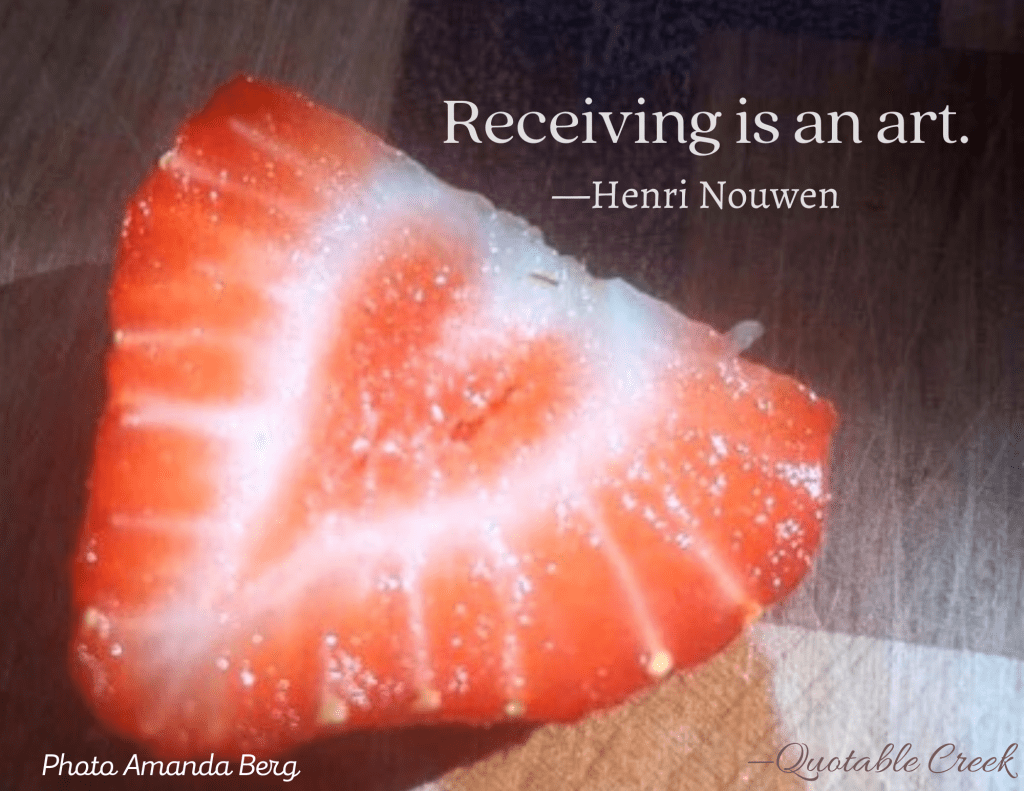
Receiving is an art. It means allowing the other to become part of our lives. It means daring to become dependent on the other. It asks for the inner freedom to say, “Without you I wouldn’t be who I am.” Receiving with the heart is, therefore, a gesture of humility and love. So many people have been deeply hurt because their gifts were not well received. Let us be good receivers.
Henri Nouwen, Bread for the Journey
These words cause us to pause and consider. Are we good receivers? Do we value those gifts and those givers in a way that causes us to open up and expand our walls, and even, perhaps, our sense of self? Can we give up our need to be in control and let our defenses down enough that others around us can share in the very creation of our lives?






 QuotableCreek.com