All we face now can feel overwhelming. It’s as if everywhere you turn, there is another challenge and another threat. And yet, even if the midst of all that is wrong, there are opportunities to shine the light, to be a voice for good, and to support others. Yes, it looks bleak now, but we are still here to do some good:
“Yes, it looks bleak. But you are still alive now. You are alive with all the others, in this present moment. And because the truth is speaking in the work, it unlocks the heart. And there’s such a feeling and experience of adventure. It’s like a trumpet call to a great adventure. In all great adventures there comes a time when the little band of heroes feels totally outnumbered and bleak, like Frodo in Lord of the Rings or Pilgrim in Pilgrim’s Progress. You learn to say ‘It looks bleak. Big deal, it looks bleak.’” — Joanna Macy
In order to make good decisions, you need the foundation of the truth. Double check, triple check, go directly to the sources. And if your understanding of what is true changes, so must your behavior.
As M. Scott Peck said:
Truth or reality is avoided when it is painful. We can revise our maps only when we have the discipline to overcome that pain. To have such discipline, we must be totally dedicated to truth.
‘Revising our maps’ is his way of saying adjust our world view, our sense of what is right or wrong, our conclusions about happened. Bottom line: We will simply not get anywhere near where we want to go if we are operating with faulty maps.
Too many people these days are trying to adjust the ‘facts’ to conform to their world view (with misinformation or disinformation) rather than the other way around.
Oh, child. How I wish for you to have a life without misery and heartache, a world without disillusionment and betrayal, a childhood unmarred by neglect or abuse, a journey without conflict. But, alas, that will not be. We do not live in a utopian world, but here in this world, and you will know sorrow and pain and, as much as I would love to shield and protect you from it, I cannot. There will be dark days, my love.
But you are brighter than the darkness, and, even in your misery, you will find a way to shine. And when you are at your lowest point, I will be there beside you knowing that you will rise again and that this pain will make you more compassionate and humble, more honest and fierce, more determined to make this world a more perfect place, because you, my beautiful child, are not meant to be kept down in the darkness, but to shine.
Sometimes, when we feel down, we need to evaluate the input coming into our lives. Are we steeped in negativity? Maybe not just news, but the vitriol that follows it in the comments? The political back and forth can get ugly and pull us down. And then we can think about the friends we surround ourselves with. Are they upbeat, trying to make things better, or always complaining?
And, while we don’t want to retreat from fighting the good fight or the friends who are going through a rough patch, it’s so easy for people to tear things down, to find the flaws, to make a conflict, and, when we are around that kind of energy constantly, we can feel beaten down.
But, there is good news to be had, and there are positive people and opportunities to be found. Sometimes we need to focus our attention there, if only for a break from the storm.
Adulting isn’t for the faint of heart. Responsibilities, worries, concerns for the future can weigh us down and make us nostalgic for the carefree days of youth. But, perhaps, there’s a remedy.
When was the last time you started something new? An art, language, trip, habit? Maybe followed a lifelong dream. Perhaps it is scary to become a ballerina at 60+ years old, but doesn’t it sound delightful? Or perhaps learn how to refinish cast-off furniture. Or speak a different language.
These are the ones I’m thinking of, what would you try? As we age, being a beginner is harder. We worry about embarrassment, or struggle with not knowing everything already. Or perhaps we think if we try something like this, we have to be a professional and don’t give ourselves permission to be bad at it. We’ve forgotten the joy in just immersing ourselves in something new.
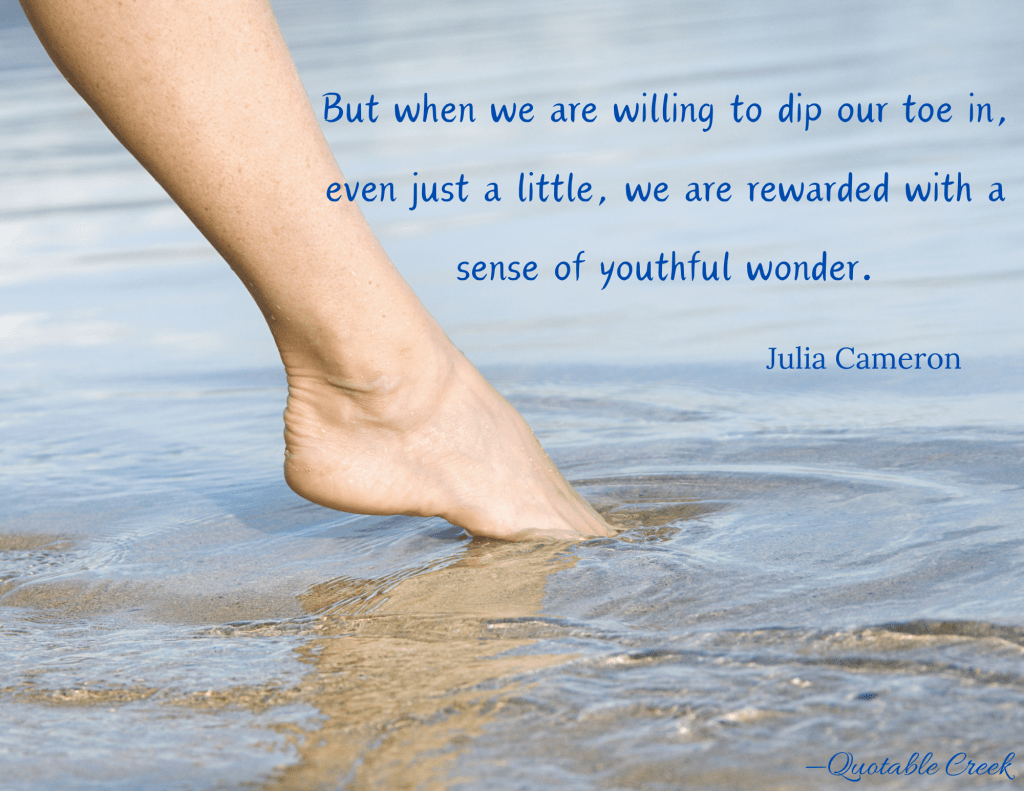
Julia Cameron says:
Often, when we say it is ‘too late’ for us to begin something, what we are really saying is that we aren’t willing to be a beginner. But when we are willing to dip our toe in, even just a little. We are rewarded with a sense of youthful wonder. Never give in, never give in, never, never, never, never.
There is always something new and exciting around the corner just waiting to experience.
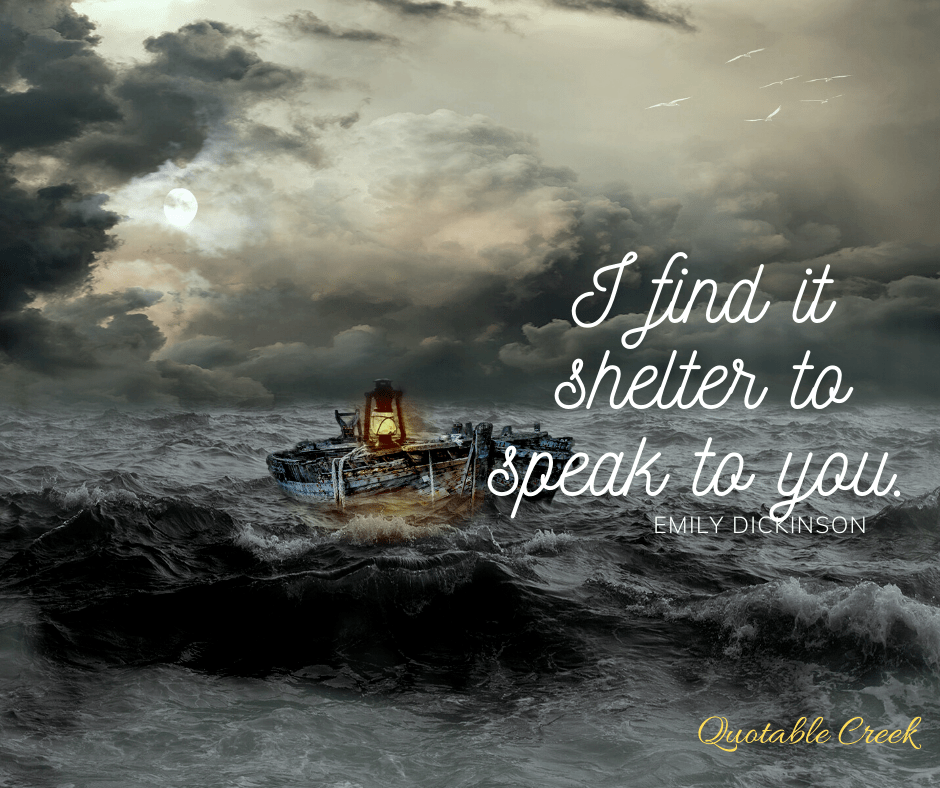
Of all the compliments you could receive, perhaps the best is that you feel like shelter. That, in all the storms and chaos that swirl around us, talking to you feels like safety. Not in the sense of being a yes man or echo chamber, or even in the sense of being able to do anything to stop the storm, but in the sense of home.
“I find it shelter when I speak to you,” says Emily Dickinson. What might we do and say to make someone feel that way? Shelter implies that the storm is still swirling, the elements are still fierce, but talking to you is a respite from that and an entry into something welcoming and safe. A place where you are known, and heard, and cared for. A place of comfort.
Certainly there are plenty of people making themselves someone’s storm. Wouldn’t it be wonderful to be someone’s shelter instead?
What can you do in this increasingly chaotic and exhausting world for someone to find it shelter when they talk with you?
Sometimes I think saints must have been extraordinary people, somehow different from the rest of us lugs, vested, perhaps, with some superior spiritual gifts or insights.
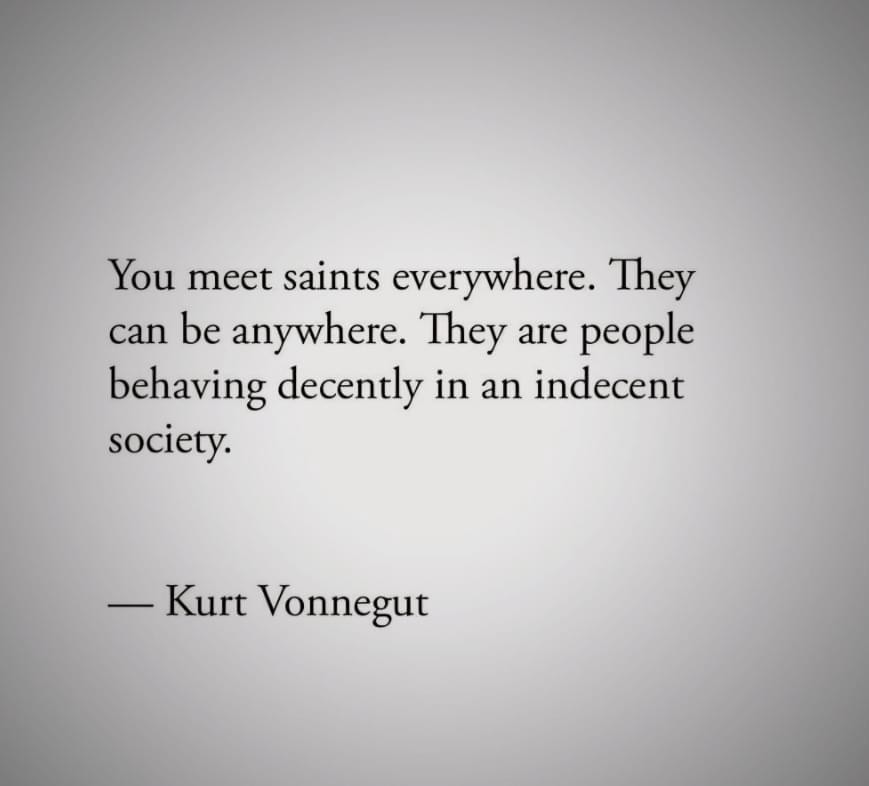
But then I realize, as did Vonnegut below, nope, just people like us, doing their best.
Whether we are ever canonized or not, this is our ‘job,’ isn’t it? To ‘behave decently in an indecent society’.
And then comes the hard part, to trust that your behaving decently will make a difference, whether you ever know about it or not.
Perfection can be the enemy of progress. When we need to move forward, we often wait until we come up with a perfect solution, sometimes so long that the opportunity to make our contribution passes. It is not only ok to be fallible, it is all we’ve got to work with: Our imperfect, fallible, often short-sighted selves doing our best to make the world a better place right here, right now, with what is right in front of us.
Take a minute to watch this lovely video of Leonard Cohen singing a reminder that perfection isn’t an option; we must do our best now.
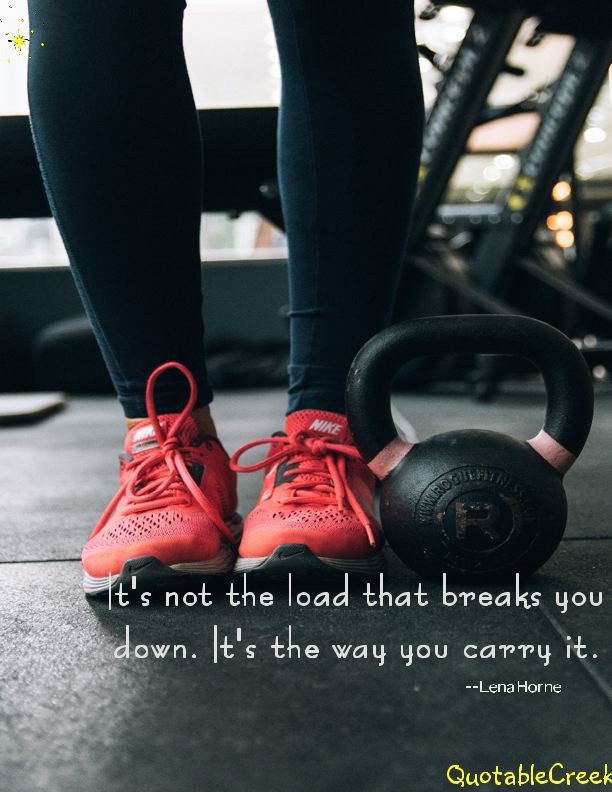
We are weighed down. The tasks ahead seem dauntless; the burdens great. There is so much to be done, and seemingly so little time. Yet, we know that others before us have been able to carry heavy burdens with grace and inner strength. How do they do it? Some ideas:
Evaluate your load. Is it really yours to carry? Holding on to other people’s problems is debilitating because we have no control over their actions. Similarly, feeling like you’re bearing the weight of a global problem on just our own shoulders is both unrealistic and unnecessary. We can help and support someone struggling, and work with others toward a common goal on larger problems, and those are properly our burdens, but we can’t force someone to behave as we would have them, and we, alone, cannot solve a problem like world hunger and peace that is so much greater than any one person. We must discern how best to offer our support and efforts, but realize that, sometimes, the ultimate solutions are beyond our control.
Focus on the gift of that present moment. It is easy to get overwhelmed in a crisis. We see or experience them daily, but when we focus on the present moment as an opportunity to help others, our perception shifts away from the weight of the burden to the lightness that comes from helping others. Yes, there is a refugee crisis, but perhaps we can help. Yes, we’ve lost our job, but perhaps that is an opportunity to do something we’ve dreamed about. Part of the burden that comes from bad things happening is trying to hold on to the world as it existed before the crisis. We mourn the loss and rail against the unfairness. But when we lay that down, and focus on the new reality and challenges present now, in the life we have now, we feel lighter.
Recognize a larger perspective. We will not always be here in this dark place. A new day will come bringing new possibilities and circumstances. We must hold on and look for the bigger picture, remembering that there are ebbs and flows to life, and that this too shall pass.
Ask for help. Sometimes we best carry our burdens by letting someone else share them. We are made to support each other. Perhaps helping you with your burden is the answer to someone else who feels that they lack purpose. Win-win. Life will surprise you that way.
Yes, we are burdened. Life can be hard. As M. Scott Peck says in The Road Less Traveled,
“Life is difficult. This is a great truth, one of the greatest truths. It is a great truth because once we truly see this truth, we transcend it. Once we truly know that life is difficult–once we truly understand and accept it–then life is no longer difficult. Because once it is accepted, the fact that life is difficult no longer matters.”
Amaze yourself. We are stronger than we realize and braver and smarter and more capable, and sometimes we just have to close our eyes and push forward.
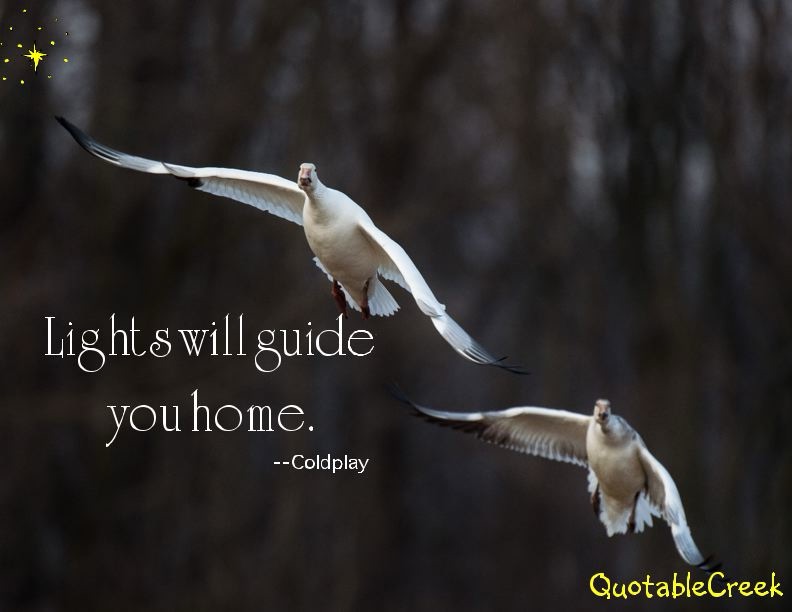
Consider the story of The Tenth Goose told by Richard R. Powell in his book Wabi Sabi for Writers:
Nine Canada geese lift off a clear mountain lake; droplets from their wings cast lines of rings behind them on the glassy surface as they rise. Light gray feathers reflect amber light from the early morning sun, a clean glow off each curved body. You watch their broad wings grip air, watch nine bodies rise and fall in rhythm against the dark forest behind them. Each bird’s neck kinks in counter-time to its wing beats so that all nine heads remain level and each set of eyes gazes steadily out at the cool dawn, bright mystery of sight amid the shiny black head feathers. Closer now, you make out the expressionless curve of their beaks, see one goose’s thin moist tongue as she honks; hear the whistle of air across wing feathers as they pass over your head. Then you notice that there is a tenth goose far back, low to the water, working hard to catch up, honking softly, as if each wing beat hurts. This goose loses a feather as she passes close over you and you watch the feather spiral and glide to the ground. You pick it up and it looks perfect, each barbule lying neatly against its neighbor, the tiny whorl of fluff near the calamus soft to the touch. Then you see that the shaft is not perfect; it is cracked open from the middle to the tip.
You keep that feather, tuck it under the strap around your car’s sun visor, look at it every day you drive to work and remember the tenth goose. Remember your own efforts to keep up. And somehow, that tenth goose gives you courage. You wonder if she will find enough food or if winter will separate her from the rest, separate her from life. She speaks to you in a dream one night. In the distracted moments of the day she speaks to you, in the elevator or while you wait in traffic. Then one night she is there in your dream again, as silent as her feather in your car. She tips her head at you and that beak, with its lumpy prominence like a Roman nose, bobs up and down and you realize she is giving you permission to speak. In the dream you speak and she turns her head to hear you and you tell her your fear of dying and your hopes while living and she comes and rattles her beak between your fingers.
There is beauty and strength in the broken places, a beauty that continues on even when everything is a struggle, that faces setbacks with determination. Sometimes we are one of the nine geese, sure and strong, in sync, but sometimes we are the tenth goose struggling to keep up. And there is beauty in that, too:
It is a kind of beauty on the edge of defeat, a beauty tenacious and brave, and it is the beauty left behind when the warm, honking goose is gone. And not just flown away–but dead and gone. That feather remains as a testament to the beauty in living; and even when the feather dries and cracks and is eventually eaten by insects or the drab extension of time, it will live on in the imaginations of those who hear the story of the tenth goose.
Remember the Story of the Tenth Goose and take heart.






 QuotableCreek.com