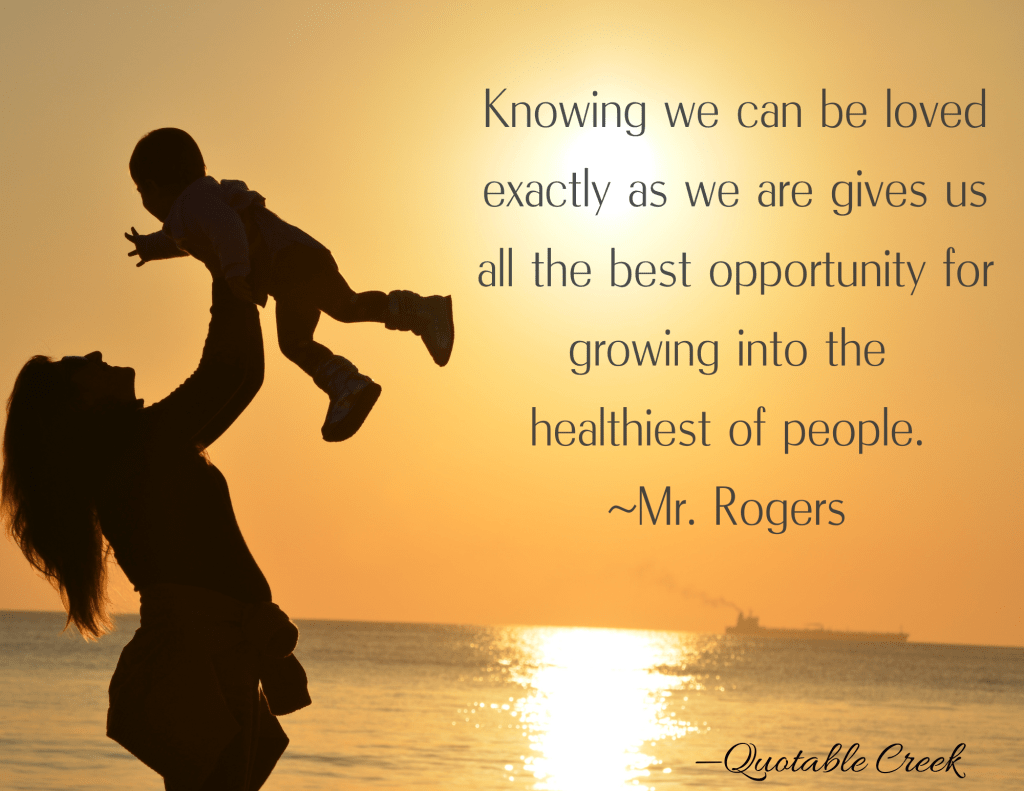
Mr. Rogers had a gift for seeing each child he encountered as an individual, a neighbor, someone worthy of respect just as they are. No need to impress him, or to put on an act, or to pretend. He accepted children. Period. No strings attached.
How wonderful.
Do you feel you are enough, just as you are? Sometimes our families, friends, or societies give us the message that we aren’t. That we need to be thinner, richer, smarter, younger, more attractive. Something different from what we are. That we must think the same as they do and fall in line. It’s exhausting.
What a gift it is to accept people, including ourselves, just as is. No one is perfect, so why pretend we are? We each have strengths and weaknesses, things we’re working on and things we’ve got sorted. Instead of finding flaws, we can look at ourselves and each other as complicated works in progress, with value just as we are, giving ourselves and each other ‘the best opportunity for growing into the healthiest of people.’
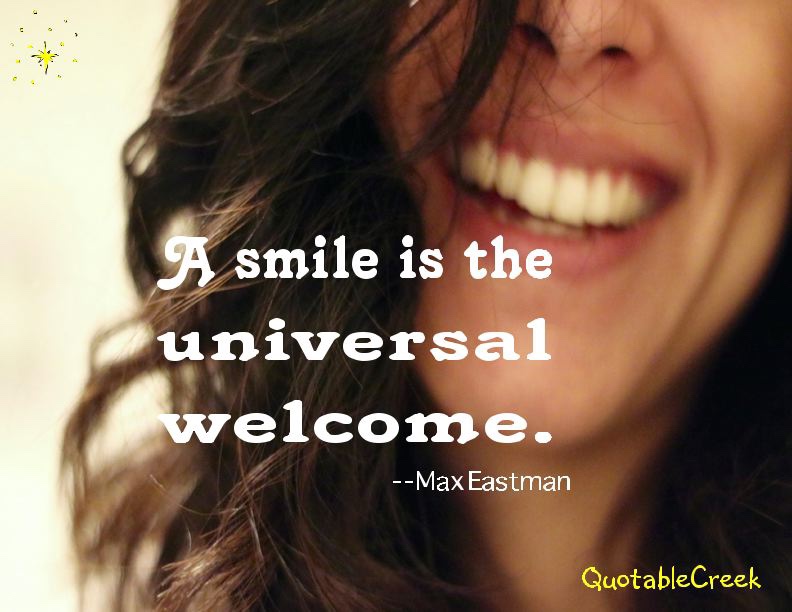
Have you been somewhere new recently? Maybe somewhere where everyone knows each other but you? Was there someone there who made you feel welcome?
When we remember what it feels like to be an outsider, we realize how powerful a warm welcome is. How generous the welcomer was to look outside of their usual orbit to notice a stranger and invite them in. A smile is the first step.
For today, consider this lovely poem on smiles and consider who you might welcome. How lucky you are to be in the position to welcome another!
Sometimes our eyes and hearts are focussed so far in the distance, that we fail to see what is right in front of us. The people we spend our days with, the beauty surrounding us, the opportunities we have to make a difference. When we zoom in to the detail, the richness of the particular moment can be astounding and surprising. What a beautiful, remarkable world we live in. So full of complexity. Each person we see is as full of contradictions and surprises as we are ourselves. Each living or created thing we see is so full of detail.
Long-term goals are great, but what a shame if we don’t appreciate each step along the way. We may work side by side with someone but barely know their name let alone what their hopes and dreams are. We may be so busy moving forward that we are blind to the heartache of even the people we live with. It is easy to speed through life with eyes averted like people descending in an elevator focussed only on the floor numbers.
Today take time today to enjoy the journey, the mysteries unfolding all around you, the people who share your path, and all the beautiful and startling things right here, right now.
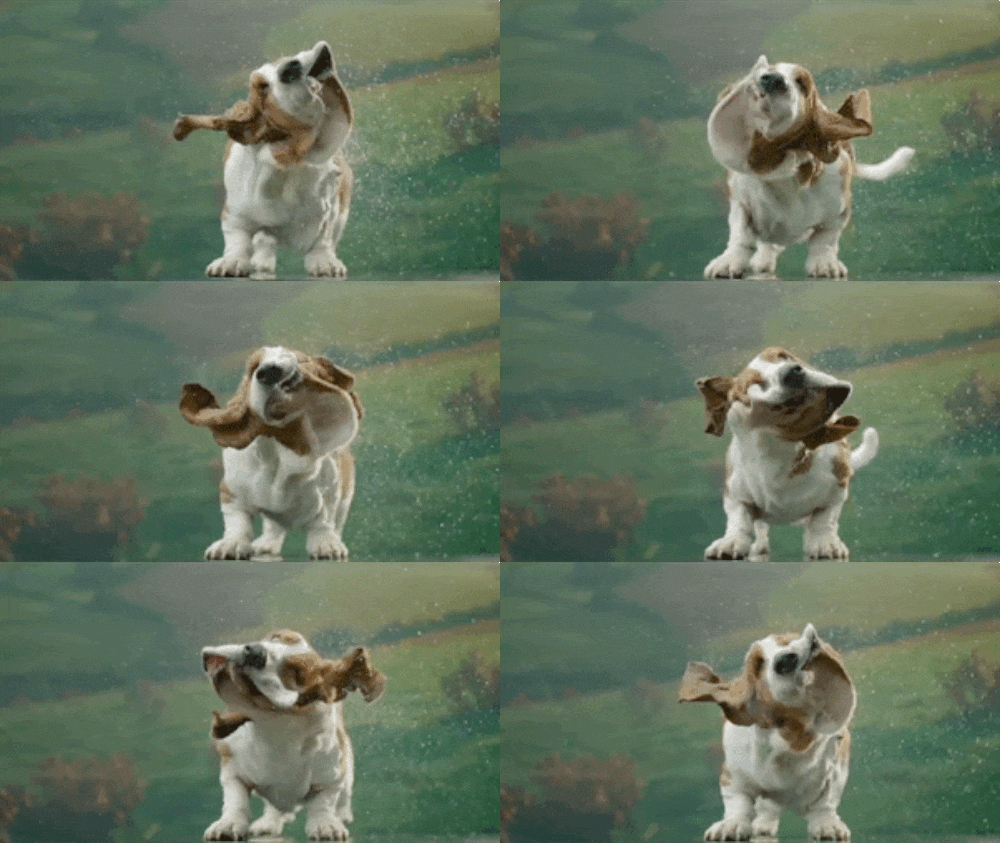
Like, for example, who can not stop and be amazed at this little beagle shaking its jowls, its great ears flopping to the beat, its sturdy paws holding on in front but shifting with its wagging tail in back, the gorgeous landscape behind it? What a fascinating little miracle, right here. Just this.
I’m a huge Ted Lasso fan. When an episode ends, I actually groan. This week was a powerful demonstration of how important words are, how the things we say can impact a person for years (for good or bad), and how important genuine, heart-felt communication is to heal old wounds.
Tough guy Roy Kent was hurt by the blunt criticism of his skills written in an article by reporter Trent Crimm from Roy’s first game when Roy was just 17. Roy still carries the article around in his wallet decades later.
Do you have any words like that that you’re still metaphorically carrying around years later? Perhaps we remember a mentor’s encouragement that sparked our interest or passion in a chosen career. Perhaps, sadly, we still struggle under the weight of words by someone who condemned us at our worst, saw as as inadequate or a failure. someone who felt we would never measure up.
Words have heft to weigh us down or sustain us. We need to remember that when we choose ours.
My daughter recently organized her library, not by any of the more common methods of organizing books—genre, audience, age, author last name, — but by color of the cover. I must say, this startled me. It upset my Dewey-decimal apple cart. But look how lovely it is!
I have always focused on organization, both as a lawyer and, now, as an author. It is so vital to figure out your system for how something is to be done. How to organize the information in the most compelling way. Generally, for instance, an appellate brief is organized chronologically, but often that isn’t the most persuasive way. Some testimony needs to be highlighted, some evidence footnoted. And so on. The organization of the brief is a hidden layer adding content. The same is true for stories, sometimes jumbling the timeline or telling things from multiple points of view adds layers and juxtapositions you simply couldn’t get in any other way.
Or, for that matter, consider organizing socks. As a little girl I tried out organizing my socks from white to black with all the colors in the middle in a lovely spectrum (she is my daughter!) but then realized that wasn’t as efficient as organizing them for their intended use—play, school, dress, etc. I’ve had similar questions in my closet. What goes with what? How should things be ordered? Currently my blouses and tops are organized from sleeveless to long-sleeved. But color would certainly be fun, or seasons, or play to formal. The possibilities are endless. But this brings me somewhat round about to my point.
Everything is organized, and we need to pay attention to how.
Consider a grocery store with the popular items at eye level and the tempting items at check out. Or the casino, windowless and clockless to encourage extended gambling. Or a library? What goes in fiction/non-fiction? Is that line ever blurry? Or the church: how would you organize a church? Where should the focus be? How, or do, you make it welcoming? Or a city? Is there a right and wrong side of the tracks? Why?
These kind of questions keep us sharp and open, more able to see when systems aren’t working or when the organization of a thing is manipulating us. And taking things and jumbling up the order, like sorting books by color rather than content, let’s us see with fresh eyes and catch new and interesting juxtapositions, and challenge the very systems we use for categorizing what’s in or out.
My three-year old said she wished we had a pet. I reminded her we have a dog and wow the genuine look of surprise on her face as it dawned on her that our dog is a pet and not just some guy who lives here.
@missmulrooney
At first it startled and amused me. But as I kept thinking about it, I realized this kid was getting at something deep and true. Our love for our pets can be a deep soul connection. That love crosses into the mysterious, into thoughts about our souls, and can be so strong that our grief in losing them can be devastating.
It’s a reminder of how interconnected and complicated our world is. Of how each creature is precious to that mix. And these thoughts upset the apple cart that has humans always putting ourselves at the center of the universe. But more important, our pets are a gift of love, abundant love, vital to the soul.
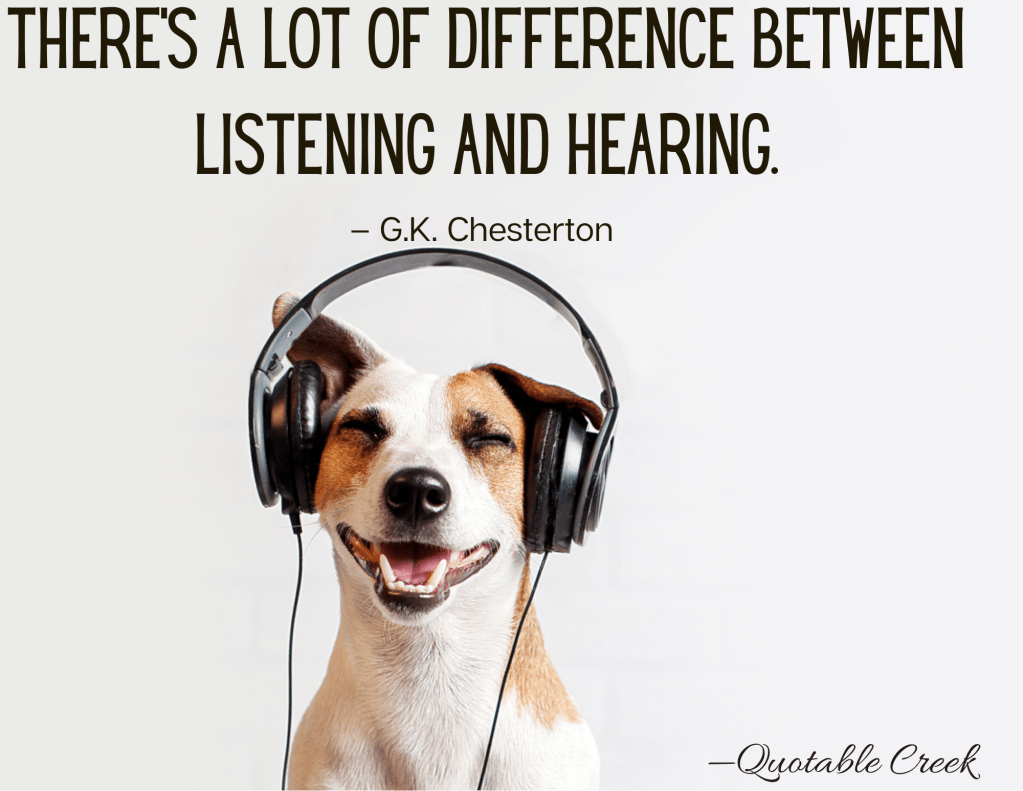
These days there is a lot of noise—everyone has a soapbox—but I wonder how much is really heard. This article explores the problem of autobiographical listening, listening with the hope of injecting a story about yourself into the mix. There are levels to this. The matcher, who always has a similar vacation or achievement to switch the conversation to. The topper who has an even better vacation or achievement to turn the conversation to. And the outright conversation narcissist where really all parts of the conversation somehow turn on him.
But if our goal is connection, we really need to learn how to better listen:
“Listen with curiosity. Speak with honesty. Act with integrity. The greatest problem with communication is we don’t listen to understand. We listen to reply. When we listen with curiosity, we don’t listen with the intent to reply. We listen for what’s behind the words.”
Roy T. Bennett, The Light in the Heart
Practice listening to understand. Avoid autobiographical listening:
“When we fail to listen from the other person’s perspective, we are listening through our own lens and tend to pass more judgments compared to simply listening,” Reigstad added. “There are four types of autobiographical listening ― evaluate, probe, advise and interpret. These responses tend to have us asking questions based on our experiences, offering advice to fix the problem and so on. It’s important to resist the urge and allow the other person to speak.”
Compassion is an active, engaging emotion. It recognizes that another’s pain is as important as your own and seeks to help alleviate it. It is the emotion behind all social justice reform.
Compassion comes from empathy which is very different from sympathy. Dr. Eric Perry describes the two like this:
To better understand empathy, it is important to distinguish it from sympathy. Sympathy is the ability to understand another person’s situation from your point of view. It is a self-centered point of view that helps you understand what the other person is going through based on your own circumstances. You are able to acknowledge how the other person is feeling but, from a distance. You do not become emotionally connected to the person. For example, you are able to sympathize with someone having problems in their relationship because you have had problems in your own relationship. You do not feel what they are feeling but you have an understanding of what they are experiencing.
Empathy is a bit more complicated and abstract. In order to experience empathy, you must have the ability to identify the emotion and to place yourself in the other person’s position. The focus of empathy is self-less. You are experiencing another person’s emotional life by your ability to connect with them. In a sense, you are vicariously feeling the emotion. For example, through empathy, you are able to feel a stranger’s loss of a child, even if you are childless, by seeing the loss through their perspective. Through this connection, you are able to wear the emotional skin of another and essentially feel with them.
The inability to imagine yourself in someone else’s place in order to understand what they are feeling will result in difficulty in connecting with others.
Narcissists and sociopaths can feel sympathy. They use their knowledge of a person’s emotions, not to help them, but to manipulate and control them. But the empathetic person shares the pain of another and works to alleviate it.
The good new is that compassion is like a muscle and can be practiced and strengthened. In this fascinating article by Greater Good, they outline some steps for increasing your empathy.
They identify four goals to the practice:
Bringing attention or awareness to recognizing that there is suffering (cognitive)
Feeling emotionally moved by that suffering (affective)
Wishing there to be relief from that suffering (intentional)
A readiness to take action to relieve that suffering (motivational)
Do you have any difficult people in your life? Chances are you can’t force them to be less toxic, but there are steps you can take to be less bothered by the encounter. In this article by Christine Carter, she suggests, among other things, that showing mercy to this difficult person will rebound to you:
Anne Lamott defines mercy as radical kindness bolstered by forgiveness, and it allows us to alter a communication dynamic, even when we are interacting with someone mired in anger or fear or jealousy. We do this by offering them a gift from our heart. You probably won’t be able to get rid of your negative thoughts about them, and you won’t be able to change them, but you can make an effort to be a loving person. Can you buy them a cup of coffee? Can you hold space for their suffering? Can you send a loving-kindness meditation their way?
Forgiveness takes this kindness to a whole new level. I used to think I couldn’t really forgive someone who’d hurt me until they’d asked for forgiveness, preferably in the form of a moving and remorseful apology letter.
But I’ve learned that to heal ourselves we must forgive whether or not we’re asked for forgiveness, and whether or not the person is still hurting us. When we do, we feel happier and more peaceful. This means that you might need to forgive the other person at the end of every day—or, on bad days, every hour. Forgiveness is an ongoing practice, not a one-time deal.
When we find ways to show mercy to even the person who has cost us sleep and love and even our well-being, something miraculous happens. “When we manage a flash of mercy for someone we don’t like, especially a truly awful person, including ourselves,” Anne Lamott writes, “we experience a great spiritual moment, a new point of view that can make us gasp.”
Here’s the real miracle: Our mercy boomerangs back to us. When we show radical kindness, forgiveness, and acceptance—and when we tell the truth in even the most difficult relationship—we start to show ourselves those things. We realize that we can love and forgive and accept even the most terrible aspects of our own being, even if it is only for a moment. We start to show ourselvesthe truth, and this makes us feel free.
Perhaps you can show that difficult person mercy today.
We can’t choose everything in life, but we can choose what kind of person we want to be.
As we deal with storms across the country and unprecedented blizzard watches here in Southern California, consider the importance of rain. Rain can be like encouragement, bringing nourishment and rebirth to dry parched land. It can promote an abundance of life and energy.
But, in excess, rain can cause flooding and landslides. It can sweep people away into rushing water and leave the landscape devastated.
Our words have the same power. We can be supportive and encouraging, fostering life and vitality in those we engage with. Or we can be harsh and critical, pessimistic and judgmental. Our words can both heal and wound. Our choice.
We can choose to be encouraging and supportive, rather than bleak and pessimistic.
We can avoid being the person who rains on someone else’s parade.







 QuotableCreek.com