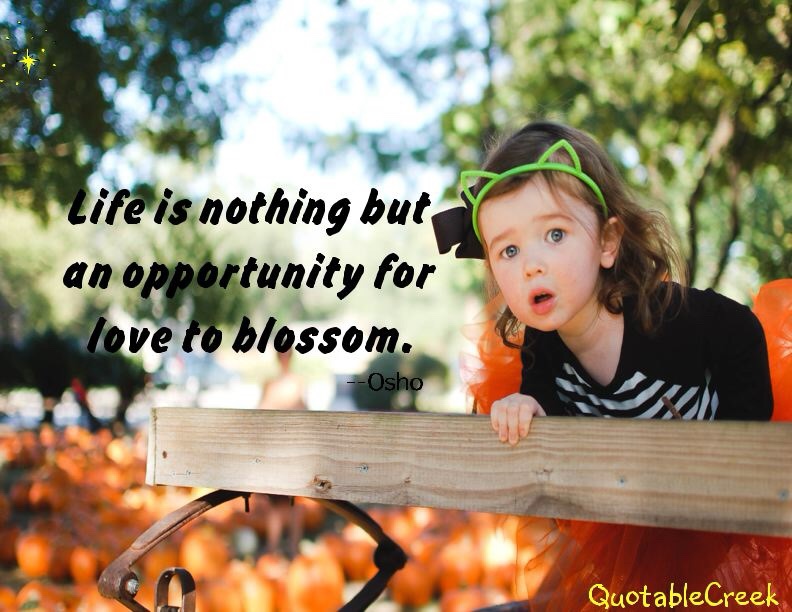
Need a sense of youthful wonder?

Adulting isn’t for the faint of heart. Responsibilities, worries, concerns for the future can weigh us down and make us nostalgic for the carefree days of youth. But, perhaps, there’s a remedy.

When was the last time you started something new? An art, language, trip, habit? Maybe followed a lifelong dream. Perhaps it is scary to become a ballerina at 60+ years old, but doesn’t it sound delightful? Or perhaps learn how to refinish cast-off furniture. Or speak a different language.

These are the ones I’m thinking of, what would you try? As we age, being a beginner is harder. We worry about embarrassment, or struggle with not knowing everything already. Or perhaps we think if we try something like this, we have to be a professional and don’t give ourselves permission to be bad at it. We’ve forgotten the joy in just immersing ourselves in something new.

Julia Cameron says:

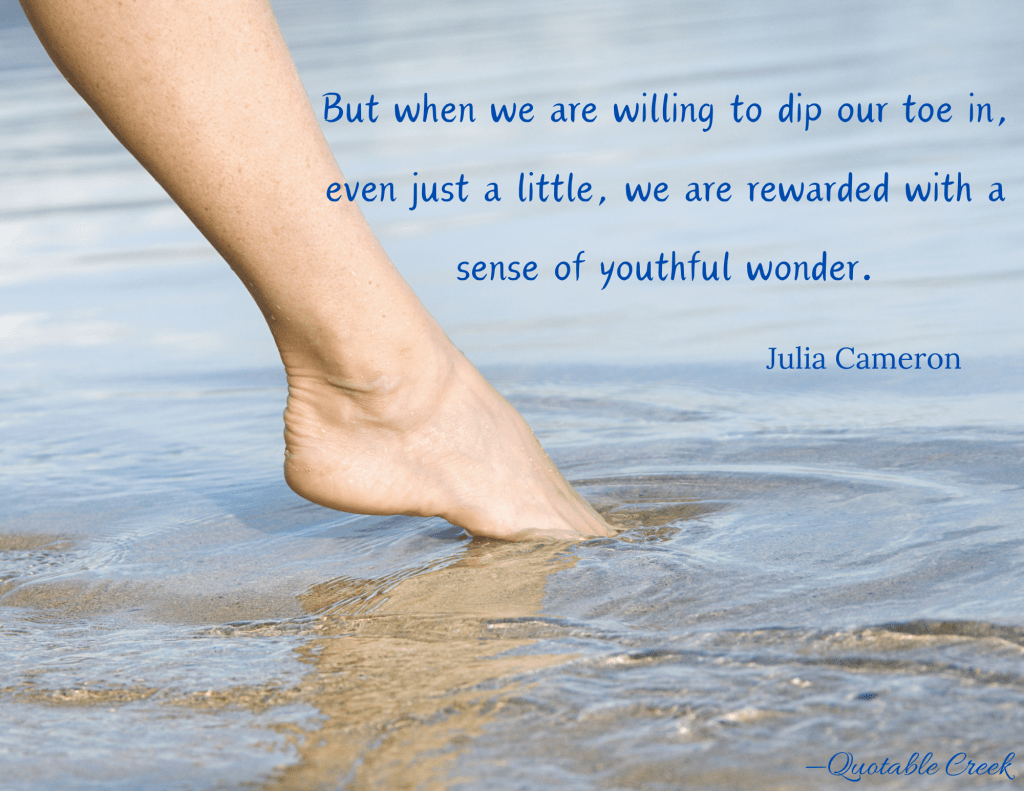
Often, when we say it is ‘too late’ for us to begin something, what we are really saying is that we aren’t willing to be a beginner. But when we are willing to dip our toe in, even just a little. We are rewarded with a sense of youthful wonder. Never give in, never give in, never, never, never, never.

There is always something new and exciting around the corner just waiting to experience.

Of mists and mellow fruitfulness.

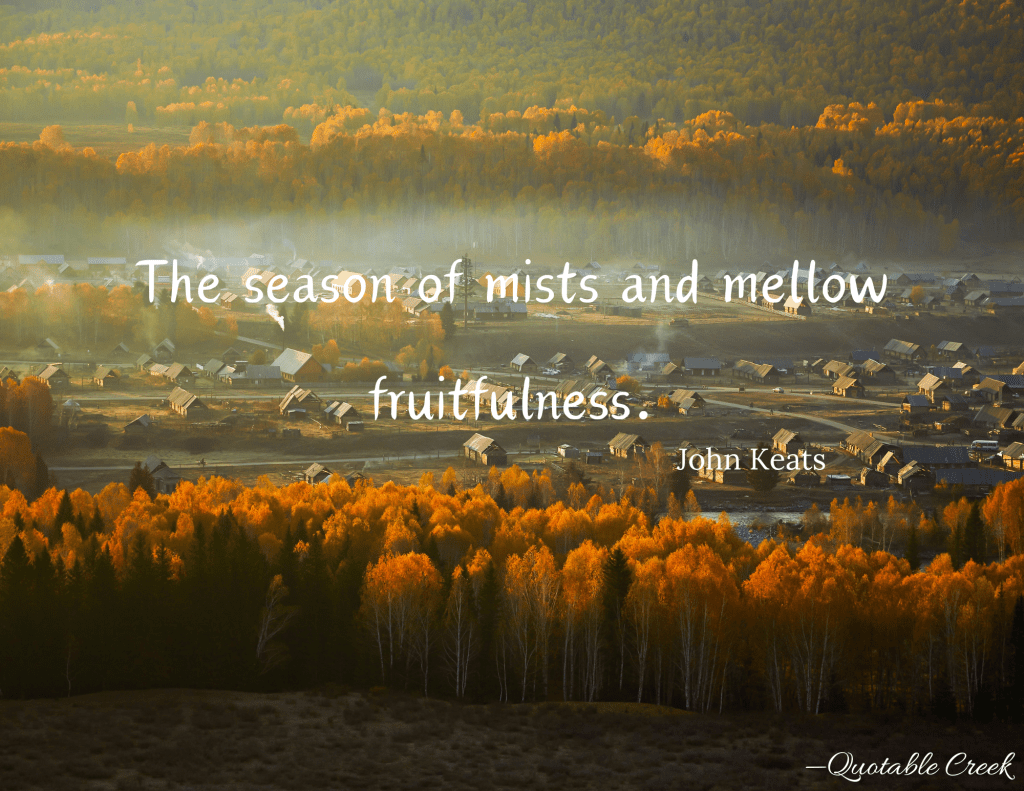
According to Keats, autumn is the season of mists and mellow fruitfulness. Isn’t that a lovely turn of phrase? So evocative. Can’t you feel the cool mist sifting its way through the treetops to settle on the dewy grass?

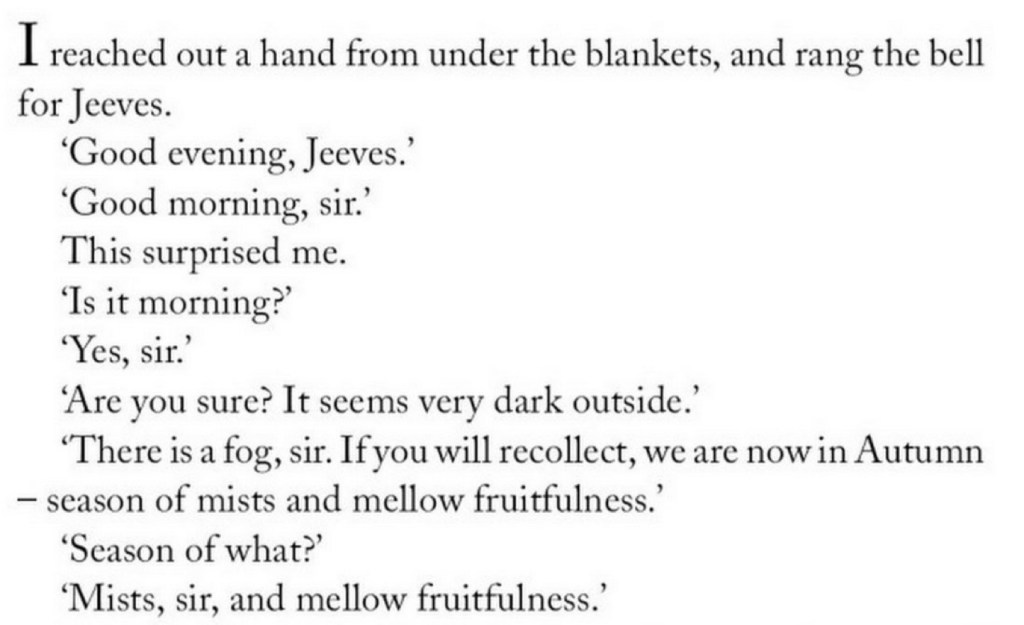
Here that phrase is in fictional conversation in a book by P.G. Wodehouse:

Isn’t that delightful?

Welcome to the season of mists and mellow fruitfulness. Enjoy the poem To Autumn by John Keats:

Season of mists and mellow fruitfulness,

   Close bosom-friend of the maturing sun;

Conspiring with him how to load and bless

   With fruit the vines that round the thatch-evesrun;

To bend with apples the moss’d cottage-trees,

   And fill all fruit with ripeness to the core;

      To swell the gourd, and plump the hazel shells

   With a sweet kernel; to set budding more,

And still more, later flowers for the bees,

Until they think warm days will never cease,

      For summer has o’er-brimm’d their clammy cells.

Who hath not seen thee oft amid thy store?

   Sometimes whoever seeks abroad may find

Thee sitting careless on a granary floor,

   Thy hair soft-lifted by the winnowing wind;

Or on a half-reap’d furrow sound asleep,

   Drows’d with the fume of poppies, while thy hook

      Spares the next swath and all its twined flowers:

And sometimes like a gleaner thou dost keep

   Or by a cyder-press, with patient look,

   Steady thy laden head across a brook;

      Thou watchest the last oozings hours by hours.

Where are the songs of spring? Ay, Where are they?

   Think not of them, thou hast thy music too,—

While barred clouds bloom the soft-dying day,

   And touch the stubble-plains with rosy hue;

Then in a wailful choir the small gnats mourn

   Among the river sallows, borne aloft

      Or sinking as the light wind lives or dies;

And full-grown lambs loud bleat from hilly bourn;

   Hedge-crickets sing; and now with treble soft

   The red-breast whistles from a garden-croft;

      And gathering swallows twitter in the skies.
Advice to your younger self.

What can you tell us? With all of your experiences to date, what have you learned that you can pass on to help others? How would you advise your younger self?

For many of us, that advice would be: don’t be afraid. In this delightful video, elders counsel their juniors with some gems on how to negotiate this crazy world.

Avoiding the drift.

Otters sleep holding hands. In the open water, it would be so easy for them to drift away from each other in the ebb and flow of the tides. They also use kelp to wrap around themselves, but there is something about the image of sleeping otters holding hands to stay connected that is utterly endearing.

Sea_otters_holding_hands.jpg.638x0_q80_crop-smart.jpg

We, too, bounce around in rough seas, and it is easy to drift away from those we love. Distractions, distance, inattentiveness add up until you are apart, in the storm separately, rather than braving it together.

Today, work to avoid the drift away from those you love.

Being shelter.

Of all the compliments you could receive, perhaps the best is that you feel like shelter. That, in all the storms and chaos that swirl around us, talking to you feels like safety. Not in the sense of being a yes man or echo chamber, or even in the sense of being able to do anything to stop the storm, but in the sense of home. 

“I find it shelter when I speak to you,” says Emily Dickinson. What might we do and say to make someone feel that way? Shelter implies that the storm is still swirling, the elements are still fierce, but talking to you is a respite from that and an entry into something welcoming and safe. A place where you are known, and heard, and cared for. A place of comfort. 

Certainly there are plenty of people making themselves someone’s storm. Wouldn’t it be wonderful to be someone’s shelter instead?

What can you do in this increasingly chaotic and exhausting world for someone to find it shelter when they talk with you?

Melting pot or mosaic?


When I was a girl, text books used the term ‘melting pot’ to describe America as if everyone were thrown into one big pot and all the differences were boiled out, with America becoming just one big homogenous pot of glop. But better metaphors have popped up in the years since. Such as a salad bowl:

We don’t need a melting pot in this country, folks. We need a salad bowl. In a salad bowl, you put in the different things. You want the vegetables – the lettuce, the cucumbers, the onions, the green peppers – to maintain their identity. You appreciate differences.Jane Elliot

But perhaps my favorite is Jimmy Carter’s:

We become not a melting pot but a beautiful mosaic. Different people, different beliefs, different yearnings, different hopes, different dreams.Jimmy Carter

I love the idea of a mosaic to define America—beauty in all the bits and pieces, each a small distinct individual unit but also a necessary part of a larger picture. 

No matter how you describe it, America at its best, living up to its ideals, is stronger because of its diversity, the unique perspectives, the mix of voices, backgrounds, cultures, and traditions.

But soft!

Are there any more beautiful words in English literature than these: “But soft! What light through yonder window breaks?”

These are Romeo’s words when he gazes at Juliet above on the balcony, but what if we were to bring these words into our everyday encounters?

But soft! Listen to the hush here, the rapt attention, all of his focus on her, just her. What if we were to whisper these words to ourselves before we talk with someone? But soft! The world fades, the focus sharpens, all of our attention is on that person. But soft! reminds us not just to be calm and attentive, but also to be gentle and reverent. Wouldn’t any conversation shift if it were preceded by such a lovely call to silence? Wouldn’t But soft! be a perfect pairing of words to bring back into common usage?

“What light through yonder window breaks?” Again, what if we were to look at each other this way? As light, as beings capable of making the world a brighter place. Even those with much of darkness about them have an inner light, a spark of good. What if we were to ignore the dark and focus on the light in each other? What a compliment it is to be called a light! Wouldn’t someone noticing our light make each of us want to shine ever more brightly? And wouldn’t that, accordingly, make the world an ever brighter place?

Look around. Someone wants your attention.

But soft!

What light through yonder window breaks?

Thankful for teachers.

We are each born helpless. How we got from there to where we are now depended on the generosity of many people. Among those are our teachers, those people who devoted their time to making sure we understood the world around us and how to negotiate the ups and downs of the road ahead. Those teachers who went beyond the lesson plan to help us learn not just facts, but how to think and analyze, how to care and feel, and how to reach out to others deserve our unending gratitude.

Full of wonder.

How lovely it is to stand still in the enormity of your questions. To realize that what you know is minuscule in relation to all there is to know. To let your curious mind take you on a journey of discovery. How liberating it is to lay down the facade of expertise and acknowledge that, in this world, we are all students.

Everyday saints.

Sometimes I think saints must have been extraordinary people, somehow different from the rest of us lugs, vested, perhaps, with some superior spiritual gifts or insights.

But then I realize, as did Vonnegut below, nope, just people like us, doing their best.

Whether we are ever canonized or not, this is our ‘job,’ isn’t it? To ‘behave decently in an indecent society’.

And then comes the hard part, to trust that your behaving decently will make a difference, whether you ever know about it or not.

Just keep making those ripples.