“In one of John Muir Laws’s books, I read something profound that changed the way my brain thinks. “As you draw the bird,” he writes, “try to feel the life within it.” So now I look at the bird before me and imagine how it senses the world, how it feels breathing cold air, how it feels to have its feathers ruffling in the wind, how it feels to always have an eye out for possible food and possible predators. The bird sees me and is a nanosecond from flying off, but it stays. Why? By imagining the life within, the bird I am drawing is alive, no longer a shape and its parts, but a thinking, sentient being, always on the brink of doing something. By feeling the life within, I am always conscious that all creatures have personalities, and so do trees and clouds and streams. To feel the life within, I now imagine myself as the bird that is looking at me. I imagine its wariness, the many ways it has almost died in its short life. I worry over its comfort and safety, and whether I will see my little companion the next day, the next year. To feel the life within is to also feel grief in the goneness of a single creature or an entire species. Imagination is where compassion grows. Let us join with children to imagine and wonder, to use curiosity as the guide to miracles in plain sight. Let us enter with them into wild wonder so that we become guardians together of all that is living and all that must be saved.”From Orion Magazine, “The Life Within”.
I wonder if we can look at each other that way, as something vaster, as thinking sentient beings with worlds of experience, some harsh. Would that help us to treat each other better? In her book, Dead Man Walking, Sister Helen Prejean describes just this sort of thing as she works with a death row inmate, a man who admittedly committed a heinous act, seeing not just the man but also, though covered with tattoos and bathed in bravado, the little wounded child within. That empathy allowed her to see past the crimes to the human and to feel compassion for him.
Perhaps today we can look with new eyes to see each other as a composite of good and bad, but each fully human and fully deserving of respect and compassion. To paraphrase Amy Tan above, when we consider the person, can we try to picture the life within, the challenges and struggles, hopes and triumphs? Can we become, together, ‘guardians of all that is living and must be saved’ in a place where ‘compassion grows’?
Love isn’t a feeling we fall in and out of. It’s an action we choose to take even when it may be challenging. Sometimes it brings pain. When we think of love as an active verb, like, as Mr. Rogers suggests above, ‘struggle’, rather than as an emotion, it opens our eyes to the fact that we must work at it. It’s a struggle, a constant readjustment and tinkering, constantly expanding our own understanding and empathy.
Love is not molding someone to our vision of what they should be, but accepting who they are and supporting them as they blossom. Thinking of love as something more akin to struggle encourages us to keep looking for new and better ways to show up for the people in our lives, to view the relationships as evolving rather than static, and to appreciate all the little successes and breakthroughs in those relationships along the way.
I discovered a new word the other day that has me soul-searching. Gramnesia, a portmanteau combining ‘grandparent’ and ‘amnesia’. A grandparent experiencing gramnesia trots out recollections of the good, easy times they had raising their children, and brings those up in a way which can be a tacit criticism of the way those children are now raising their grandkids. In other words, someone experiencing gramnesia has forgotten the complete picture of parenthood.
While it’s natural to look fondly back on the years when your children were little, it may be problematic if you make those now grown children feel it is unnatural to struggle.
As Allie McQuaid says:
In a follow-up Instagram Reel, McQuaid explained that the main reason these comments are unhelpful is that they don’t change the things parents of young kids are struggling with and they minimize the very real stress they’re facing.
“Our boomer parents telling us that we didn’t cry ever (whether that’s true or not is up for debate apparently..) doesn’t change the fact that OUR baby now is crying and needs our care,” McQuaid wrote.
Instead of judging or comparing, perhaps it would be more helpful for grandparents to be curious. What might they learn and discover from how their children are showing up now as parents?
Parenting techniques change. Smacking someone with a paddle may have been acceptable once, but now it’s illegal, for instance. Priorities change. Keeping up with the Joneses or maintaining appearances may not be as important to your kids as quality time with their kids. Perhaps the gramnesiac will have something to learn. and perhaps, too, they’ll discover a way to help, something they may have greatly appreciated when they were going through the challenges of raising children.
And also, as hard as it is to be vulnerable and discuss the hard times, those stories, call them ‘momeries’, (portmanteau of mom and memories) may make your child feel hopeful and encouraged as they shoulder parenting duties, that times will be both tough and rewarding beyond their wildest expectation.
Fear of failure can keep us from trying something we really, really want to try. And it can keep us from admitting that we have taken a wrong turn and need to reevaluate things. But, at some point, we have to ask ourselves, why? What is so bad about failure?
Thomas Edison famously said, “I have not failed. I’ve just found 10,000 ways that won’t work.” Each experiment that did not succeed helped him move forward on the one path that would ultimately succeed by ruling out the other paths. That attitude helped spur him on because each failed experiment was itself a discovery and taught him something he didn’t know before.
In this remarkable TED talk, Kathryn Schulz, a self-proclaimed wrong-ologist, talks about failure and our responses to it and suggests that it is in these moments of failure, or, as she sees it, moments when reality does not align with our expectations, that the moments of growth, creativity, expansion happen:
So effectively, we all kind of wind up traveling through life, trapped in this little bubble of feeling very right about everything.
I think this is a problem. I think it’s a problem for each of us as individuals, in our personal and professional lives, and I think it’s a problem for all of us collectively as a culture. So what I want to do today is, first of all, talk about why we get stuck inside this feeling of being right. And second, why it’s such a problem. And finally, I want to convince you that it is possible to step outside of that feeling and that if you can do so, it is the single greatest moral, intellectual and creative leap you can make.
So why do we get stuck in this feeling of being right? One reason, actually, has to do with a feeling of being wrong. So let me ask you guys something — or actually, let me ask you guys something, because you’re right here: How does it feel — emotionally — how does it feel to be wrong? Dreadful. Thumbs down. Embarrassing. Okay, wonderful, great. Dreadful, thumbs down, embarrassing — thank you, these are great answers, but they’re answers to a different question. You guys are answering the question: How does it feel to realize you’re wrong? (Laughter) Realizing you’re wrong can feel like all of that and a lot of other things, right? I mean it can be devastating, it can be revelatory, it can actually be quite funny, like my stupid Chinese character mistake. But just being wrong doesn’t feel like anything.
I’ll give you an analogy. Do you remember that Loony Tunes cartoon where there’s this pathetic coyote who’s always chasing and never catching a roadrunner? In pretty much every episode of this cartoon,there’s a moment where the coyote is chasing the roadrunner and the roadrunner runs off a cliff, which is fine — he’s a bird, he can fly. But the thing is, the coyote runs off the cliff right after him. And what’s funny — at least if you’re six years old — is that the coyote’s totally fine too. He just keeps running — right up until the moment that he looks down and realizes that he’s in mid-air. That’s when he falls. When we’re wrong about something — not when we realize it, but before that — we’re like that coyote after he’s gone off the cliff and before he looks down. You know, we’re already wrong, we’re already in trouble, but we feel like we’re on solid ground. So I should actually correct something I said a moment ago. It does feel like something to be wrong; it feels like being right.
We have all been raised to get the right answers on the test, to score a winning shot, to achieve. But reality is more complex than a true-false quiz. No one of us has all the answers. And yet it feels like we do.
Schulz thinks this can be dangerous:
Think for a moment about what it means to feel right. It means that you think that your beliefs just perfectly reflect reality. And when you feel that way, you’ve got a problem to solve, which is, how are you going to explain all of those people who disagree with you? It turns out, most of us explain those people the same way, by resorting to a series of unfortunate assumptions. The first thing we usually do when someone disagrees with us is we just assume they’re ignorant. They don’t have access to the same information that we do, and when we generously share that information with them, they’re going to see the light and come on over to our team. When that doesn’t work, when it turns out those people have all the same facts that we do and they still disagree with us, then we move on to a second assumption,which is that they’re idiots. (Laughter) They have all the right pieces of the puzzle, and they are too moronic to put them together correctly. And when that doesn’t work, when it turns out that people who disagree with us have all the same facts we do and are actually pretty smart, then we move on to a third assumption: they know the truth, and they are deliberately distorting it for their own malevolent purposes. So this is a catastrophe.
This attachment to our own rightness keeps us from preventing mistakes when we absolutely need to and causes us to treat each other terribly. But to me, what’s most baffling and most tragic about this is that it misses the whole point of being human. It’s like we want to imagine that our minds are just these perfectly translucent windows and we just gaze out of them and describe the world as it unfolds. And we want everybody else to gaze out of the same window and see the exact same thing. That is not true, and if it were, life would be incredibly boring. The miracle of your mind isn’t that you can see the world as it is.It’s that you can see the world as it isn’t. We can remember the past, and we can think about the future,and we can imagine what it’s like to be some other person in some other place. And we all do this a little differently, which is why we can all look up at the same night sky and see this and also this and also this.And yeah, it is also why we get things wrong.
We are fallible. We make mistakes, constantly even, and no amount of convincing ourselves otherwise changes this particular reality. Once we accept this, we can soften our edges in the ways we treat each other and ourselves. We can jump into an uncertain future, not knowing what can happen because we realize we ACTUALLY DO NOT KNOW what will happen. That lack of knowledge isn’t something to be ashamed of or to pretend isn’t there like Wile E. Coyote who has just run off a cliff: it’s part of the human condition. We simply do not have all the answers.
Today, embrace the moment and consider each experience a learning opportunity to grow and stretch and learn. To maybe, even, discover you’ve been wrong and to incorporate that new knowledge into your choices going forward.
When we find ourselves in challenging times and are unsure which way to turn, let these words help guide you.
Do justice. Peace, justice, love are things we do and bring about, not things we wait for. With our best discernment, we offer ourselves to the world, hoping to make a difference. Kind words, loving hearts, calm demeanors, patience, forbearance, and forgiveness. The way of the One we follow. A servant’s heart but a leader’s strength.
Love mercy. Oh, how the world loves vengeance, cancelling, grudges, getting even, punishment. To love mercy is a kinder, gentler path, one that believes in the redeem-ability of every last one of us. One that doesn’t insist on being avenged or having the last word. One that delights in forgiveness and healing.
Walk humbly. No matter how hard we try to do or be right, we may be wrong. The other guy might be right. And, get this, God loves the other guy as much as God love you.
In 2006 a high school English teacher asked students to write to a famous author and ask for advice. Kurt Vonnegut was the only one to respond – and his response is magnificent:
“Dear Xavier High School, and Ms. Lockwood, and Messrs Perin, McFeely, Batten, Maurer and Congiusta:
I thank you for your friendly letters. You sure know how to cheer up a really old geezer (84) in his sunset years. I don’t make public appearances any more because I now resemble nothing so much as an iguana.
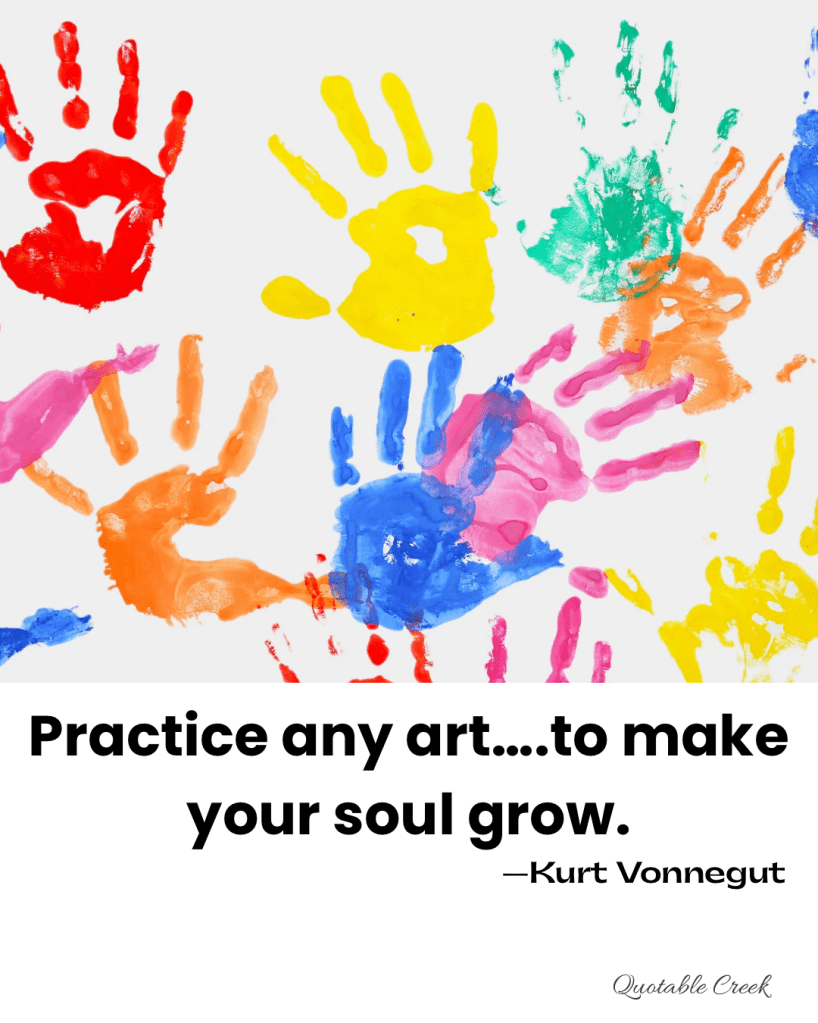
What I had to say to you, moreover, would not take long, to wit: Practice any art, music, singing, dancing, acting, drawing, painting, sculpting, poetry, fiction, essays, reportage, no matter how well or badly, not to get money and fame, but to experience becoming, to find out what’s inside you, to make your soul grow.
Seriously! I mean starting right now, do art and do it for the rest of your lives. Draw a funny or nice picture of Ms. Lockwood, and give it to her. Dance home after school, and sing in the shower and on and on. Make a face in your mashed potatoes. Pretend you’re Count Dracula.
Here’s an assignment for tonight, and I hope Ms. Lockwood will flunk you if you don’t do it: Write a six line poem, about anything, but rhymed. No fair tennis without a net. Make it as good as you possibly can. But don’t tell anybody what you’re doing. Don’t show it or recite it to anybody, not even your girlfriend or parents or whatever, or Ms. Lockwood. OK?
Tear it up into teeny-weeny pieces, and discard them into widely separated trash receptacals. You will find that you have already been gloriously rewarded for your poem. You have experienced becoming, learned a lot more about what’s inside you, and you have made your soul grow. God bless you all!” ~Kurt Vonnegut
There is something soul-stretching about entering the zone, that timelessness we find in creating art. Writing, drawing, dancing, singing. All of it. Lose yourself in creating and find yourself a bit different on the other end.
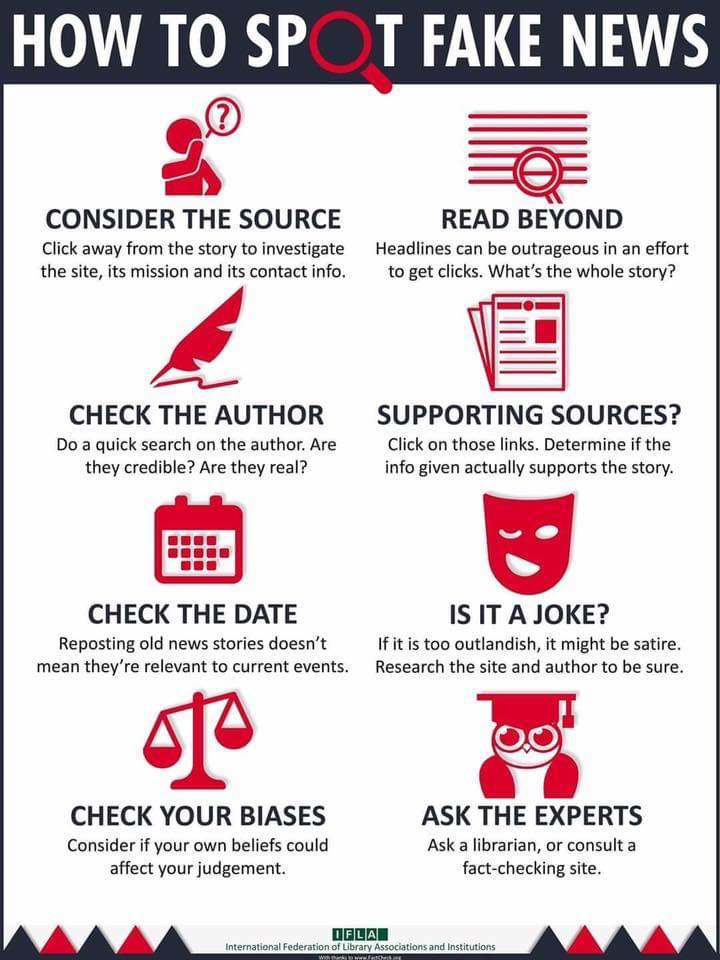
In this world of instant ‘news’ and polarized camps, it is difficult to siphon off the untrue, inflammatory, and malicious from the true, helpful, and conciliatory.
This is particularly true when we learn that one of the goals of social media is to monetize our attention. In the stunning must-see documentary, The Social Dilemma on Netflix, creators of popular social media sites like Facebook and Pinterest discuss how they have monetized their apps to drive profit. The apps are free to use. What is for sale is…you. Your attention. Your time. Your behavior.
What you click on, how long you look at it, and how you react is all measured. Complex algorithms calculate what data to show you based on what you are most likely to click. If you click on articles on empathy, you’ll be shown more stories on empathy. And if you click on dark or divisive articles, you will get more of same. Meanwhile, each of those clicks is a pay out from those seeking to put their messages into your head. The algorithms aren’t based on whether the content is good for you to view; they are based on what you are most likely to click. It is not hard to see how someone can become radicalized if they follow one of the darker holes further and further down.
So what to do? First, maybe affirm a universal truth. We want to make our decisions based on reality, not lies. We want to conform our understanding to facts, not alter the facts to fit our understanding. It’s as if there is a map to our destination. When we realize we are off course to a place we want to be, we change course, we don’t rewrite the map.
Second, consider your sources. Are they reputable? Rather than feeding the narrative you may want to hear, do they present the issues fairly and with minimal bias? If you are constantly being fed information that doesn’t square with what you see and hear happening around you, change up your sources.
Finally, read broadly. Don’t rely on a single person or news source. With respect to social media, seek out reliable sources directly and go to their sites to read the articles rather than clicking on a tempting link. We can be better informed than ever before, but we need to be intentional about it rather than passively wait for ‘news’ articles to pop up on your Facebook feed.
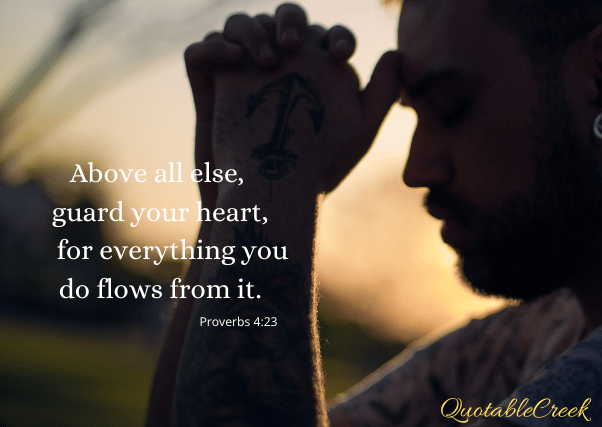
Social media is a powerful tool, but, like any tool, it can be a force for both good and bad. We need to be wary consumers and protect ourselves from being manipulated solely by advertisers trying to make a dime without regard to whether what they are showing us is true or decent. We need to guard our hearts, not to shelter ourselves from bad news or hurt in the world, but to keep ourselves from falling victim to fraud and deceit and unwittingly perpetuating false narratives ourselves.
Have you fallen for fake news lately? What steps have you taken to make sure you are reading and passing on reliable information?
I recently clicked on an article purporting to be a response from someone who had been silent on a current political issue. I fell for the ‘Check the Date’ problem above. The article was from about four years ago. That person was still being silent on the current issue, so I didn’t get any new information, but that duplicitous advertiser made some money off my click.
Communication can be tough, particularly after a long silence. Finding inroads, healing thaws, rediscovering common ground takes effort.
Sometimes it’s nice to have a game plan before going into what might be an emotionally-charged conversation.
Consider this one:
So often we get lost in who’s right, who’s wrong. But is that really the point? Harsh words are often spoken in just such a competition to be right. Often the words cause more harm than the original conflict. Is right/wrong really the best way? Especially when the objective is to try to get a friendship back on track.
Being gentle, vulnerable, attentive is true strength. Moving through the world with a genuine sense of curiosity rather than an avowed sense of your own rightness can open the door to a better appreciation of someone else’s point of view and a greater chance of improving, rather than destroying, the remnants of a relationship you hope to save.
We don’t let just anyone see us vulnerable, hear our secret stories, watch us struggle. To most of the world, we carry a bit of a shield between them and our tender parts. But there are some few we trust to see the real person behind the mask. We must love those people very much to be so naked and exposed.
Because we need to lay those masks down sometimes, don’t we? We can’t live a life of posture. And so we seek out places where and people with whom we can relax and let down our hair, unafraid of judgment, unconcerned with being deemed eccentric. Perhaps to be part of nature, to rest among creation until we lose sight of where we stop and others begin.
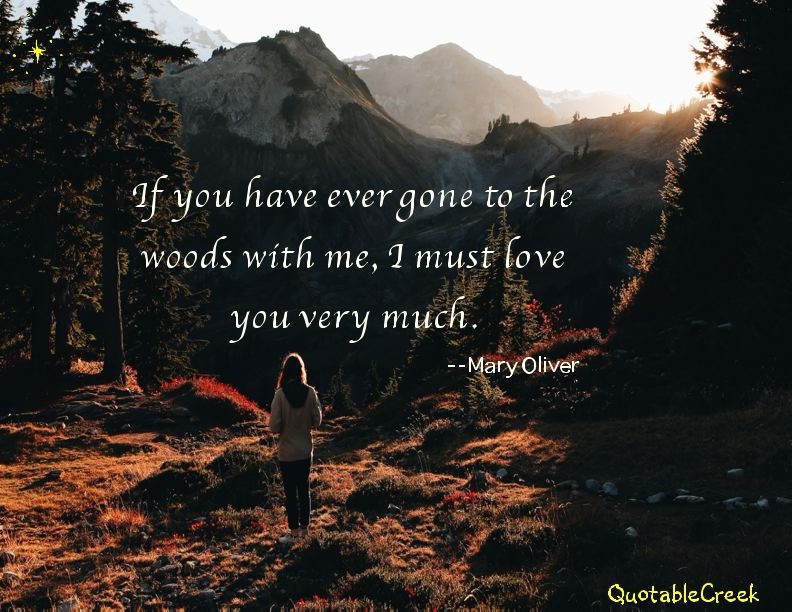
In this poem, Mary Oliver takes us into her sacred space–the woods.
She must love us very much.
How I Go To the Woods
by Mary Oliver
Ordinarily, I go to the woods alone, with not a single friend, for they are all smilers and talkers and therefore unsuitable.
I don’t really want to be witnessed talking to the catbirds or hugging the old black oak tree. I have my way or praying, as you no doubt have yours.
Besides, when I am alone I can become invisible. I can sit on the top of a dune as motionless as an uprise of weeds, until the foxes run by unconcerned. I can hear the almost unhearable sound of the roses singing.
If you have ever gone to the woods with me, I must love you very much.
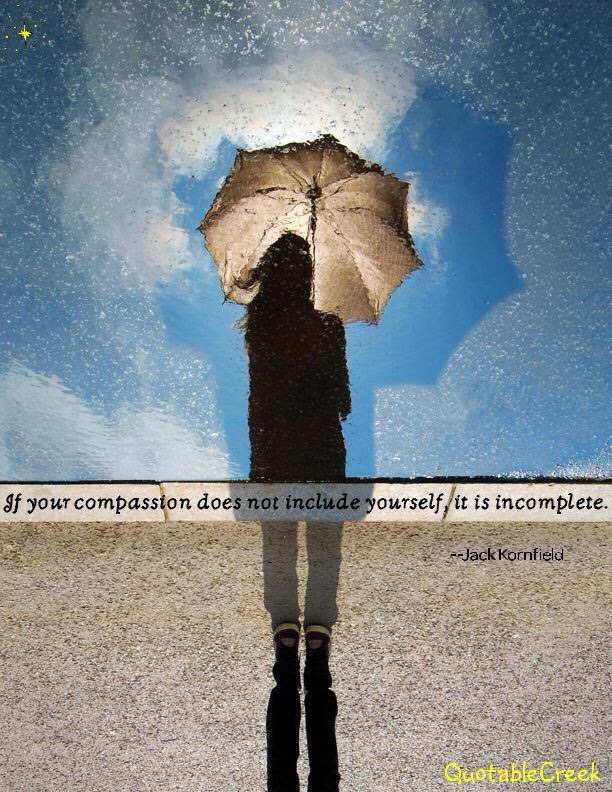
If one of your friends were struggling with the problems you are facing right now, what words would you offer in support? Would you call them names, berate them, remind them of all the other times they messed up just like this and how, honestly, can they ever expect to get anything right, ever?
Probably not. Right? But often this is the way we talk to ourselves. We replay all our other mistakes in our minds, call ourselves stupid, sink into our shells scared to face the world.
But why do we do this? If the words we would offer our friend are what we think would help, why are we so reticent to speak kind encouraging words to ourselves? Maybe today is a good day to try a different approach.
Be a kind friend to yourself. Offer yourself words of support and encouragement. Focus on all the many times you got things right. Tell yourself the truth: you are precious and beloved.



 QuotableCreek.com