Persevere

Sometimes things hum along nicely, and you can feel a deep sense of progress in yourself, your relationships, and the world.

Sometimes the opposite is true.

You feel yourself retreating and losing hope. Your relationships fray. Progress in the world is wiped away.

At times like these, we need to hunker down and draw on a well of hope inside in each of us that springs up with the knowledge that we can do better, we deserve better, and we will fight for ourselves and each other to make the world better.

We may not know yet the battleground we will be called to or the terms of engagement.

We do, though, know the weaponry we will fight with.

Love, honesty, integrity, justice, compassion. These tools of the light will vanquish darkness. We can’t forget what is good and right.

Finally, brethren, whatsoever things are true, whatsoever things are honest, whatsoever things are just, whatsoever things are pure, whatsoever things are lovely, whatsoever things are of good report; if there be any virtue, and if there be any praise, think on these things. Philippians 4:8

We must persevere.

Hold on.

Is your life all ups, no downs? Do you ever feel a need to make it look like it is? Maybe to pretend the rough stuff doesn’t exist or put on a big smile to cover a broken heart? Do you ever feel like there must be something wrong with your faith if your life is going badly?

Truth is, bad things happen. To the best, most faithful of people. Life’s struggles can feel overwhelming. You can get to the point where you simply cannot see how someone could think and feel the way they do. You can lose hope.

At times like these you need to breathe deep and get yourself to a quiet place. And it sure would do no harm, and maybe a whole lot of good, to read a poem like this:

The Peace of Wild Things

by Wendell Barry

When despair for the world grows in me

and I wake in the night at the least sound

in fear of what my life and my children’s lives may be,

I go and lie down where the wood drake

rests in his beauty on the water, and the great heron feeds. 

I come into the peace of wild things who do not tax their lives with forethought of grief. 

I come into the presence of still water.

And I feel above me the day-blind stars waiting with their light. 

For a time I rest in the grace of the world, and am free.

And the good news is, you can read this poem, and your soul will calm without even being in that place where the wood drake rests in his beauty on the water. The words of a good poem are like magic. They can heal you and still the churning waters of your soul. And they can help you remember the ‘day-blind stars waiting with their light’, because, yes, we cannot see the stars in the daytime, but they are there. Shining.

May you rest in the grace of the world and find peace.

Breathe in this new day.

Apparently, chaos is on the agenda. With breakneck speed, legal norms are being tossed aside, and guardrails appear missing. It’s hard not to be overwhelmed with concerns about our future.

What to do?

When we lose our way or feel overwhelmed, we can return to nature and be renewed. Hear the birds singing. Feel the cool breeze. See the long grass ripple in a gentle wind like ocean waves. Breathe in the sweet earthy fragrance of the morning. Feel small and surrounded by an amazing, complicated system that has been pulsating with life for millions of years. That awe is good for us:

It has long been established that a healthy diet and lots of sleep and exercise bolster the body’s defenses against physical and mental illnesses. But the new study, whose findings were recently published in the journal Emotion, is one of the first to look at the role of positive emotions in that arsenal.

That awe, wonder, and beauty promote healthier levels of cytokines suggests that the things we do to experience these emotions—a walk in nature, losing oneself in music, beholding art—has a direct influence upon health and life expectancy,” says UC Berkeley psychologist Dacher Keltner, a coauthor of the study.

Breathe in the day, full of life and possibility. Breathe out the stress, the worry, the defeat.

In.

Out.

In.

Out.

In.

And for a more guided practice consider adding these words to your breath, suggested by my former pastor John Foster:

Be still my soul and steadfast.

No one knows what tomorrow will bring, and that can be frightening. We are in a volatile time. It helps to keep our attention on the present and what we can do here and now.

The great poets help calm our souls. Take comfort today from these tender words from Mary Oliver:

Be still, my soul, and steadfast.
Earth and heaven both are still watching
though time is draining from the clock
and your walk, that was confident and quick,
has become slow.

So, be slow if you must, but let
the heart still play its true part.
Love still as once you loved, deeply
and without patience. Let God and the world
know you are grateful. That the gift has been given.


+ Mary Oliver

We do not know what tomorrow brings, but we will approach it with full souls, grateful and loving, ready to meet the day with a steadfast heart.

A fighting hope.

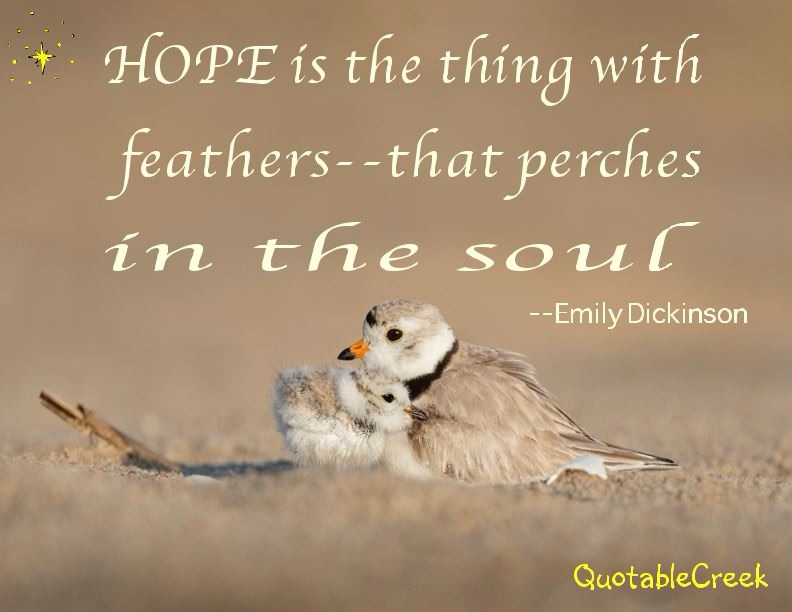
We begin the year with hope. Hope for peace; hope for good health; hope for reconciliation and redemption; hope for progress on our journeys and throughout the world. Emily Dickinson’s poem is a lovely metaphor to return to when drawing on this hope to get us through rough days:

“Hope” is the thing with feathers –

That perches in the soul –

And sings the tune without the words –

And never stops – at all –

And sweetest – in the Gale – is heard –

And sore must be the storm –

That could abash the little Bird

That kept so many warm –

I’ve heard it in the chillest land –

And on the strangest Sea –

Yet – never – in Extremity,

It asked a crumb – of me.

Hope is active, isn’t it? Sometimes singing, sometimes soaring, sometimes hanging on by its toenails. Faith is different. Mary Oliver describes this difference beautifully in her book, Upstream:

In the winter I am writing about, there was much darkness. Darkness of nature, darkness of event, darkness of the spirit. The sprawling darkness of not knowing. We speak of the light of reason. I would speak here of the darkness of the world, and the light of _______. But I don’t know what to call it. Maybe hope. Maybe faith, but not a shaped faith–only, say a gesture, or a continuum of gestures. But probably it is closer to hope, that is more active, and far messier than faith must be. Faith, as I imagine it, is tensile, and cool, and has no need of words. Hope, I know is a fighter and a screamer.

As we go forward, let us hope for a better world for every one, but let it be an active hope–a fighting, kicking and screaming hope– a hope that urges us into that battle of making the world the better place.

For as long as we can.

One of my personal heroes, Jimmy Carter, 100 years old, has passed away, and the world is a bit darker without his light. He has been such a wonderful example of walking the walk. He said:

“My faith demands – this is not optional – my faith demands that I do whatever I can, wherever I can, whenever I can, for as long as I can with whatever I have to try to make a difference.”

What a wonderful way to look at our possible impact. Using what we have, not waiting until we have more or better resources or to be older and wiser, or wishing we were younger and stronger. Right now, with what’s available. 

And wherever we find ourselves, adopting a bloom where you’re planted attitude. Even if we are in our own harsh spot. Considering what can we do here. 

And always looking for opportunities to do good. Not necessarily solving the world’s problems, but doing your own little bit of good. Right here, right now. 

Let’s go. 

Thank you, President Carter, for this reminder. You will be missed.

Staying alive with joy.

How do we make sure we aren’t just staying alive but staying vibrant? Making our moments count? Making an impact and difference in the lives of those we care about? Making our lives matter?

Consider Virginia Woolf’s words:

Whatever happens, stay alive. Don’t die before you’re dead. Don’t lose yourself, don’t lose hope, don’t lose direction.

Stay alive, with yourself, with every cell of your body, with every fiber of your skin.

Stay alive, learn, study, think, read, build, invent, create, speak, write, dream, design.

Stay alive, stay alive inside you, stay alive also, outside, fill yourself with colors of the world, fill yourself with hope, with Wow Scenery.

Stay alive with joy.

There is only one thing you should not waste in life, and that’s life itself.

How do we become hard-hearted as we age, focused so much on ourselves and our own needs? How do we deaden ourselves to community and lives being lived around us, turning inward and reclusive, dying really to the fabric of life?

I just watched the muppet version of Christmas Carol which did a great job of capturing Charles Dickens’s classic story about the transformation of Ebenezer Scrooge, first his turning in, the selfishness, the greed, the callousness to those around him, his miserliness in spirit and deed.

But then, with the spirits’ intervention, Scrooge has an epiphany and realization that life is a looking out, a contributing, a generosity and an overflowing of joy. His life becomes filled with vibrancy and exuberance and a realization of the difference he can make in the here and now. At that moment, he becomes part of something larger than himself, alive with possibility and connection.

Each of us faces Scrooge’s dilemma. We may not be miserable misers, but perhaps we have turned in to focus on ourselves. Perhaps we’ve become callous to the suffering around us and blind to the good we can do. Perhaps we’ve lost the joy.

Scrooge’s story reminds us all that it isn’t too late to turn over a new leaf, to reach out to those around us, to wear our love and concern on our sleeves, to care. And by spreading joy, we find ourselves drenched in it as well.

Patience, Grasshopper.

What is worth fighting for? Sometimes a battle is won in a courageous show of strength and derring do. A fireman runs into a burning building to save a child. A passerby stops to help victims of an accident. A pilot steers a damaged plane to safety.

But sometimes the battle requires showing up time after time with love, kindness, and patience. Not giving up on someone. Having faith that love will win. Believing that relationships can be salvaged.

That takes courage, too.

Praying with the news.

How do we read the news and not get overwhelmed or angry, disconnected or depressed? How do we keep showing up with compassion and grace in a world where there is so much hate? How do we keep ourselves on the right path through the midst of it all? How do we continue to show up from a place of compassion, forgiveness, and grace? how do we keep our hearts from growing hard?

In this thoughtful letter, Rabbi Yael Levy shares his insights on how to pray with the news:

The 17th of the Hebrew month Tammuz initiates a three-week period of mourning that leads to Tisha b’Av, which is the day that marks the destruction of the Temples in Jerusalem in 586 BCE and 70 CE.

Tradition teaches that the Temple was destroyed because hatred became the operating principle in the community. The scorn, contempt and disdain that characterized daily interactions caused the Divine Presence to flee and leave the Temple vulnerable to attack.

These next three weeks ask us to reflect on the hatred that we allow to take root in our hearts. The wisdom of the tradition acknowledges that hatred can sometimes feel energizing and “so right,” but allowing it to fill our bodies and guide our actions leads to destruction.

Many years ago I was taught the practice of praying with the news. I have shared it over the years and always find myself returning to it during this season.

In this practice, each time we read or listen to a news report that enrages us, we turn our attention to those harmed by what is happening and pray for their healing and well-being. Doing so encourages us to acknowledge feelings of anger, grief and despair, and at the same time it turns our attention toward connection and compassion. Praying with the news can help us learn to bear witness to devastation and mayhem, while keeping our hearts soft, our minds calm, and our actions clear.

I am struggling mightily with this practice these days in the wake of continued violence and oppression in this country and throughout the world. Hatred can sometimes feel like such a welcome harbor. Not only does it feel so right, it can also act as a shield, creating the illusion that I don’t have to acknowledge the grief and heartbreak I am experiencing.

I need practices to help quiet the rage and fear, to loosen the constriction of hatred and to help me be with overwhelming grief. I need practices to help me return to compassion, love, joy and possibility. I find praying with the news both painful and helpful. It keeps me connected, allows sorrow, and grounds me in care and love.Weekly reading from the Awakin.org newsletter.

Consider the children.

We all hurt right now. Our whole world grieves the loss of what once was. The present turmoil and divisiveness weigh us down. Each of us is struggling.

But what of the children? How are they doing? How will they remember this time?

They look to us to keep them safe, to care for them, to put their needs first. They don’t understand the greater turmoil. They see, keenly, what is right in front of them. What is that?

While we may not have a ton of control over world events, we do have control over how we treat the littlest among us. Consider the profound effect your words and actions have on children just starting to be introduced to the world. Temper your anger, your frustration, your dismay. There is no harm in having a full range of emotions, and teaching children that they, too, will be subject to sadness and disappointment, frustration and anger, bewilderment and helplessness as they age. But never let them forget that you love them and are with them and that you will stay in their corners come what may.