There are things in this life that break us. Usually they involve some sort of loss—of health, of life, of relationship, of stuff. Despair is a crippler. You can’t breathe; you can’t think; you can’t see a way out. The world becomes very small until it feels like you are living in a tiny bubble apart from everything and everyone, floating along fragile in your pain. At times like these, you have to force yourself to hope and to push through. Start with your breath. In and out, in and out, until it is smooth and full, rather than broken with the catch in your throat from the threatening cry. Keep at that, smooth and full, smooth and full, smooth and full until you can open your eyes and start noticing beauty, maybe, at first, in the tiniest of things. A drop of dew on the grass, the feel of breeze on your skin, laughter of a child, the bud of a flower, birds in flight. Keep at it. No one said it would be easy. Keep at it. Smooth and full, smooth and full, smooth and full.
Fear keeps us from trying, from stepping out, from baring our hearts. It makes us smaller than we are. When we fear heartbreak, we flee from love or offer only a superficial version of ourselves, practically guaranteeing the relationship will lack depth. When we fear failure, we don’t try, or try only halfheartedly, practically assuring a lack of success. When we fear others, we keep to those we perceive to be like ourselves, thereby ensuring that we will not enrich our relationships with diversity.
Fear tells us to cower, to not show up, to be less than we know we are.
We build our fears and then act in ways that reinforce them until they become self-fulfilling prophecies. Our fears become so much a part of our reality that we begin to accept them as ‘truth’. But when we analyze our fears critically, we can harness our inner strength and step through our limitations. So the antidote to fear may well be truth, cultivating it relentlessly, forcing ourselves to examine our fear with a microscope, and dissect it into harmless pieces.
In this powerful TED talk, Issac Lidsky explores how his fears that blindness would rob him of joy and meaning in his life fell aside when he critically examined them and chose to push through those fears to a full and rich life– lacking in sight, but abundant in vision. He urges us to push through our own fears, challenge our assumptions, and correct our misconceptions:
Hold yourself accountable for every moment, every thought, every detail. See beyond your fears.Recognize your assumptions. Harness your internal strength. Silence your internal critic. Correct your misconceptions about luck and about success. Accept your strengths and your weaknesses, and understand the difference. Open your hearts to your bountiful blessings.
Your fears, your critics, your heroes, your villains — they are your excuses, rationalizations, shortcuts,justifications, your surrender. They are fictions you perceive as reality. Choose to see through them.Choose to let them go. You are the creator of your reality. With that empowerment comes complete responsibility.
Today, consider what’s holding you back and challenge your assumptions.
Do not lose heart. The challenges you see today are the ones you must face. You are strong enough to do your part, and you will find allies everywhere you look.
Do not be afraid.
You may feel you are riding on stormy seas, but look around you. In the words of Dr. Clarissa Pinkola Estes:
Look out over the prow; there are millions of boats of righteous souls on the waters with you. Even though your veneers may shiver from every wave in this stormy roil, I assure you that the long timbers composing your prow and rudder come from a greater forest. That long-grained lumber is known to withstand storms, to hold together, to hold its own, and to advance, regardless.
In any dark time, there is a tendency to veer toward fainting over how much is wrong or unmended in the world. Do not focus on that. There is a tendency, too, to fall into being weakened by dwelling on what is outside your reach, by what cannot yet be. Do not focus there. That is spending the wind without raising the sails.
We are needed, that is all we can know. And though we meet resistance, we more so will meet great souls who will hail us, love us and guide us, and we will know them when they appear. Didn’t you say you were a believer? Didn’t you say you pledged to listen to a voice greater? Didn’t you ask for grace? Don’t you remember that to be in grace means to submit to the voice greater?
Ours is not the task of fixing the entire world all at once, but of stretching out to mend the part of the world that is within our reach. Any small, calm thing that one soul can do to help another soul, to assist some portion of this poor suffering world, will help immensely. It is not given to us to know which acts or by whom, will cause the critical mass to tip toward an enduring good.
You do not need to do everything. Do what you can, where you can, with what you can. Your actions combined with actions from millions of like-minded individuals will make a difference for good.
No one knows what tomorrow will bring, and that can be frightening. We are in a volatile time. It helps to keep our attention on the present and what we can do here and now.
The great poets help calm our souls. Take comfort today from these tender words from Mary Oliver:
Be still, my soul, and steadfast. Earth and heaven both are still watching though time is draining from the clock and your walk, that was confident and quick, has become slow.
So, be slow if you must, but let the heart still play its true part. Love still as once you loved, deeply and without patience. Let God and the world know you are grateful. That the gift has been given.
+ Mary Oliver
We do not know what tomorrow brings, but we will approach it with full souls, grateful and loving, ready to meet the day with a steadfast heart.
Are these the times that try people’s souls? What does it mean to have your soul tried anyway?
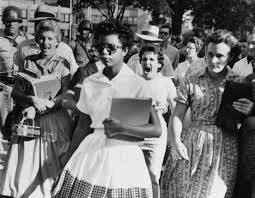
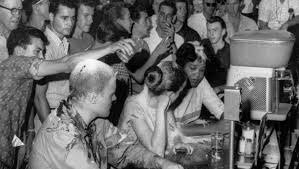
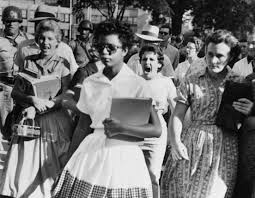
I’ve been thinking about this picture:
Those faces, contorted in rage, caught for history. This picture, reflecting a military presence during school desegregation, anticipating, presumably, a violent reaction from the mob, freezes a moment in history. I wonder how those women feel looking back on it. Would they be ashamed to have been part of a mob hurling epithets at this young woman? Would they feel contrition?
That period in history was certainly turbulent. Fraught with animosity directed at those seeking an education, because of the color of their skins, the women in the crowd wear their anger and hate openly in their faces.
We too are in turbulent times. Whole industries are churning out content intended to divide us, to make us hate others like the women in this picture? We are fed misinformation and disinformation designed to further these divides. Presumably the motive for this hate industry is profit, but at what expense? Will this hate-filled rhetoric cost souls?
It will certainly try them, and it is our job to protect our souls. To listen deep to the wisdom that seeks love and peace, harmony and cooperation. To deplug from the constant rhetoric of othering and hate.
It’s a loud angry world. Hush and listen to the harmony of your soul.
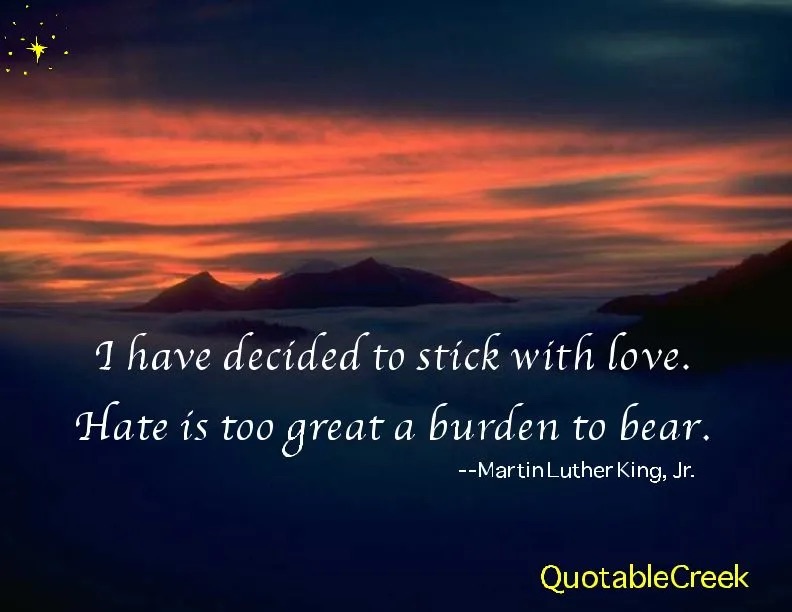
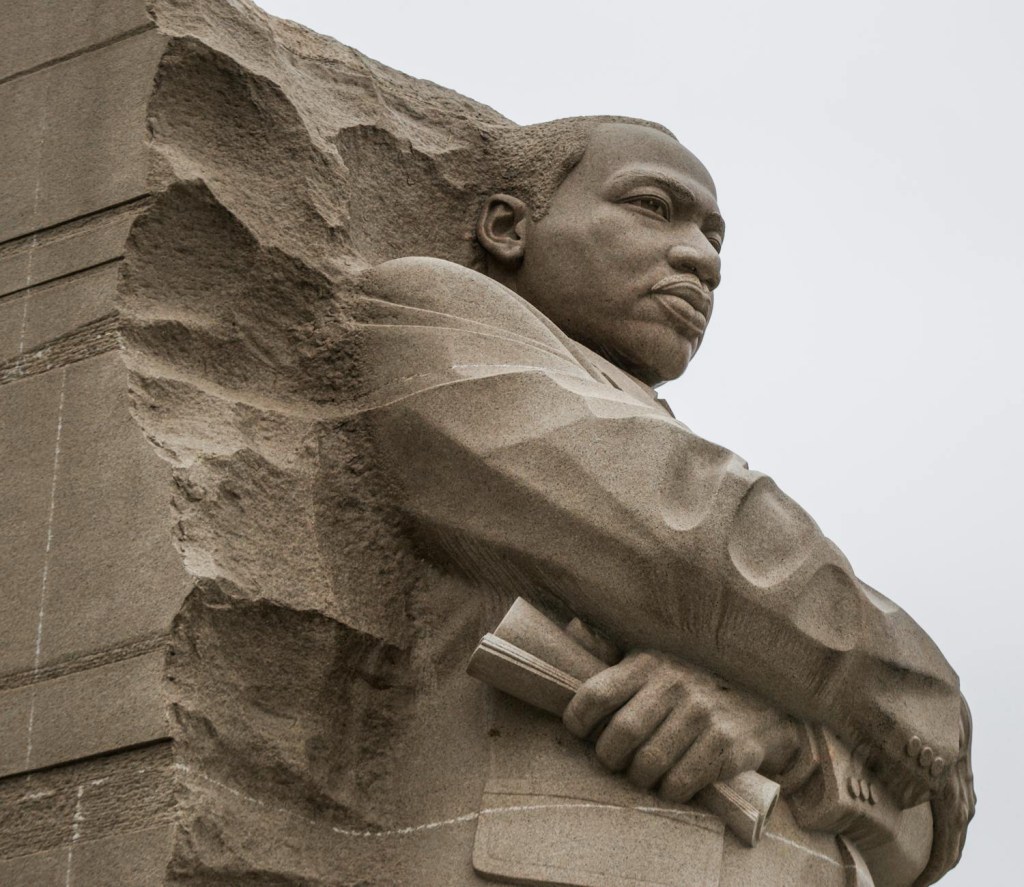
Today is Martin Luther King, Jr. Day. Also Inauguration Day. When we picture King, we picture him as heroic, confident, strong. And these are likely the pictures you may see today.
And, of course, he was these things. Championing civil rights and railing against injustice, able to see inequity in the systems around him and dream of a better way. He was an advocate of love over hate and peaceful protest.
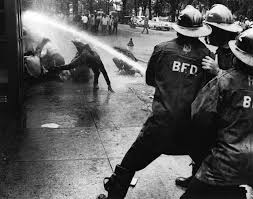
And yet, his life was not a peaceful one. He was killed for the beliefs he professed. And much of the progress he made was met with violence and hate.
Progress is not a straight line, and hate is ever-present. And hate can be powerful and beguiling and intimidating. And hate can creep into the consciousness of a group, or even a nation.
And yet, I will stand with King for love over hate, all these years later, and do what I can to continue his fight for justice and peace.
Because, even in the midst of hateful people and those who seek to divide, justice and truth are on the right side of history.
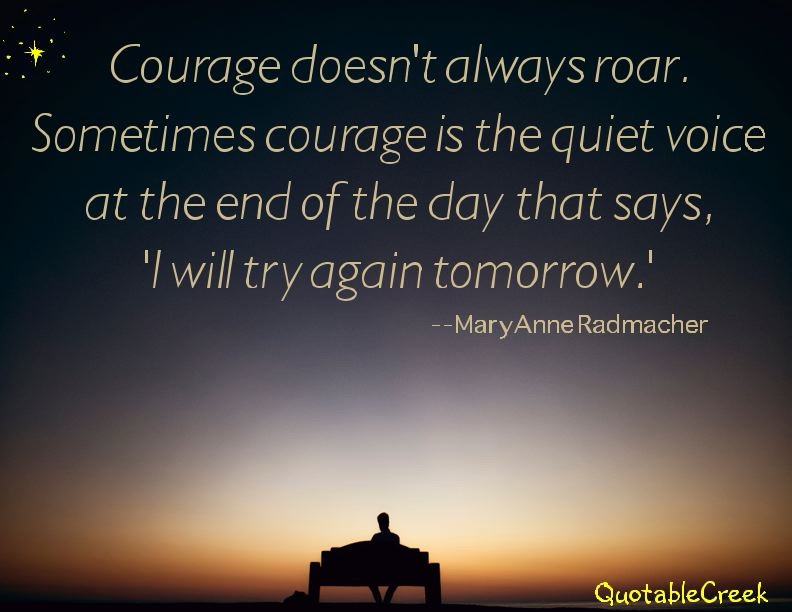
What is worth fighting for? Sometimes a battle is won in a courageous show of strength and derring do. A fireman runs into a burning building to save a child. A passerby stops to help victims of an accident. A pilot steers a damaged plane to safety.
But sometimes the battle requires showing up time after time with love, kindness, and patience. Not giving up on someone. Having faith that love will win. Believing that relationships can be salvaged.
So much of our suffering is invisible. Loneliness, sorrow, depression, not fitting in. We can bind up our own cuts and scrapes, but how do we bind up those kind of wounds?
There is an old parable about heaven and hell. In both, people are forced to eat with spoons that are too long to feed themselves. In hell, they are starving. In heaven, they feed each other.
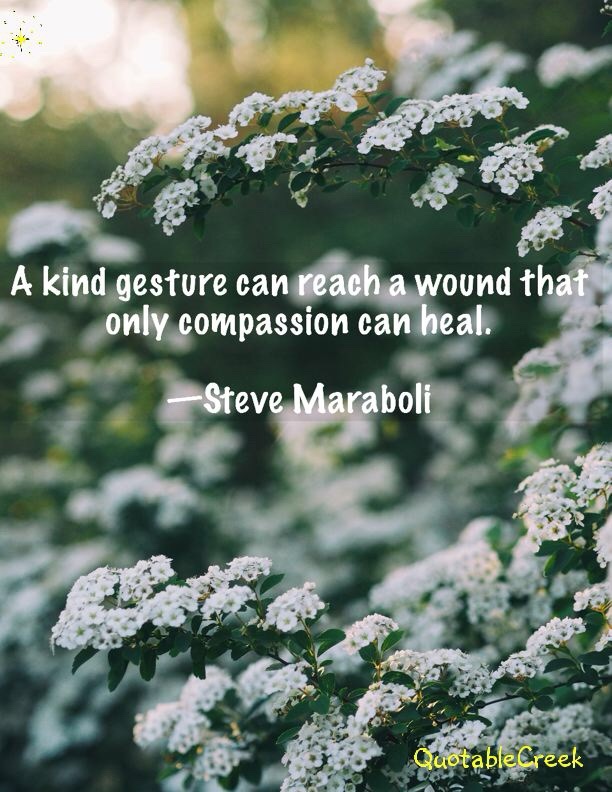
When it comes to these invisible hurts, we are healed by kindness, one to another. We don’t know when we are being kind that it may help someone, but it certainly can’t hurt. And it may be just the long-spooned nourishment that someone else needs.
To inspire acts of kindness today, watch this video of a poor baby elephant stuck in a muddy hole. The gratitude its mother shows its rescuers will melt your heart.
All we face now can feel overwhelming. It’s as if everywhere you turn, there is another challenge and another threat. And yet, even if the midst of all that is wrong, there are opportunities to shine the light, to be a voice for good, and to support others. Yes, it looks bleak now, but we are still here to do some good:
“Yes, it looks bleak. But you are still alive now. You are alive with all the others, in this present moment. And because the truth is speaking in the work, it unlocks the heart. And there’s such a feeling and experience of adventure. It’s like a trumpet call to a great adventure. In all great adventures there comes a time when the little band of heroes feels totally outnumbered and bleak, like Frodo in Lord of the Rings or Pilgrim in Pilgrim’s Progress. You learn to say ‘It looks bleak. Big deal, it looks bleak.’” — Joanna Macy
What questions do we frame for ourselves at the end of the day? What are the questions that have caused us to soul-search and perhaps take a new path? What questions have forced you to look at something a different way?
Sometimes the questions are more important than the answers. There are some that resonate so deeply with us, we may spend a lifetime trying to answer them. In her piece about the beauty of these profound questions, Karen Horneffer-Ginter identifies some that have been meaningful to her:
When used properly, questions have the potential to connect us to the world of another. A heartfelt “How are you?” or “How was your day?” can become the bridge that keeps us in relationship to the lives of those we love. Sometimes, too, questions create a bridge within ourselves, allowing us to hear what’s going on at a deeper level. We know when we’ve encountered a question that has this potential because it stays with us — maybe for the day, maybe for our whole lives. It taps us on the shoulder to wake us up, or it wiggles its way in more deeply, opening us up to seeing things in a new way.
I still recall first encountering Judith Duerk’s chorus of questions about how my life might have been different if there had been a sacred circle to step into. Mary Oliver asking me about my plans for this one wild and precious life, Oriah Mountain Dreamer wanting to know what I ache for and if I dare to dream of meeting my heart’s longing, and Angeles Arrien reminding me of the questions asked in some indigenous cultures: When did you stop singing? When did you stop dancing? I think of my friend Ming, asking me at lunch one day if I thought writing was my fullest and truest expression. All these questions have remained close companions across the years.
The questions that have been consuming my thoughts and are my close companions these days are What does it mean to be welcoming? How does welcome look? How does it change the mix if it is accepted? What are the stumbling blocks to be truly welcoming? Where does fear creep in to inhibit welcome? How will my life be different because I have welcomed another into it? How will it disrupt my comfort zone, and how will I get my ego out of the way to be more accepting?
What are the questions in your heart, questions that are your close companions? And just the framing of those questions can be significant, as she suggests above. Consider the difference between ‘What do I have to do today?’ and ‘What do I get to do today?’ That simple shift helps us move from feeling burdened to being grateful for all the opportunities presented by the day.
What are the questions that have been your close companions? What do you get to do today to help answer them?



 QuotableCreek.com