Word clutter

I’m not a fan of clutter. I’m also quite challenged to part with stuff. It’s a problem. Like some people avoid carbs or sugar, I avoid ‘collecting’ because I know, given my propensities, it will lead to clutter. But there are many things that are clutter-free that I love to collect. Among these are words. Words are just so delightful— the sound and smack of them, their history, their aptness for a particular purpose.

One of my favorite bits of writing advice is to collect words that might fit for the time and place of your story.

In The Writer’s Portable Mentor, Priscilla Long writes:

The writers of deep and beautiful works spend real time gathering words. They learn the names of weeds, and tools, and types of roof. They make lists of color words (ruby, scarlet, cranberry, brick). They savor not only the meanings, but also the musicality of words. They are hunting neither big words nor pompous words nor Latinate words but mainly words they like. They are not “improving their vocabulary” or studying for the SAT or the GRE. They are not trying to be fancy or decorative. This is a different kind of thing.

She suggests keeping a journal of these words and going on quests to capture more:

HANDS ON: MAKE YOUR OWN LEXICON
Buy a small bound and sewn blank book, with fine paper. This is your Lexicon.
Put in words you like, words that strike your fancy, words you want to own. I suggest giving each word half a page. Put in the word _ lickspittle – and draw a horizontal line dividing the page in half. This way you can put in a word and look it up later. (Under lickspittle write: a contemptible, fawning person; a flatterer or toady.) You will end up with two words per page.
This is not a typical vocabulary list full of horrible Latinate words you don’t know and don’t want to know.
The rule is, put in only the good words, the juicy words, the hot words. From time to time, savor this book. Look up words you’ve put in (something from your reading) and haven’t looked up yet. Be sure to investigate the root. Put in familiar words along with new words. Play with sounds right in your Lexicon: kitchen matches; cord/weird/word/ fired/turd.
From time to time read a big dictionary hunting for a new good word, any word that strikes your fancy: galoot.
On some pages make word lists. Fiddle parts – peg box, button, side rib, bridge. Words for blue – cobalt, woad, sapphire, smalt. Words from an art exhibition you especially loved – bone, tin plate; cotton, cord, silk ribbon, silver, galloon; coconuts, shells, ostrich eggs (from
Moscow Treasures).
Put down things you don’t know the names of. Do you know the parts of a window? (Muntin? Sash?) Do you know the parts of a rocking chair? Draw or describe the thing in your Lexicon and then set about looking (in a book on house repairs or on furniture) for splat or spindle or stile. Do not order your list in any way.

She goes on to discuss making a word trap to fit the piece you are working on, the musicality and derivation of words, the vowel scale, and all sorts of other intriguing ways to add nuance, accuracy, and lilt to your piece. Hers is one of my favorite craft books, of which I have dozens. (See above about my hoarding propensities.)

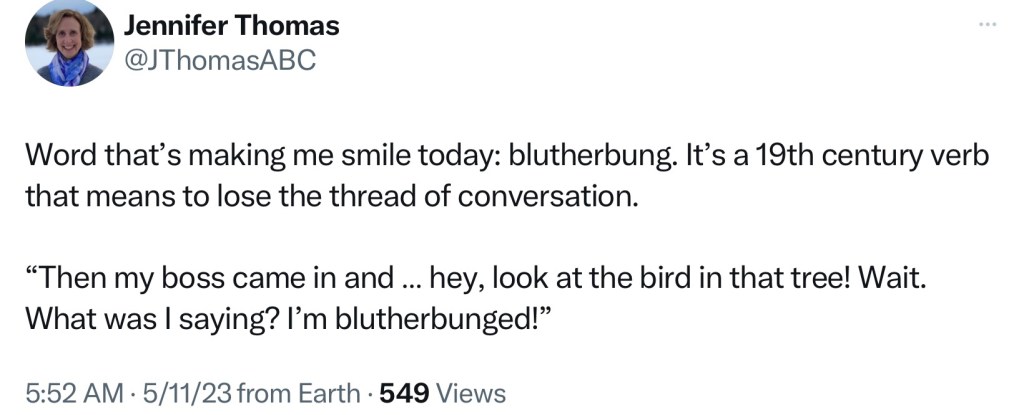
But this intro brings me to my joy for the day. I discovered someone on Twitter who shares this love of words, who posted a word for the day. It’s blutherbung, an appropriate word for me these days as it turns out.
And then I looked at her feed and found another
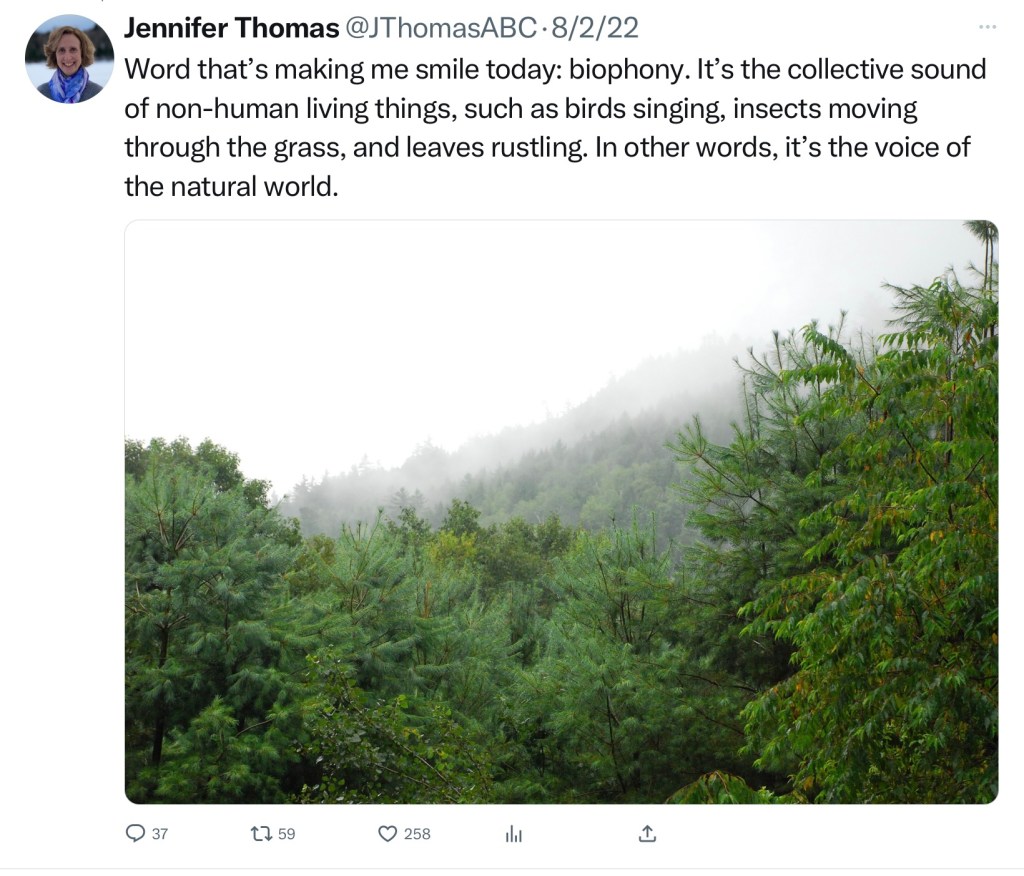
Lickspittle, blutherbung, biophony. Aren’t these just wonderful? who do you suppose thought these up, studying human nature or the natural world and coming up with just the word to describe that particular confluence of traits? And now I’ve subscribed to her feed to get these delightful tidbits each day.

As you can probably guess, another thing I collect is quotations. I have a little book to jot them as I’m reading an article or book. I periodically look through this little book and write my thoughts about them. Which is what brought me here to writing Quotable Creek.

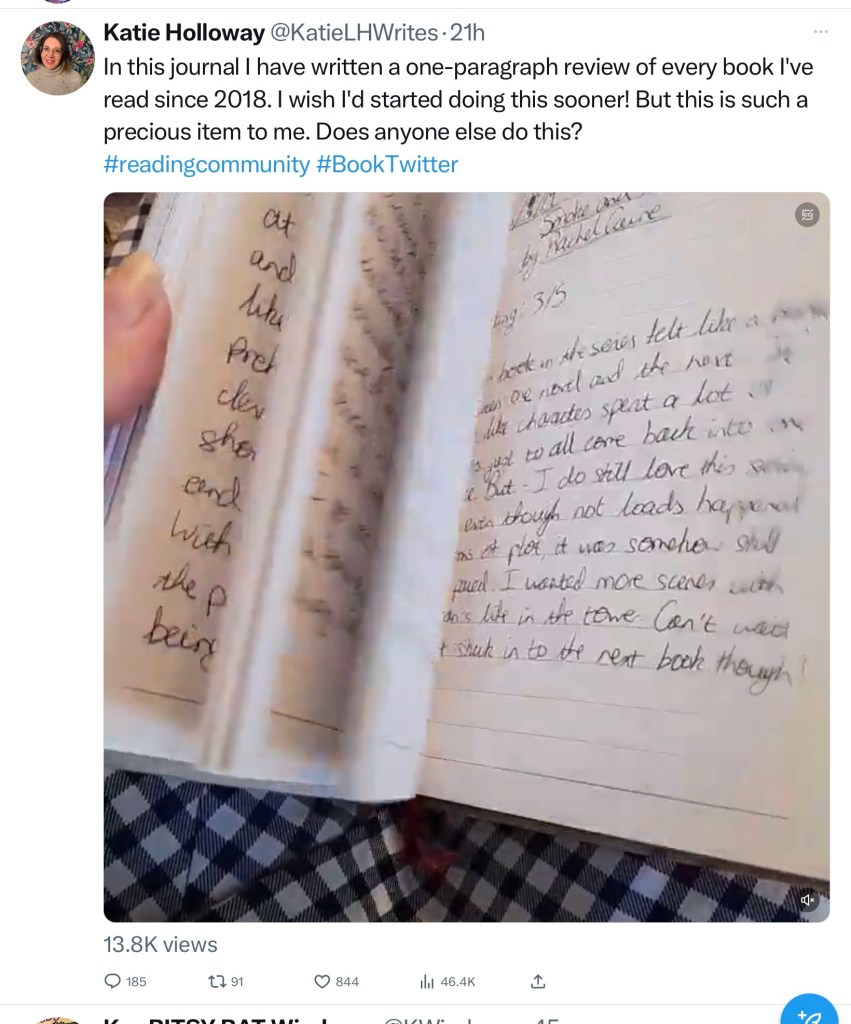
Another thing I ‘collect’ is gratitudes. I write the things I’m thankful for in a gratitude journal, to keep them and remember those moments. My next thing I’m thinking of to collect is book impressions. I read quite a bit, but get blutherbunged and forget about them. Perhaps keeping a little thought about each will bring them back to me. It’s another thing I found on Twitter. Probably when I was reading from the word lady’s thread.
God winks

Often, when we look back at our lives, we will see strange coincidences that came at meaningful times in our life. That person you met, show you watched, book you read, something you overheard that serendipitously was just what you needed in that moment. My pastor calls these God winks. It feels like someone is watching over you and caring.

Of course, these could be just coincidental. But they are important, pivotal, coincidences.

Emma Thompson puts it this way:

I think books are like people, in the sense that they’ll turn up in your life when you most need them. After my father died, the book that sort of saved my life was Gabriel García Márquez’s novel One Hundred Years of Solitude. Because of that experience, I firmly believe there are books whose greatness actually enables you to live, to do something. And sometimes, human beings need story and narrative more than they need nourishment and food.

Emma Thompson in @oprah’s O Magazine.

The most important thing is having the eyes to recognize the impact and the willingness to be open to change and growth.

God winks are everywhere if you develop the eyes to see them.

With friends beside you.

I recently read the book, Remarkable Bright Creatures by Shelby Van Pelt with my book club. It is a wonderful book of, among other things, the friendship between a 70-year old widow and a giant Pacific octopus. The main character has her own group of friends who have been together for decades and call themselves the Knit-wits because they started with knitting in common.

One of my book club members, the youngest (as she often reminds us) asked at our meeting, “Are we the knit-wits?” I smiled. I have known this group of friends for decades. We raised our children together and now are delighting in grand parenthood together. We’ve weathered storms together, celebrated each other’s victories, and helped each other through loss. We meet religiously every week to catch up with each other. What a delight it is to have ‘through thick and thin’ friends.

I found this sweet friendship poem I offer here to them.

A Friend

A person who will listen and not condemn
Someone on whom you can depend
They will not flee when bad times are here
Instead they will be there to lend an ear
They will think of ways to make you smile
So you can be happy for a while
When times are good and happy there after
They will be there to share the laughter
Do not forget your friends at all
For they pick you up when you fall
Do not expect to just take and hold
Give friendship back, it is pure gold.

Gillian Jones

Thankful for the whole everything.

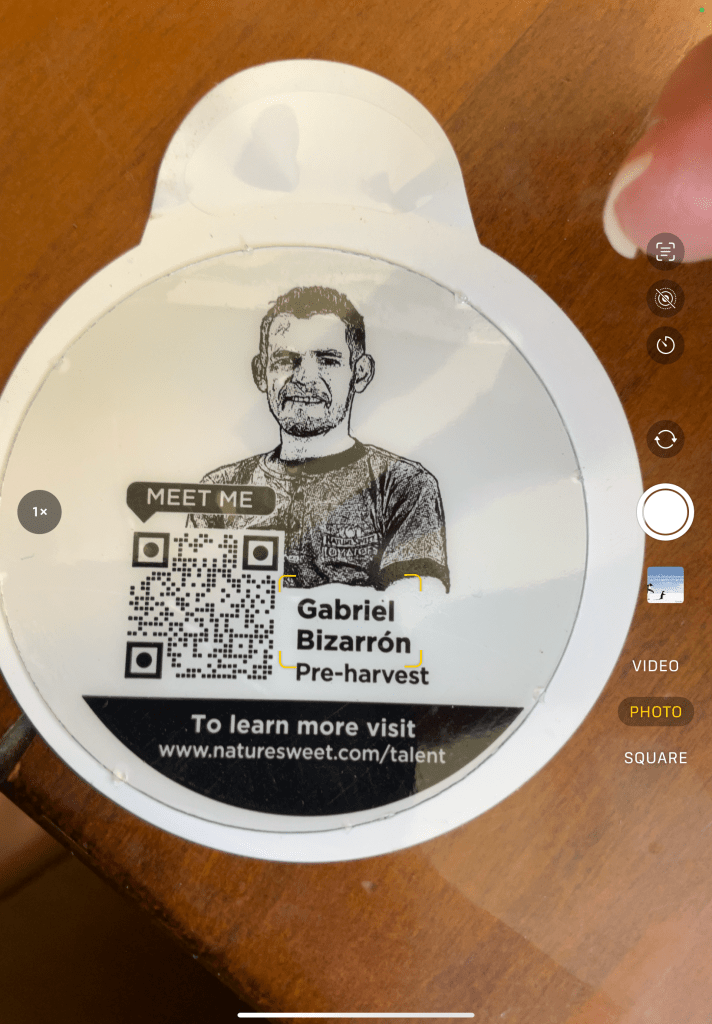
Yesterday, I was minding my business, making a quick salad for lunch. As I peeled the sticker top off the little plastic tub of cherry tomatoes, I was caught by surprise. On the back of the sticker was a picture of a man and a scan code to learn more about him.

It turns out Gabriel Bizarrón helps to make sure my tomatoes are bug free and have the right nutrients, He is working toward a degree in agribusiness. Gabriel is one of the many people responsible for helping me have a delicious healthy lunch, and I’m thankful for him.

Which got me thinking about all the other people in the chain of bringing these tomatoes to my belly, and there are so many. Stopping and imagining all the hands and minds that went into bringing my meals into existence, and being grateful for each of them, was quite a fun exercise. There are so many! What a wonderful invisible web of people there are behind the scenes to bring each of us food, clean water, electricity, and so on. Not to mention being grateful for businesses, like this and like Snapple with their hidden quotes, that take time to make their packaging inspirational. It is staggering once you start thinking about it, and really no end in sight, because each ‘thankful for’ leads to another, infinitely.

What a wonderful world!

Our last chance to be alive.

Now is our time to be alive. It will not come again. This is our last chance to savor nature and all of its wonder, to spend time with loved ones, to do good, to spread joy. This is it. This is our opportunity.

In the movie, Michael, an angel comes to Earth to influence the course of events. He, apparently, smells of cookies. But there is a scene, after ‘battle’ (he’s that kind of angel), when he is savoring the day. He is soaking it in, just enjoying being corporeal, waltzing with the breeze.

If only we could hold on to that wonder, awe, and appreciation, live in the moment, truly appreciate all we’ve been given here. What a fine world that would be.

A simple prayer

People have always told stories. Plopped down on this earth with so much beyond our understanding, we struggle to make sense of things, to find cohesion and purpose, and to fit. We long for meaning outside of our circumstance and kinship beyond our borders.

Stories help. They comfort and guide us, inspire and warn, and make us feel less alone. Others feel the way you feel. And, at the root of story, is a turning away from ourselves toward something greater.

My book GERTIE, THE DARLING DUCK OF WWII, was just released. It tells the non-fiction story of a time during WWII when things were bleak, hopes worn raw, when a little duck built her nest on a high pole above a foul river. A hopeless place, really, for keeping the ducklings alive. Yet, the city of Milwaukee rallied around this little duck and saved her brood. Stories about Gertie’s struggles captured the attention of the entire world, comforted soldiers overseas, and gave everyone a glimpse of a better day. Stories about Gertie shared the front page with stories about Hitler, kamikaze pilots, and concentration camps.

For me, Gertie’s story will always be an embodiment of Psalm 91:4, “He will cover you with his feathers, and under his wings you will find refuge; his faithfulness will be your shield and rampart.” To me, her story feels like a message of hope in the darkest of times, a prayer and response.

At heart, most stories are a prayer—a way of reaching for something more, a hope, a yearning, a plea. Stories help connect us and give us peeks behind the curtain.

Most this amazing day.

There are some poems that reach so deep, they become part of us that we can call up by heart. This is one for me, ‘I thank you God for most this amazing day’ is a phrase never far from my mind. Something about the inverted syntax seems to sum up that overwhelm, spilling over feeling of joy at creation, at being here in it, at the amazing miracle of it all.

Enjoy the whole poem. It’s spectacular.

i thank You God for most this amazing
day:for the leaping greenly spirits of trees
and a blue true dream of sky;and for everything
which is natural which is infinite which is yes

(i who have died am alive again today
and this is the sun’s birthday;this is the birth
day of life and of love and wings;and of the gay
great happening illimitably earth)

how should tasting touching hearing seeing
breathing any—lifted from the no
of all nothing—human merely being
doubt unimaginable You?

(now the ears of my ears awake and
now the eyes of my eyes are opened)

e.e. cummings

And for a real treat, here it is sung:

Happy spring!

Favorite things.

When you get a group of kids together, and ask them their favorite color, there is always that one kid who picks rainbow. I admire this kid.

I was never this kid.

I’ve always played by the rules, even if it caused me tons of angst trying to somehow weigh my fondness for the blue of a cloudless summer day, or the lavender of a jacaranda tree, or buttercup yellow, or soft blush pink. How do people pick these kind of things? Favorites?

But the rainbow kid stretches his arms wide and says, ‘I’ll pick them all, all the colors of the rainbow.’ This kid embraces color, life, variety, and has little concern with limits and rules. Gusto. Zest. Vibrancy. These are the attributes of this kid.

I hope, but cannot confirm, that I wasn’t the kid who told him to pick just one. Who told him rainbow wasn’t a color, and that picking rainbow was like picking infinite wishes from a genie. Against the rules. Or that kind of teacher for that matter. Because sometimes we are meant to throw our arms wide and say, ‘All of it. I love all of it. Color itself. How wonderful we live in a world of color.’

(I’ve settled in on answering periwinkle because I adore that color, it was my grandmother’s favorite color, and I adored her, and it has a wonderful sounding name that tickles me.)

Counting not months but moments.

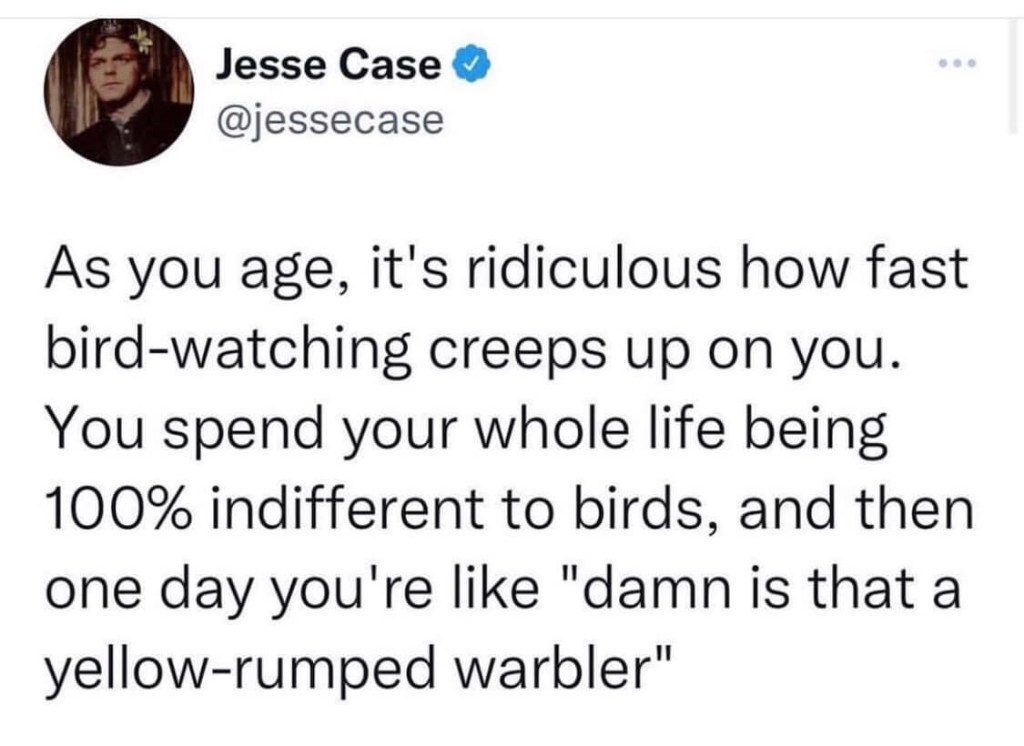
Some of my friends and I are noticing our interests shift these days. This tweet sums up the phenomenon perfectly.

And it’s not just birds, but the weather, the garden, the laugh of a child. The little moments bear a new luster. And of course it makes sense. As our lives are rushing by in our younger years, the little things can get lost. We always will have the time to stop and look, to smell the roses, we reason, so we put it off. But as we feel our time here becoming more finite, our attention hones. We pause. We marvel. We are constantly astonished.

As it turns out, this experience isn’t so much a reflection of our age as it is our perception of time. When we feel time vast, spreading out before us, our focal point is on the future, but when we feel a possible end to our time here, our attention draws close and we appreciate the little things. So even someone young facing death will have this urge to stop and soak in the little things.

In his book, Being Mortal; Medicine and What Matters in the End, Atul Gawande summarizes research on this experience:

“…how we seek to spend our time may depend on how much time we perceive ourselves to have. When you are young and healthy, you believe you will live forever. You do not worry about losing any of your capabilities. People tell you “the world is your oyster,” “the sky is the limit,” and so on. And you are willing to delay gratification—to invest years, for example, in gaining skills and resources for a brighter future, you seek to plug into bigger streams of knowledge and information. You widen your networks of friends and connections, instead of hanging out with your mother. When horizons are measured in decades, which might as well be infinity to human beings, you most desire all that stuff at the top of Maslow’s pyramid- achievement, creativity, and other attributes of ‘self-actualization,” but as your horizons contract—when you see the future ahead of you as finite and uncertain—your focus shifts to the here and now, to everyday pleasures and the people closest to you.”

Being Mortal: Medicine and What Matters in the End, by Atul Gawande

But our ‘knowledge’ of the time we have is far from certain. Sometimes our belief we will always have another day keeps us from appreciating the days we have. Practices like mindfulness and meditation, reading poetry, help ground us in the present so we can capture those moments, but it’s difficult to keep our own mortality enough in our consciousness to really grasp the preciousness of each moment.

In the play, Our Town, by Thornton Wilder, the lead character Emily, a young woman who loses her life early in childbirth, is given the opportunity to revisit one day in her life, and she sees it all with new eyes:

Emily: Oh, Mama, look at me one minute as though you really saw me. Mama, fourteen years have gone by. I’m dead. You’re a grandmother, Mama! Wally’s dead, too. His appendix burst on a camping trip to North Conway. We felt just terrible about it – don’t you remember? But, just for a moment now we’re all together. Mama, just for a moment we’re happy. Let’s really look at one another!…I can’t. I can’t go on.It goes so fast. We don’t have time to look at one another. I didn’t realize. So all that was going on and we never noticed. Take me back — up the hill — to my grave. But first: Wait! One more look. Good-bye , Good-bye world. Good-bye, Grover’s Corners….Mama and Papa. Good-bye to clocks ticking….and Mama’s sunflowers. And food and coffee. And new ironed dresses and hot baths….and sleeping and waking up. Oh, earth, you are too wonderful for anybody to realize you. Do any human beings ever realize life while they live it–every, every minute?
Stage Manager: No. (pause) The saints and poets, maybe they do some.
Emily: I’m ready to go back.”

Our Town, by Thornton Wilder

Today is that day, a day for us to realize life while we’re living it, every, every minute as much and as best as we can.

Praying our way into gratitude.

There are as many ways to pray as there are people praying. But what is it, exactly? Maybe it’s easier to answer what it isn’t: a flamboyant show, a chance to pose and preen publicly, a subterfuge, a droning recitation of memorized but not considered words.

What prayer actually is, though, is more complicated: a bridge between ourselves and the mysterious, a chance to become small, and yet fully individual, in a vastness, an experience of awe. Mary Oliver’s definition above in her poem Praying is lovely: a doorway into thanks. Consider the whole poem:

Praying

It doesn’t have to be

The blue iris, it could be

Weeds in a vacant lot, or a few

Small stones; just

Pay attention, then patch

A few words together and don’t try

To make them elaborate,

This isn’t a contest but the doorway

Into thanks, and a silence in

Which another voice may speak.

Pay attention; see the beauty around you; give thanks. Rinse and repeat.