A work-out routine for character.

In her book Almost Everything, Anne Lamott describes her struggle with hate:

Hate weighed me down and muddled my thinking.  It isolated me and caused my shoulders to hunch, the opposite of sticking together and lifting our hands and eyes to the sky.  The hunch changes our posture, because our shoulders slump, and it changes our vision, as we scowl and paw the ground.  So as a radical act we give up the hate and the hunch the best we can.  We square our shoulders and lift our gaze….

Hating the way I was feeling helped me give up Camel cigarettes thirty-two years ago, and then alcohol.  It is good to surrender things that poison us and our world.  Am I free of such toxicity now?  Well about forty percent, and that is a pretty good deal.  I’ll take it.”

She now considers the circumstances and people pushing her to hate as helpful weight-training equipment to build muscles in her soul, ‘Nautilus equipment for your character.’

That’s a helpful perspective shift, isn’t it?

Praying with the news.

How do we read the news and not get overwhelmed or angry, disconnected or depressed? How do we keep showing up with compassion and grace in a world where there is so much hate? How do we keep ourselves on the right path through the midst of it all? How do we continue to show up from a place of compassion, forgiveness, and grace? how do we keep our hearts from growing hard?

In this thoughtful letter, Rabbi Yael Levy shares his insights on how to pray with the news:

The 17th of the Hebrew month Tammuz initiates a three-week period of mourning that leads to Tisha b’Av, which is the day that marks the destruction of the Temples in Jerusalem in 586 BCE and 70 CE.

Tradition teaches that the Temple was destroyed because hatred became the operating principle in the community. The scorn, contempt and disdain that characterized daily interactions caused the Divine Presence to flee and leave the Temple vulnerable to attack.

These next three weeks ask us to reflect on the hatred that we allow to take root in our hearts. The wisdom of the tradition acknowledges that hatred can sometimes feel energizing and “so right,” but allowing it to fill our bodies and guide our actions leads to destruction.

Many years ago I was taught the practice of praying with the news. I have shared it over the years and always find myself returning to it during this season.

In this practice, each time we read or listen to a news report that enrages us, we turn our attention to those harmed by what is happening and pray for their healing and well-being. Doing so encourages us to acknowledge feelings of anger, grief and despair, and at the same time it turns our attention toward connection and compassion. Praying with the news can help us learn to bear witness to devastation and mayhem, while keeping our hearts soft, our minds calm, and our actions clear.

I am struggling mightily with this practice these days in the wake of continued violence and oppression in this country and throughout the world. Hatred can sometimes feel like such a welcome harbor. Not only does it feel so right, it can also act as a shield, creating the illusion that I don’t have to acknowledge the grief and heartbreak I am experiencing.

I need practices to help quiet the rage and fear, to loosen the constriction of hatred and to help me be with overwhelming grief. I need practices to help me return to compassion, love, joy and possibility. I find praying with the news both painful and helpful. It keeps me connected, allows sorrow, and grounds me in care and love.

Weekly reading from the Awakin.org newsletter.

Who are you on the internet?

cat

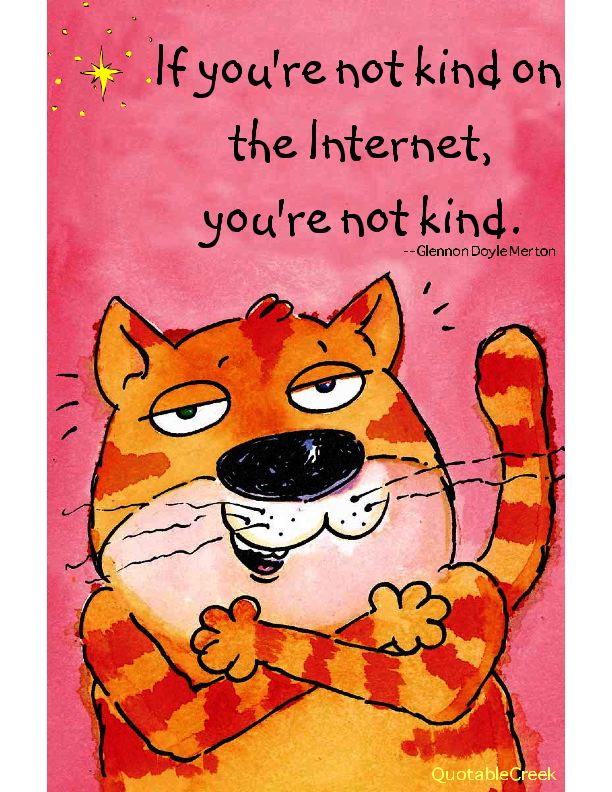
How do you behave when you can be completely anonymous? The internet can shield us from face-to-face contact, and for many people that can lead to snark….or worse. As Glennon Doyle Merton points out, the internet itself is neutral. We bring to it what we are. We get out of it what we seek:

The internet is neither good nor bad. It’s neutral—it becomes for each of us exactly what we bring to it. In our real life and our internet life, we live inside whatever we build. Since we are spending more and more of our lives online, our internet selves must be decent, courageous healers so we can inhabit communities of tolerance and humanity.

Here are a few gut checks:

1. Remember, you are what you post.
Integrity means there is not a real-life you and an internet you. The two are one and the same. If you’re not kind on the internet, you’re not kind.

2. Post with intention.
Before you hit send, ask yourself: Why am I sharing this picture, meme, idea, article? Is your true motivation to spread joy, encourage, enlighten, teach? Or is it to brag? To shame someone? If your intention is pure, then the response will be, too.

3. Dispense compassion.
When people express opinions that differ from yours, take it as a chance to grow. Seek to understand over being understood. Be curious, not defensive. The only way to disarm another human being is by listening.

For those of us with Facebook feeds who follow sites other than just friends and family, we can choose whether we follow fake news or hateful sites. Instead, we can choose sites that help expand our knowledge and compassion. Our feeds are like gardens we can choose how to plant.

And we always have a choice of whether we want to pass on snark, or hate, or false information, or sarcasm. Whether we want to pile on a mob mentality of attack and destruction.

We can choose to make our responses to other people’s posts measured and kind, to rely on facts rather than innuendo, and to simply not respond. We can help build the type of world we want to see, right here on the internet.