Speaking to graduating law students, Julian Aguon said
No offering is too small. No stone unneeded. All of us – whether we choose to become human rights lawyers or corporate counsel, or choose never to practice law at all but instead become professors or entrepreneurs or disappear anonymous among the poor or stay at home and raise bright, delicious children – all of us, without exception, are qualified to participate in the rescue of the world.
And this is true for any profession, calling, or vocation. We each matter. We each contribute to the mix. We each are qualified to rescue this world.
In any time in history, including our own in which we now find ourselves, some individuals stand apart from the crowd on behalf of what is right. Their example inspires others from that moment forward in time.
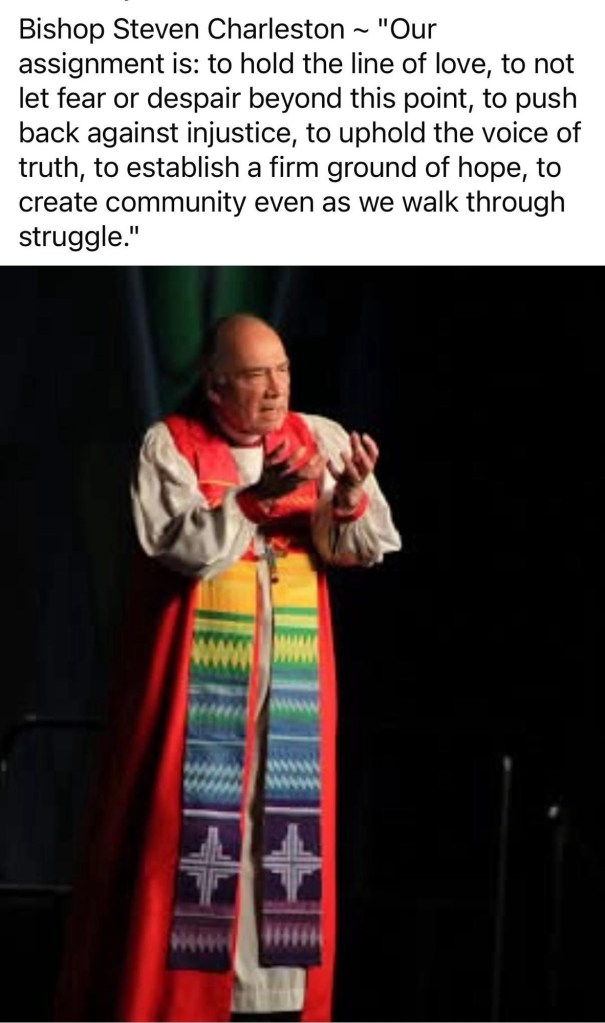
What is our job in these troubled times? During any times, but particularly during times where we are seeing peoples’ rights eroded and trampled, when legal safeguards are flouted, and when authoritarianism is on the rise, our job is to hold the line. Continue to be a place of comfort and succor to the hurting, feed the hungry, grieve with the mourning.
The Japanese Macaques, snow monkeys, are a deeply hierarchical society, their status in the group inherited from their mothers. Living in frigid temperatures, the upper class snow monkeys spend their time in natural hot springs, leaving the rest to huddle in the snow and look on as they luxuriate. The Emperor Penguins also live in frigid conditions, huddled together, but they constantly rotate, letting those most exposed on the outside come to the center for warmth. They take turns. It keeps those in the center from overheating and those on the fringes from freezing.
Sharing is an interesting phenomenon. It’s easy to see that when a society shares its resources, the whole group benefits, but how does that play out in the human species? Do we see the benefit to the whole group from sharing what we have, or do we focus on clutching more and more into our own fists? Some humans are uniquely able, it seems, to rationalize selfish behavior even when looking directly at the needs of others. But others consider their own resources an opportunity to help others. This is true both on an individual level, and on a larger societal level. It’s an interesting matter of perspective.
Friendships are taking a hit these days. Politics, world views, differing opinions are tearing people apart.
What is it that holds people together instead?
One thing is an abiding concern for the other person, despite your differences. If you can advocate against the death penalty on behalf of a stranger, couldn’t you bring yourself to see what is good and redeemable inside a former friend? Inside an enemy even? Searching for common ground is hard work, but really the main point of living in community. Isn’t it?
I was recently reminded about a story from 2017 where two little boys were caught in a rip tide and swept out to sea. Their entire family and four woud-be rescuers tried to swim out to save them but ended up similarly stranded. Officials on shore stood, helpless, waiting for a rescue boat while the family and would-be rescuers floundered.
But then the people on the beach did a remarkable thing. People from all walks of life, across every possible difference or division, linked arms together and formed a human chain stretching out into the ocean until they reached those stuck and and then passed them person to person, beginning with the little boys, Noah (11) and Stephen (8), and ending with their grandmother who had tried to save them, back to safety.
Stories like this don’t get a lot of press. But it’s why we’re here.
What makes some people able to empathize more than others, able to help in dire circumstances, able to put the greater good above the personal good? Bryan Stephenson, founder of the Equal Justice Institute, fierce advocate against systemic racism, and criminal defense attorney for those on death row explains: “I do it because I’m broken, too.” That recognition of a common humanity and brokenness by a system that needs changing propels him to fight.
Who among us isn’t broken? Because we all are bound together, we all suffer in an unjust world. Because we all have known pain, we all have the capacity to put ourselves into the shoes of those hurting.
In his book, Just Mercy, Stephenson explains:
My years of struggling against inequality, abusive power, poverty, oppression, and injustice had finally revealed something to me about myself. Being close to suffering, death, executions and cruel punishments didn’t just illuminate the brokenness of others; in a moment of anguish and heartbreak, it also exposed my own brokenness. You can’t effectively fight abusive power, poverty, inequality, illness, oppression, or injustice and not be broken by it.
We are all broken by something. We have all hurt someone and have been hurt. We all share the condition of brokenness even if our brokenness is not equivalent. I desperately wanted mercy for Jimmy Dill and would have done anything to create justice for him, but I couldn’t pretend that his struggle was disconnected from my own. The ways in which I have been hurt–and have hurt others–are different from the ways Jimmy Dill suffered and caused suffering. But our shared brokenness connected us.
Paul Farmer, the renowned physician who has spent his life trying to cure the world’s sickest and poorest people, once quoted me something that the writer Thomas Merton said: ‘We are bodies of broken bones.’ I guess I’d always known but never fully considered that being broken is what makes us human. We all have our reasons. Sometimes we’re fractured by the choices we make; sometimes we’re shattered by things we would never have chosen. But our brokenness is also the source of our common humanity, the basis for our shared search for comfort, meaning, and healing. Our shared vulnerability and imperfection nurtures and sustains our capacity for compassion.
We all have a choice. We can embrace our humanness, which means embracing our broken natures and the compassion that remains our best hope for healing. Or we can deny our brokenness, forswear compassion, and, as a result, deny our humanity
…So many of us have become afraid and angry. We’ve become so fearful and vengeful that we’ve thrown away children, discarded the disabled, and sanctioned the imprisonment of the sick and the weak–not because they are a threat to public safety or beyond rehabilitation but because we think it makes us seem tough, less broken. …We’ve submitted to the harsh instinct to crush those among us whose brokenness is most visible. But simply punishing the broken–walking away from them or hiding them from sight–only ensures that they remain broken and we do, too. There is no wholeness outside of our reciprocal humanity.Just Mercy, by Bryan Stephenson
How many of the problems we face today can be mitigated by recognizing our common humanity, by following the Golden Rule of treating others how we would have them treat us, a tenet found in many of the world’s religions? How would we have others treat us if we were the elderly, the sick, the refugee, the hurt, the accused, the other? Each of us would benefit from considering things from this perspective. Bryan Stephenson continues:
Whenever things got really bad, and they were questioning the value of their lives, I would remind them that each of us is more than the worst thing we’ve ever done. I told them that if someone tells a lie, that person is not just a liar. If you take something that doesn’t belong to you, you are not just a thief. Even if you kill someone, you’re not just a killer. I told myself that evening what I had been telling my clients for years. I am more than broken. In fact, there is a strength, a power even, in understanding brokenness, because embracing our brokenness creates a need and desire for mercy, and perhaps a corresponding need to show mercy. When you experience mercy, you learn things that are hard to learn otherwise. You see things you can’t otherwise see; you hear things you can’t otherwise hear. You begin to recognize the humanity that resides in each of us.
…I began thinking about what would happen if we all just acknowledged our brokenness, If we owned up to our weaknesses, our deficits, our biases, our fears. Maybe if we did, we wouldn’t want to kill the broken among us who have killed others. Maybe we would look harder for solutions to caring for the disabled, the abused, the neglected, and the traumatized.Just Mercy, by Bryan Stephenson
We are all broken. Some of us don’t acknowledge that. We have all hurt and been hurt. It is that humbling insight that can help us recognize our common humanity across all divides. If we just have the eyes to see and the ears to hear. Stephenson refers to an unnamed pastor who would preface singing: “The minister would stand, spread his arms wide, and say, “Make me to hear joy and gladness, that the bones which thou hast broken may rejoice.”
This week, Pope Francis passed away, and stories are circulating about some of the changes he made in the church and some of his more compelling speeches. Back in 2017, in a surprise TED talk, Pope Francis put in a request for more tenderness in our lives. He stressed that we are all connected:
First and foremost, I would love it if this meeting could help to remind us that we all need each other, none of us is an island, an autonomous and independent “I,” separated from the other, and we can only build the future by standing together, including everyone. We don’t think about it often, but everything is connected, and we need to restore our connections to a healthy state. Even the harsh judgment I hold in my heart against my brother or my sister, the open wound that was never cured, the offense that was never forgiven, the rancor that is only going to hurt me, are all instances of a fight that I carry within me, a flare deep in my heart that needs to be extinguished before it goes up in flames, leaving only ashes behind.
Many of us, nowadays, seem to believe that a happy future is something impossible to achieve. While such concerns must be taken very seriously, they are not invincible. They can be overcome when we don’t lock our door to the outside world. Happiness can only be discovered as a gift of harmony between the whole and each single component. Even science – and you know it better than I do – points to an understanding of reality as a place where every element connects and interacts with everything else.
The Pope suggested tenderness for bridging the divides that separate us:
And what is tenderness? It is the love that comes close and becomes real. It is a movement that starts from our heart and reaches the eyes, the ears and the hands. Tenderness means to use our eyes to see the other, our ears to hear the other, to listen to the children, the poor, those who are afraid of the future.To listen also to the silent cry of our common home, of our sick and polluted earth. Tenderness means to use our hands and our heart to comfort the other, to take care of those in need….
Yes, tenderness is the path of choice for the strongest, most courageous men and women. Tenderness is not weakness; it is fortitude. It is the path of solidarity, the path of humility. Please, allow me to say it loud and clear: the more powerful you are, the more your actions will have an impact on people, the more responsible you are to act humbly. If you don’t, your power will ruin you, and you will ruin the other. …
The future of humankind isn’t exclusively in the hands of politicians, of great leaders, of big companies.Yes, they do hold an enormous responsibility. But the future is, most of all, in the hands of those peoplewho recognize the other as a “you” and themselves as part of an “us.” We all need each other. And so, please, think of me as well with tenderness, so that I can fulfill the task I have been given for the good of the other, of each and every one, of all of you, of all of us. Thank you.
As we grieve, Pope Francis, let us heed his words. The future is in our hands. Can we think of and treat each other with tenderness? Do we recognize that we are all part of an “us”?
We are all masterpieces, really. Works of art of exquisite complexity and beauty. Marvels. But we forget and get sidetracked by external things—success, age, worldliness. But it’s worth remembering.
Maybe you’re older, or weaker, or not quite as sharp as you used to be. Maybe your energy is fading, or you’ve gotten depressed and overwhelmed. Maybe all your ducks aren’t in a row, and all your bells don’t ring. Maybe you don’t think you can make a difference.
It is in just such times that you must press on. Your gifts are needed. The world doesn’t need you to be perfect; it needs you to show up.
Sonder. A made-up word for a very real emotion. In his Dictionary of Obscure Sorrows, John Koenig defines it: “sonder, n. the realization that each random passerby is living a life as vivid and complex as your own.”
It’s a remarkable realization. We are all the stars of our own lives. We have our supporting casts filled with friends and families, maybe a foe or two, and then a whole world of incidental extras to our story. People behind the lit windows or sitting quiet on a shared bus or in some far off country. When we pause, we realize that they, too, have rich and complex stories filled with their own casts of characters. Their sorrows and joys are as real to them as ours to us.
Koenig has created a remarkable video to illustrate this notion of sonder. And his Dictionary of Obscure Sorrows is well worth your time. It is filled with profound insight and wonder.
But what to do with this realization, this feeling of sonder? It creates more than a passing fancy in us, doesn’t it? It leads to looking others in the eyes with respect rather than dismissing them as somehow lesser. It leads us to want to help ease their pain, as we realize that pain is as deep and biting as any we ourselves have felt, maybe even worse. It leads us to reevaluate our own centrality. Yes, we are central to our own stories, by virtue of our limited perspectives. But we don’t need to be bound in the fetters of our own subjectivity. We are central to our own stories, but not to the whole story, the world’s story, humanity’s story. There we are part of a vast cast of players, each at once both the star of their own story, and an extra in someone else’s.