Maybe you’re older, or weaker, or not quite as sharp as you used to be. Maybe your energy is fading, or you’ve gotten depressed and overwhelmed. Maybe all your ducks aren’t in a row, and all your bells don’t ring. Maybe you don’t think you can make a difference.
It is in just such times that you must press on. Your gifts are needed. The world doesn’t need you to be perfect; it needs you to show up.
Sonder. A made-up word for a very real emotion. In his Dictionary of Obscure Sorrows, John Koenig defines it: “sonder, n. the realization that each random passerby is living a life as vivid and complex as your own.”
It’s a remarkable realization. We are all the stars of our own lives. We have our supporting casts filled with friends and families, maybe a foe or two, and then a whole world of incidental extras to our story. People behind the lit windows or sitting quiet on a shared bus or in some far off country. When we pause, we realize that they, too, have rich and complex stories filled with their own casts of characters. Their sorrows and joys are as real to them as ours to us.
Koenig has created a remarkable video to illustrate this notion of sonder. And his Dictionary of Obscure Sorrows is well worth your time. It is filled with profound insight and wonder.
But what to do with this realization, this feeling of sonder? It creates more than a passing fancy in us, doesn’t it? It leads to looking others in the eyes with respect rather than dismissing them as somehow lesser. It leads us to want to help ease their pain, as we realize that pain is as deep and biting as any we ourselves have felt, maybe even worse. It leads us to reevaluate our own centrality. Yes, we are central to our own stories, by virtue of our limited perspectives. But we don’t need to be bound in the fetters of our own subjectivity. We are central to our own stories, but not to the whole story, the world’s story, humanity’s story. There we are part of a vast cast of players, each at once both the star of their own story, and an extra in someone else’s.
is so easy to work, work, work, building up our resumés. Noses to the grindstone. Shouldering on. Or for those who aren’t in jobs any longer, filling our days with tasks, scrolling the news. But, when it all comes to a stop, when we are done on this Earth, have we built up what really matters?
Will we leave behind people who loved us, who we loved with everything we had to give while we had the chance to give it? Have we showed our people how much they mean to us? Have we dared to truly love?
Or will we leave too much left unsaid, unfelt, unloved?
I wonder about Christians responding to the challenges confronting our world right now. How does worshipping a humble carpenter, a servant, a loving non-violent man, inform our choices now?
He shunned power. He empathized with the suffering of others. He humbled himself even unto death.
I wonder about the choices he made while tempted in the desert before embarking on his ministry:
Then Jesus was led by the Spirit into the wilderness to be tempted by the devil. 2 After fasting forty days and forty nights, he was hungry. 3 The tempter came to him and said, “If you are the Son of God, tell these stones to become bread.”
4 Jesus answered, “It is written: ‘Man shall not live on bread alone, but on every word that comes from the mouth of God.’”
5 Then the devil took him to the holy city and had him stand on the highest point of the temple.6 “If you are the Son of God,” he said, “throw yourself down. For it is written:
“‘He will command his angels concerning you, and they will lift you up in their hands, so that you will not strike your foot against a stone.’”
7 Jesus answered him, “It is also written: ‘Do not put the Lord your God to the test.’”
8 Again, the devil took him to a very high mountain and showed him all the kingdoms of the world and their splendor. 9 “All this I will give you,” he said, “if you will bow down and worship me.”
10 Jesus said to him, “Away from me, Satan! For it is written: ‘Worship the Lord your God, and serve him only.’”
11 Then the devil left him, and angels came and attended him.
Matthew 4:1-11
Would Christians today think he made the right decision to eschew power? A while back, WWJD (What would Jesus do?) was a common question. It’s still worth thinking about now.
We see Jesus saving the lost, healing the sick, speaking truth to power, standing up for the marginalized, refusing to grab power. Isn’t that what he would expect those of us who follow him to do now?
And he would, of course, tell us, as he told so many when he walked this Earth,
If you look carefully, can you tell who is suffering a storm in their lives? Maybe the fog of depression, the tumult of marital strife, the buffeting of indecision, the downpour of failure? Often a calm demeanor masks these inner storms. Maybe you’ve experienced some rough weather of your own. In all of these situations, your personal sunshine–a warm smile and cheerful disposition–can quiet the storms, or at least make people feel not quite so lonely until the sun shines again. Today, bring your sunshine with you; you never know who is in a stormy place.
When you have the power, or are on top, or when everything is going your way, it’s only natural to want to strut. You don’t want to think about a time when you might be powerless, on the bottom, or have the world against you.
That’s a downer, isn’t it?
But that’s exactly where religion urges us to go, to think about the world from other perspectives, to consider what life is like for people without your privilege, to have empathy with the unfortunate. Because, after all, if you were in their shoes, wouldn’t you hope they would look out for you?
Have you ever had a conversation where what you have to say doesn’t even seem to be part of the conversation? Someone can ask you how you are, and you reply, and they just go on talking about whatever is on their mind as if you’ve not said anything? It’s really more a monologue than a dialogue, since only their concerns are discussed.
It’s frustrating. And lonely to be in that kind of conversation.
Listening is such an easy way to show concern and care for someone else. Responding to what they say, being engaged, asking questions, actually including them in the conversation rather than treating them like they’re only there to hear what you have to say.
In this world of increasing narcissism, self-absorption, and loneliness, listening needs to make a comeback. Not just listening while you’re thinking up what your response will be or how you can divert the conversation back to you and your concerns, but listening. Real listening.
Perhaps the person you’re talking to could really use an opportunity to be heard.
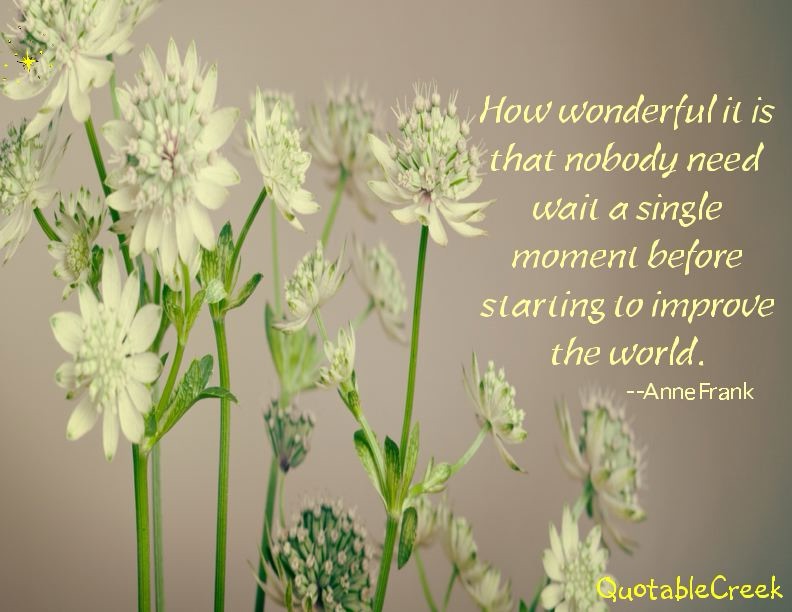
What tools do we need before we start to improve the world? What are we waiting for? Perhaps we are waiting for extra money or time. Perhaps we are waiting for retirement. Perhaps we are waiting to get all our own issues squared away first before we start thinking about helping someone else with theirs. Perhaps we are waiting for someone to ask us for help.
But consider Anne Frank. Forced to live in hiding to avoid the Nazi round-up and murder of Jews, she had little contact with the outside world. She, herself, was in mortal danger around the clock. She was just a kid, really, someone we think of helping rather than being the helper. And yet her attitude was so full of optimism and hope, it continues to shine now, decades later, lighting a weary world.
What a difference an attitude makes! She didn’t wait for the right time or resources. She didn’t wait until she could have a huge impact on the world. She didn’t wait until she was old or famous or wealthy. She didn’t even wait until she was safe. She started right then with what she had. A cheerful disposition, a concern for her family and the others in hiding with her, a willingness to step forward and try to make the world a better place.
What can you do to improve the world? Isn’t it wonderful that you can start right now?
Miep Gies was a young office worker when she hid and supported Anne Frank and her family, protecting them from Nazis and the danger of being sent to a concentration camp. After Anne and her family were betrayed and captured, Miep collected Anne’s diaries and eventually returned them to Anne’s father, Otto, who survived the war. That diary has been read by millions of people now, inspiring acts of heroism and showing, in a very intimate way, the horror of WWII as viewed through the eyes of an innocent, complex, lovely, vibrant girl, Anne.
Miep wasn’t famous or rich or particularly accomplished, yet she managed through her actions to shine a very bright light on hate and replace it with a more powerful portrait of love. Anne, too, wasn’t famous or rich or accomplished, although we can see now how she was a gifted author, but her words have been inspiring and a powerful force against evil in the world.
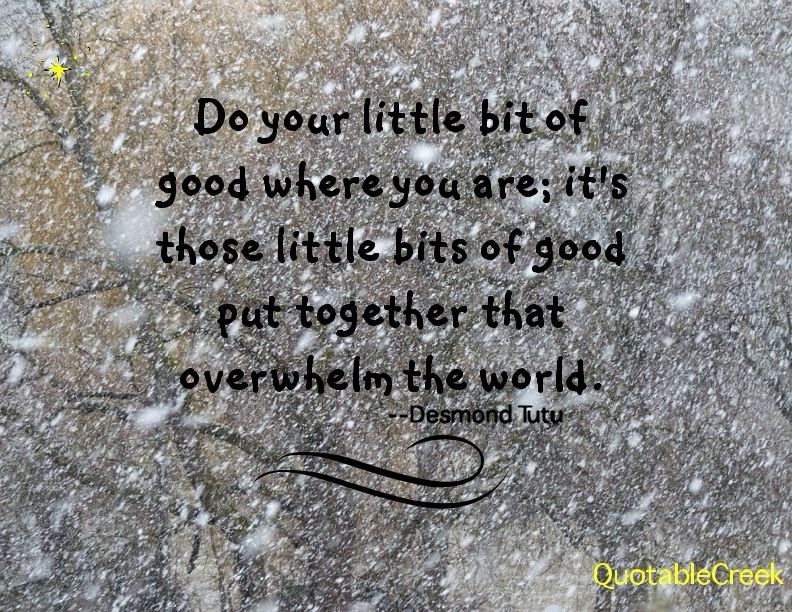
No matter our position or age or wealth or gender, we each can make a contribution that makes the world more bright.




 QuotableCreek.com