Reteaching loveliness.

You and everyone around you are buds, waiting to fully bloom. Sometimes we need reminders of that fact.

Consider this poem from Galway Kinnell:

Relearning Loveliness

The bud

Stands for all things,

Even for those things that don’t flower,

For everything flowers, from within, of self-blessing:

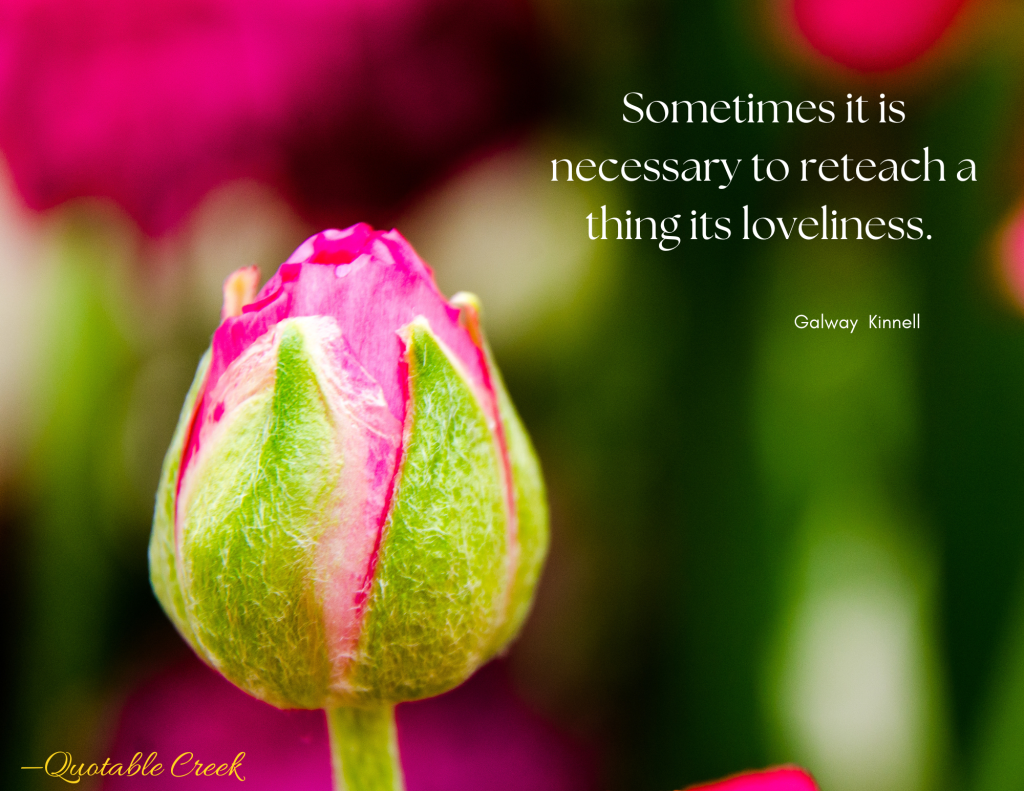
Though sometimes it is necessary to reteach a thing its loveliness,

To put a hand on the brow

Of the flower,

And retell it in words and in touch,

It is lovely

Until it flowers again from within, of self-blessing.

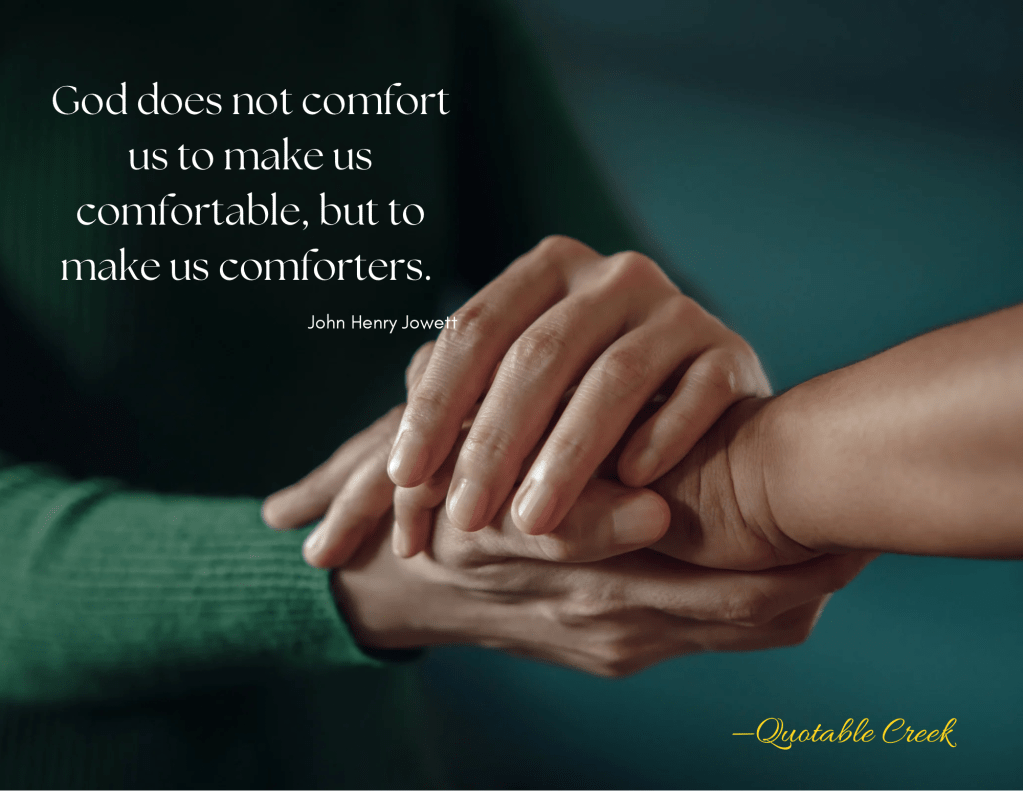
Bless the comforters.

Bless the comforters, those who reach out and see others hurting and grief stricken, and offer them solace. Who sit with those going through difficult times, and give of their presence. Who offer kind, comforting words.

We sometimes think those who are good at comforting don’t know loss of their own, but the opposite is probably true.

As said by Rainer Maria Rilke:

Do not assume that he who seeks to comfort you now lives untroubled among the simple and quiet words that sometimes do you good. His life may also have much sadness and difficulty, that remains far beyond yours. Were it otherwise, he would never have been able to find such words.

Perhaps the only good to come of great loss is the ability to recognize it in others and offer them comfort and companionship.

Bless the comforters.

Practicing courage.

Life is full of hard choices. Particularly when you aren’t the one in danger. Making those tough choices, entering the fray, speaking truth to power, defending the defenseless are vital actions for our collective survival.

As Brené Brown says, 

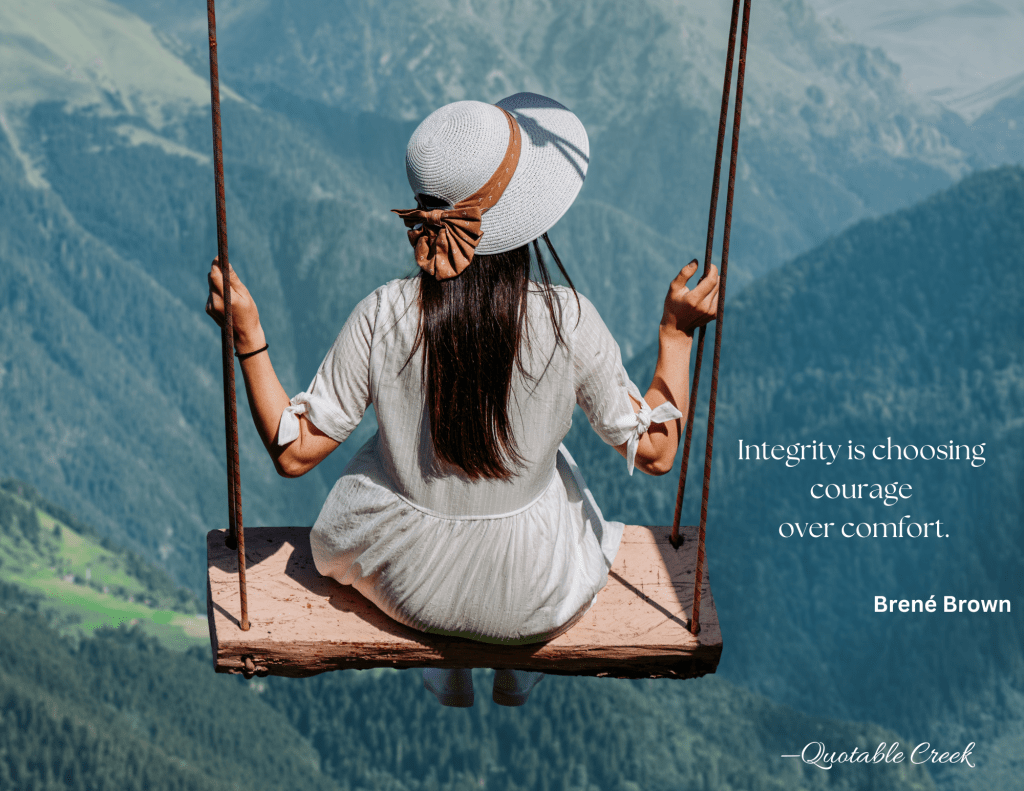
Integrity is choosing courage over comfort; it’s choosing what’s right over what’s fun, fast, or easy; and it’s practicing your values, not just professing them

Practicing our values, not just professing them. What are your values? How can you bring that to bear in the choices confronting you today?

Many of us have opinions and desire to help in difficult situations but are afraid to raise our voices. We worry about alienating others or of seeming strident. But if not now, when?

Maybe we can start in small ways and exercise our courage muscles.

Consider these words from Maya Angelou:

“I would encourage us to try our best to develop courage. It’s the most important of all the virtues, because without courage, you can’t practice any other virtue consistently. You can be anything erratically — kind, fair, true, generous, all that. But to be that thing time after time, you need courage.

We need to develop courage, and we need to develop it in small ways first. Because we wouldn’t go and say, ‘I’ll pick up this 100-pound weight’ without knowing our capacity. So we need to say, ‘Oh, I’ll start by picking up a five-pound weight, then a 10-pound weight, then a 25-pound, and sooner or later I’ll be able to pick up a 100-pound weight.’ And I think that’s true with courage.

You develop a little courage, so that if you decide, ‘I will not stay in rooms where women are belittled; I will not stay in company where races, no matter who they are, are belittled; I will not take it; I will not sit around and accept dehumanizing other human beings’ — if you decide to do that in small ways, and you continue to do it — finally you realize you’ve got so much courage. Imagine it — you’ve got so much courage that people want to be around you. They get a feeling that they will be protected in your company.” — Maya Angelou

Look for ways to test your voice and develop your courage muscles today. Perhaps it’s in saying you disagree, perhaps it’s posting something to show solidarity with those going through difficulty, perhaps it’s speaking truth to power. Today, a five pound weight of courage flexing. Soon, you will develop the courage you need for the big battles ahead.

Persevere

Sometimes things hum along nicely, and you can feel a deep sense of progress in yourself, your relationships, and the world.

Sometimes the opposite is true.

You feel yourself retreating and losing hope. Your relationships fray. Progress in the world is wiped away.

At times like these, we need to hunker down and draw on a well of hope inside in each of us that springs up with the knowledge that we can do better, we deserve better, and we will fight for ourselves and each other to make the world better.

We may not know yet the battleground we will be called to or the terms of engagement.

We do, though, know the weaponry we will fight with.

Love, honesty, integrity, justice, compassion. These tools of the light will vanquish darkness. We can’t forget what is good and right.

Finally, brethren, whatsoever things are true, whatsoever things are honest, whatsoever things are just, whatsoever things are pure, whatsoever things are lovely, whatsoever things are of good report; if there be any virtue, and if there be any praise, think on these things. Philippians 4:8

We must persevere.

Empathy for the win.

Nothing is more important than empathy
for another human being’s suffering.
Not a career.
Not wealth.
Not intelligence.
Certainly not status.
We have to feel for one another
if we’re going to survive
with dignity.

~Audrey Hepburn

Studies show empathy, the ability to put yourself in another person’s shoes and consider their point of view, might be on the decline in the United States. With a lack of empathy comes the possibility of othering, cruelty, and self-absorption.

What can we do to increase our empathy for others?

Consider this novel idea: empathy walks. Literally mirroring someone’s walk, not in a stalkery or critical way, but as a silent practice in visualizing what it must be like to be that person. Consider this example:

It all started on one of my regular walks into town. I was head-down, in a hurry, when I noticed an older woman ahead of me. She was walking slowly—agonizingly slowly, if I’m being honest—and my first instinct was annoyance. But then I thought about the old acting school exercise. What if, instead of speeding up to dodge her, I matched her pace? So, I slowed down, mimicking her small, deliberate steps, the way she slightly leaned to one side, her arms swaying as if carrying invisible weights.

And then it hit me: empathy. Not the mushy, Hallmark-card kind, but a physical understanding of what it might feel like to be her. As I moved like her, my irritation evaporated. I didn’t just see her; I felt her. I thought about the phrase “walk a mile in someone else’s shoes,” and realized it’s not the shoes that matter; it’s the walk….

So, the next time you’re out walking, try it. Pick someone ahead of you and mimic their stride. Notice where they’re tight, where they’re loose, how they carry themselves. Let their tension teach you about your own. Let their walk reshape yours. And maybe, just maybe, you’ll feel a little less separate and a little more connected—to them, to yourself, and to this messy, beautiful, shared experience we call being human.

The Value of an Empathy Walk by Maggie Rowe

We are all different, with different joys and burdens, challenges and delights. We each bring a different package of strengths and weaknesses to any situation. As we begin to appreciate the different points of views and perspectives of those around us, our empathy grows, and with that, our own world expands.

We are needed, that is all we can know.

Do not lose heart. The challenges you see today are the ones you must face. You are strong enough to do your part, and you will find allies everywhere you look.

Do not be afraid.

You may feel you are riding on stormy seas, but look around you. In the words of Dr. Clarissa Pinkola Estes:

Look out over the prow; there are millions of boats of righteous souls on the waters with you. Even though your veneers may shiver from every wave in this stormy roil, I assure you that the long timbers composing your prow and rudder come from a greater forest. That long-grained lumber is known to withstand storms, to hold together, to hold its own, and to advance, regardless.

In any dark time, there is a tendency to veer toward fainting over how much is wrong or unmended in the world. Do not focus on that. There is a tendency, too, to fall into being weakened by dwelling on what is outside your reach, by what cannot yet be. Do not focus there. That is spending the wind without raising the sails.

We are needed, that is all we can know. And though we meet resistance, we more so will meet great souls who will hail us, love us and guide us, and we will know them when they appear. Didn’t you say you were a believer? Didn’t you say you pledged to listen to a voice greater? Didn’t you ask for grace? Don’t you remember that to be in grace means to submit to the voice greater?

Ours is not the task of fixing the entire world all at once, but of stretching out to mend the part of the world that is within our reach. Any small, calm thing that one soul can do to help another soul, to assist some portion of this poor suffering world, will help immensely. It is not given to us to know which acts or by whom, will cause the critical mass to tip toward an enduring good.

You do not need to do everything. Do what you can, where you can, with what you can. Your actions combined with actions from millions of like-minded individuals will make a difference for good.

Do not lose heart.

Bearing one another’s burdens.

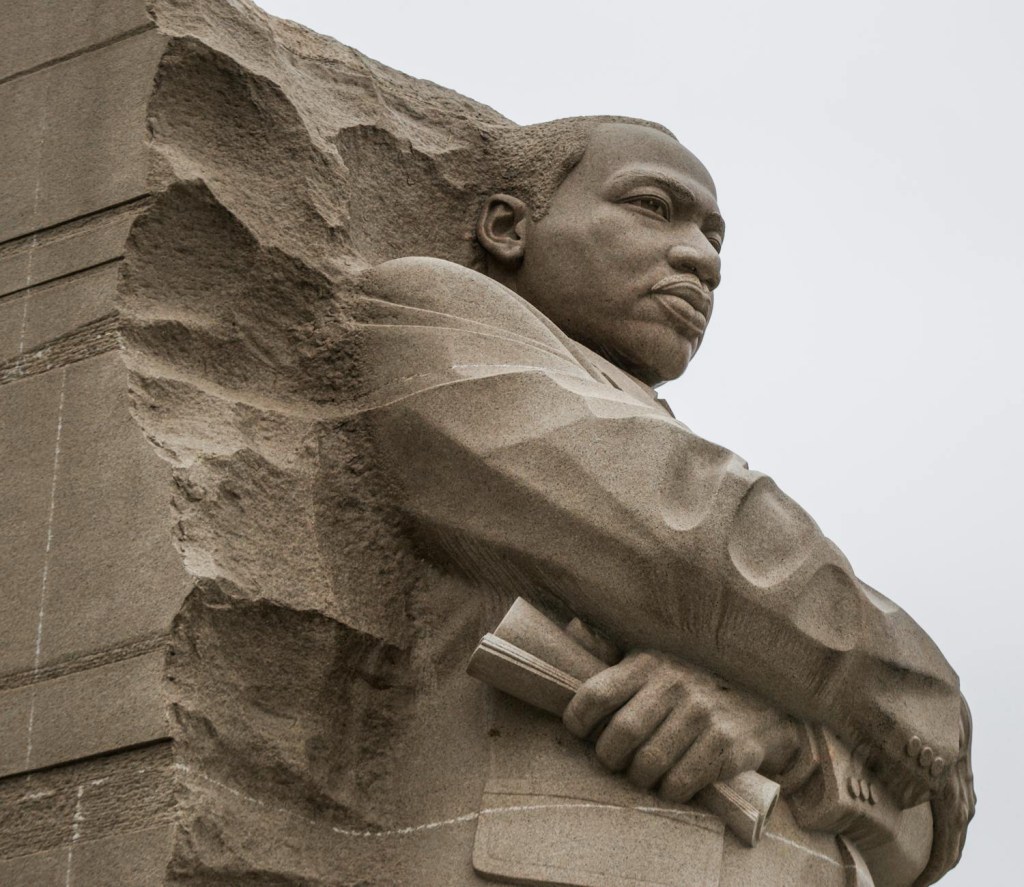
Today is Martin Luther King, Jr. Day. Also Inauguration Day. When we picture King, we picture him as heroic, confident, strong. And these are likely the pictures you may see today.

And, of course, he was these things. Championing civil rights and railing against injustice, able to see inequity in the systems around him and dream of a better way. He was an advocate of love over hate and peaceful protest.

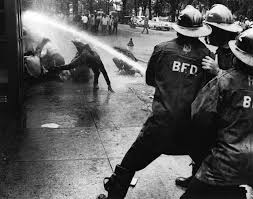
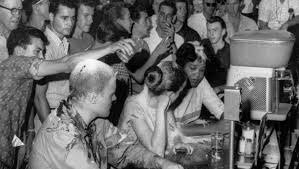
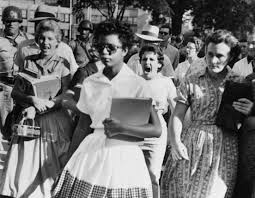
And yet, his life was not a peaceful one. He was killed for the beliefs he professed. And much of the progress he made was met with violence and hate.

Progress is not a straight line, and hate is ever-present. And hate can be powerful and beguiling and intimidating. And hate can creep into the consciousness of a group, or even a nation.

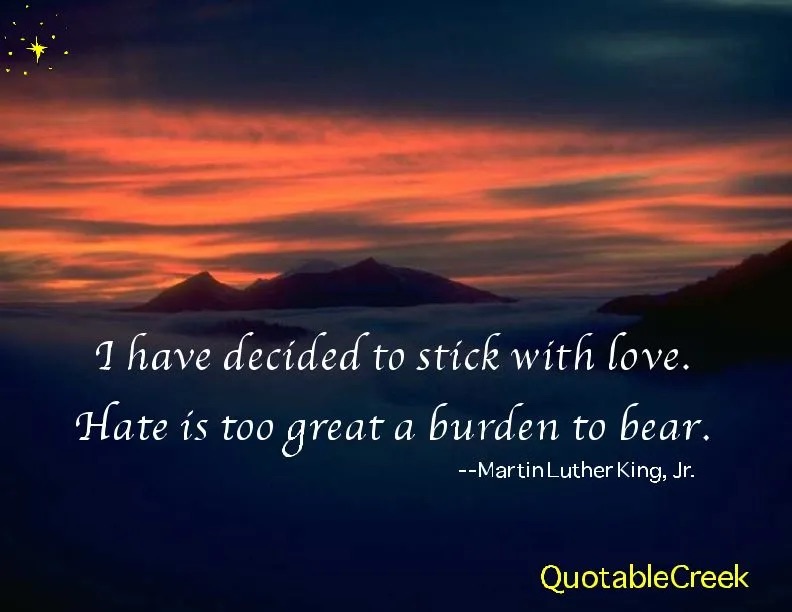
And yet, I will stand with King for love over hate, all these years later, and do what I can to continue his fight for justice and peace.

Because, even in the midst of hateful people and those who seek to divide, justice and truth are on the right side of history.

What kind of difference will you make?

As I write this, Los Angeles is burning. Many have lost their homes, their lives, their livelihoods. Many are displaced. All of us who live here are afraid, as near 100 mile per hour winds buffet our homes and render firefighting difficult if not impossible. All of us are thinking about the possibility of losing the security of home. We are one turn in the wind away from being displaced. We didn’t do anything to deserve this any more than any victim of natural disaster.

And perhaps, like me, we look around at what is happening and see people making choices.

Heroic firefighters and first responders rushing into danger.

Churches opening their doors to accept the displaced.

Grassroots attempts to collect funds and supplies for those hardest hit.

People praying and reaching out to comfort and shelter their neighbors.

And yet, we can’t help but see the others.

A suspected arsonist arrested.

A politician lying to cast blame on his enemies, making light of human suffering.

People mocking those who have lost their homes if they are rich or famous as if the wealthy can’t suffer.

People making things better and people making things worse. Isn’t that always the way? People who help and people who hurt.

And on behalf of people in the middle of this crisis, bags packed, waiting to know if they will have to flee their homes and lose everything, trying to decide what to bring or maybe not even having time for that, I will say how the actions of people out of harm’s way makes a tremendous impact. Calls and emails from people checking in and expressing concern, offers of help and sanctuary, heroic actions on behalf of others, fills us with hope and community in the midst of the darkness. Thank you to those people.

This time it is we who live in Los Angeles suffering, but tomorrow it could be you. No one is immune from the possibility of loss.

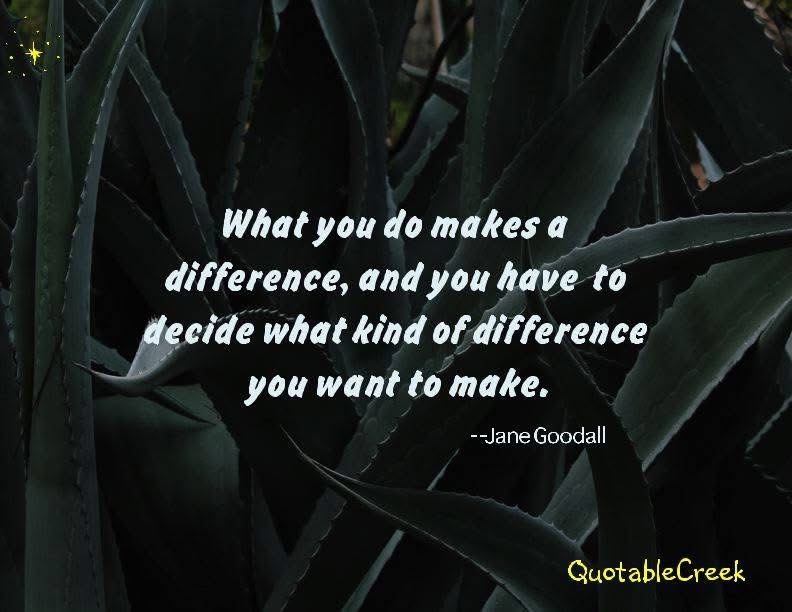
The question in all of it always is, what kind of difference will you decide to make with your life, for most assuredly what you do will make a difference. So which is it?

Help or hurt?

A fighting hope.

We begin the year with hope. Hope for peace; hope for good health; hope for reconciliation and redemption; hope for progress on our journeys and throughout the world. Emily Dickinson’s poem is a lovely metaphor to return to when drawing on this hope to get us through rough days:

“Hope” is the thing with feathers –

That perches in the soul –

And sings the tune without the words –

And never stops – at all –

And sweetest – in the Gale – is heard –

And sore must be the storm –

That could abash the little Bird

That kept so many warm –

I’ve heard it in the chillest land –

And on the strangest Sea –

Yet – never – in Extremity,

It asked a crumb – of me.

Hope is active, isn’t it? Sometimes singing, sometimes soaring, sometimes hanging on by its toenails. Faith is different. Mary Oliver describes this difference beautifully in her book, Upstream:

In the winter I am writing about, there was much darkness. Darkness of nature, darkness of event, darkness of the spirit. The sprawling darkness of not knowing. We speak of the light of reason. I would speak here of the darkness of the world, and the light of _______. But I don’t know what to call it. Maybe hope. Maybe faith, but not a shaped faith–only, say a gesture, or a continuum of gestures. But probably it is closer to hope, that is more active, and far messier than faith must be. Faith, as I imagine it, is tensile, and cool, and has no need of words. Hope, I know is a fighter and a screamer.

As we go forward, let us hope for a better world for every one, but let it be an active hope–a fighting, kicking and screaming hope– a hope that urges us into that battle of making the world the better place.

For as long as we can.

One of my personal heroes, Jimmy Carter, 100 years old, has passed away, and the world is a bit darker without his light. He has been such a wonderful example of walking the walk. He said:

“My faith demands – this is not optional – my faith demands that I do whatever I can, wherever I can, whenever I can, for as long as I can with whatever I have to try to make a difference.”

What a wonderful way to look at our possible impact. Using what we have, not waiting until we have more or better resources or to be older and wiser, or wishing we were younger and stronger. Right now, with what’s available. 

And wherever we find ourselves, adopting a bloom where you’re planted attitude. Even if we are in our own harsh spot. Considering what can we do here. 

And always looking for opportunities to do good. Not necessarily solving the world’s problems, but doing your own little bit of good. Right here, right now. 

Let’s go. 

Thank you, President Carter, for this reminder. You will be missed.