Getting out of our own way.

Do you find yourself making the same mistakes repeatedly? Maybe even sabotaging relationships or failing to meet your goals? Is it possible you are getting in your own way?

In this insightful article, Tim Hoch identifies 10 ways you may be making your life harder than it needs to be:

1. You ascribe intent.

Another driver cut you off. Your friend never texted you back. Your co-worker went to lunch without you. Everyone can find a reason to be offended on a steady basis. So what caused you to be offended? You assigned bad intent to these otherwise innocuous actions. You took it as a personal affront, a slap in the face.

Happy people do not do this. They don’t take things personally. They don’t ascribe intent to the unintentional actions of others.

2. You’re the star of your own movie.

It is little wonder that you believe the world revolves around you. After all, you have been at the very center of every experience you have ever had.

You are the star of your own movie. You wrote the script. You know how you want it to unfold. You even know how you want it to end.

Unfortunately you forgot to give your script to anyone else. As a result, people are unaware of the role they are supposed to play. Then, when they screw up their lines, or fail to fall in love with you or don’t give you a promotion, your movie is ruined.

Lose your script. Let someone else star once in awhile. Welcome new characters. Embrace plot twists.

3. You fast forward to apocalypse.

I have a bad habit of fast forwarding everything to its worst possible outcome and being pleasantly surprised when the result is marginally better than utter disaster or jail time. My mind unnecessarily wrestles with events that aren’t even remotely likely. My sore throat is cancer. My lost driver’s license fell into the hands of an al-Qaeda operative who will wipe out my savings account.

Negativity only breeds more negativity. It is a happiness riptide. It will carry you away from shore and if you don’t swim away from it, will pull you under.

4. You have unrealistic and/or uncommunicated expectations.

Among their many shortcomings of your family and friends is the harsh reality that they cannot read your mind or anticipate your whims.

Did your boyfriend forget the six and a half month anniversary of your first movie date? Did your girlfriend refuse to call at an appointed hour? Did your friend fail to fawn over your tribal tattoo?

Unmet expectations will be at the root of most of your unhappiness in life. Minimize your expectations, maximize your joy.

5. You are waiting for a sign.

I have a friend who won’t make a decision without receiving a “sign.” I suppose she is waiting on a trumpeted announcement from God. She is constantly paralyzed by a divinity that is either heavily obscured or frustratingly tardy. I’m not disavowing that fate or a higher power plays a role in our lives. I’m just saying that it is better to help shape fate than be governed by it.

6. You don’t take risks.

Two words: Live boldly. Every single time you are offered a choice that involves greater risk, take it. You will lose on many of them but when you add them up at the end of your life you’ll be glad you did.

7. You constantly compare your life to others.

A few years ago I was invited to a nice party at a big warehouse downtown. I was enjoying the smooth jazz, box wine and crustless sandwiches. What more could a guy want? Later in the evening I noticed a steady parade of well-heeled people slide past and disappear into another room. I peeked and saw a large party with beautiful revelers dancing and carrying on like Bacchus. Suddenly my gig wasn’t as fun as it had been all because it didn’t appear to measure up to the party next door- a party I didn’t even know existed until just moments before.

I do this frequently. Those people are having more fun. Mary has a bigger boat. Craig gets all the lucky breaks. Ted has more money. John is better looking.

Stop it.

Always remember what Teddy Roosevelt said: “Comparison is the thief of joy.”

8. You let other people steal from you.

If you had a million dollars in cash under your mattress, you would check it regularly and take precautions to insure it is safe. The one possession you have that is more important than money is time. But you don’t do anything to protect it. In fact you willingly give it to thieves. Selfish people, egotistical people, negative people, people who won’t shut up. Treat your time like Fort Knox. Guard it closely and give it only to those who deserve and respect it.

9. You can’t/won’t let go.

These are getting a little harder aren’t they? That’s because sometimes you have to work at happiness. Some hurdles are too difficult to clear by simply adjusting your point of view or adopting a positive mindset.

Do you need to forgive someone? Do you need to turn your back on a failed relationship? Do you need to come to terms with the death of a loved one?

Life is full of loss. But, in a sense, real happiness would not be possible without it.  It helps us appreciate and savor the things that really matter. It helps us grow. It can help us help others grow.

Closure is a word for people who have never really suffered. There’s no such thing. Just try to “manage” your loss. Put it in perspective. You will always have some regret and doubt about your loss. You may always second guess yourself. If only you had said this, or tried that.

You’re not alone. Find someone who understands and talk to that person. Reach out for support. If all else fails, try #10 below.

10. You don’t give back.

One way to deal with loss is to immerse yourself in doing good. Volunteer. Get involved in life.

It doesn’t even have to be a big, structured thing. Say a kind word. Encourage someone. Pay a visit to someone who is alone. Get away from your self-absorption.

When it comes down to it, there are two types of people in this world. There are givers and there are takers. Givers are happy. Takers are miserable. What are you?

Do any of these fit?  You may need to get out of your own way.

The extraordinary in my cup of coffee.

Sometimes we see the extraordinary in the ordinary. This poem perfectly captures the blessing in such a day:

Lord, here I am.

How strange it is,

That some days feel like hurricanes

And others like glassy seas

And others like nothing much at all,

Today is a cosmic shrug.

My day planner says, 

Rather conveniently,

That I will not need you,

Cry for you, reach for you.

Ordinarily, I might not think of you at all.

Except, if you don’t mind,

Let me notice you.

Show up in the small necessities

And everyday graces.

God, be bread.

Be water.

Be laundry.

Be the coffee cup in my hands

And the reason to calm down in traffic.

Be the gentler tone in my insistence today

That people pick up after themselves for once.

When I catch my own reflection

Or feel my own self-loathing

Fluttering in my stomach.

Calm my mind,

Lift my spirit,

Make this dumb, ordinary day

My prayer of thanks.

Be the reason I feel loved.The Lives We Actually Have, by Kate Bowler and Jessica Richie

Astonishing a mean world.

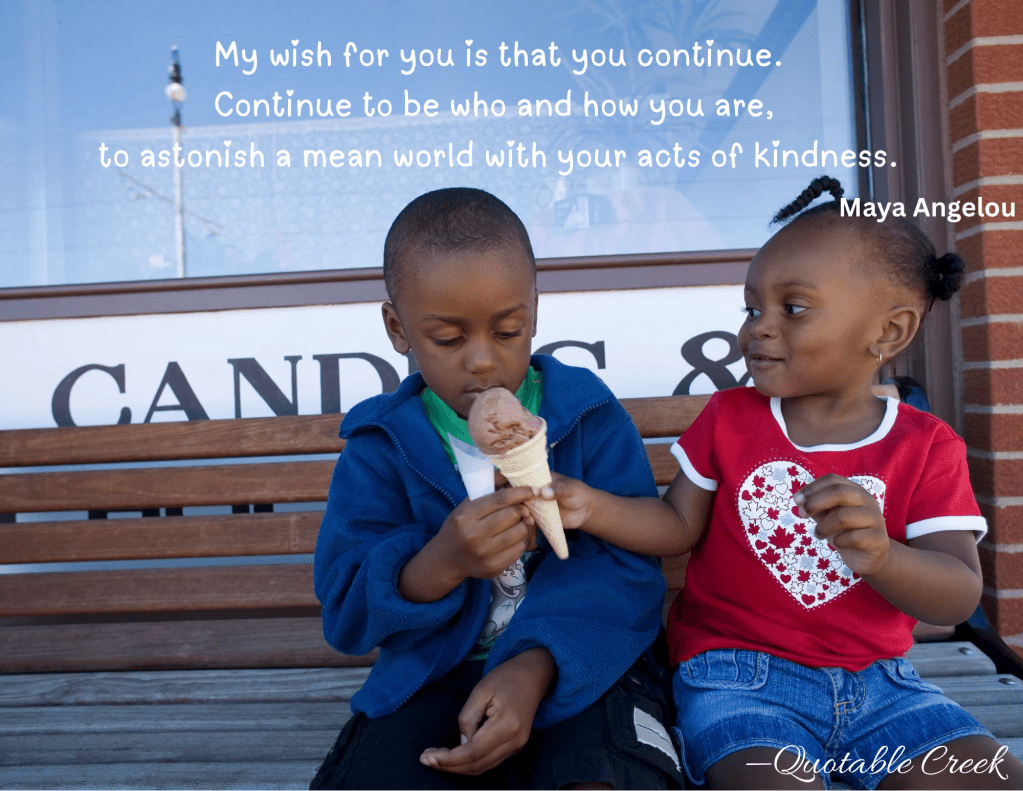
Astonishing a mean world is quite the life goal. Flipping the script. Not buying in to the smallness, pettiness, and cruelty you see around you.

Imagine the ripple effects of such kindness.

Perhaps you’ve heard the story of the man and the starfish. In sum, a man is walking along the beach at low tide finding starfish that have landed too far above the water line to survive. He dislodges them and throws them back into the ocean. A bystander is astonished and scolds him, saying that he will never be able to make a difference as there are miles and miles of beach with hundreds of stranded starfish. The man responds, tossing another back into the ocean, “Made a difference to that one,” he remarks.

Making a difference doesn’t have to be a grand gesture. It can be quite small, perhaps only affecting the person in front of you right now. Perhaps the difference is choosing an unexpected response to cruelty. Perhaps the response is to not lose hope.

Hang in there. The starfish are right in front of you on your path if you choose to see them.

An infinite succession of presents.

This moment we are in is but one in the collection of moments that make a life, a story, a history. Each moment building on the last, forward toward a powerful culmination. To stay hopeful and earnest in each moment, no matter how dire, is a testament to what we hold dear, to hope, to a belief that all things will ultimately work together for good.

As Howard Zinn says,

TO BE HOPEFUL in bad times is not just foolishly romantic. It is based on the fact that human history is a history not only of cruelty, but also of compassion, sacrifice, courage, kindness.
What we choose to emphasize in this complex history will determine our lives. If we see only the worst, it destroys our capacity to do something. If we remember those times and places—and there are so many—where people have behaved magnificently, this gives us the energy to act, and at least the possibility of sending this spinning top of a world in a different direction.
And if we do act, in however small a way, we don’t have to wait for some grand utopian future. The future is an infinite succession of presents, and to live now as we think human beings should live, in defiance of all that is bad around us, is itself a marvelous victory.

Do not give up on the beliefs you have. To be decent, kind, not returning hate for hate, to speak truth to power, to retain hope for a brighter future, a future willing to work for. That is a marvelous victory.

Balcony people

Are there people in your life who encourage you and make you feel stronger and lifted up? Are there some who drag you down or take the wind out of your sails?  In her book, Balcony People, Joyce Landor Heatherley argues there are two types of people: the evaluators and the affirmers. She suggests:

I am sure, if there were a way to view a movie and see instant replays of all the strategic change points in our lives, that we’d instantly spot the people who either broke our spirits by their critical or judgmental evaluations, or who healed us by their loving, perceptive affirmations.

To be honest, I seem to be able to remember the negative comments of evaluators faster and more clearly than the positive remarks of the affirmers. I’m not alone in this ability to recall the negative….I suspect that not far from anyone’s conscious level of thinking lies the memory of an evaluator who pulled on his or her spiked boots and stomped deliberately over our bare soul and personhood.

Do you have any of these evaluators in your life? Maybe you can recognize the voice in your head that tells you that you can’t do something. In her book The Artist’s Way: A Spiritual Path to Higher Creativity, Julia Cameron calls these the censors. Maybe you have many censors, a rogue’s gallery of them.

So what do we do with these evaluators and censors to keep them from stifling our blossoming with their negative talk or opinions? Heatherley suggests leaving them in the past, even if that past was five minutes ago:

We all have the choice to replay the harmful remarks from evaluators, or we can choose to let them pass on. We can even choose to make allowances for their discouraging, destructive words. But best of all is the choice to willingly focus our minds and hearts on today’s person who is affirming us.

So who are these affirmers in our lives? Think back…

Who by one small sentence or more, has changed and lifted your opinion of yourself? Who was the person early in your life who recognized the first sparks of originality in the labyrinths of your mind and soul and saw what no one else saw? And who is the special affirmer who catches quick glimpses of the flames from the fires of your potential and tells you so? Who, by his or her words, helps you to respect and believe in your own value as a person? And who is the affirmer who encourages you to stretch and dream beyond your self-imposed limits and capabilities?

These affirmers are your Balcony People, cheering you on to blossom and stretch. These are the people whose words you must cling to when working toward your goal. These affirmers see you “by a clearer, truer light. They [are] able to peel back the layers of pretense [you] wear like like costumes for a bad play. Most of the time they [see] through and past the masks [you] hide behind. Then, once having broken through to [you] they’d get on with the business of motivating [you] to be all [you] can be.”

Affirmation is vital to our health and progress:

When others discern the good, the noble, the honorable, and the just tenets of our character (no matter how minuscule they may be) and proceed to tell us how they admire those traits, we feel visible. We begin to ‘see’ ourselves and our worth. We feel nurtured and nourished, but mostly we feel loved.

The Basement People do just the opposite. With their words they cause you to doubt and shrink. They focus on your flaws or failings. They encourage you to not try, to stay where you are, to wallow in the “murky waters of failure and discouragement.” We don’t need to linger on their words.

Who is in your Balcony? Who cheers you on and sees your unique worth? Who do you admire in history for their accomplishments or moral victories?

When you struggle, picture these people, your Balcony People. Remember their words. Let their affirmations encourage and comfort you in defeat and to keep pressing onward in your goals.

You are meant to blossom not wither. You are meant to shine not lurk in the shadows.

You are meant to soar.

Presence over presents

It’s getting harder to find the right presents for my granddaughters. I’m keenly feeling their growing up and the fact we are of different generations. Their world now contains so many things that I have so little clue about.

And Christmas for us, with kittens in the house, requires a whole new game plan. Making things festive without creating feline hazard zones is challenging.

And, with a family filled with different eating preferences and diets, food is a puzzle.

But, as with the Whos in Whoville, Christmas will come and find us regardless of how decorated we are or how many presents are under the tree, and we will learn the underlying truth again that Christmas isn’t about the stuff. It’s about the love. And that, we have in abundance.

Presence over presents for the win.

Remember whose you are

The days before Christmas can be frantic. We sometimes find our tempers short, our tongues loose, and our wits frayed. We think of Christmas as something in the future, speeding toward us, that we need to hurry around and prepare for so that we can enjoy His coming. But a birthday, like Christmas, is a celebration of something that has already happened. And, in the case of Christmas, it is a celebration of a whole new world order that is here. We are His now, not just at Christmas. We need to shine with His love now and everyday. Particularly when the world is harried. We need to reflect the joy and peace that comes with knowing that love conquers all.

Pause. Breathe. And remember whose you are.

Rest and be thankful.

Without the rests and pauses, music would just be noise. The pauses add shape and definition to any composition and allow the rise and fall of the melody to stand out. In order to hear the music that is our life, we need to pause. Between tasks, before we react, when others are speaking. We need to rest when we are weary, to conclude that not everything needs to be done today, now, or maybe even at all. Sometimes less is more.

And as we pause, let us give thanks. For this life, these opportunities, these people (including those who vex you), and the abundance of life all around us.

Thanks for it all.

Opening to gratitude.

Happy thanksgiving.

In honor of the holiday, what is a way we can open to gratitude? Sometimes the veil is pulled back, and we can glimpse a larger picture, a connection between all things, an appreciation for the here and now, and we are grateful.

Brother David Steindl-Rast explains how these jolts into a different reality can change a day, and, perhaps, even a world:

My vision of the world? My hope for the future? This topic sounds a bit big. Allow me to start small—say, with crows. They are my special friends. Just as I am writing these lines, one of them, the shy one among my three regular guests, is gobbling up the Kitty Fritters I put out for them. This brings to mind a short poem by Robert Frost that might provide a stepping-stone for our deliberations about world-vision and hope for the future—if any.

The way a crow
Shook down on me
The dust of snow
From a hemlock tree
Has given my heart
A change of mood
And saved some part
Of a day I had rued.

Surely you will remember a similar experience of your own: some quirky little incident made you smile, changed your mood, and suddenly the world looked brighter. If this ever happened to you, the key for understanding a causal chain of great consequence is in your hand:  any change in attitude changes the way one sees the world, and this in turn changes the way one acts. When Robert Frost claims that the crow’s little trick “saved” part of a day he had rued, or of which he repented, he means this in the full sense of a redeeming change of heart. When he got home, I’m sure he greeted Mrs. Frost in a better mood than he would have been able to do without the crow’s nudge. And there is no telling what this did to her—and to the way she treated the dog afterwards, or talked more kindly to her neighbor.

He continues to suggest five small, easily adopted ways to bring this gratitude into your life and, consequently, into the world:

1.  Say one word today that will give a fearful person courage.

All gratitude expresses trust. Suspicion will not even recognize a gift as gift: who can prove that it isn’t a lure, a bribe, a trap? Gratefulness has the courage to trust and so overcomes fear. The very air has been electrified by fearfulness these days, a fearfulness fostered and manipulated by politicians and the media. There lies our greatest danger: fear perpetuates violence. Mobilize the courage of your heart. Say one word today that will give a fearful person courage.

2. Make a firm resolution never to repeat stories and rumors that spread fear.

Because gratitude expresses courage, it spreads calm. Calm of this kind is quite compatible with deep emotions. In fact, mass hysteria fostered by the media betrays a morbid curiosity rather than deep feeling—superficial agitation rather than a deep current of compassion. The truly compassionate ones are calm and strong. Make a firm resolution never to repeat stories and rumors that spread fear. From the stillness of your heart’s core reach out. Be calm and spread calm.

3. Make contact with people whom you normally ignore

When you are grateful, your heart is open—open towards others, open for surprise. When disasters hit we often see remarkable examples of this openness: strangers helping strangers sometimes in heroic ways. Others turn away, isolate themselves, dare even less than at other times to look at each other. Violence begins with isolation. Break this pattern. Make contact with people whom you normally ignore—eye-contact at least—with the cashier at the supermarket, someone on the elevator, a beggar. Look a stranger in the eyes today and realize that there are no strangers.

4. Give someone an unexpected smile today

You can feel either grateful or alienated, but never both at the same time. Gratefulness drives out alienation; there is not room for both in the same heart. When you are grateful you know that you belong to a network of give-and-take and you say “yes” to that belonging. This “yes” is the essence of love. You need no words to express it; a smile will do to put your “yes” into action. Don’t let it matter to you whether or not the other one smiles back. Give someone an unexpected smile today and so contribute your share to peace on earth.

5.  Listen to the news today and put at least one item to the test of Common Sense.

What your gratefulness does for yourself is as important as what it does for others. Gratefulness boosts your sense of belonging; your sense of belonging in turn boosts your Common Sense—not the conventional mind set which we often confuse with it. The common sense that springs from gratefulness is incompatible with a set mind. It is just another name for thinking wedded to cosmic intelligence. Your “yes” to belonging attunes you to the common concerns shared by all human beings—all beings for that matter. In a world we hold in common, nothing else makes sense but Common Sense. We have only one enemy: Our common enemy is violence. Common Sense tells us: we can stop violence only by stopping to act violently; war is no way to peace. Listen to the news today and put at least one item to the test of Common Sense.

The five steps I am suggesting here are small, but they work. It helps that they are small: anyone can take them. Imagine a country whose citizens—maybe even its leaders—are brave, calm, and open towards each other; a country whose people realize that all human beings belong together as one family and must act accordingly; a country guided by Common Sense. To the extent to which we show ourselves not hateful but grateful this becomes reality.

Who would have thought that a prankish crow shaking down snow from a hemlock tree could inspire this vision of a sane world? Well, if we leave it to the crows, there is still hope.

Small steps; big pay-off. And, to remember, keep your eyes open for the birds. They are there, singing songs of hope.

Wishing you joy.

Today, may you find joy in all the little moments. In the solitude and in the bustle. In the labor and in the rest. May that joy bring you peace and connection on this imperfect day in your imperfect life. May joy choose you.

Enjoy this poem on joy by Donna Ashworth: