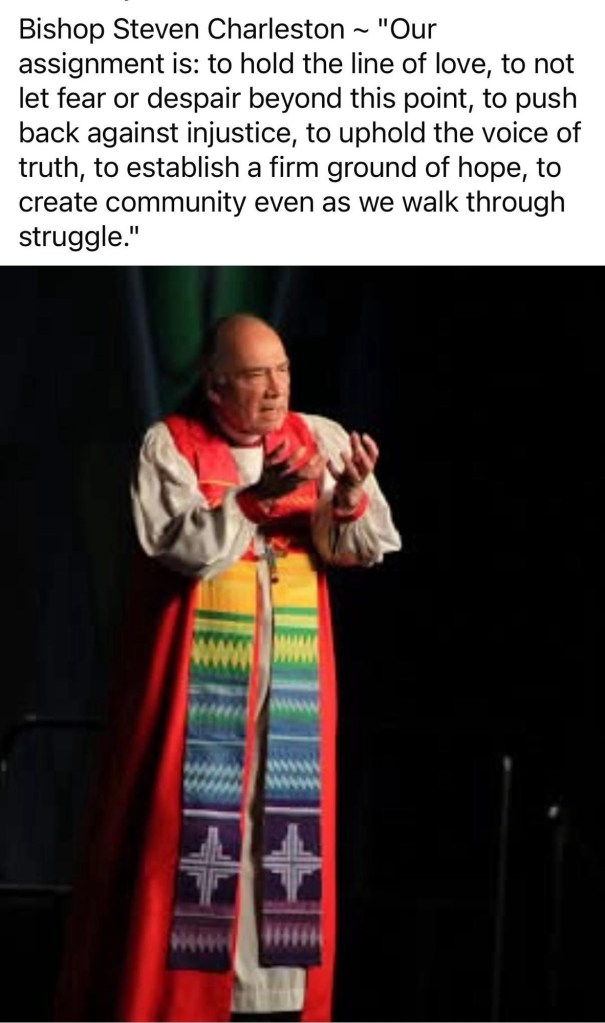
What is our job in these troubled times? During any times, but particularly during times where we are seeing peoples’ rights eroded and trampled, when legal safeguards are flouted, and when authoritarianism is on the rise, our job is to hold the line. Continue to be a place of comfort and succor to the hurting, feed the hungry, grieve with the mourning.
The Japanese Macaques, snow monkeys, are a deeply hierarchical society, their status in the group inherited from their mothers. Living in frigid temperatures, the upper class snow monkeys spend their time in natural hot springs, leaving the rest to huddle in the snow and look on as they luxuriate. The Emperor Penguins also live in frigid conditions, huddled together, but they constantly rotate, letting those most exposed on the outside come to the center for warmth. They take turns. It keeps those in the center from overheating and those on the fringes from freezing.
Sharing is an interesting phenomenon. It’s easy to see that when a society shares its resources, the whole group benefits, but how does that play out in the human species? Do we see the benefit to the whole group from sharing what we have, or do we focus on clutching more and more into our own fists? Some humans are uniquely able, it seems, to rationalize selfish behavior even when looking directly at the needs of others. But others consider their own resources an opportunity to help others. This is true both on an individual level, and on a larger societal level. It’s an interesting matter of perspective.
Friendships are taking a hit these days. Politics, world views, differing opinions are tearing people apart.
What is it that holds people together instead?
One thing is an abiding concern for the other person, despite your differences. If you can advocate against the death penalty on behalf of a stranger, couldn’t you bring yourself to see what is good and redeemable inside a former friend? Inside an enemy even? Searching for common ground is hard work, but really the main point of living in community. Isn’t it?
I was recently reminded about a story from 2017 where two little boys were caught in a rip tide and swept out to sea. Their entire family and four woud-be rescuers tried to swim out to save them but ended up similarly stranded. Officials on shore stood, helpless, waiting for a rescue boat while the family and would-be rescuers floundered.
But then the people on the beach did a remarkable thing. People from all walks of life, across every possible difference or division, linked arms together and formed a human chain stretching out into the ocean until they reached those stuck and and then passed them person to person, beginning with the little boys, Noah (11) and Stephen (8), and ending with their grandmother who had tried to save them, back to safety.
Stories like this don’t get a lot of press. But it’s why we’re here.
What are you going to be when you grow up? What do you do?
Tough questions for any kid, and not always easy for an adult. People love to pigeonhole: the doctor, the artist, the nurse, the mom, the cop, as if that title sums you up and all their questions about you have been answered. But what if the answer to that question is qualitatively different– an answer that covers what you want to be regardless of whether you’re a kid, employed, unemployed, retired, sick, etc?
What if that answer is: kind and brave?
In a recent blog post, Glennon Doyle recounts a time when her son said just that:
When Chase was eight, a woman approached us at the grocery store and said, “What a handsome boy! What do you plan to be when you grow up, young man?” Chase looked at her and said, “I plan to be kind and brave, ma’am.”
This was just one of the best moments of my life. Kind and brave has been our family’s battle cry for as long as I can remember. And I’ve always told my kids that your job isn’t who you are. Your character is who you are. So when folks ask my kids what they “want to be,” they think character, not career.
The great thing about this shift is that my kiddos understand that their life doesn’t magically begin when they “grow up.” Anybody still waiting for that to happen? Me too. Not them. They know that their life is NOW. Childhood is not just a dress rehearsal for adulthood. No way. It’s a whole beautiful thing, all on its own. Childhood is just as real as adulthood. Just as important. Kids can be who they want to be TODAY. They don’t have to wait.
Chase wants to be a human being who is kind and brave and he is already that. He know that his “success” does not depend upon whether he lands some job or not. He knows he’ll be a success if he continues to practice kindness and courage wherever and with whomever he finds himself. His roles will change but his character will remain. He is already who he wants to be. So he can just go about being himself forever. Following his curiosity. One Next Right Thing at a time.
You too. You can just go about being yourself. Following your curiosity. One Next Right Thing at a time. Life starts now. There is no “When I” there is only “I am.” And it’s just as simple and hard as that.
Now take a look again at those few job descriptions above. They’ve morphed a bit, haven’t they? What does a kind and brave doctor look like, a kind and brave artist, a kind and brave nurse, mom, or cop? Suddenly the picture of that person has stretched out of one-dimension and become complex and layered. Kind and brave people in any role or job description and at any age have unique challenges depending on the circumstances.
Children have a way of shaking things up. Don’t they? They see things we’ve stopped noticing. They question things we’ve started to take for granted. They cause us to stop and notice. They hold up a giant mirror to us and cause us to do some soul-searching.
That is, if we take the time to listen.
Why is that person asking for money? Why are people starving? Why do some people get treated better? Why do you say one thing in public but do another in private? Is this fair? Does everyone cheat? Does everyone lie? Is there a better way?
They force us to confront the gap between what we say they should do and what we do, or what society does, or what their friends do. Most adults suffer from some degree of cognitive dissonance: the mental discomfort from holding two or more differing beliefs, ideas or values at the same time. We value honesty but cheat on our taxes. We tell them not to bully others but then bully them or laugh as others are bullied. We tell them never to hit someone else while spanking them. We tell them all children are precious but then harbor racial or gender biases.
They notice.
And they point it out.
For those of us listening, this is a time to ask ourselves what we do, in fact, stand for and then work to align our lives with those values, to be internally and externally consistent.
For an unbelievably uplifting video of a diverse group of kids singing their hearts out, please watch this video. It will start your day off with hope and promise and excitement for the future of our nation and world.
In a recent Oprah magazine, Elizabeth Gilbert talks about her Inner Crone — a version of herself old, happy, and well past the point of fear — that she pictures when she needs a shot of courage. She considers her Inner Crone to be “a badass old lady who already dwells somewhere deep within [her] and whom [she] hope[s] to fully become someday.” Picturing her Inner Crone gives Gilbert gumption.
But she also remembers her Inner Child, and pictures that child particularly when she is feeling depressed or hard on herself:
Many years ago when I was going through a dark season of depression and self-loathing, I taped a sweet photograph of myself at the tender age of 2 on my bathroom mirror. Looking at that photo every day reminded me that I once was this blameless little person, deserving of all tenderness–and that part of me would always be this blameless little person deserving of all tenderness. Meditating upon a smaller and more innocent version of my face helped me to learn to be more compassionate to myself. I was finally able to recognize that any harm I inflicted on me, I was also inflicting on her. And that little kid clearly didn’t deserve to be harmed.
We could all benefit from picturing our Inner Child when we are being hard on ourselves. Would you criticize that little child the way you are criticizing yourself now, or would you be more patient and encouraging? Would you demand perfection from that child, or would you celebrate progress? If you were wounded by adults when you were a child, you now are an adult who can support that little child in a healing way.
Think back. Can you remember that Inner Child who is still a part of you? The joy and exuberance, enthusiasm and trust, innocence and promise? No matter how far you’ve come from that start, treat yourself with kindness, patience, and compassion. That Inner Child is alive and well…and trusts you.
Picture a fussy baby, afraid to fall asleep, but then comforted in his mother’s arms by her lilting lullaby, her breath soft against his face, her song sweet to his ears.
Who among us can’t, at times, relate to that child? The future seems particularly uncertain. Worry disrupts sleep. Anxiety weakens our resolve.
There is something about a lullaby, though, the soft tones, the repetitive melody, the gentleness of the presentation, that can help soothe and relax, comfort and reassure us. The sweet song can reach into our long past baby consciousness and help us rest.
Take a minute to enjoy this beautiful rendition of Billy Joel’s Goodnight, My Angel, by Social Dissonance with soloist Ryan Nagelmann. May it help you find peace.
Tending is such a dear word, not much used these days. To tend: ‘to care or look after, to give one’s attention to’. Lincoln reminds us to ask where we are and whether we are tending. Where we are. Are we where we want to be? Are our relationships as tender and loving as we would like? Are we tending? Do we feel someone is tending to that relationship with us? Do we feel tended to?
What are the kind, gentle ways we can tend to our relationships?
When someone tells us they are sad their relationship with us isn’t better, is our first instinct to deflect, blame, ignore, change the subject, shrug, laugh? Or is to pause, breathe deep, and say, ‘Yes, I wish our relationship was closer, too. Where are we? Are we tending? What can we do to better tend our relationship and draw closer rather than shrug and pull away?’
The world is certainly full of shruggers who turn away even from their closest relationships in favor of new friends or less vulnerability. The shruggers, the cynics, the distancers, the superficial. So be it.
But God bless the tenders. That is where the heart is.
This week, Pope Francis passed away, and stories are circulating about some of the changes he made in the church and some of his more compelling speeches. Back in 2017, in a surprise TED talk, Pope Francis put in a request for more tenderness in our lives. He stressed that we are all connected:
First and foremost, I would love it if this meeting could help to remind us that we all need each other, none of us is an island, an autonomous and independent “I,” separated from the other, and we can only build the future by standing together, including everyone. We don’t think about it often, but everything is connected, and we need to restore our connections to a healthy state. Even the harsh judgment I hold in my heart against my brother or my sister, the open wound that was never cured, the offense that was never forgiven, the rancor that is only going to hurt me, are all instances of a fight that I carry within me, a flare deep in my heart that needs to be extinguished before it goes up in flames, leaving only ashes behind.
Many of us, nowadays, seem to believe that a happy future is something impossible to achieve. While such concerns must be taken very seriously, they are not invincible. They can be overcome when we don’t lock our door to the outside world. Happiness can only be discovered as a gift of harmony between the whole and each single component. Even science – and you know it better than I do – points to an understanding of reality as a place where every element connects and interacts with everything else.
The Pope suggested tenderness for bridging the divides that separate us:
And what is tenderness? It is the love that comes close and becomes real. It is a movement that starts from our heart and reaches the eyes, the ears and the hands. Tenderness means to use our eyes to see the other, our ears to hear the other, to listen to the children, the poor, those who are afraid of the future.To listen also to the silent cry of our common home, of our sick and polluted earth. Tenderness means to use our hands and our heart to comfort the other, to take care of those in need….
Yes, tenderness is the path of choice for the strongest, most courageous men and women. Tenderness is not weakness; it is fortitude. It is the path of solidarity, the path of humility. Please, allow me to say it loud and clear: the more powerful you are, the more your actions will have an impact on people, the more responsible you are to act humbly. If you don’t, your power will ruin you, and you will ruin the other. …
The future of humankind isn’t exclusively in the hands of politicians, of great leaders, of big companies.Yes, they do hold an enormous responsibility. But the future is, most of all, in the hands of those peoplewho recognize the other as a “you” and themselves as part of an “us.” We all need each other. And so, please, think of me as well with tenderness, so that I can fulfill the task I have been given for the good of the other, of each and every one, of all of you, of all of us. Thank you.
As we grieve, Pope Francis, let us heed his words. The future is in our hands. Can we think of and treat each other with tenderness? Do we recognize that we are all part of an “us”?