Reading history is one of the best ways ironically to really enter the present. As James Baldwin says:
One must say Yes to life and embrace it whenever it is found — and it is found in terrible places; nevertheless, there it is. For nothing is fixed, forever and forever and forever, it is not fixed; the earth is always shifting, the light is always changing, the sea does not cease to grind down rock. Generations do not cease to be born, and we are responsible to them because we are the only witnesses they have. The sea rises, the light fails, lovers cling to each other, and children cling to us. The moment we cease to hold each other, the moment we break faith with one another, the sea engulfs us and the light goes out. ~James Baldwin
We look at our past and see people making their ways, making mistakes, celebrating triumphs, struggling but then getting back up. And this is true during objectively awful times of war or suffering as well as in more relatively peaceful times. People go on. They find a way to come together, to survive, to do better.
I wonder what historians will say fifty years from now about the times we are in right now. Will they point to the divisions between us or the attempts to heal and grow. Will they see in us the grit and forbearance we can recognize in our ancestors?
All we face now can feel overwhelming. It’s as if everywhere you turn, there is another challenge and another threat. And yet, even if the midst of all that is wrong, there are opportunities to shine the light, to be a voice for good, and to support others. Yes, it looks bleak now, but we are still here to do some good:
“Yes, it looks bleak. But you are still alive now. You are alive with all the others, in this present moment. And because the truth is speaking in the work, it unlocks the heart. And there’s such a feeling and experience of adventure. It’s like a trumpet call to a great adventure. In all great adventures there comes a time when the little band of heroes feels totally outnumbered and bleak, like Frodo in Lord of the Rings or Pilgrim in Pilgrim’s Progress. You learn to say ‘It looks bleak. Big deal, it looks bleak.’” — Joanna Macy
We all want to succeed, but what is the metric for measuring whether we’ve been successful? There are so many. Money, status, power, bucket lists, fame, travel… but what of the little things? Are you successful if you have enough money to buy a small country but no one to love or trust? Is it success if you are famous but lonely? If you have power but wield it to cause pain and misfortune to others, how can that be considered success? If you’ve traveled the world but not been truly present anywhere, does that count?
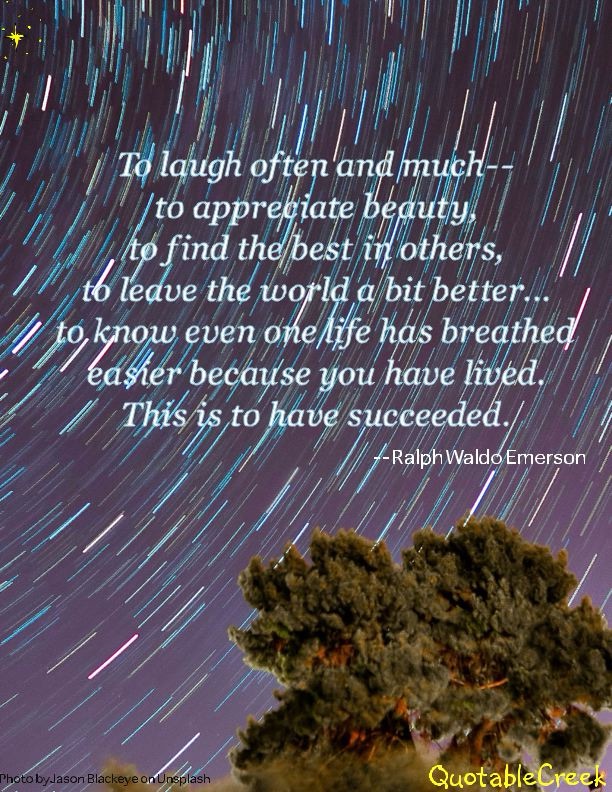
Perhaps true success at this thing called life is as simple as Emerson’s thoughts above. To leave the world a bit better, to ease the burdens of others, to look for and bring out the best in others, to do no harm. These all matter, maybe not in measurable concrete ways, but in ways we can all feel and appreciate if not count. More important, these are all things we each can do. We have the ability to be successful beyond our wildest imaginings.
And don’t forget to laugh often and much. Finding the joy and not letting it slip right past you undetected is important, too.
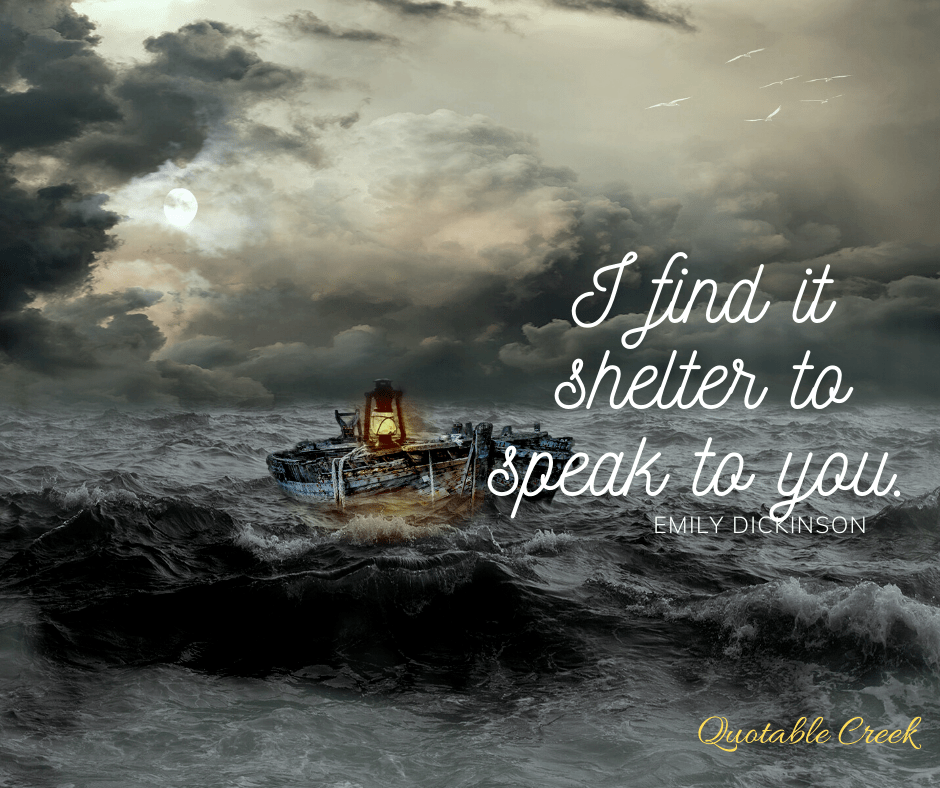
Of all the compliments you could receive, perhaps the best is that you feel like shelter. That, in all the storms and chaos that swirl around us, talking to you feels like safety. Not in the sense of being a yes man or echo chamber, or even in the sense of being able to do anything to stop the storm, but in the sense of home.
“I find it shelter when I speak to you,” says Emily Dickinson. What might we do and say to make someone feel that way? Shelter implies that the storm is still swirling, the elements are still fierce, but talking to you is a respite from that and an entry into something welcoming and safe. A place where you are known, and heard, and cared for. A place of comfort.
Certainly there are plenty of people making themselves someone’s storm. Wouldn’t it be wonderful to be someone’s shelter instead?
What can you do in this increasingly chaotic and exhausting world for someone to find it shelter when they talk with you?
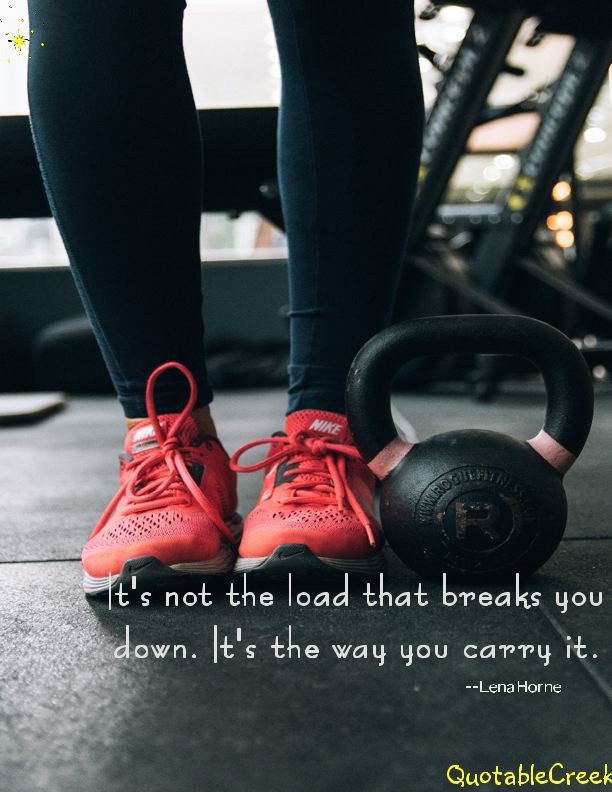
We are weighed down. The tasks ahead seem dauntless; the burdens great. There is so much to be done, and seemingly so little time. Yet, we know that others before us have been able to carry heavy burdens with grace and inner strength. How do they do it? Some ideas:
Evaluate your load. Is it really yours to carry? Holding on to other people’s problems is debilitating because we have no control over their actions. Similarly, feeling like you’re bearing the weight of a global problem on just our own shoulders is both unrealistic and unnecessary. We can help and support someone struggling, and work with others toward a common goal on larger problems, and those are properly our burdens, but we can’t force someone to behave as we would have them, and we, alone, cannot solve a problem like world hunger and peace that is so much greater than any one person. We must discern how best to offer our support and efforts, but realize that, sometimes, the ultimate solutions are beyond our control.
Focus on the gift of that present moment. It is easy to get overwhelmed in a crisis. We see or experience them daily, but when we focus on the present moment as an opportunity to help others, our perception shifts away from the weight of the burden to the lightness that comes from helping others. Yes, there is a refugee crisis, but perhaps we can help. Yes, we’ve lost our job, but perhaps that is an opportunity to do something we’ve dreamed about. Part of the burden that comes from bad things happening is trying to hold on to the world as it existed before the crisis. We mourn the loss and rail against the unfairness. But when we lay that down, and focus on the new reality and challenges present now, in the life we have now, we feel lighter.
Recognize a larger perspective. We will not always be here in this dark place. A new day will come bringing new possibilities and circumstances. We must hold on and look for the bigger picture, remembering that there are ebbs and flows to life, and that this too shall pass.
Ask for help. Sometimes we best carry our burdens by letting someone else share them. We are made to support each other. Perhaps helping you with your burden is the answer to someone else who feels that they lack purpose. Win-win. Life will surprise you that way.
Yes, we are burdened. Life can be hard. As M. Scott Peck says in The Road Less Traveled,
“Life is difficult. This is a great truth, one of the greatest truths. It is a great truth because once we truly see this truth, we transcend it. Once we truly know that life is difficult–once we truly understand and accept it–then life is no longer difficult. Because once it is accepted, the fact that life is difficult no longer matters.”
Amaze yourself. We are stronger than we realize and braver and smarter and more capable, and sometimes we just have to close our eyes and push forward.
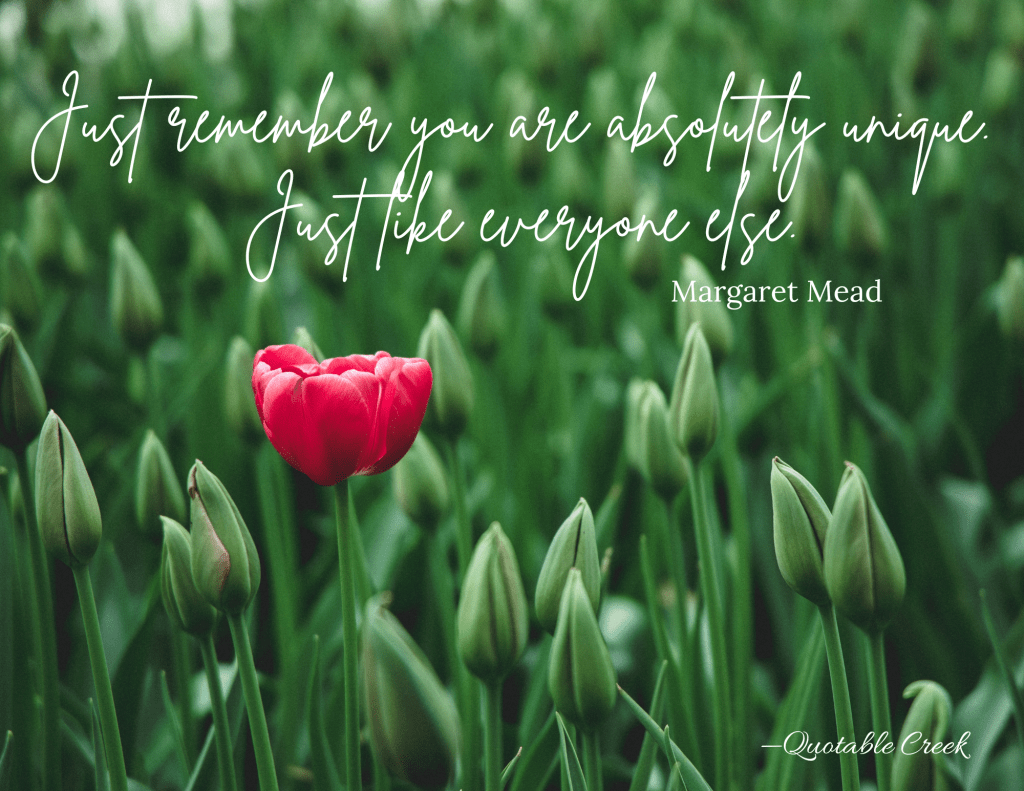
What are the things you love, the things you hate, the things that keep you up at night? What are your favorite smells, sounds, tastes, sights, things to touch? How are you inhabiting that body you’ve been given and finding joy?
Whatever your combination of answers to these questions is, it is uniquely your own. It is what makes you, you.
For each of us, that answer will be different, but all part of the same global struggle for individualism. Here is George Bernard Shaw’s answer to some of these questions:
So long as I remain alive and well, I shall continue to feel strongly about prose style, to love the surface of the earth, and to take a pleasure in solid objects and scraps of useless information.
None of us knows what the future holds. But we do know the values we hold dear—honesty, integrity, love, compassion, empathy, respect, tolerance. As we raise our children, we instill these values. As adults, we model these values whether we win or lose, succeed or fail, sink or swim. Watching us, they learn, and, as they go forward into their futures, they will bring these values to their own decisions. If each of us does this, we will leave the world a better brighter place for our having been here.
When we find ourselves in challenging times and are unsure which way to turn, let these words help guide you.
Do justice. Peace, justice, love are things we do and bring about, not things we wait for. With our best discernment, we offer ourselves to the world, hoping to make a difference. Kind words, loving hearts, calm demeanors, patience, forbearance, and forgiveness. The way of the One we follow. A servant’s heart but a leader’s strength.
Love mercy. Oh, how the world loves vengeance, cancelling, grudges, getting even, punishment. To love mercy is a kinder, gentler path, one that believes in the redeem-ability of every last one of us. One that doesn’t insist on being avenged or having the last word. One that delights in forgiveness and healing.
Walk humbly. No matter how hard we try to do or be right, we may be wrong. The other guy might be right. And, get this, God loves the other guy as much as God love you.
Black white. Up down. Left right. In out. We are a people who love to categorize. Categories simplify things and help us to sort out our place in the world.
But then there’s that puggle, a baby platypus. Classified as a mammal but laying eggs with a duck-like bill, aquatic, poisonous. No wonder the platypus astounded the scientific community when it was first discovered in 1799. Indeed, the skin of the first platypus discovered, preserved in the British museum of Natural History, still bears the marks made by the curator at the time who tried to pry off the bill, convinced the creature was a fake.
The puggle doesn’t categorize easily.
While categorizing can be helpful, it can also be limiting if we fail to see outside the norms and lines we draw. And when it comes to humans, where do we draw the lines? We humans are nearly impossible to sort into classifications because we have so many unique characteristics. Categorizing might even keep us from looking for and seeing the individuals behind the label.
We can find differences and commonalities among any group of people.
It’s okay to be heartbroken for more than one group of people at the same time. When it comes to showing compassion, we don’t have to pick sides. Sometimes, often really, maybe even always, there is hurt and anguish everywhere, and we can mourn the lot of it.
Beware people who tell you not to be concerned for this group or that group and the hurt they feel.
Beware those who try to dehumanize others.
Beware those who lump you in as the ‘enemy’ for working to assure people are treated humanely.
Beware people who draw lines between us and them.
Beware those who try to limit you to a label or single identity.
Our hearts are big enough to embrace it all. What we must save is love.




 QuotableCreek.com