Praying with the news.

How do we read the news and not get overwhelmed or angry, disconnected or depressed? How do we keep showing up with compassion and grace in a world where there is so much hate? How do we keep ourselves on the right path through the midst of it all? How do we continue to show up from a place of compassion, forgiveness, and grace? how do we keep our hearts from growing hard?

In this thoughtful letter, Rabbi Yael Levy shares his insights on how to pray with the news:

The 17th of the Hebrew month Tammuz initiates a three-week period of mourning that leads to Tisha b’Av, which is the day that marks the destruction of the Temples in Jerusalem in 586 BCE and 70 CE.

Tradition teaches that the Temple was destroyed because hatred became the operating principle in the community. The scorn, contempt and disdain that characterized daily interactions caused the Divine Presence to flee and leave the Temple vulnerable to attack.

These next three weeks ask us to reflect on the hatred that we allow to take root in our hearts. The wisdom of the tradition acknowledges that hatred can sometimes feel energizing and “so right,” but allowing it to fill our bodies and guide our actions leads to destruction.

Many years ago I was taught the practice of praying with the news. I have shared it over the years and always find myself returning to it during this season.

In this practice, each time we read or listen to a news report that enrages us, we turn our attention to those harmed by what is happening and pray for their healing and well-being. Doing so encourages us to acknowledge feelings of anger, grief and despair, and at the same time it turns our attention toward connection and compassion. Praying with the news can help us learn to bear witness to devastation and mayhem, while keeping our hearts soft, our minds calm, and our actions clear.

I am struggling mightily with this practice these days in the wake of continued violence and oppression in this country and throughout the world. Hatred can sometimes feel like such a welcome harbor. Not only does it feel so right, it can also act as a shield, creating the illusion that I don’t have to acknowledge the grief and heartbreak I am experiencing.

I need practices to help quiet the rage and fear, to loosen the constriction of hatred and to help me be with overwhelming grief. I need practices to help me return to compassion, love, joy and possibility. I find praying with the news both painful and helpful. It keeps me connected, allows sorrow, and grounds me in care and love.

Weekly reading from the Awakin.org newsletter.

We are made for welcome

When we are being welcoming, the focus is outward not inward. We look to what would make the other person comfortable, not what would make us comfortable. We don’t invite vegetarians, and then serve meat. Or teetotalers and serve alcohol. We get out of our own perspective and walk in the guest’s shoes to consider what would make them comfortable.

Aesop illustrated this premise with the Tale of the Fox and the Stork:

A fox invites a stork to eat with him and provides soup in a bowl, which the fox can lap up easily; however, the stork cannot drink it with its beak. The stork then invites the fox to a meal, which is served in a narrow-necked vessel. It is easy for the stork to access but impossible for the fox. The moral drawn is that the trickster must expect trickery in return and that the golden rule of conduct is for one to do to others what one would wish for oneself.

https://en.wikipedia.org/wiki/The_Fox_and_the_Stork

The same is true, presumably, when welcoming people to the Lord’s table. What would make others comfortable? How can you reach more people? What about the way you do things might be off putting? How can you step out of your own perspective to consider what would make others in the community feel welcomed and comfortable? Our job isn’t to be a bar to spreading the word but a conduit.

Desmond Tutu talks about the importance of a broad welcome:

We are made for goodness. We are made for love. We are made for friendliness. We are made for togetherness. We are made for all of the beautiful things that you and I know. We are made to tell the world that there are no outsiders. All are welcome: black, white, red, yellow, rich, poor, educated, not educated, male, female, gay, straight, all, all, all. We all belong to this family, this human family, God’s family.

The mystery never leaves you.

What an amazing world this is, every bit of it connected to something else, and all together. Under every footstep we take are millions of organisms working out their life journeys. As is true in every breath we take, bite we eat, even into our own interior microscopic landscapes. The whole world is simply thrumming with life force, of which we are a part. We can spend a lifetime studying how it all fits together, and would still probably fall short of understanding the full complexity.

Irish philosopher and poet, John O’Donohue puts it this way

Well, I think it makes a huge difference, when you wake in the morning and come out of your house, whether you believe you’re walking into dead geographical location, which is used to get to a destination, or whether you’re emerging out into a landscape that is just as much if not more alive as you, but in a totally different form, and if you go towards it with an open heart and a real, watchful reverence, that you will be absolutely amazed at what it will reveal to you.

https://onbeing.org/programs/john-odonohue-the-inner-landscape-of-beauty/

Perhaps if we realized the enormity of life force we are wandering amongst, we would walk more softly, breathe more deeply, and open our eyes wide in surprise and delight at the beauty of it all.

Facing fear

Standing up to fear changes a person. It helps you to put matters in perspective. Where once fear loomed over you, insurmountable, now you can honor the courage it took to move past it into unfamiliar territory.

Eleanor Roosevelt was a courageous woman. Despite her husband’s attempts to placate the South, she regularly bucked segregation and was a vocal proponent of civil rights. She was able to call out racism and force others to see it for what it was:

By 1939, ER decided to attack the hypocritical way in which the nation dealt with racial injustice. She wanted her fellow citizens to understand how their guilt in “writing and speaking about democracy and the American way without consideration of the imperfections within our system with regard to its treatment . . . of the Negro” encouraged racism. Americans, she told Ralph Bunche in an interview for Gunnar Myrdal’s American Dilemma, wanted to talk “only about the good features of American life and to hide our problems like skeletons in the closet.” Such withdrawal only fueled violent responses; Americans must therefore recognize “the real intensity of feeling” and “the amount of intimidation and terrorization” racism promotes and act against such “ridiculous” behavior.

You can’t clearly see a problem before you if you are too scared to look at it and call it out for what it is. Where are the injustices in your immediate orbit? Are there people being treated unfairly? How can you add your voice to help identify the problem and move toward healing? These problems are right here, close to home.

As Eleanor Roosevelt said:

Where after do human rights begin? In small places, close to home– so close and so small that they cannot be seen on any map of the world. Yet they are the world of the individual person: The neighborhood he lives in; the school or college he attends; the factory, farm or office where he works. Such are the places where every man, woman, and child seeks equal justice, equal opportunity, equal dignity without discrimination. Unless these rights have meaning there, they have little meaning anywhere. Without concerted citizen action to uphold them close to home, we shall look in vain for progress in the larger world.

-“Remarks at the United Nations,” March 27, 1958

https://erpapers.columbian.gwu.edu/quotations-eleanor-roosevelt

Fear is a crippler. It keeps you rooted in a course of action you know to be wrong. Focusing on the fear helps it to loom even larger before you. Instead, focus on the better world you are trying to help build. Spreading love and justice is exciting and uplifting. Being part of something bigger than yourself, working for a common goal, in an effort to improve people’s circumstance is rewarding.

You don’t have to see the whole path in front of you. Take, and keep taking, that next step forward.

I’m spring

As I age, I have a new appreciation for those poets like Dylan Thomas raging against mortality. I do not want to go gentle into that good night. I like it here.

Here is a new variation on that theme I enjoyed:

Sorrow Is Not My Name
BY ROSS GAY

—after Gwendolyn Brooks

No matter the pull toward brink. No
matter the florid, deep sleep awaits.
There is a time for everything. Look,
just this morning a vulture
nodded his red, grizzled head at me,
and I looked at him, admiring
the sickle of his beak.
Then the wind kicked up, and,
after arranging that good suit of feathers
he up and took off.
Just like that. And to boot,
there are, on this planet alone, something like two million naturally occurring sweet things,
some with names so generous as to kick
the steel from my knees: agave, persimmon,
stick ball, the purple okra I bought for two bucks
at the market. Think of that. The long night,
the skeleton in the mirror, the man behind me
on the bus taking notes, yeah, yeah.
But look; my niece is running through a field
calling my name. My neighbor sings like an angel
and at the end of my block is a basketball court.
I remember. My color’s green. I’m spring.

Loving what’s mortal

As we age, there is loss. That loss is like a presence that follows us relentlessly like a shadow. No avoiding it. No pretending. We are mortal. The people we love are mortal, perhaps imminently so. This is part of the rules of engagement. And while most of us avoid thinking too much about it, poets like Mary Oliver offer life instructions:

To live in this world, you must be able to do three things:

To love what is mortal

To hold it against your bones knowing your own life depends on it;

And, when the time comes, to let it go, to let it go.

I honestly don’t know which of these three rules is the hardest. Right now, they each seem nearly impossible. But having the courage to follow these instructions feels like the answer.

Her full poem is below.

Look, the trees
are turning
their own bodies
into pillars

of light,
are giving off the rich
fragrance of cinnamon
and fulfillment,

the long tapers
of cattails
are bursting and floating away over
the blue shoulders

of the ponds,
and every pond,
no matter what its
name is, is

nameless now.
Every year
everything
I have ever learned

in my lifetime
leads back to this: the fires
and the black river of loss
whose other side

is salvation,
whose meaning
none of us will ever know.
To live in this world

you must be able
to do three things:
to love what is mortal;
to hold it

against your bones knowing
your own life depends on it;
and, when the time comes to let it go,
to let it go.

“In Blackwater Woods” by Mary Oliver, from American Primitive. © Back Bay Books, 1983.

Compassion for animals.

Apparently, today is World Penguin Day which reminded me of this delightful story about penguin JinJing and the man who saved his life. Each year, this little penguin swims 5000 miles to be with his friend.

So much is beyond our understanding including heart-warming stories like this about the bonds between a wild animal and a human who showed them kindness.

Enjoy this video.

Our last chance to be alive.

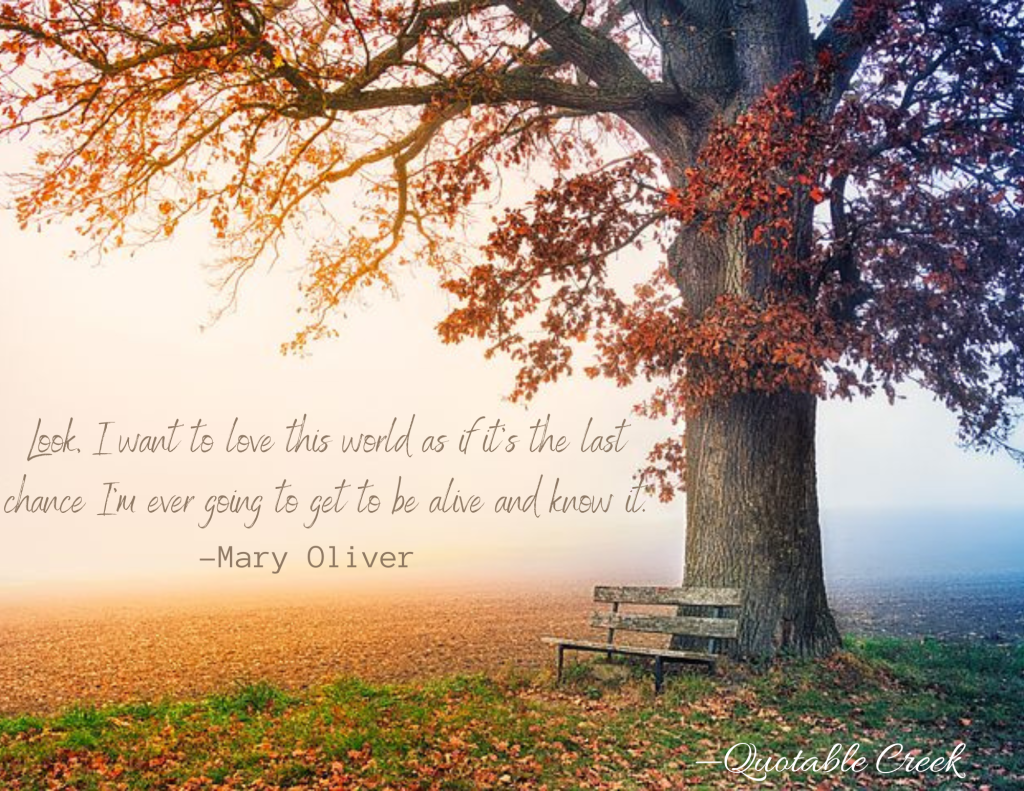
Now is our time to be alive. It will not come again. This is our last chance to savor nature and all of its wonder, to spend time with loved ones, to do good, to spread joy. This is it. This is our opportunity.

In the movie, Michael, an angel comes to Earth to influence the course of events. He, apparently, smells of cookies. But there is a scene, after ‘battle’ (he’s that kind of angel), when he is savoring the day. He is soaking it in, just enjoying being corporeal, waltzing with the breeze.

If only we could hold on to that wonder, awe, and appreciation, live in the moment, truly appreciate all we’ve been given here. What a fine world that would be.

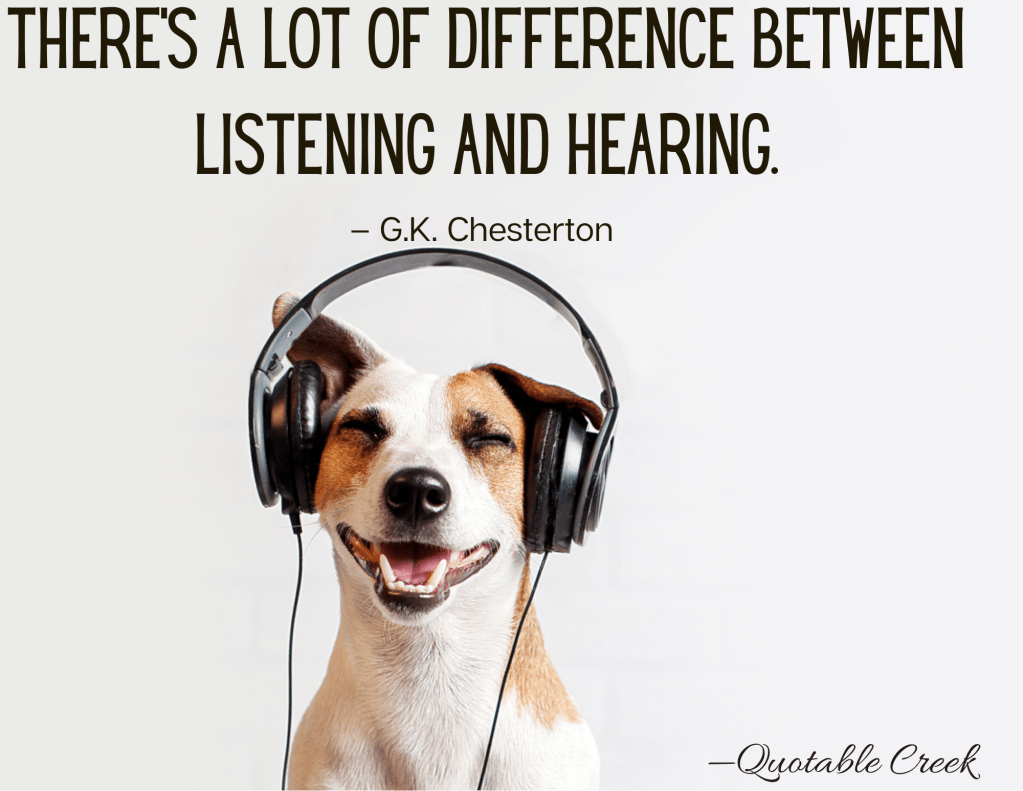
Active listening.

These days there is a lot of noise—everyone has a soapbox—but I wonder how much is really heard. This article explores the problem of autobiographical listening, listening with the hope of injecting a story about yourself into the mix. There are levels to this. The matcher, who always has a similar vacation or achievement to switch the conversation to. The topper who has an even better vacation or achievement to turn the conversation to. And the outright conversation narcissist where really all parts of the conversation somehow turn on him.

But if our goal is connection, we really need to learn how to better listen:

“Listen with curiosity. Speak with honesty. Act with integrity. The greatest problem with communication is we don’t listen to understand. We listen to reply. When we listen with curiosity, we don’t listen with the intent to reply. We listen for what’s behind the words.”

Roy T. Bennett, The Light in the Heart

Practice listening to understand. Avoid autobiographical listening:

“When we fail to listen from the other person’s perspective, we are listening through our own lens and tend to pass more judgments compared to simply listening,” Reigstad added. “There are four types of autobiographical listening ― evaluate, probe, advise and interpret. These responses tend to have us asking questions based on our experiences, offering advice to fix the problem and so on. It’s important to resist the urge and allow the other person to speak.”

https://www.huffpost.com/entry/how-to-fight-urge-make-everything-about-yourself_l_640a48c0e4b006d19e26da5e

Listen for what is behind the words. Let yourself connect with the other person. There will be another day for your story.

Care for the caretakers.

Today, I want to lift up the caregivers. Whether for an aging parent, ailing spouse, struggling child, or young grandchildren, or all or some of these together. It takes a good person to care and do their best to help.

Rosalyn Carter made this insight:

There are only four kinds of people in the world: Those who have been caregivers. Those who are currently caregivers. Those who will be caregivers. And those who will need a caregiver.

We are all interconnected. We all will experience a time when we need help and times when we can offer help. It is a blessing to care about others and to let others care for us. Caring is at the heart of every good thing done in the world.

So, to the caregivers: may God bless you. Your work is making a better world.