Hope in the tiniest places.
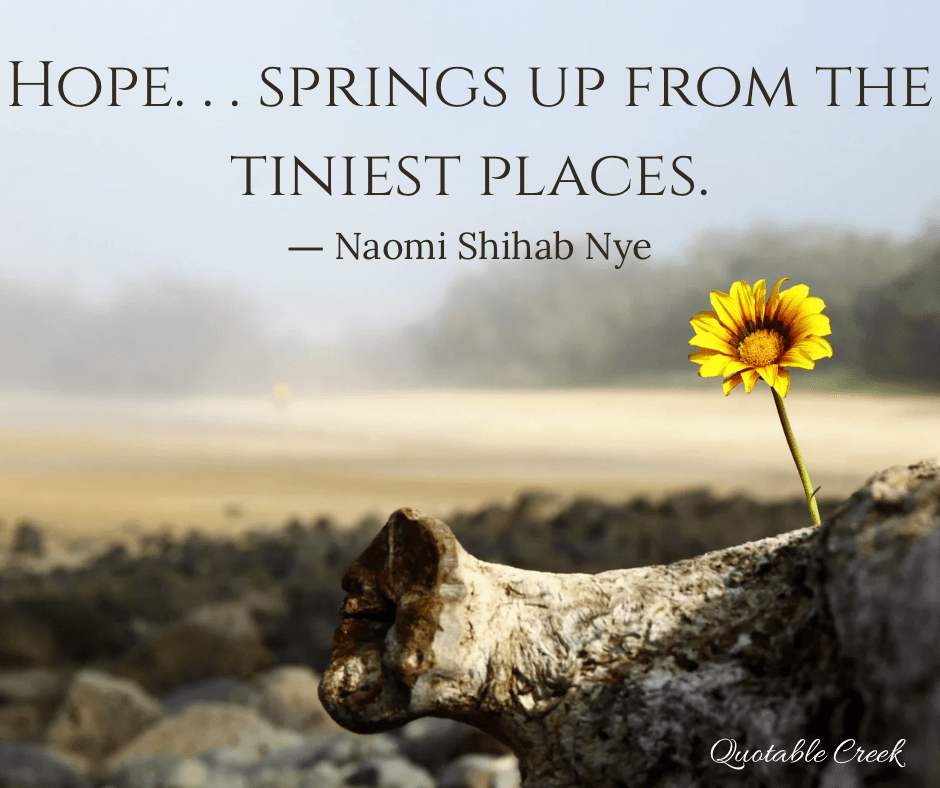
Today, notice signs of hope in unlikely places. In the smile of a baby, the fledgling arguments for peace by a child, the chink in the armor of an opponent.
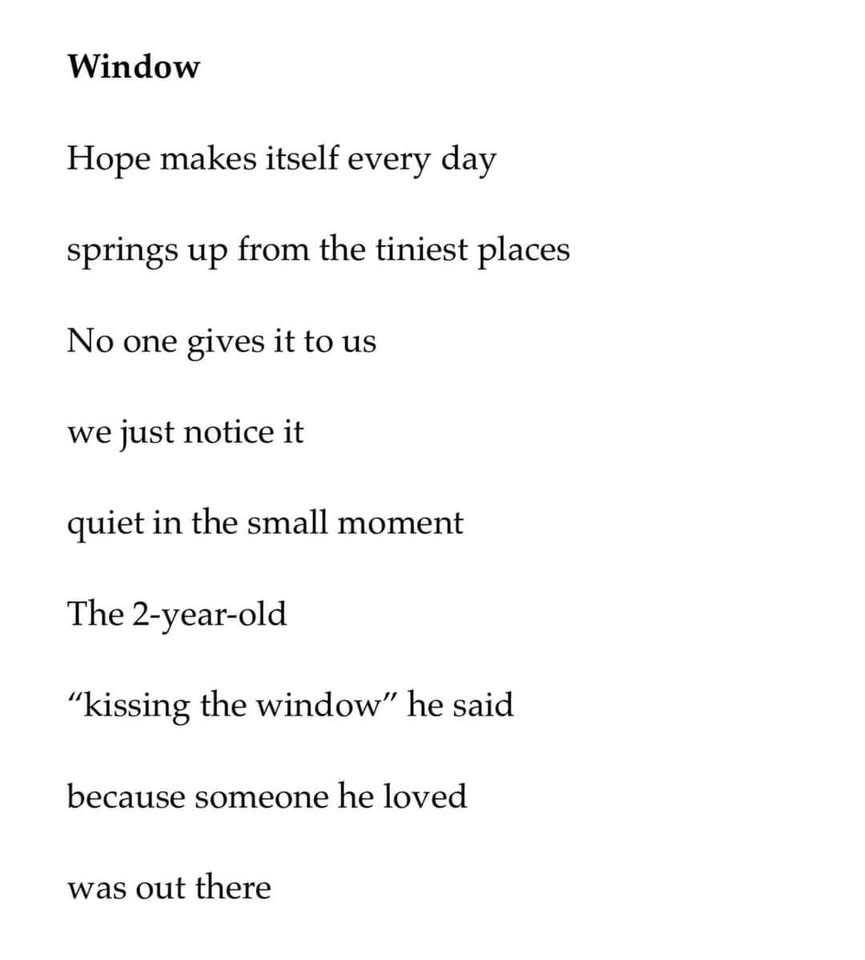
Today, notice signs of hope in unlikely places. In the smile of a baby, the fledgling arguments for peace by a child, the chink in the armor of an opponent.
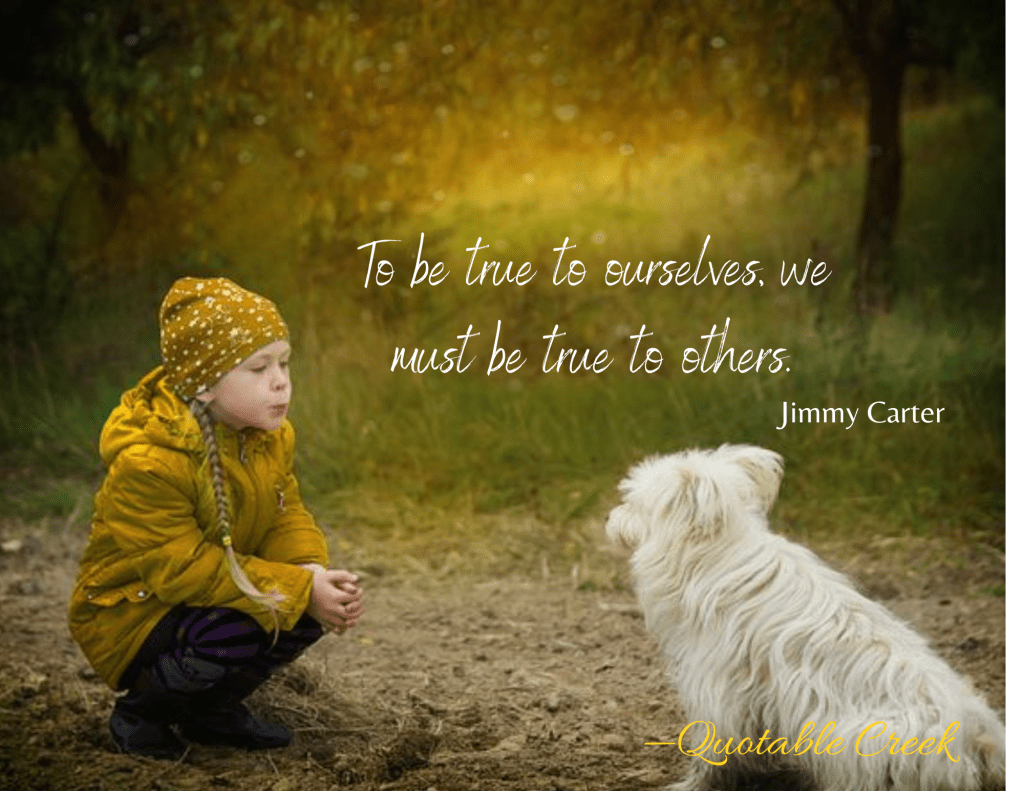
One of my personal heroes, Jimmy Carter, 100 years old, has passed away, and the world is a bit darker without his light. He has been such a wonderful example of walking the walk. He said:
“My faith demands – this is not optional – my faith demands that I do whatever I can, wherever I can, whenever I can, for as long as I can with whatever I have to try to make a difference.”
What a wonderful way to look at our possible impact. Using what we have, not waiting until we have more or better resources or to be older and wiser, or wishing we were younger and stronger. Right now, with what’s available.
And wherever we find ourselves, adopting a bloom where you’re planted attitude. Even if we are in our own harsh spot. Considering what can we do here.
And always looking for opportunities to do good. Not necessarily solving the world’s problems, but doing your own little bit of good. Right here, right now.
Let’s go.
Thank you, President Carter, for this reminder. You will be missed.
Humans are complicated creatures. Sometimes we feel emotions and have no idea why. And perhaps that is for good reason because much of what affects us is hidden. Consider, for example, subliminal advertising. People would go to the movies and watch reels that had ‘Buy Popcorn’ hidden in a few frames, not enough to consciously notice, but enough so that people watching got the sudden urge for popcorn. Or perhaps you’ve been watching a show where the characters are sharing a cup of coffee and, suddenly, felt an urge for a cup of Joe. Model homes are designed and staged in such a way that you can easily imagine yourself living there and stepping into the life reflected in the art and photographs of that fictional happy family, if only you buy the house.
Or consider the influence of color. Pink has been associated with a calming effect and has been used in drunk tanks and visiting team locker rooms in an effort to sway human behavior.And it works so well that now the Western Athletic Conference has a rule that the lockers rooms can be painted any color, including pink, but both teams must have the same color.
It behooves us to pay attention to what we are paying attention to. Are our emotions being stirred up? Take a minute and consider why. Is someone trying to manipulate us in some way? It happens often in advertising and politics. Being aware of the ways we can be influenced, and opening our eyes to those manipulations, helps keep us in the driver’s seats of our own lives.
One of my personal heroes, Jimmy Carter, almost 100 years old, is trying to hang on to vote in this election. He has been such a wonderful example of walking the walk. He says:
“My faith demands – this is not optional – my faith demands that I do whatever I can, wherever I can, whenever I can, for as long as I can with whatever I have to try to make a difference.”
What a wonderful way to look at our possible impact. Using what we have, not waiting until we have more or better resources or to be older and wiser, or wishing we were younger and stronger. Right now with what’s available.
And wherever we find ourselves, adopting a bloom where you’re planted attitude. Even if we are in our own harsh spot. Considering what can we do here.
And always looking for opportunities to do good. Not necessarily solving the world’s problems, but doing your own little bit of good. Right here, right now.
Let’s go.
Thank you, President Carter, for this reminder.
Life is full of hard choices. Particularly when you aren’t the one in danger. Making those tough choices, entering the fray, speaking truth to power, defending the defenseless are vital actions for our collective survival.
As Brené Brown says,
Integrity is choosing courage over comfort; it’s choosing what’s right over what’s fun, fast, or easy; and it’s practicing your values, not just professing them.
Practicing our values, not just professing them. What are your values? How can you bring that to bear in the choices confronting you today?
Standing up to fear changes a person. It helps you to put matters in perspective. Where once fear loomed over you, insurmountable, now you can honor the courage it took to move past it into unfamiliar territory.
Eleanor Roosevelt was a courageous woman. Despite her husband’s attempts to placate the South, she regularly bucked segregation and was a vocal proponent of civil rights. She was able to call out racism and force others to see it for what it was:
By 1939, ER decided to attack the hypocritical way in which the nation dealt with racial injustice. She wanted her fellow citizens to understand how their guilt in “writing and speaking about democracy and the American way without consideration of the imperfections within our system with regard to its treatment . . . of the Negro” encouraged racism. Americans, she told Ralph Bunche in an interview for Gunnar Myrdal’s American Dilemma, wanted to talk “only about the good features of American life and to hide our problems like skeletons in the closet.” Such withdrawal only fueled violent responses; Americans must therefore recognize “the real intensity of feeling” and “the amount of intimidation and terrorization” racism promotes and act against such “ridiculous” behavior.
You can’t clearly see a problem before you if you are too scared to look at it and call it out for what it is. Where are the injustices in your immediate orbit? Are there people being treated unfairly? How can you add your voice to help identify the problem and move toward healing? These problems are right here, close to home.
As Eleanor Roosevelt said:
Where after do human rights begin? In small places, close to home– so close and so small that they cannot be seen on any map of the world. Yet they are the world of the individual person: The neighborhood he lives in; the school or college he attends; the factory, farm or office where he works. Such are the places where every man, woman, and child seeks equal justice, equal opportunity, equal dignity without discrimination. Unless these rights have meaning there, they have little meaning anywhere. Without concerted citizen action to uphold them close to home, we shall look in vain for progress in the larger world.
-“Remarks at the United Nations,” March 27, 1958
https://erpapers.columbian.gwu.edu/quotations-eleanor-roosevelt
Fear is a crippler. It keeps you rooted in a course of action you know to be wrong. Focusing on the fear helps it to loom even larger before you. Instead, focus on the better world you are trying to help build. Spreading love and justice is exciting and uplifting. Being part of something bigger than yourself, working for a common goal, in an effort to improve people’s circumstance is rewarding.
You don’t have to see the whole path in front of you. Take, and keep taking, that next step forward.
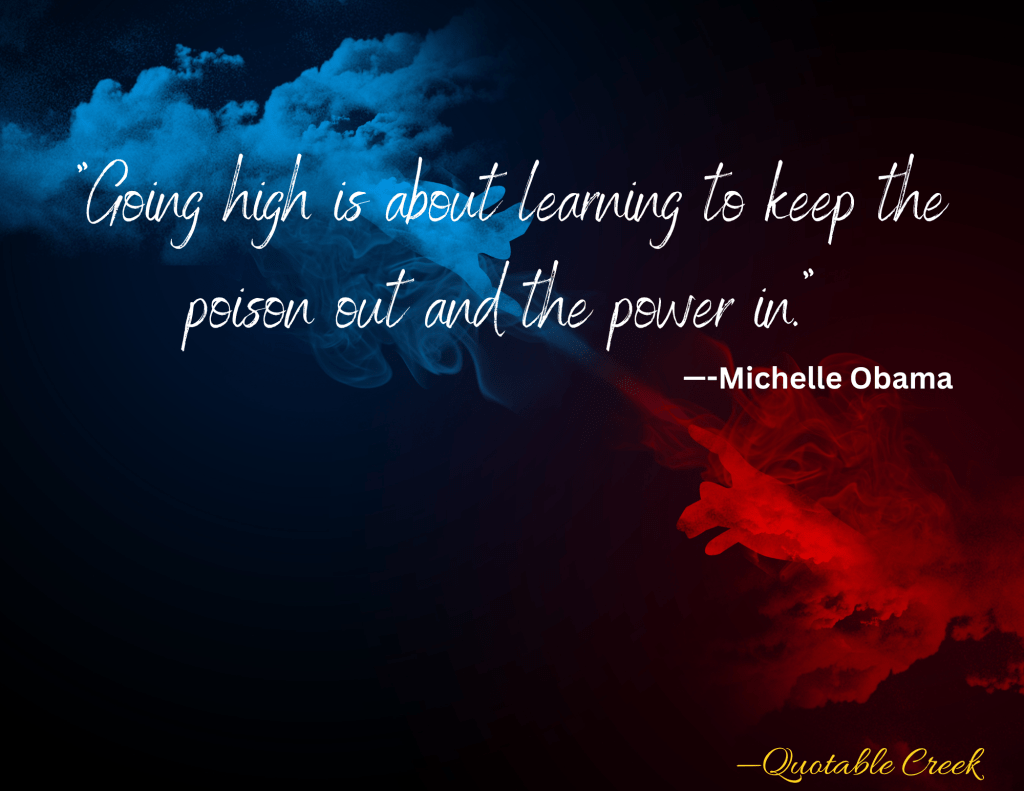
We are bombarded daily with stories of fraud, cheating, self-interest, and dishonesty. People talking over each other, shoving, hostile. Everything is so charged and hot. Sometimes it feels like the people who stoop to these tactics might win the race and that we should do it, too. Otherwise, the ‘bad’ side will triumph. And yet.
Honesty matters. Integrity matters. Truth matters. Fairness and justice matter. On the foundations of these qualities, trust is built.
Explaining her ‘go high’ comment, Michelle Obama says,
My answer is yes. We need to keep trying to go high. Operating with integrity matters. It will matter forever. It is a tool.
At the same time, though, I want to be clear: Going high is something you do rather than merely feel. It’s not some call to be complacent and wait around for change, or to sit on the sidelines as others struggle. It is not about accepting the conditions of oppression or letting cruelty and power go unchallenged. The notion of going high shouldn’t raise any questions about whether we are obligated to fight for more fairness, decency, and justice in this world; rather, it’s about how we fight, how we go about trying to solve the problems we encounter, and how we sustain ourselves long enough to be effective rather than burn out. There are some who see this as an unfair and ineffective compromise, an extension of respectability politics, in which we conform to rather than challenge the rules in order to get by. Why, people rightly wonder, do we need to try to be so reasonable all the time?
I can see how some think that reason leaves no room for rage. I understand the perception that going high means that you somehow remove yourself and remain unbothered by all that might otherwise gall and provoke you.
But it’s not that at all.
When I first said those words…, I was neither removed nor unbothered. In fact, I was pretty agitated….
But where was my actual power? I knew it didn’t reside in my hurt and rage, at least as they existed in raw forms. My power lay in whatever I could manage to do with that hurt and rage, where I could take it. It hinged on whether or not I could elevate those feelings into something that would become harder for others to write off, which was a clear message, a call to action, and a result I was willing to work for.
That’s what going high is for me. It’s about taking an abstract and usually upsetting feeling and working to convert it into some sort of actionable plan, to move through the raw stuff and in the direction of a larger solution.
I want to be clear that this is a process, and not always a quick one. It can take time and patience. It’s okay to sit and stew for a while, to live inside the agitation caused by injustice or fear or grief, or to express your pain. It’s okay to grant yourself the space you need to recover or heal. For me, going high usually involves taking a pause before I react. It is a form of self-control, a line laid between our best and worst impulses. Going high is about resisting the temptation to participate in shallow fury and corrosive contempt and instead figuring out how to respond with a clear voice to whatever is shallow and corrosive around you. It’s what happens when you take a reaction and mature it into a response.
Because here’s the thing: Emotions are not plans. They don’t solve problems or right any wrongs. You can feel them—you will feel them, inevitably—but be careful about letting them guide you. Rage can be a dirty windshield. Hurt is like a broken steering wheel. Disappointment will only ride, sulking and unhelpful, in the back seat. If you don’t do something constructive with them, they’ll take you straight into a ditch.
My power has always hinged on my ability to keep myself out of the ditch.
https://time.com/6233764/michelle-obama-go-high-2022/
Here’s to staying out of the ditch.
It doesn’t really matter what your New Year’s resolution is, it’s all about the how, not the what. Adverbs are important when it comes down to it.
If your resolution is to lose a few pounds, does it make a difference whether you lose it sensibly or too fast or maybe, even, because you’re ill?
If your resolution is to make more money, does it make a difference if it is done at someone else’s expense or illegally?
No matter what we pick as the what of the resolution, the focus really must be on the how as well. Consider the adverb. The how of things makes a difference.
Generously or greedily. Selfishly or selflessly. Safely or recklessly. Kindly or maliciously. Honestly or dishonestly.
For every action that you can resolve to do, there is a spectrum of hows to reach that goal. Maybe, even, there is a line that can be crossed on that spectrum where the what isn’t important anymore because it involves a how that will make us someone who we don’t want to be.
So, when you’re going about planning your new year, consider what adverbs you want to be a part of it.
In this world of instant ‘news’ and polarized camps, it is difficult to siphon off the untrue, inflammatory, and malicious from the true, helpful, and conciliatory.
This is particularly true when we learn that one of the goals of social media is to monetize our attention. In the stunning must-see documentary, The Social Dilemma on Netflix, creators of popular social media sites like Facebook and Pinterest discuss how they have monetized their apps to drive profit. The apps are free to use. What is for sale is…you. Your attention. Your time. Your behavior.
What you click on, how long you look at it, and how you react is all measured. Complex algorithms calculate what data to show you based on what you are most likely to click. If you click on articles on empathy, you’ll be shown more stories on empathy. And if you click on dark or divisive articles, you will get more of same. Meanwhile, each of those clicks is a pay out from those seeking to put their messages into your head. The algorithms aren’t based on whether the content is good for you to view; they are based on what you are most likely to click. It is not hard to see how someone can become radicalized if they follow one of the darker holes further and further down.
So what to do? First, maybe affirm a universal truth. We want to make our decisions based on reality, not lies. We want to conform our understanding to facts, not alter the facts to fit our understanding. It’s as if there is a map to our destination. When we realize we are off course to a place we want to be, we change course, we don’t rewrite the map.
Second, consider your sources. Are they reputable? Rather than feeding the narrative you may want to hear, do they present the issues fairly and with minimal bias? If you are constantly being fed information that doesn’t square with what you see and hear happening around you, change up your sources.
Finally, read broadly. Don’t rely on a single person or news source. With respect to social media, seek out reliable sources directly and go to their sites to read the articles rather than clicking on a tempting link. We can be better informed than ever before, but we need to be intentional about it rather than passively wait for ‘news’ articles to pop up on your Facebook feed.
Social media is a powerful tool, but, like any tool, it can be a force for both good and bad. We need to be wary consumers and protect ourselves from being manipulated solely by advertisers trying to make a dime without regard to whether what they are showing us is true or decent. We need to guard our hearts, not to shelter ourselves from bad news or hurt in the world, but to keep ourselves from falling victim to fraud and deceit and unwittingly perpetuating false narratives ourselves.
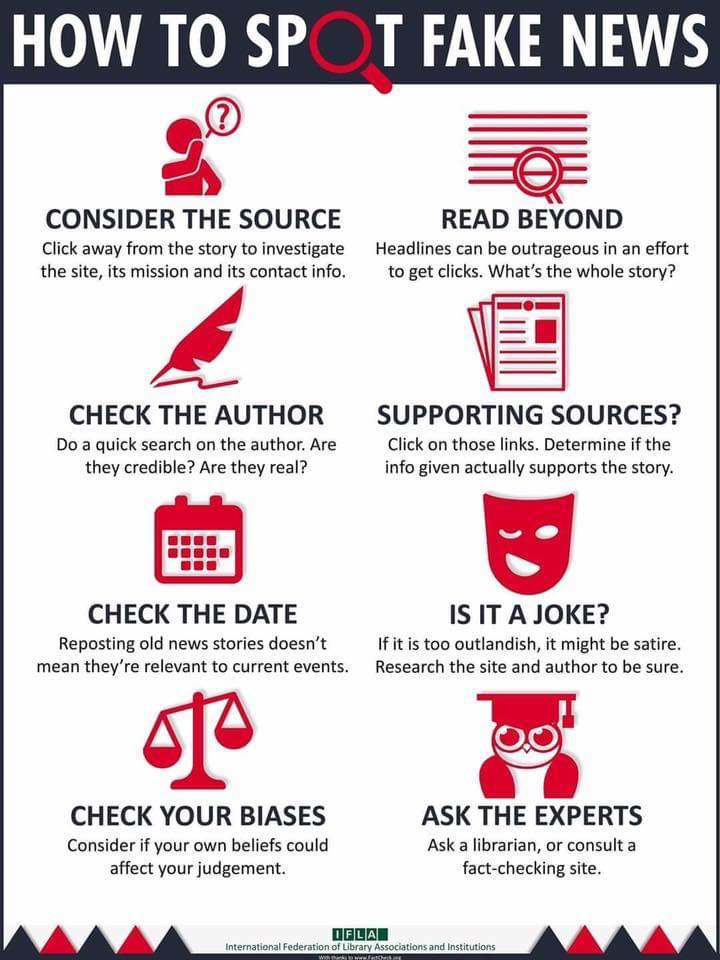
From Shari:
Have you fallen for fake news lately? What steps have you taken to make sure you are reading and passing on reliable information?
I recently clicked on an article purporting to be a response from someone who had been silent on a current political issue. I fell for the ‘Check the Date’ problem above. The article was from about four years ago. That person was still being silent on the current issue, so I didn’t get any new information, but that duplicitous advertiser made some money off my click.
How about you?
Figuring out the right question to ask is well more than half of the struggle. Sometimes it helps when we start with our foundational principles–honesty, integrity, loyalty, peacefulness–and work backwards. Wanting to stay true to the morals we value in ourselves thins out the herd of available questions to ask in a given scenario. Then, the right question to ask becomes more apparent.
 QuotableCreek.com